

The best platform to sell digital products depends on whether buyers know you. If they do, Payhip’s free plan (5% a sale) or CartMango, which I run (0% a sale, free right now, $10 a year once paid plans start in November), is the pick. If not, Etsy ($0.20 a listing plus 6.5%) brings shoppers.
Those picks come from 14 platforms narrowed by 4 cuts, with fees worked out on a $5 sale, card processing included. On that sale Gumroad (10% plus $0.50) takes $1.45, Payhip $0.70 and CartMango $0.45. Sellfy (from $22 a month, billed yearly) only pays off once your sales are steady.
A teacher who sells printable planners asked the r/passive_income community which platform to use. Their problem fit in 1 line: “When you’re selling digital products for $5-$15 each, losing $1-2 per sale adds up.”
Page 1 of Google often gets that math wrong. Its 7 guides recommend more than 20 platforms between them, and 4 of the 7 quote at least 1 price the platform’s own page no longer shows.
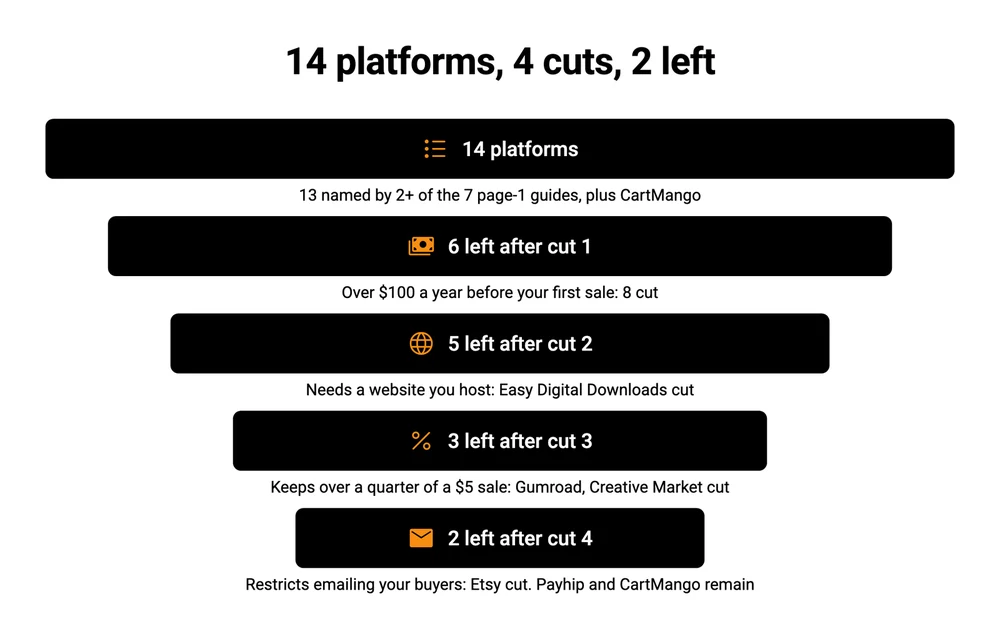
So this post works the other way round. It starts with the 14 platforms that keep coming up and cuts them down with 4 checks you can repeat yourself.
The checks are the bill before your first sale, the website you need, what a $5 sale leaves you, and whether you can email your buyers.
Key Takeaways
- Fees take the biggest share at low prices. In 6 Etsy price studies on this blog, 7 of 8 median prices sat between $2.63 and $5.
- Gumroad takes $1.45 of a $5 sale. That is its 10% plus $0.50, with card processing on top, or 29% of the sale.
- Monthly plans cost $120 to $1,716 a year before you sell anything. For a new seller that rules out 8 platforms, Kajabi and Sellfy among them.
- Payhip’s free plan and CartMango clear all 4 cuts. You keep $4.30 of a $5 sale on Payhip and $4.55 on CartMango, before CartMango’s yearly plan.
- Etsy is the cut worth breaking. It limits emailing your buyers, but its shoppers can find a seller nobody knows yet.
The 14 contenders for best platform to sell digital products
The 14 platforms in this post are the 13 that at least 2 of the 7 guides on Google’s first page recommend, plus CartMango.
Picking a platform is the first decision, and the pricing and setup mistakes come right after it. If you want to catch those before your first launch, the Online Selling Mistakes Challenge sends 5 of them by email, 1 a day.
Gumroad is in all 7 guides. Payhip and Sellfy appear in 5. Etsy, Shopify, SendOwl, Podia and Teachable appear in 4. Thinkific and Creative Market appear in 3, and Kajabi, Easy Digital Downloads and DPD (Digital Product Delivery) in 2. The 14th is CartMango, the checkout I built and run. None of the 7 guides mention it, so it goes through the same 4 cuts as everyone else, with the numbers shown.
Every fee below is worked out on a $5 sale. The price comes from this blog’s own Etsy price studies of crochet patterns, recipe ebooks, embroidery files, Excel templates, planner PDFs and resume templates. 7 of their 8 median prices landed between $2.63 and $5. At that price, a flat $0.50 fee is 10% of the sale on its own.
What page 1 gets wrong about these prices
4 of the 7 guides quote a price for these platforms that the platform’s own page no longer shows, and a 5th gives Gumroad’s fee as a flat 10%. Guides put SendOwl’s entry price at $9 and $18 a month, and SendOwl’s own page says $39.
| Platform | A guide says | The platform’s own page says |
|---|---|---|
| Gumroad | A flat 10% (Thinkific, AWeber, kvitly) | 10% plus $0.50, with 2.9% plus $0.30 card processing on top |
| SendOwl | $9 a month plus 5% (AWeber), $18 a month (Thinkific) | $39 a month, or $32.50 billed yearly |
| Sellfy | $19 a month (AWeber) | $29 a month, or $22 billed yearly |
| Podia | Free with 8% fees (AWeber), $39 a month (uteach), $33 billed yearly (Big Cat Creative) | $49 a month, or $42 billed yearly, plus 5% a sale |
| Teachable | A free plan at $1 plus 10% (Thinkific) | No free plan. From $29 a month billed yearly, plus 7.5% |
| Creative Market | Takes 40% (Thinkific) | Pays shops 50% of net revenue on a standard license |
Thinkific’s guide shows an “updated” date and still prices SendOwl at $18 a month.
Cut 1: anything that costs over $100 a year before your first sale
The first cut removes 8 of the 14 platforms: every one that bills you more than $100 a year before a single buyer shows up. At a $5 price, $100 is the full price of 20 sales. The teacher on Reddit ruled out Shopify on the same grounds. They did not have regular sales yet, so a monthly subscription was out of budget.
Of the 7 below, Kajabi costs the most at $1,716 a year billed yearly and DPD the least at $120, with no yearly discount on offer.
| Platform | Cheapest plan | Billed yearly | Per year | The catch |
|---|---|---|---|---|
| DPD | 20 products | $10 a month (monthly only) | $120 | 1 GB of files |
| Sellfy | Starter | $22 a month | $264 | Capped at $10,000 in sales a year |
| Teachable | Starter | $29 a month | $348 | Plus a 7.5% transaction fee |
| SendOwl | Launch | $32.50 a month | $390 | Capped at $10,000 in sales a year |
| Podia | Mover | $42 a month | $504 | Plus a 5% transaction fee |
| Thinkific | Start | $82 a month | $978 | Built around courses |
| Kajabi | Basic | $143 a month | $1,716 | 5 products |
Sellfy’s yearly figure is 12 months at $22 and DPD’s is 12 months at $10, since neither prints a yearly total.
Shopify is the 8th. Every plan on its main pricing page becomes a paid monthly plan after a short trial, and each one works out well over $100 a year. A Shopify store also needs a separate app before it can deliver a file, which the Shopify setup guide walks through.
Sellfy and SendOwl charge nothing per sale, and Kajabi hosts courses, a community and email on 1 bill. They cost too much for a shop that has not sold anything yet, which is the stage this cut is about.
2 of the survivors pass with a footnote. Easy Digital Downloads passes because its core plugin is free. CartMango passes because it is free right now, and once paid plans start in November it costs $10, $20 or $30 a year, which is still a bill before your first sale, just a small one.
That leaves 6: Gumroad, Payhip, Etsy, Creative Market, Easy Digital Downloads and CartMango.
Cut 2: anything that needs a website you build and host yourself
Easy Digital Downloads is the only one of the 6 left that needs a website of your own, because it is a WordPress plugin. You install it on a WordPress site that you host and keep updated. The core plugin is free on WordPress.org. Its Personal pass is $99.50 for the first year and renews at $199, on top of the hosting bill. That suits someone who already runs a WordPress site. For anyone else it adds a second project before the first sale of their digital downloads.
The other 5 all host the selling page for you. Gumroad, Payhip, Etsy and Creative Market give you a product page or a shop, and CartMango has Mini Pages, a simple sales page it hosts that links straight to the checkout. None of them has an edge here, and you can sell without a website on any of them.
That leaves 5: Gumroad, Payhip, Etsy, Creative Market and CartMango.
Cut 3: anything that takes more than a quarter of a $5 sale
On a $5 card sale, Creative Market leaves you at most $2.50 and Gumroad $3.55, so both fail, while Etsy leaves $4.07, Payhip’s free plan $4.30 and CartMango $4.55.
| Platform | What it charges | Fee on $5 | You keep | Share taken |
|---|---|---|---|---|
| Creative Market | Pays you 50% of net revenue | $2.50 or more | $2.50 at most | 50% or more |
| Gumroad | 10% plus $0.50, plus 2.9% plus $0.30 card | $1.45 | $3.55 | 29% |
| Etsy | $0.20 listing, 6.5% transaction fee, 3% plus $0.25 card | $0.93 | $4.07 | 18.6% |
| Payhip (free plan) | 5%, plus 2.9% plus $0.30 card | $0.70 | $4.30 | 14% |
| CartMango | 0%, plus 2.9% plus $0.30 card | $0.45 | $4.55 | 9% |
The line sits at a quarter because the teacher on Reddit said losing $1 to $2 a sale adds up, and a quarter of $5 is $1.25.
CartMango’s $0.45 is the card fee on Stripe’s pricing page, and CartMango adds nothing to it. You pay its yearly plan instead, which the next sections weigh against Payhip’s 5%. The Payhip and CartMango rows both use Stripe’s rate. PayPal charges its own.
Gumroad’s pricing page does not mention card processing. Its help center does: the 10% plus $0.50 “does not include” card processing of 2.9% plus $0.30. Even the teacher on Reddit described the fee as 10% plus payment processing and left out the $0.50.
With the card’s $0.30, Gumroad charges a fixed $0.80 on every sale, which is 16% of a $5 file before any percentage. 3 of the 6 page-1 guides that price Gumroad leave the $0.50 out, and so does the summary Google shows above the results.
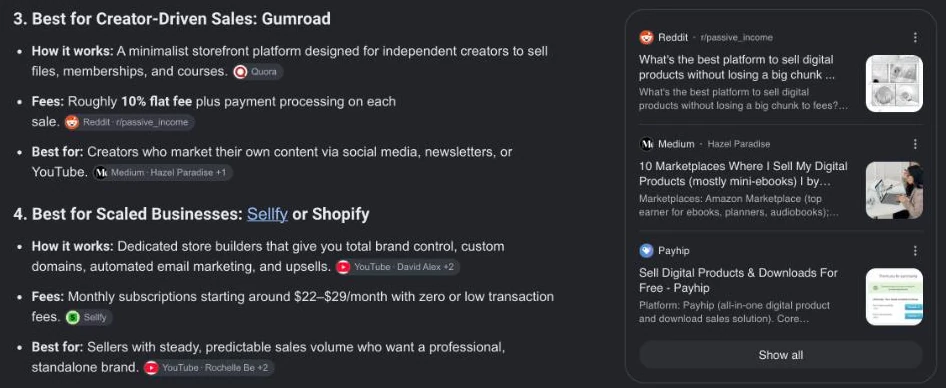
The AI Overview Google shows for this search. Read the Gumroad line: “Roughly 10% flat fee” leaves out the $0.50 charged on every direct sale.
Gumroad gives something back for that fee. Since January 2025 it acts as the merchant of record, so it collects and pays sales tax on your sales worldwide. Its share also falls as your price rises: on a $20 sale Gumroad takes $3.38, about 17%.
Creative Market sits at the far end. Creative Market’s shop terms pay you 50% of net revenue on a standard license, so at least half of every sale goes to the marketplace that found the buyer.
The Etsy exception: Offsite Ads
Etsy passes this cut on a normal order only. When a sale comes through Etsy’s Offsite Ads, Etsy’s fee policy adds 15% of that order, or 12% once a shop passes $10,000 in yearly sales. At 15%, that same $5 sale leaves you $3.32, a 33.6% share, which would fail this cut. Shops under $10,000 a year can opt out of Offsite Ads, so a small shop can keep every order at $0.93.
That leaves 3: Payhip, Etsy and CartMango.
Cut 4: anything that limits emailing your own buyers
Etsy fails the last cut, because it lets you add a buyer to your mailing list only with their consent. Etsy’s Seller Policy says that without that consent, “you may not add any Etsy member to your email or physical mailing list”. A buyer you can email again is worth more than 1 sale. They already trusted you with their money, so the next product, the update and the bundle all go to someone who said yes once.
In a 2023 email to my own list, about why I move social followers onto an email list, I put it this way: “No one (not even my mom or dog) can take it away from me.” A list of buyers works the same way, and everyone on it has already paid you.
Payhip and CartMango both hand you the buyer’s email address. Payhip has email marketing built in. CartMango sends each buyer into the email tool you already use, with native connections for Kit, ActiveCampaign, Beehiiv and BirdSend, and Make.com for the rest.
That leaves 2: Payhip and CartMango.
What is left: Payhip’s free plan or CartMango
Payhip’s free plan and CartMango clear all 4 cuts. The choice between them comes down to how much you sell and where your buyers live.
Payhip’s free plan costs nothing until you sell and leaves you $4.30 of a $5 sale, while CartMango leaves $4.55 but adds a $10 to $30 yearly plan once paid plans start in November.
| Platform | Before your first sale | You keep of $5 | Strongest point | Still does not do |
|---|---|---|---|---|
| Payhip (free plan) | $0 | $4.30 | Collects and pays EU and UK VAT and US and Canadian sales tax for you | No upsells or downsells |
| CartMango | $0 right now, then $10 to $30 a year | $4.55 | 0% per sale on every plan, with upsells and downsells from the $20 plan | No marketplace traffic. Course hosting and a community are not live yet |
The yearly plan is the catch on CartMango’s side. On the $10 Silver plan, the $0.25 Payhip takes from each $5 sale adds up to $10 after 40 sales in a year. Sell fewer than 40 files at $5, or fewer than 10 at $20, and Payhip’s free plan costs you less. Silver also caps you at 10 products, and Gold at 25.
Payhip’s tax handling is a real advantage if you sell to Europe. It collects, reports and pays digital VAT for you, paperwork you would otherwise do yourself. Every Payhip feature is on the free plan too, including courses and memberships, though its subscriptions only work with Stripe. The Payhip pricing guide shows when its Plus and Pro plans beat the free plan’s 5%.
CartMango leaves you as the legal seller of record, so check how you will handle sales tax and VAT before you sell to Europe.
Order bumps are on every CartMango plan. Upsells, downsells and cart abandonment come on the $20 Gold plan, and an affiliate system on the $30 Platinum plan. Payouts go straight to your own Stripe or PayPal account. Video lessons have to sit on a host like YouTube or Vimeo, since CartMango does not host video files.
A simple way to decide: pick Payhip if your sales are small or you sell a lot to Europe and want the tax handled. Pick CartMango if you plan to add upsells and downsells, or expect 5% of every sale to grow past $10 to $30 a year.
When these cuts point the wrong way
The cuts suit a new seller with low prices, and 3 kinds of seller should set them aside.
Volume is the first case. Sellfy’s $22 a month beats Payhip’s 5% once your sales pass $440 a month, which is 88 sales at $5. A reply in the same Reddit thread put it this way: “At $5-$15 per sale, a 5% cut beats paying a monthly fee.” That reply put the switch point at around $500 a month.
Video courses are the second case. Kajabi, Podia, Teachable and Thinkific host the lessons, track progress and run the student login, which is what their monthly price pays for. The course platform comparison prices each one.
Higher prices are the third. Gumroad’s fixed $0.50 matters less on a $20 or $50 product, and its Discover marketplace can bring buyers, at 30% of each sale it finds.
Break cut 4 and start on Etsy if nobody knows you yet
Etsy failed the buyer-email cut, and it is still the right first shop for a seller with no audience, because its shoppers are already searching for printables, planners and templates. A checkout page of your own gets the visitors you send it.
If you have no followers and no email list, being found is worth more than owning the buyer list for now.
Open an Etsy shop and opt out of Offsite Ads while you are under $10,000 a year. Add a checkout of your own for the followers you build outside Etsy, and run both side by side. The Etsy fee breakdown shows what Etsy costs at each price.
FAQ
Is Gumroad free to sell digital products?
Gumroad is free to join and has no monthly fee. Each direct sale costs 10% plus $0.50, card processing of 2.9% plus $0.30 comes on top, and sales through its Discover marketplace cost a flat 30%. On a $5 product that is $1.45 gone. The Gumroad pricing breakdown covers payouts and the high-volume rate.
Is Etsy or Gumroad better for selling digital products?
Etsy is better if you need buyers to find you, and it takes less of a $5 sale: $0.93 against Gumroad’s $1.45. Gumroad suits a seller who brings their own audience, because you get your buyers’ email addresses, which Etsy’s policy limits. On a $20 sale Etsy takes $2.35 and Gumroad $3.38, so the gap shrinks as a share of the sale, from 10.4 points to 5.2.
Where can you sell digital products for free?
Gumroad and Payhip’s free plan charge nothing until you make a sale, then take 10% plus $0.50 and 5% of each sale. Free to start still costs you per sale: on a $5 file, Gumroad’s fee is 29% of the price. CartMango is free right now and takes no cut, then costs $10 to $30 a year once paid plans start in November. Etsy charges $0.20 to list each item, and some new shops pay a one-time set-up fee. More routes are in selling online for free.
Which platform is best for selling ebooks?
Payhip’s free plan and CartMango suit a PDF ebook sold to your own readers, because both clear the 4 cuts above. Payhip, Gumroad and CartMango all protect the download link, so a shared link does not hand out free copies. If you want readers to find the book on Amazon, KDP is a separate route with its own royalty rules, compared in this list of platforms to sell ebooks.
Do you need a website to sell digital products?
No. Gumroad, Payhip, Etsy and Creative Market host your product page, and CartMango hosts a simple sales page through Mini Pages. Of the 6 platforms left after cut 1, only Easy Digital Downloads needs a WordPress site of your own.
What a $5 sale should leave you
On the 2 platforms that cleared every cut, a $5 sale leaves you $4.30 to $4.55 once fees are paid. To check your own, take your real price, subtract every fee the platform’s own page lists, and multiply by the sales you expect in a year. That sum tells you the best platform to sell digital products for your own shop better than any ranking can, this one included.
If you bring your own buyers and want every cent above the card fee, that is the job CartMango was built for. It takes 0% per sale, puts order bumps on every plan and sends each buyer into your email tool. It is free right now, then from $10 a year once paid plans start in November.
About the Author

👋 I’m Welly, founder of CartMango (the site you’re on), a checkout platform for digital product sellers. We’ve previously processed $179M+. I also run BirdSend (email marketing tool, 3.1B+ emails sent). On the side I show other non-techie digital sellers how I use AI workflows to automate 50%+ of my operations. Find me on LinkedIn.
Related Reading
- Online store for digital products: the 3 store types and what each costs on a $10 sale
- Best Gumroad alternative: 7 options for sellers leaving Gumroad’s 10% plus $0.50
- Payhip alternatives: 7 options if you outgrow Payhip
- Competitors of Etsy: 15 Etsy alternatives sorted by type, with real fees