

An online store for digital products is 1 of 3 things: a marketplace like Etsy, a storefront the platform hosts for you like Payhip or Sellfy, or your own checkout through a tool like SendOwl or CartMango. They split on what each sale costs and whether buyers show up on their own. Every fee below was read live.
I read all 8 pages Google puts on the first page for this search. 7 of them hand you a list of platforms and walk away. The one that tries hardest lists 15, in a single flat run, with no way to tell which ones give you a shop window and which ones only take the money.
That flat list is the problem. 2 platforms can sit side by side with the same fee and be completely different products. The marketplace puts your work in front of millions of people who are already shopping. The hosted storefront gives you a nice page that nobody has any reason to visit.
Below: the 3 real categories, what a $10 sale leaves in your pocket on each, and the sales caps that only turn up after you have signed up.
Key Takeaways
- There are 3 categories, not 1 list. A marketplace brings buyers and takes a cut. A hosted storefront and your own checkout bring no buyers at all.
- Gumroad’s 10% is not the whole cost. Card processing stacks on top of it, so a $10 sale really costs you $2.09, not $1.00.
- A percentage cut keeps growing, a flat fee does not. Payhip’s 5% passes Sellfy’s $22 a month once you sell around $440 a month.
- Sellfy, SendOwl and Podia all cap you. Sellfy’s cheapest plan stops at $10,000 of sales a year, and SendOwl upgrades you automatically when you cross its limit.
- Etsy has 87 million active buyers and 5.7 million active sellers. That works out at roughly 15 buyers per seller, and the ratio is getting worse.
- Only a marketplace hands you traffic. Every other option starts you at 0 visitors on day 1, whatever you paid for it.
Before the platforms, 1 thing worth fixing first. Most people lose more money to a handful of repeated selling mistakes than they ever lose to platform fees. The free 5-day Online Selling Mistakes Challenge walks through the 5 that cost solo sellers the most, 1 short email a day.
Marketplace, hosted storefront, or your own checkout
The 3 categories differ on 1 question: who is responsible for bringing the buyer?
A marketplace is a shop inside somebody else’s mall. Etsy and Creative Market already have shoppers typing searches into their bar. You list a product, their search engine may show it to somebody, and they take a cut for the introduction. You are renting a spot, and the landlord sets the rules on pricing, refunds, listing quality and what you are allowed to sell.
A hosted storefront is a shop the platform builds and hosts for you, on their domain or yours. Payhip, Sellfy, Gumroad and Podia all do this, though Podia bundles course hosting, email and a community on top of the storefront. You get a real page with your products on it, a cart and a checkout, without touching any code.
What you do not get is anybody walking past. There is no search bar full of shoppers behind it.
Your own checkout is the money-handling part, bolted onto a page you already control. SendOwl, Easy Digital Downloads, SureCart and CartMango sit here. You keep your site, your domain and your design, and the tool takes the payment, delivers the file and emails the receipt.
Shopify sits slightly outside all 3. It is built for shipping physical goods, and its Digital Products app, which attaches the file to the order, is free and made by Shopify itself. The app is the cheap part. The Shopify plan underneath it is the cost, and for somebody selling 5 PDFs it is a lot of shop to run.
The lines blur at the edges, and that is fine. Gumroad gives you a hosted page and embeddable buttons. CartMango has Mini Pages, a simple sales page it hosts for you, so you can use it without a website of your own. If you already have a site, adding a checkout to it is usually the shorter route, and if you do not, selling without a website is a solved problem now.
The reason to sort platforms this way before you sort them by price: a marketplace fee buys you something the other 2 cannot sell you at any price. Between a hosted storefront at 0% and your own checkout at 0%, you are looking at the same deal with a different logo on the page.
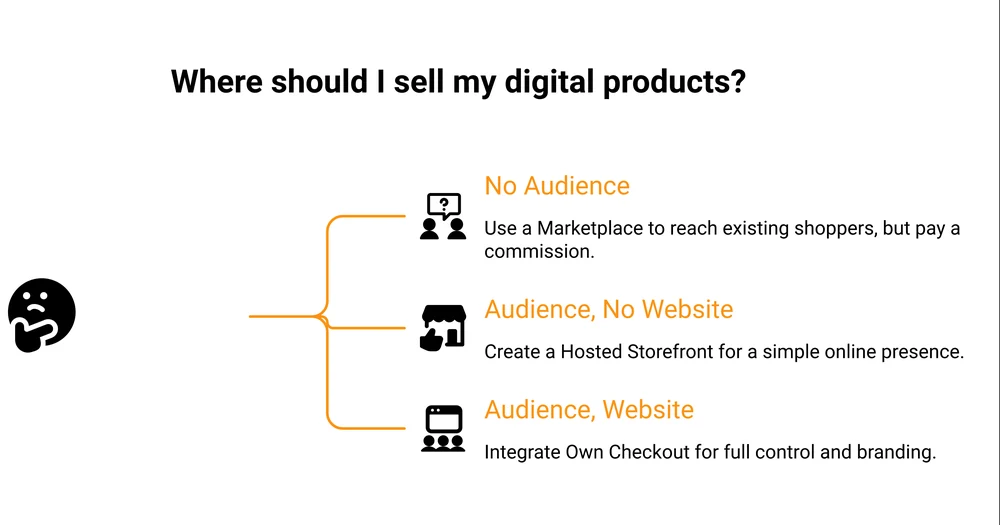
Which of the 3 store types fits depends on whether you already have an audience and whether you already have a site.
What an online store for digital products costs on a $10 sale
A $10 digital download costs you between $0.59 and $2.09 depending on where you sell it. $10 is the working example because it sits in the middle of the $5 to $15 band most first-time sellers price at, and every number below was read at the vendor’s own pricing page.
Payment processing is the part most guides leave out. Stripe charges 2.9% plus $0.30 on a domestic US card. PayPal Checkout charges 3.49% plus $0.49, which is about 25 cents more on every $10 sale. That comes out of your money on top of whatever the platform takes, on nearly every platform in the table.
Gumroad is the one people get wrong most often. Its pricing page says 10% plus $0.50 and calls it transparent pricing with no hidden fees. Its own help centre then says that figure “does not include: Credit card processing (2.9% + $0.30)”. So the real cost of a $10 direct sale is $2.09, and the roundup on page 1 of Google that lists Gumroad as “10% per sale” is understating it by more than a dollar.
On a $10 digital download, Gumroad takes $2.09 and Etsy takes $1.40, while Payhip takes $1.09 and both Sellfy and CartMango take only the processor’s $0.59.
| Platform | Store type | Plan cost | Cut of a $10 sale | You keep |
|---|---|---|---|---|
| Etsy | Marketplace | $0.20 per listing | $1.40 | $8.60 |
| Gumroad | Hosted storefront | No plan fee | $2.09 | $7.91 |
| Payhip Free | Hosted storefront | No plan fee | $1.09 | $8.91 |
| Podia Mover | Hosted storefront | $504 a year | $1.09 | $8.91 |
| Sellfy Starter | Hosted storefront | $22 a month, billed yearly | $0.59 | $9.41 |
| CartMango | Own checkout, hosted page optional | Free until October 2026, then $10 to $30 a year | $0.59 | $9.41 |
I should say plainly that CartMango is my platform, built so the per-sale cut is the processor’s and nothing else.
Read the last 2 columns together, because the plan cost column changes the story completely. Sellfy and CartMango both leave $9.41 in your pocket on that sale. Sellfy charges $22 a month for the privilege and CartMango charges $10 a year. Podia’s Mover plan is the outlier: $504 a year AND a 5% cut, which is the same per-sale cost as Payhip’s free plan.
In fairness to Podia, that $504 is buying course hosting, email and a community that nothing else in the table includes. It is a fair price for a bigger product, and a lot to pay if all you wanted was somewhere to sell a PDF.
Etsy’s $1.40 is the only fee in that table that buys you something. More on that further down.
Worth a separate note on Gumroad, because it has a second rate. Sales that come through Gumroad’s own Discover marketplace are charged a flat 30%, and that one genuinely does include processing. So a $10 Discover sale leaves you $7.00.
That is a marketplace fee, so compare it against Etsy on the same basis. Etsy’s all-in cost on that same $10 sale is $1.40, against $3.00 through Gumroad Discover. Our Gumroad pricing breakdown has the full math if you are weighing that one.
Per-sale cut or flat fee: where the lines cross
A percentage never stops growing. A flat fee does. That single difference decides more of your yearly bill than any feature on any comparison chart.
Somebody in the Reddit thread that ranks for this exact search put it in 1 line: “as you grow, % fees never stop scaling. On $1k/mo, 5% = $50.” That is correct, and it is the whole argument.
Here is where the lines actually cross. Payhip’s 5% costs more than Sellfy’s $22 a month once you sell about $440 a month, and it costs more than CartMango’s $10 a year once you sell about $17 a month.
| Monthly sales | Payhip Free, 5% cut | Sellfy Starter, flat | CartMango, flat |
|---|---|---|---|
| $200 | $10 | $22 | about $0.83 |
| $440 | $22 | $22 | about $0.83 |
| $1,000 | $50 | $22 | about $0.83 |
| $3,000 | $150 | $22 | about $0.83 |
Those are platform fees only. Card processing is the same on all 3, so it cancels out of the comparison.
2 honest caveats before anybody switches on the strength of that table.
The first is that Payhip’s free plan has no product limit and no revenue limit at all, which is more than most paid plans give you. If you are selling $50 a month, paying Payhip $2.50 plus the processor’s cut on each sale is a perfectly sensible arrangement, and you can move later.
The second is that a cheap plan can be cheap because it is small. CartMango’s $10 tier holds 10 products and 10 Mini Pages. Sellfy’s $22 plan holds unlimited products. If you are listing 40 things, those are not the same product at a different price.
Podia’s pricing and Payhip’s pricing have the same kind of limit hiding in them, and it is worth reading the tier you would actually land on rather than the headline.
The sales caps that only show up after you sign up
Several platforms in this category cap how much you are allowed to sell on a plan, and almost nobody writing about them mentions it. It is not a percentage cut, so it does not show up in a fee column, and it does not bite until you are doing well.
Sellfy’s cheapest plan stops at “Up to $10k in sales per year”, SendOwl’s Launch plan stops at $10,000 of sales a year and upgrades you automatically when you cross it, Podia’s Mover plan caps you at 50 products, and CartMango’s $10 plan caps you at 10 products.
| Platform | Entry plan | The limit | What happens when you hit it |
|---|---|---|---|
| Payhip Free | No plan fee | None. Unlimited products, unlimited revenue | Nothing |
| Sellfy Starter | $22 a month, billed yearly | Up to $10k in sales per year | Move up to Business at $59 a month |
| SendOwl Launch | $39 a month | $10,000 sales a year, 5,000 orders | “you will be notified immediately and upgraded” |
| Podia Mover | $504 a year | 50 products, 100 email subscribers | Move up to Shaker at $1,008 a year |
| CartMango Silver | $10 a year | 10 products, 10 Mini Pages, 2 GB storage | Move up to Gold at $20 a year |
SendOwl’s wording is the one to sit with. Its own pricing page says usage is measured over a trailing 12 months and that if you go past a limit, “you will be notified immediately and upgraded”. So the plan you chose is the plan you have until your business works, at which point the price changes for you. Our SendOwl pricing breakdown goes through those tiers in full.
Pricing software this way is normal, and the caps are printed on the page. The problem is that every roundup ranking for this search prints the monthly price and skips the ceiling, so the number you compare on is not the number you will pay.
Can you start a free online store for digital products?
Yes, on 2 of the platforms here, and 1 of the search results that says “free” is not offering a free plan at all.
Sellfy’s homepage ranks on page 1 for this exact search, under the title “Create a Free Online Store”. Sellfy’s pricing page offers a 14-day free trial and 3 paid plans. The cheapest is $22 a month billed yearly, or $29 billed monthly. There is no free tier.
The 2 genuinely free starts are Payhip and Gumroad, and they charge you the same way: nothing up front, a cut of each sale. Payhip’s free plan takes 5% and puts no limit on products or revenue. Gumroad takes 10% plus $0.50 with card processing on top. On a $10 sale that is $0.50 in platform fees against $1.50, before the $0.59 the processor takes from both of them.
At identical volume Payhip’s free plan is the cheaper free plan by a wide margin.
CartMango is free for everybody until October 2026, with no cut of any sale, and after that plans run $10 to $30 a year. Affiliate management, course hosting and community are not live yet. Affiliate is planned for September 2026, and courses and community for October 2026, all on the $30 a year plan.
The catch that applies to all of them: free to open is not the same as free to run. You still pay Stripe or PayPal on every sale, and you still have to find every single buyer. If the budget is the deciding factor, our guide to selling online for free runs the payout math across more platforms than this post does.
A store is not customers
Every platform on this page will have you selling within an hour. Not 1 of them, except a marketplace, will bring you a single visitor.
Etsy is the clearest illustration of what a marketplace fee actually buys, because Etsy has to publish the numbers. In its quarterly filing for the 3 months to June 2026, Etsy reported 86,969 thousand active buyers and 5,706 thousand active sellers. That is 87 million people who have bought something in the past year, against 5.7 million shops competing for them, or roughly 15 buyers per seller.
Read the direction of travel too, because it matters more than the headline. A year earlier the same filing showed 87,340 thousand buyers and 5,388 thousand sellers.
Sellers grew 5.9% and buyers fell slightly. Buyers per seller went from about 16 to about 15 in 12 months. Marketplace traffic is real, and it is being divided more ways each year.
That is before you pay the 6.5% transaction fee, the $0.20 listing fee and 3% plus $0.25 in US processing.
Your own store starts at 0 and stays at 0 until you do something about it.
I have been on the wrong end of this. Years ago, when I launched my email tool, I cold-emailed hundreds of people a day trying to get anybody to try it. For about 2 months we offered a free plan that held up to 5,000 subscribers, and I still had to beg people to take it. Free.
I got rejected most of the time, and some of the replies scolded and shouted at me. Having a product and a page to sell it on was never the hard part.
So budget the same thought for getting seen as you spend picking a tool. A short list that works: an email list you own, 1 platform where your buyers already gather, and something worth linking to. Our post on promoting digital products covers the mistake most people make here, and it is not the one you would guess.
You can also run both at once, and plenty of sellers do. List on Etsy for discovery, keep your own store for repeat buyers and for anybody who found you directly. If you are weighing that split, selling digital products on Etsy has the fee math by price point, and there are 15 Etsy alternatives worth knowing about before you commit.
Where to get digital products to sell if you have none yet
You have 3 routes, and they trade time against margin and against how much of the product is really yours.
Make it yourself. Slowest to start, best margin, and the only route where nobody else is selling the identical file. A first product does not need to be big. A checklist, a spreadsheet template or a 12-page guide is a real product if it solves 1 problem properly.
Buy resale rights. PLR and MRR sellers license you a finished product to rebrand and sell. Fast, and the obvious trade is that other people bought the same file. Our guide to where to buy digital products to resell covers the marketplaces and the licence terms to read before you spend.
License somebody else’s work. Slower and more paperwork, but you get something genuinely differentiated without making it from scratch.
Stuck for a starting point, our list of 100 digital product ideas is sorted into 7 categories, and how to price digital products walks through the PPF Method plus the 4 pricing mistakes that cost the most.
FAQ
What digital products sell well online?
Templates, printables, presets, ebooks and short courses are the reliable sellers, mostly because they solve a narrow problem for somebody who already knows they have it. Fit matters as much as category. Design assets do well on marketplaces where people search visually. Courses, memberships and coaching do better on your own store, where you can follow up by email and sell again.
Do I need an LLC to sell digital products?
Not to start. In most places you can sell as a sole proprietor and report the income on your personal return. An LLC or its local equivalent separates your personal assets from business liability, which matters more as revenue grows or if you take on contractors. Rules differ by country and by state, so check yours rather than copying a US answer off a blog.
Can I sell on a marketplace and my own store at the same time?
Yes, and it is usually the better setup. The marketplace does discovery and takes its cut. Your own store handles repeat buyers, email subscribers and anybody who came from a link, at a much lower cut. Just keep pricing consistent, and check the marketplace’s terms, since some restrict what you can say about selling elsewhere.
Do I need my own website to run an online store for digital products?
No. Payhip, Sellfy, Gumroad and Podia all host a storefront for you, and CartMango’s Mini Pages hosts a sales page that links to its checkout. A website of your own helps with search traffic and with owning the whole experience, and it is not a requirement for taking the first payment.
Pick the store, then go find the buyers
If you are starting from nothing and want the lowest risk, open a Payhip free store and accept the 5%. If you already have an audience and expect steady sales, a 0% platform on a flat fee will cost you less every month you keep selling. If you want the discovery, take Etsy’s 6.5% with your eyes open about the 15-buyers-per-seller math, and put a store of your own behind it for the second sale.
An online store for digital products should take a small, predictable amount from you and leave the rest alone. CartMango is free for everyone until October 2026, and after that it is $10 to $30 a year. Per year, not per month, with no cut of any sale.
About the Author

👋 I’m Welly, founder of CartMango (the site you’re on), a checkout platform for digital product sellers. We’ve previously processed $179M+. I also run BirdSend (email marketing tool, 3.1B+ emails sent). On the side I show other non-techie digital sellers how I use AI workflows to automate 50%+ of my operations. Find me on LinkedIn.
Related Reading
- How to add a shopping cart to a website: 4 methods with the real fee math on each
- Selling digital products on Etsy: honest fee math by price point, and the lock-in nobody warns you about
- How to sell online for free: net payout on a $30 sale across 7 platforms
- Gumroad pricing: for readers ready to work out what the 10% really costs them