
A crochet pattern becomes a sellable product once it is written up, tested and exported as a PDF. Designers sell crochet patterns on Etsy, Ravelry, LoveCrafts and Ribblr, or through their own checkout. Those routes differ less on listing fees than on how much of a cheap pattern their fixed fees swallow.
I went looking for what it actually costs to sell a crochet pattern, and found a mess.
1 guide sitting on page 1 of Google still quotes Etsy’s old 5% commission. The real number is 6.5%. A platform’s own help page says you can sell there “completely for free without paying a commission”, while its payments policy sets a 25 cent minimum on every pattern sold.
None of that would matter much on a $40 product. Crochet patterns are nowhere near $40 products.
So I did the work myself. I sampled 191 crochet pattern listings on Etsy to find what they really sell for, then read every platform’s own fee page and did the arithmetic. Below is what each route costs on a real pattern price, what patterns are actually priced at, and the 1 fee rule that quietly costs small sellers the most.
Key Takeaways
- The median crochet pattern in my 191-listing Etsy sample asks $3.84, and 3 in 4 are priced under $6.25.
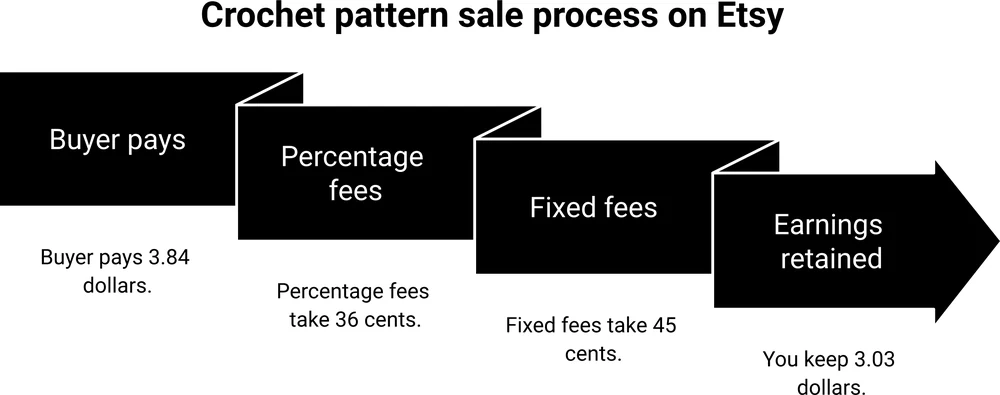
- At that median price Etsy keeps $0.81 of $3.84, which is 21% of the sale, because $0.45 of it is fixed.
- Ribblr advertises a 4% sale fee but enforces a 25 cent minimum, so a $3.84 pattern really pays 6.5%.
- Ravelry charges nothing under $30 a month, pays only through PayPal, and hides its fee table behind a login.
- Percentages mislead on cheap products. The fixed cents per sale decide who actually keeps your money.
New to selling files rather than finished items? The free 5-day Online Selling Mistakes Challenge walks through the 5 mistakes that cost solo sellers the most, and none of them are about crochet.
Where to sell crochet patterns, and what each route really costs
Etsy, Ravelry, LoveCrafts, Ribblr and your own checkout page are the 5 realistic places to sell crochet patterns. Each one charges in a different way, so the comparison that matters is what lands in your account after a single sale.
I read every fee below on the platform’s own pricing or policy page rather than repeating another blog. The figures assume a US seller and a sale at $3.84, the median asking price in my Etsy sample further down this post.
On a $3.84 pattern, Etsy takes $0.81 and leaves you $3.03. Ribblr takes $0.66, Ravelry takes $0.62 through PayPal alone, Payhip’s free plan takes $0.60, LoveCrafts takes $0.50, and CartMango takes $0.41, which is the payment processor’s cut rather than a platform fee.
| Route | Listing fee | Platform cut | Payment processing | You keep on $3.84 |
|---|---|---|---|---|
| Etsy | $0.20 per sale | 6.5% | 3% + $0.25 | $3.03 |
| Ribblr | Free | 4%, minimum $0.25 | Stripe, 2.9% + $0.30 | $3.18 |
| Ravelry | Free | None under $30/month | PayPal only, 3.49% + $0.49 | $3.22 |
| Payhip | Free | 5% on the free plan | Stripe, 2.9% + $0.30 | $3.24 |
| LoveCrafts | Free | 4% + $0.35, under $40/month | Included in that 4% | $3.34 |
| CartMango | Free | 0% | Your own Stripe, 2.9% + $0.30 | $3.43 |
I should be upfront that CartMango is my own platform, which is why it takes no cut of the sale. CartMango is free until October 2026 and then starts at $10 a year, so at this median price CartMango takes about 25 sales a year to pay for itself against Etsy.
2 things the table cannot show, and both matter.
Ravelry and LoveCrafts only look cheapest while you are small. Ravelry’s own help pages say it starts charging above $30 a month in sales, which is about 8 patterns at the median price.
LoveCrafts’ designer handbook adds a 5% selling fee on monthly revenue between $40 and $1,500. That is roughly 11 patterns. Above those lines both platforms get more expensive than the table suggests.
Ravelry carries a quieter catch. PayPal is the only way it pays designers, so a PayPal problem becomes a you-do-not-get-paid problem, and its actual fee table sits behind a login that a prospective seller cannot open. LoveCrafts pays a month in arrears, on the 25th, also through PayPal.
Etsy has a second cost the others do not. Its Offsite Ads fee is 15% of any sale that came through an ad Etsy ran for you, dropping to 12% once your shop passes $10,000 in a year.
Below $10,000 you can switch Offsite Ads off. Once you cross that line the fee gets cheaper and you can no longer opt out.
If you want the fuller breakdown of that one platform, I wrote up honest fee math on Etsy separately, including what happens at higher price points.
The fixed fees that the percentages hide
The advertised percentage stops describing your costs the moment your product is cheap. Every platform above charges a fixed amount per sale on top of its percentage, and that fixed amount does not shrink with your price.
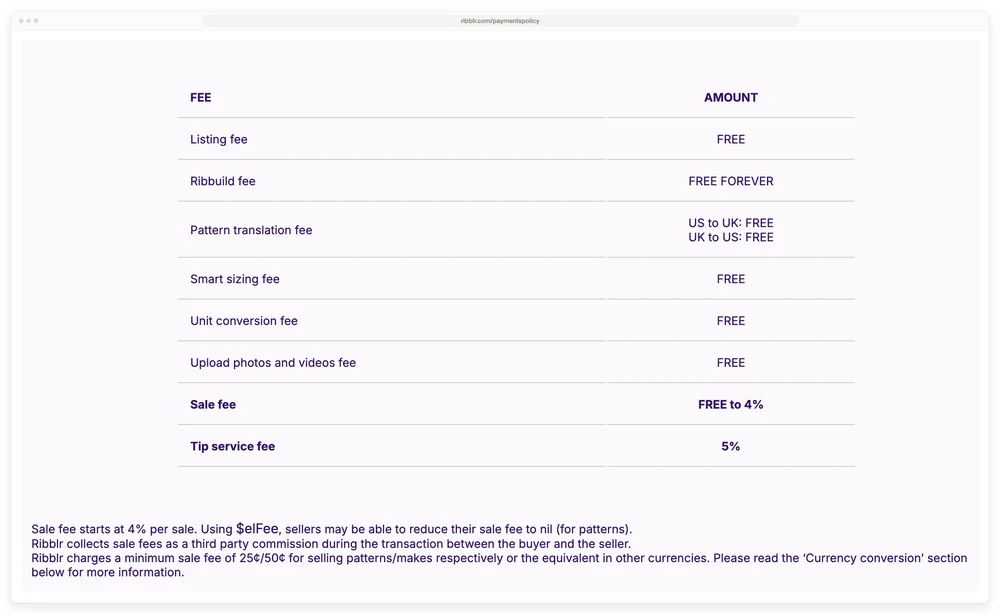
Ribblr is the clearest case. Its help pages say you can sell “completely for free without paying a commission” using its fee-reducing program, while its payments policy states the sale fee “starts at 4% per sale” with a minimum of 25 cents per pattern. 4% of $6.25 is exactly 25 cents, so any pattern priced below $6.25 pays the floor rather than the rate.
Ribblr advertises 4%, but on a $3.84 pattern the real cut is 6.5%, and on a $1.99 pattern it is 12.6%, more than 3 times the advertised figure.
| Pattern price | 4% would be | Actually charged | Real rate |
|---|---|---|---|
| $1.99 | $0.08 | $0.25 | 12.6% |
| $3.84 | $0.15 | $0.25 | 6.5% |
| $5.00 | $0.20 | $0.25 | 5.0% |
| $6.25 | $0.25 | $0.25 | 4.0% |
| $10.00 | $0.40 | $0.40 | 4.0% |
144 of the 191 listings I sampled, just over 3 in 4, sit below that $6.25 line. So most crochet patterns on sale right now pay the floor rather than the advertised rate.
Here is that policy on Ribblr’s own site, where the rate and the floor sit 2 lines apart:
The same arithmetic runs everywhere. Etsy’s $0.45 of fixed charges is 4.5% of a $10 pattern and 45% of a $1 pattern.
1 seller in a r/CraftyCommerce thread described listing printer-friendly versions of her free patterns at $1 to cover her fees. At $1, Etsy keeps 55 cents of it.
Marketplaces are still a reasonable choice. The sticker percentage is just a poor way to choose between them.
What crochet patterns actually sell for
The median crochet pattern on Etsy asks $3.84. I sampled 191 digital crochet pattern listings across the first 3 pages of Etsy’s own search results, filtered to digital downloads, with prices read in US dollars.
I checked the pooled figure across all 191 rather than reporting a single page, because the 3 pages disagreed slightly on their own ($4.00, $3.75 and $4.06).
Crochet patterns cluster low: 1 in 4 asks under $2, nearly 2 in 3 ask $5 or less, and only 9 of the 191 broke $10.
| Asking price | Listings | Share |
|---|---|---|
| Under $2 | 49 | 25.7% |
| $2 to $4 | 52 | 27.2% |
| $4 to $6 | 37 | 19.4% |
| $6 to $8 | 29 | 15.2% |
| $8 to $10 | 15 | 7.9% |
| Over $10 | 9 | 4.7% |
The full range ran from $0.20 to $25.52, with a mean of $4.55. The mean sits above the median because a handful of large bundles pull it up, which is why the median is the more useful number to price against.
This is the piece missing from every guide I read. Advice to “price at $3 to $10” is fine until you notice that the bottom of that range hands more than a fifth of your money to a marketplace before you have earned anything.
How to price your crochet patterns
Price above $6.25 if you can defend it, because that is where the fixed fees stop dominating. Below it you are paying a toll that has nothing to do with your percentage, and the cheaper you go the worse the ratio gets.
Most patterns sit well below that line, so getting above it usually means changing what you sell rather than editing a price field. 3 practical moves:
- Sell a bundle instead of a single pattern. A $12 bundle of 4 pays 1 set of fixed fees instead of 4. On Etsy that costs $1.59 in fees against $2.96 for the same 4 patterns sold separately at $3, a saving of $1.37.
- Put your cheapest patterns where the fixed fee is smallest. A $2 pattern keeps $1.36 on Etsy and $1.64 on your own checkout. The gap is small in cents and large in percentage terms.
- Give the cheap ones away and sell the bundle. A free pattern on Ravelry or Instagram costs you nothing to distribute and does the job a $1 listing was doing badly.
Pricing digital files is its own topic, and I go deeper on the method in how to price digital products.
How much money can you make selling crochet patterns
Hard numbers for crochet pattern income are scarce. The clearest public account describes 6 months earning nothing, then about $1,000 a month by the 1-year mark. That is 1 designer’s experience, and 1 account cannot tell you what your own year will look like.
It comes from Little World of Whimsy, an amigurumi designer who wrote up 9 lessons from her first year in business. She was also explicit that at the very beginning, over 90% of her income came from brand sponsorships, most of them through a single company, rather than from pattern sales.
In the r/CraftyCommerce thread above, a designer who had published her first pattern the previous Saturday reported 29 sales so far, split across Etsy and Ravelry. At the median price, 29 sales is about $111 in revenue and about $88 of it left after Etsy’s fees.
What both accounts have in common is the work behind the sales. A pattern keeps earning after you write it, and it still needs listings, photographs and promotion before the first buyer ever finds it.
What makes a crochet pattern worth buying
A pattern sells when a stranger can finish the project without asking you a question. That is the whole product. The design gets attention, but the write-up is what earns the refund-free sale and the repeat customer.
The 4 things buyers consistently ask for:
- Standard terms and clear counts. US or UK terms stated up front, with row or round counts a maker can check against.
- Photographs of the steps, not only the finished object. The finished piece sells the pattern. The step photos stop the emails.
- A tester who is not you. Someone else making the item from your written words is the only way to find the row where your instructions stop making sense.
- Sizing and materials stated plainly. Yarn weight, hook size, finished measurements, and how much yarn the project eats.
On format, a PDF remains the safe default because a buyer can print it, keep it and open it in 10 years. Ribblr’s interactive patterns are genuinely liked by makers, and 2 separate commenters in that Reddit thread praised being able to tick off rows as they go, so an interactive version is a reasonable second format rather than a replacement.
Whatever you export, remember the file leaves your hands the moment it sells. I covered the practical options in protecting digital downloads, and the same rules apply to any PDF you sell.
Can buyers sell the items they make from your pattern?
In the US, copyright protects your written pattern, not the finished garment it produces. Your PDF, its photographs and its wording are yours, and copying or reselling that file is infringement. A hat someone crochets from it is generally theirs to sell.
This question keeps surfacing in the same communities where designers ask where to sell, including 2 separate threads in the search results for this topic. The reason is that useful articles, meaning things with a practical function like clothing, sit outside what US copyright covers, while the instructions for making them sit inside it.
What that means in practice for you as a designer:
- You can ask, and many designers do. A polite line in your listing requesting credit when someone sells a finished item is normal and widely respected.
- You cannot rely on that line as law. Treat it as a request to your customers, not a term you could enforce.
- The file is the thing to protect. Sharing, reuploading or reselling your PDF is the actual infringement, and it is also the one you can do something about.
If you sell internationally, this is US-specific and other countries treat it differently, so take the above as the American default rather than a global rule.
Getting your first crochet patterns seen
Every route in this post needs traffic, and you either bring it yourself or borrow it from a marketplace. Etsy and Ravelry are the 2 places with makers already searching, which is exactly why designers keep paying their fees.
That trade shows up plainly in seller behaviour. In the r/CraftyCommerce thread, 1 designer noted that she prices lower on Ravelry because its fees are lower and still gets more sales on Etsy, calling it “the main spot”.
Discovery and margin are 2 different problems, and a lower fee only solves 1 of them. A marketplace that puts your pattern in front of buyers can be worth more than the percentage it charges.
The usual answer is to run both: a marketplace for discovery, your own checkout for the buyers who already know your name and the bundles you would rather not hand over 21% of.
FAQ
Where is the best place to sell crochet patterns?
Etsy and Ravelry have the most makers actively searching, so they are the best places to be found. Ravelry is cheaper on fees, particularly under $30 a month in sales, but only reaches knitters and crocheters. Sellers commonly list on both, then add their own checkout for bundles and repeat buyers.
How much money can you make selling crochet patterns?
Expect very little in the first months and a slow build after that. 1 designer publishing openly about her results took 6 months to earn anything and reached about $1,000 a month around a year in, with most of her early income coming from sponsorships rather than patterns. At the $3.84 median price, 100 pattern sales a month is under $400 before fees.
What crochet patterns sell well?
Amigurumi and small plush projects dominate the listings I sampled, alongside garments, accessories and seasonal makes. Bundles priced between $7 and $15 were the main way sellers escaped the low single-digit prices most single patterns sit at.
How do I price my crochet patterns?
Price above $6.25 where you can, because below that the fixed per-sale fees take a rising share of your money. The market median is $3.84, so pricing above it needs either a bundle, a more involved project, or a name buyers already trust.
Do I need my own website to sell crochet patterns?
No. Marketplaces host your listing, and checkout tools like CartMango, Payhip or Gumroad host a sales page for you and handle the file delivery. A website of your own is useful later for building an audience, not for taking the first payment.
How do I sell my crochet patterns if I have never sold anything before?
Write and test 1 pattern, export it as a PDF, and list it on Etsy or Ravelry to reach people already looking. Add your own checkout once you have repeat buyers or a bundle worth protecting the margin on. Starting costs nothing beyond Etsy’s $0.20 listing fee.
The part of your price you can stop giving away
Fees on a $3.84 product take a fifth of it. Whichever way you sell crochet patterns, those fixed cents are the part you can do something about, whether that means bundling, pricing higher, or sending your repeat buyers somewhere that keeps less.
That last route is what CartMango does. CartMango takes 0% of your sale, hosts the sales page and delivers the file, so on a $3.84 pattern you keep $3.43 instead of $3.03. CartMango is free until October 2026, then starts at $10 a year.
About the Author

👋 I’m Welly, founder of CartMango (the site you’re on), a checkout platform for digital product sellers. We’ve previously processed $179M+. I also run BirdSend (email marketing tool, 3.1B+ emails sent). On the side I show other non-techie digital sellers how I use AI workflows to automate 50%+ of my operations. Find me on LinkedIn.
Related Reading
More on where to sell crochet patterns and other digital files, and what each route costs:
- Selling digital products on Etsy: the full fee math at every price point, and where the fees start to outweigh the traffic
- How to price digital products: the method behind picking a number you can defend
- How to sell PDFs: delivery, locking and what actually sells as a downloadable file
- Protecting digital downloads: 8 practical ways to stop your pattern being passed around
- Payhip alternatives: for readers comparing checkout tools properly