

Gumroad pricing is 10% plus $0.50 per direct sale, with card processing of 2.9% plus $0.30 charged on top, so the real cost is about 12.9% plus $0.80. Sales that come through the Gumroad Discover marketplace cost a flat 30% instead, and that rate does include processing. There is no monthly fee.
I run a checkout platform, which means I read pricing pages for a living, and the gap between a headline rate and what lands in your bank account is almost always wider than sellers expect.
Gumroad is a clean example. Its pricing page says 10% plus $0.50, its own help centre says that figure excludes card processing, and the second of those is the one your payout actually follows. Underneath both sits a layer nobody puts on a pricing page at all: minimum balances, holding periods, currency conversion, and a 2% cut if you get paid by PayPal.
This post walks the whole cost, from the moment a buyer clicks pay to the moment the money reaches your account.
Key Takeaways
- Gumroad’s real direct-sale cost is about 12.9% plus $0.80, not the 10% plus $0.50 on the pricing page.
- Card processing of 2.9% plus $0.30 is charged separately on direct sales, and Gumroad’s own help centre says so.
- The 30% Discover marketplace rate is genuinely all-inclusive, which makes it cheaper than direct on very low prices.
- Being Merchant of Record means Gumroad handles your sales tax worldwide. It does not mean processing is bundled.
- Payouts need a $100 minimum balance, sit 7 days before releasing, and cost 2% if paid via PayPal.
What Gumroad pricing actually looks like in 2026
Gumroad has no plans, no tiers and no monthly subscription. You list a product for free and pay only when something sells. That part of the marketing is true.
What you pay depends entirely on how the sale happened. There are 2 rates:
- Direct sales, where a buyer arrives through your own link, your profile or your storefront: 10% plus $0.50 per transaction.
- Discover sales, where a new buyer finds your product through Gumroad’s own marketplace search: 30% flat per transaction.
That is the whole published structure. There are no volume discounts and no reduced rate once you cross a revenue threshold, and the old tiered system where the percentage dropped as you sold more has been removed.
Because the rate is flat across revenue levels, modelling your fees at $1,000 a month against $50,000 tells you nothing new: it is the same percentage applied to a bigger number. What genuinely moves the rate is the price of each product.
Free resource: most of what quietly eats a solo seller’s margin is not the platform fee at all. The free 5-day Online Selling Mistakes Challenge walks through the 5 leaks that cost creators the most, and how to close each one.
If you are still deciding what to charge in the first place, our guide to how to price digital products covers the method before the fee math.
Gumroad fees on a direct sale: the number behind the 10%
Gumroad’s pricing page lists 10% plus $0.50 and promises “no hidden fees”. Its help centre article on fees is more specific, stating that the 10% plus $0.50 charge “does not include” credit card processing of 2.9% plus $0.30, or PayPal fees.
So a direct card sale carries 2 separate charges: Gumroad’s platform fee of 10% plus $0.50, and card processing of 2.9% plus $0.30. Combined, that is roughly 12.9% plus $0.80 per direct sale. The processing figure is the standard US card rate, which you can check against Stripe’s published pricing, and Stripe is the processor sitting behind Gumroad.
On a $50 product that means $5.50 to Gumroad and $1.75 to the processor, so you keep $42.75.
If you searched this and read the summary at the top of Google, that summary is wrong.
Google’s AI Overview for “gumroad pricing” states that credit card processing is “built into” the 10% rate, and gives a take-home of $44.50 on a $50 sale. The real figure is $42.75. Google is citing a source that got the math right, then summarising it incorrectly.
The published guides on this topic are mostly accurate. The error is sitting in the answer box above them, which is what most people read now instead of the pages underneath.
What you actually keep at each price point
The percentage is flat. The fixed portion is not. That $0.50 plus $0.30 lands on every sale regardless of price, so cheap products lose a far bigger share.
| Sale price | Gumroad fee | Card processing | Total fees | You keep | Effective rate |
|---|---|---|---|---|---|
| $10 | $1.50 | $0.59 | $2.09 | $7.91 | 20.9% |
| $25 | $3.00 | $1.03 | $4.03 | $20.97 | 16.1% |
| $50 | $5.50 | $1.75 | $7.25 | $42.75 | 14.5% |
| $100 | $10.50 | $3.20 | $13.70 | $86.30 | 13.7% |
| $250 | $25.50 | $7.55 | $33.05 | $216.95 | 13.2% |
| $500 | $50.50 | $14.80 | $65.30 | $434.70 | 13.1% |
Fees calculated from Gumroad’s published direct-sale rate plus standard US card processing.
A $10 product hands over more than a fifth of its price. A $500 product hands over about an eighth. Same platform, same rate card.
Below about $5 it gets genuinely ugly. A seller on r/ecommerce selling gaming products priced between $1 and $3 posted their numbers: $58 in sales returned $12 after fees, and on one $1.02 sale they kept $0.09. Other sellers in the same r/ecommerce thread walked through the arithmetic and landed in the same place.
Their business model was the problem more than the platform. Fixed per-transaction fees punish micro-priced products everywhere, not only here. But it is worth seeing what that looks like before you price a product at $3.
The 30% Discover fee, and when it is worth paying
Discover is Gumroad’s marketplace. When a buyer who has never heard of you finds your product through Gumroad’s own search and buys it, that sale is charged at 30% flat. Unlike the direct rate, this one really is all-inclusive: processing sits inside the 30%, so there is no second charge.
The 30% is worth judging on what it buys rather than on its size.
A direct sale at 12.9% is a customer you found and paid for somewhere else, in time or in ad spend. A Discover sale at 30% is a customer Gumroad found for you. Set against what paid acquisition usually costs, giving up 30% of one sale for a buyer you did not have is a decent trade.
Two caveats: Discover applies to marketplace-originated sales whether you wanted them or not, and sending your own traffic to a product listed in Discover can still get those sales charged at the marketplace rate.
There is also an inversion worth knowing about. Because the direct rate carries a fixed $0.80 and the Discover rate does not, the 2 rates cross over at about $4.68, below which the “expensive” 30% marketplace rate is actually the cheaper one.
| Sale price | Direct sale cost | Discover cost | Cheaper option |
|---|---|---|---|
| $3 | $1.19 (39.6%) | $0.90 (30%) | Discover |
| $10 | $2.09 (20.9%) | $3.00 (30%) | Direct |
| $50 | $7.25 (14.5%) | $15.00 (30%) | Direct |
Above roughly $5, direct wins and keeps winning. Under it, the fixed fee does more damage than the marketplace cut.
Merchant of Record: what it covers, and what it does not
Since 1 January 2025, Gumroad has acted as your Merchant of Record. This is a genuine benefit and it is worth understanding properly, because it is also the single most misread thing about Gumroad’s pricing.
As Merchant of Record, Gumroad is the legal seller in the transaction. It collects and remits sales tax, VAT and GST worldwide on your behalf, and your own tax settings are switched off because you no longer need them.
For a solo seller with international buyers, that removes a real compliance headache. If you want the general concept rather than Gumroad’s version of it, Merchant of Record has a plain definition.
What it does not do is bundle your card processing. Being the legal seller for tax purposes and absorbing the processor’s cut are separate arrangements, and Gumroad only does the first on direct sales. Conflating the two is the likely source of the Google summary error above.
The one place both are bundled is Discover, where the 30% covers everything.
Gumroad payout rules most sellers find out too late
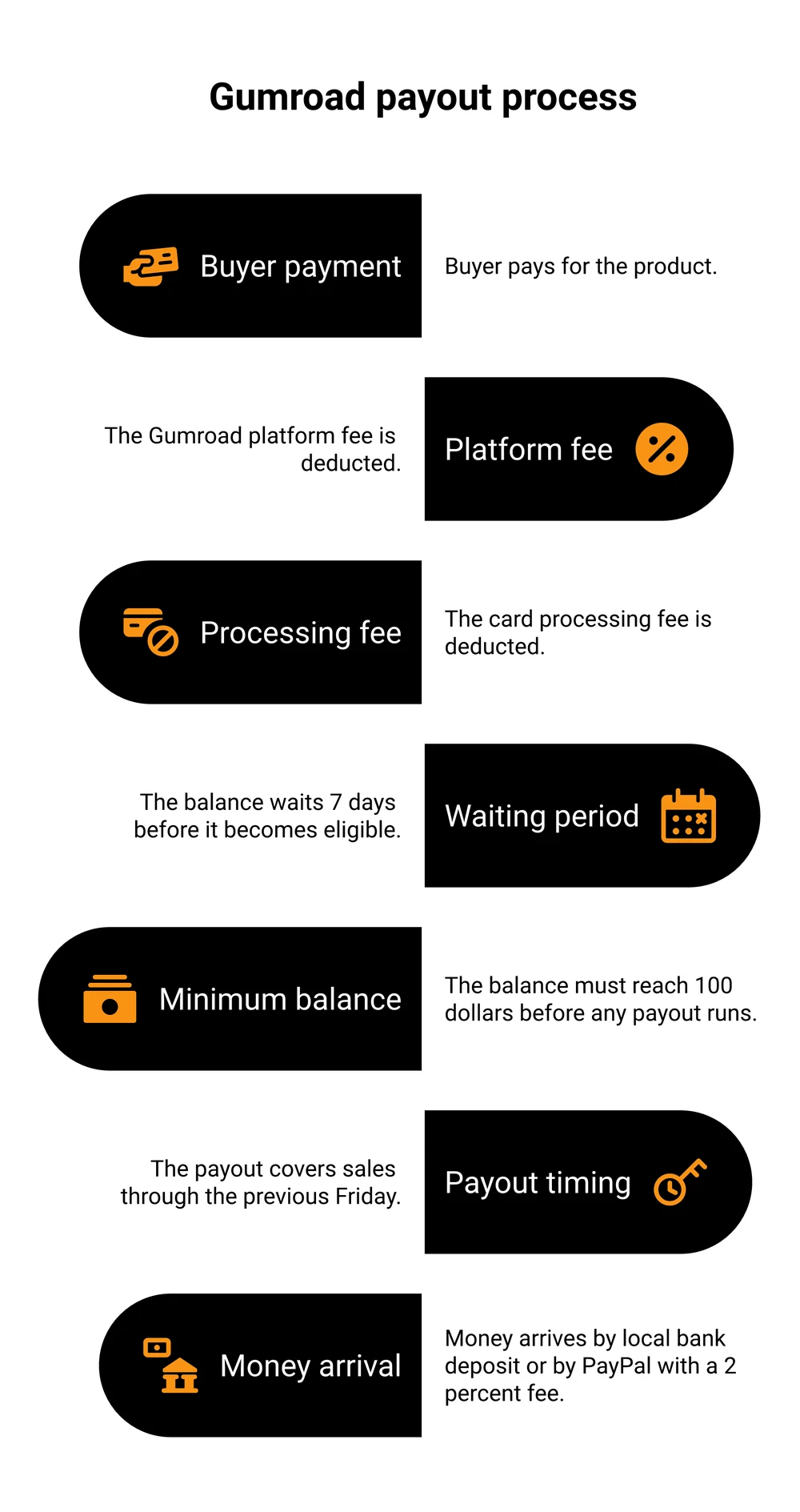
Fees decide what you earn. Payout rules decide when you see it, and they carry their own costs. None of it appears on the pricing page.
When you get paid
- You need a $100 minimum balance before any payout is released. Many countries have higher local-currency minimums.
- Every sale sits for a minimum 7-day holding period before it becomes eligible.
- Payouts cover sales made through the previous Friday, UTC.
- You can choose daily, weekly, monthly or quarterly. Daily is available only to US sellers with an eligible bank account and at least 4 prior payouts.
- Bank transfers take 2 to 7 business days once sent.
For a seller doing $30 a week, that $100 floor means getting paid roughly monthly no matter which cadence is selected.
What payouts cost
- PayPal payouts carry a 2% fee. On $1,000 that is $20 on top of everything already deducted. If your country supports direct bank deposit, taking it saves you that 2%. Our breakdown of PayPal fees covers how these stack in general.
- Instant payouts cost 3%, capped at $10,000, and are US-only for sellers with 4 completed payouts.
- Currency conversion happens at the exchange rate at the time of sale, not at payout. If you sell in USD and get paid in another currency, the rate is locked when the buyer pays, which can work for or against you.
What can go wrong
- Your first payout waits on an account review of 1 to 3 weeks, with Gumroad’s stated benchmark around 3 to 4 sales and a balance over $100.
- Changing your country can forfeit your balance, which Gumroad states directly, citing restrictions from its payment partners. Pick carefully at signup.
- Payouts go to a local bank account or PayPal only, so Payoneer, Wise, wire transfers and cheques are not supported. If your country supports neither, Gumroad has no way to pay you at all.
- Buying your own product to speed up the review will get you flagged for fraud. Use the test purchase feature instead.
Frozen payouts and slow support are the most common complaints sellers raise publicly, which is worth weighing alongside the fee math. If that worries you, is Gumroad safe looks at the platform’s track record in more detail.
The costs that stack on top
The 12.9% is the minimum, not the maximum, and several things add to it:
- Mobile app sales carry roughly 30% extra, going to Apple or Google rather than Gumroad.
- Affiliate commissions split the fees proportionally, so an affiliate earning 30% carries 30% of that purchase’s fees.
- Refunds do not make you whole. Gumroad returns its own fee but keeps the processing share, because processors do not return it, so a refunded $50 sale still costs you $1.75.
- Chargebacks carry the usual processor penalties on top of the lost sale.
Stack the wrong combination, a Discover sale in the mobile app with an affiliate attached, and the effective rate climbs well past anything on the pricing page. That is how sellers end up posting screenshots of 50% or higher wondering what happened.
How Gumroad pricing compares to other checkout tools
Most comparisons line up headline percentages, which is exactly the framing that produced the confusion this post exists to clear up. The more useful columns are whether processing is included and what the entry plan caps you at.
| Platform | Fixed cost | Platform cut | Processing included | Entry plan limit |
|---|---|---|---|---|
| Gumroad | $0 | 10% + $0.50 direct, 30% Discover | No on direct, yes on Discover | None |
| Payhip | $0 free plan | 5% free, 2% on $29/mo, 0% on $99/mo | No | None |
| ThriveCart | $47/mo, lifetime available | 0% | No | None |
| Sellfy | $29/mo, or $22/mo annual | 0% | No | $10k sales a year |
| SendOwl | $39/mo, or $32.50/mo annual | 0% | No | $10k sales a year |
| SamCart | $79/mo | 0% | No | None |
| CartMango | Free during beta, then from $10/year | 0% | No | 10 products |
Prices read from each platform’s own pricing page. Annual billing lowers several of these. Only Gumroad’s Discover rate bundles processing, so on every other row you also pay your processor’s roughly 2.9% plus $0.30.
To be upfront about the last row: CartMango is my own platform, so read it with that in mind. It is also the only row with a product limit on its entry plan, capped at 10, where the others let you list as many as you like.
The trade is the same everywhere. Gumroad charges nothing until you sell, which makes it the easiest place to start and the most expensive place to scale, while the subscription tools reverse that: you pay whether or not you sell, and keep almost everything once you do.
Run it on 100 sales of a $30 product, $3,000 in revenue. Gumroad takes about $467, while a tool with no per-sale cut takes only the processing, about $117, plus whatever the plan costs. At 5 sales a month the maths flips entirely and the per-sale model wins.
Watch the caps as well, because Sellfy and SendOwl both limit their entry plans to $10,000 of sales a year, so the cheapest row is not always the one you stay on.
One thing Gumroad has that none of the others do, mine included: Discover is a real marketplace with real buyers browsing it. Every other platform in that table expects you to bring every visitor yourself, with no discovery and nobody stumbling across your product. If you have no audience yet, that alone is a fair reason to accept Gumroad’s rate for a while.
For the wider field, we compare the options in Gumroad alternatives, and Gumroad vs Payhip covers the closest head-to-head. For marketplace routes instead, see where to sell besides Etsy.
How to pay less without leaving Gumroad
If Gumroad suits you otherwise, a few things genuinely reduce what you hand over:
- Price above $20. The fixed $0.80 stops mattering much once the price clears roughly $25, and most of the pain at $5 and $10 is that fixed portion rather than the percentage.
- Bundle cheap products rather than listing them separately. 5 items at $3 sold one at a time cost about $5.95 in fees, while the same 5 sold as one $15 bundle cost $2.74, saving $3.21 on identical revenue.
- Take bank deposit over PayPal where your country supports it, and skip the 2% payout fee.
- Drive your own traffic so sales are charged at the direct rate rather than the Discover rate, which reverses under about $4.68 where Discover is cheaper.
- Build the fee into your price. If you need $27 clear on a direct sale, list at about $32.
None of this touches the 12.9% itself. That is simply the price of selling on Gumroad.
Gumroad pricing FAQ
Does Gumroad take 10%?
Gumroad takes 10% plus $0.50 on direct sales, but that is not the full cost. Card processing of 2.9% plus $0.30 is charged separately, bringing the real total to about 12.9% plus $0.80. Sales through the Discover marketplace are charged 30% flat, and that rate does include processing.
Why is Gumroad so expensive?
For most sellers the answer is the fixed portion rather than the percentage. The $0.50 platform fee and $0.30 processing fee apply to every sale at any price, so a $10 product pays an effective 20.9% while a $250 product pays 13.2%. Discover sales at 30% and mobile app sales carrying an extra 30% push it higher again.
Why are people leaving Gumroad?
The complaints sellers raise publicly cluster around payout friction rather than the headline rate: the $100 minimum balance, the 7-day hold, account reviews running 1 to 3 weeks, and difficulty reaching support. Discussions on r/ecommerce give a sense of the sentiment. Fee surprises come up too, usually from sellers who expected the 10% to be everything.
Is Gumroad free to sell on?
Gumroad is free to join, free to list and charges no monthly fee, so you pay only when you sell. The per-sale cut is where Gumroad makes its money, and on a direct sale that runs to about 12.9% plus $0.80.
Does Gumroad support Payoneer?
No. Gumroad pays out by direct bank deposit in supported countries, or PayPal where bank deposit is unavailable. Payoneer, Wise, wire transfers, cheques and money orders are not supported. If your country supports neither bank deposit nor PayPal, Gumroad currently has no way to pay you.
What is better, Etsy or Gumroad?
They solve different problems. Etsy is a marketplace with buyers already browsing, so you get traffic and pay for it through listing fees, a transaction fee and optional ads. Gumroad gives you a checkout and expects you to bring the audience. With no traffic yet, a marketplace does more for you. With an audience, selling direct keeps more per sale and hands you the customer’s email.
What this means for your pricing
Gumroad pricing works out at roughly 12.9% plus $0.80 on a direct sale, 30% flat through Discover, and a payout layer adding a 2% PayPal fee, a $100 minimum and a 7-day wait before any of it moves.
Gumroad is a reasonable platform that is cheap to start and expensive at volume. Knowing the real number is what lets you price correctly, instead of finding the gap on your first payout.
If your products sit under $10, run the effective-rate table against your own prices before you commit to Gumroad pricing. That is where most sellers get caught out.
If running your own numbers through that table stung, that is exactly why it is worth knowing. CartMango is the checkout I built for solo digital sellers who would rather pay a flat yearly price than a cut of every sale. It is free through beta, then starts at $10 a year, charged per year instead of per month, with no percentage taken off the top of what you sell.
About the Author

👋 I’m Welly, founder of CartMango (the site you’re on), a checkout platform for digital product sellers. We’ve previously processed $179M+. I also run BirdSend (email marketing tool, 3.1B+ emails sent). On the side I show other non-techie digital sellers how I use AI workflows to automate 50%+ of my operations. Find me on LinkedIn.
Related Reading
- Best Gumroad alternatives: 7 checkout options compared on real fees
- How to price digital products: the method to use before the fee math
- How much does PayPal charge: the other fee that quietly eats your margin
- Competitors of Etsy: for readers weighing a marketplace instead