

How to sell online for free comes down to 3 routes. Local marketplaces like Facebook Marketplace and Craigslist charge nothing when a buyer picks up in person, while free-to-list marketplaces like eBay and Etsy charge nothing upfront and take a cut when the item sells. Free digital checkout tools like CartMango, Gumroad or Payhip cost nothing to start.
I read the page-1 results for this search. 3 of them are published by print-on-demand companies. Another opens with a section called “Before You Go Free: Why Some Sellers Skip the Free Route Entirely” and closes with one called “When to Upgrade to Shopify.”
So the people answering “how do I sell online for free” mostly make money when you stop.
There is a second problem. One of those posts runs a heading called “Completely Free Platforms to Sell Items Online” and lists eBay, Etsy, Mercari, Poshmark and Depop underneath it, while its own table a screen earlier files those same platforms under “fees on sales.”
Free to list and free to sell are different things. The gap between them is where your money goes.
Here is what a single $30 sale actually pays you on each route.
Key Takeaways
- Free to list is not free to sell. Most free platforms charge nothing upfront, then take roughly 5% to 15% at the moment money changes hands.
- 3 fee layers stack on a typical sale: a listing fee, a commission when it sells, and payment processing on top.
- Local pickup is the only route with no fee on either side. Vinted charges sellers nothing, but its buyers pay a mandatory 5% + $0.70.
- Digital products are the one case where selling free actually holds up, because there is no inventory, shipping or per-unit cost.
- A marketplace charges you a cut in exchange for sending you buyers. Running your own checkout costs no cut, but nobody is browsing it.
Free to list is not free to sell
Mercari says it plainly on its own how-to-sell page: “Listing is free. We only charge fees when your sale is complete.”
That is the whole model, stated honestly. Nothing to pay until you succeed, then a cut of the success.
Most “free selling site” roundups stop at the first half of that sentence. Here is the second half, which is where 3 separate charges stack up.
Layer 1: the listing fee. What it costs to put the item up. Often waived. eBay gives you 250 free listings a month, then charges $0.35 each. Etsy charges $0.20 per listing whether or not the thing ever sells.
Layer 2: the commission. The cut taken when the item sells. This is the big one, and it goes by different names depending on the platform: final value fee, transaction fee, selling fee, commission. On eBay it is 13.6% for most categories, plus $0.40 per order on anything over $10. On Etsy it is 6.5%.
Layer 3: payment processing. The card fee. Etsy charges US sellers 3% + $0.25 on top of its 6.5% transaction fee. eBay is one of the few that folds processing into its final value fee, so nothing extra there. If you run your own checkout, this is Stripe or PayPal charging you 2.9% + $0.30, and it is the only layer you can never fully escape.
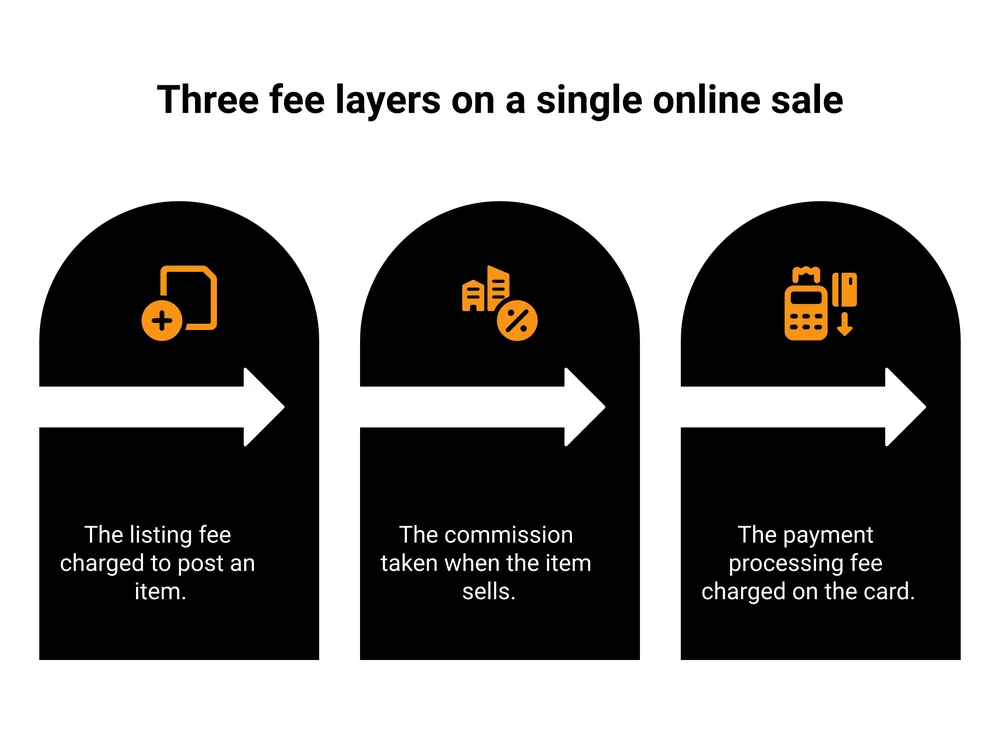
Miss the stacking and your mental math is off by half. A 6.5% platform is not a 6.5% platform once you add $0.20 up front and 3% + $0.25 at the end.
If you want the deeper breakdown on that third layer, I wrote up PayPal fees separately.
Before you list anything, it is worth knowing which of these leaks is actually costing you the most. That is what the free 5-day Online Selling Mistakes Challenge walks through, based on the 5 mistakes I see solo sellers repeat.
What a $30 sale actually pays you
Same item, same price, 7 routes. Every fee below was verified at each platform’s own pricing page.
| Where you sell | Fees on a $30 sale | You keep | Who finds the buyer |
|---|---|---|---|
| Facebook Marketplace, local pickup | None, cash in person | $30.00 | The platform |
| Vinted | No seller fee. Buyer pays 5% + $0.70 | $30.00 | The platform |
| eBay | 13.6% + $0.40 per order | $25.52 | The platform |
| Etsy | $0.20 listing + 6.5% + 3% + $0.25 | $26.70 | The platform |
| Gumroad, digital | 10% + $0.50, plus 2.9% + $0.30 processing | $25.33 | You |
| Payhip free plan, digital | 5% + 2.9% + $0.30 processing | $27.33 | You |
| CartMango, digital | $0 platform fee in beta + 2.9% + $0.30 processing | $28.83 | You |
I should be upfront: CartMango is my platform. It is free through beta, then starts at $10 a year, and it takes no percentage of your sales, which is why its row lands where it does. The last column is the part that stops this from being a straight win, and I come back to it near the end.
3 things jump out of that table.
The spread between best and worst is $4.48 on a $30 item. That is 15% of the sale price, gone, on a decision most sellers make in about 4 seconds.
Vinted really does keep its promise to sellers. Its own how it works page says “There are no selling fees on Vinted. You keep 100% of what you earn.”
So how does Vinted make money? From the buyer. Its help centre says a Buyer Protection fee is “mandatory for every order” and runs “usually 5% + $0.70,” added automatically at checkout. Your $30 item costs the buyer about $32.20.
Understand that rather than celebrate it. The cost did not vanish, it moved to the other side of the transaction, and that has a consequence for you.
Your item shows up more expensive than the price you set. A buyer comparing your $30 listing against the same thing elsewhere is really comparing $32.20, and a higher total at checkout is one of the oldest reasons a sale does not happen. You keep 100% of the sales you make, but the fee is quietly working against how many sales you make.
But notice which routes keep you the most. Facebook local pickup keeps all $30 because you did the work of meeting a stranger in a parking lot.
One more thing worth knowing about eBay. Another page-1 roundup quotes its fee as 13.25%, and that number is real, but it belongs to the Coins and Paper Money category. Most categories are 13.6%. Small difference, and it tells you how carefully those posts are kept current.
How to sell online for free depends on what you are selling
This is the fork nobody draws, and it decides everything downstream.
The Federal Reserve actually measures this. In its 2024 household survey, 13% of US adults made money selling things. The split underneath that number is the whole story. 10% were selling items they previously owned, 4% were selling things they bought to resell, and 3% were selling things they made.
So most people searching this are clearing out a closet, not launching a store. The advice those 3 groups need is not the same.
You are clearing out used stuff. Old furniture, clothes, a bike, phones. You want money for things you already own and you are not building a business. Local marketplaces are genuinely free for you.
You make physical products. Prints, candles, jewelry, handmade goods. Something has to get manufactured, packed and shipped. Free platforms exist but every sale carries a real cost, because every sale carries a real object.
You sell digital products. Templates, presets, ebooks, courses, printables. No inventory, no shipping, no cost per copy. If you are not sure what counts, here is what digital products are.
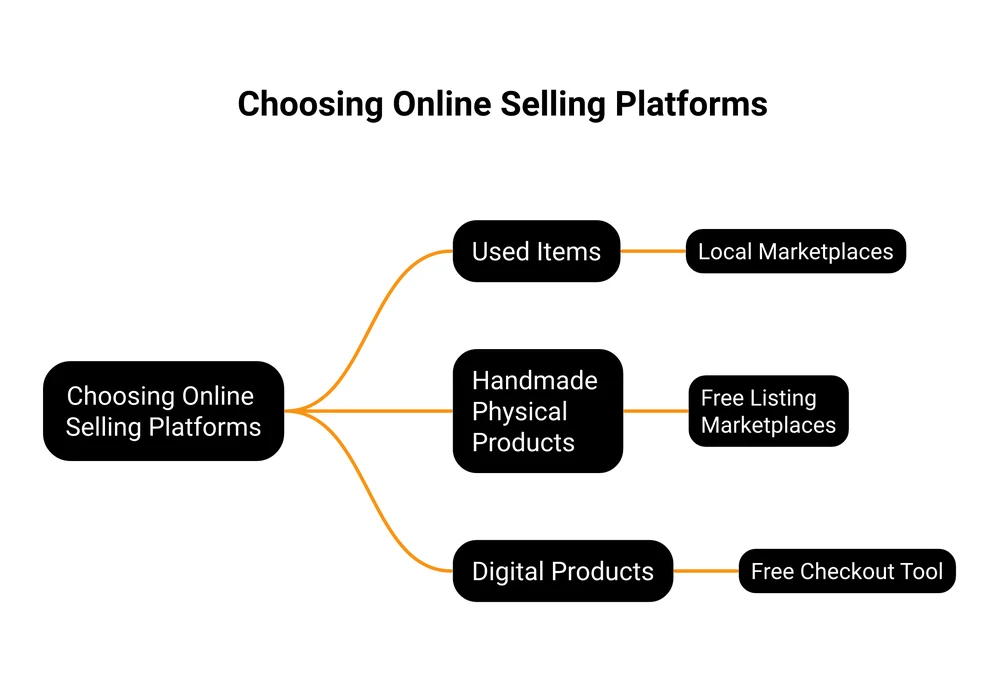
Only the third group has a path that stays free at scale. The first group has a path that is free but does not scale. The middle group has neither, and most “sell online for free” articles are written as though everyone is in the middle.
Selling used stuff online for free: local pickup is the real 0%
If you are clearing out a garage, stop reading roundups and open Facebook Marketplace.
Local pickup carries no selling fee, no shipping label and no payment processing, because the buyer hands you cash. Craigslist, Nextdoor and OfferUp work the same way. When I checked this search on 18 July 2026, Google’s own AI Overview led with exactly this, and it is right.
The trade-offs are real though.
Your buyer pool is whoever lives within driving distance. You will get lowballers. There is no buyer protection and no dispute process, so a bad sale is just a bad day.
A few things that make it work better:
- Meet in a public place during daylight. Many police stations now have marked exchange zones.
- Take cash. Not a check, not a “I’ll send it after pickup” promise. One of the roundups on this SERP devotes a whole section to the Craigslist fake check scam, and it is still the most common one.
- Price about 10% above what you will accept, because the first message is almost always an offer.
- Photograph the item in daylight against a plain background. It costs nothing and it is the single biggest difference between a listing that moves and one that sits.
The moment you agree to ship something, this route starts charging you. Meta charges a selling fee on shipped Marketplace orders, and the shipping label comes out of your side.
Selling handmade or physical products without paying monthly
This is the hardest of the 3 cases, and the one where “free” gets stretched furthest.
You have 2 real options.
Free-to-list marketplaces. Etsy, eBay, Depop, Vinted, eCrater. You pay nothing to open the shop.
Etsy and eBay then take a cut when something sells, while Vinted charges sellers nothing and puts the shipping cost on the buyer. What that cut buys you is traffic, because people are already searching there, which is not nothing. If Etsy is on your list, I compared where to sell besides Etsy across 15 options.
Free plans on store builders. Square Online, Freewebstore and Mozello all have genuine free tiers. Read the caps before you commit, because that is where the catch lives. Mozello’s free plan, for example, gives you 0% sales commission but caps you at 5 products and 0.5 GB of storage, which is a real ceiling if you ever want a 6th product.
Now the part several page-1 posts get wrong. Shopify, Wix, BigCommerce and Amazon appear on multiple “free websites to sell online” lists. Those are free trials or paid monthly plans. A trial that expires in 3 days is not a free way to sell online, and putting it on the list makes the list useless to the exact beginner it claims to serve.
For physical goods there is no version of this where selling costs nothing. You are picking which cost you would rather carry: a cut of each sale, a monthly fee, or the hours it takes to bring your own traffic.
Selling digital products: the one genuinely free path
Here is what nobody on page 1 says, because 3 of the 10 results sell printing.
Digital products are the case where free actually works.
There is no inventory, so no money sits tied up in stock you might never sell. Shipping disappears entirely, along with the labels, the packaging and the parcels that go missing. Best of all, your 400th sale costs you exactly what your 1st did, which is nothing.
That leaves a single leak: whatever the platform takes.
The numbers from the table above, restated for this case. Gumroad takes 10% + $0.50 per sale, and card processing of 2.9% + $0.30 is charged on top of that. Being merchant of record means Gumroad handles your sales tax, not your card processing.
Payhip’s free plan takes 5% and Stripe or PayPal charge their standard rate on top, which Payhip states plainly in its own pricing FAQ. CartMango takes no percentage and is free through beta, so what you pay is the processor’s 2.9% + $0.30.
All 3 let you start without a card on file. If you want a wider look at that category, here are the Gumroad alternatives worth knowing.
A real question at this point: do you need a website? No. Every one of those tools hosts a page for you, so selling without a website is the normal starting point rather than a workaround.
2 things to get right regardless of which you pick.
Delivery should be automatic. The buyer pays and the file arrives, with no you in the middle at 11pm. Manual delivery works for a handful of sales and then it quietly becomes your job.
And protect the file. A PDF that spreads freely is a product that stops selling. Watermarking and expiring download links handle most of it.
If this is where you are heading, starting a digital product side hustle covers the income side honestly, including what the first year usually looks like.
The real trade: audience or margin
Look at that last table column again, because it is the real decision.
A marketplace sends you buyers and charges a cut for doing it. Your own checkout charges nothing, and it also sends you nobody.
Neither is free. You are paying either in money or in traffic, and traffic is the harder one to find when you are starting.
That is why the eBay row keeping $25.52 is not obviously worse than the CartMango row keeping $28.83. eBay came with buyers. Your own checkout came with an empty page and a link you have to go promote yourself.
The fee squeeze is real for people who never solve the traffic side. In a March 2025 r/ecommerce thread, a seller described their Mercari economics in plain numbers: buyers paid around $8 an item, most of it shipping, and after fees they were keeping “anywhere from 20¢-95¢.” At that margin the platform is not really a sales channel, it is a hobby with paperwork.
What actually works is using both in order.
Start where the buyers already are, because a 13% cut of a sale beats 100% of no sale. Collect emails from every buyer you get. Then move your repeat customers to your own checkout, where the cut disappears.
The marketplace becomes your discovery channel and your own checkout becomes your margin. That sequence is also how most of the businesses you can run solo get past their first year.
Free selling FAQs
What is the best site to sell stuff for free?
For used physical items, Facebook Marketplace with local pickup, because there is no selling fee, no shipping cost and no processing fee. Vinted is the other genuine 0% option for clothing, since it charges sellers nothing. For handmade goods, Etsy costs nothing to open but takes $0.20 per listing plus 6.5% plus 3% + $0.25 when a sale happens.
How to sell online for beginners?
Pick one platform and list one item this week. Photograph it in daylight, write a title containing the words a buyer would search, and price it against completed listings for the same thing. Do not build a store, a brand or a logo first. Sell one item, learn what the fees actually cost, then decide where to put the second.
How to sell things online with no money?
All 3 routes in this guide need $0 upfront. Local marketplaces are free to list and free to sell, and eBay gives 250 free listings a month while charging only when an item sells. Free digital checkout tools cost nothing to open. Your real cost is time spent on photos, descriptions and getting people to look.
Which platform is easiest to sell on?
Facebook Marketplace, by a distance. You already have an account, listing takes about 2 minutes from your phone, and there is nothing to set up. eBay asks more of you but reaches national buyers. Your own checkout is the most work at the start and the least work per sale later.
Before you list anything
The decision is smaller than it looks. Match the route to what you are selling, then check what the sale actually pays you before you list, not after.
Clearing out used things, meet someone locally and keep all of it. Making physical products, accept that a cut or a monthly fee is the price of the traffic. Selling digital products, you are in the one category where selling online for free genuinely stays free, so keep the cut rather than handing it over out of habit.
The platform that says free on the homepage is not always the one that leaves the most in your account.
If you go the digital route, the number that decides whether it is worth your time is how much each buyer is worth. That is the part CartMango is built for: order bumps and upsells at the checkout itself, so the same buyer spends more without you having to go find another one. Free through beta, then starting at $10 a year, with no cut of your sales.
About the Author

👋 I’m Welly, founder of CartMango (the site you’re on), a checkout platform for digital product sellers. We’ve previously processed $179M+. I also run BirdSend (email marketing tool, 3.1B+ emails sent). On the side I show other non-techie digital sellers how I use AI workflows to automate 50%+ of my operations. Find me on LinkedIn.
Related Reading
- How to sell digital products without a website: the no-website path in full, start to finish
- Starting a digital product side hustle: honest income numbers for the first year
- Competitors of Etsy: 15 marketplaces and store builders with real fee math
- Gumroad alternatives: for readers ready to compare checkout tools properly