

The biggest competitors of Etsy are Amazon Handmade and eBay for built-in buyer traffic, Shopify and Big Cartel for running your own store, and Folksy or MakerPlace by Michaels for strictly handmade goods. Digital sellers often sell direct with a tool like CartMango (free right now, from $10 a year once paid plans start in November, 0% per sale), Gumroad (10% + $0.50 per sale), or Payhip (5% per sale on its free plan). This guide compares each by current fees and the type of seller it fits best.
If you sell on Etsy, you’ve probably watched the fees climb and wondered what else is out there. You’re not alone.
Back in 2022, Etsy raised its transaction fee to 6.5%, and more than 14,000 sellers went on strike over it. Since then the feed has filled with mass-produced and AI-generated listings, so standing out as a real maker is harder than it was 3 years ago.
Leaving isn’t simple, though. Etsy has buyer traffic that most alternatives can’t match, so the wrong move can cost you sales.
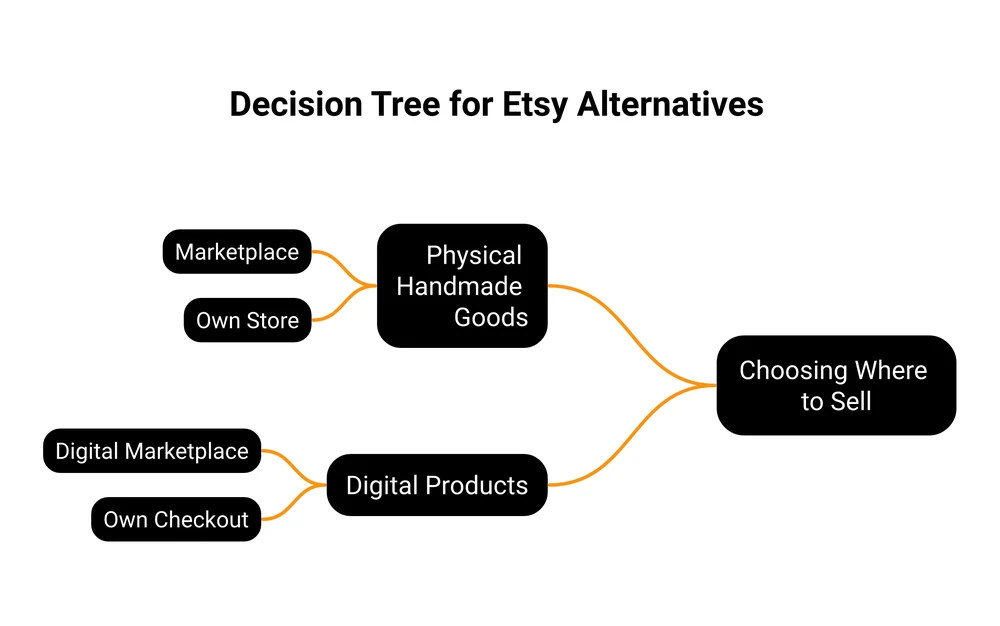
The best competitor for you comes down to 2 things: what you sell, physical or digital, and whether you already have an audience of your own. This guide breaks down the real options by category, with current fees, so you can choose the one that fits your shop instead of guessing.
Key Takeaways
- 5 real categories. Etsy’s competitors fall into handmade marketplaces, big general marketplaces, your own store, digital-product platforms, and print-on-demand.
- No perfect swap. No single platform replicates Etsy’s built-in buyer traffic, so most sellers diversify instead of switching all at once.
- Traffic versus ownership. Marketplaces bring you buyers but take a cut and keep the customer. Your own store keeps both for you, if you can drive the traffic.
- Digital sellers win by going direct. If you sell digital products, selling from your own checkout keeps the most per sale, and it’s the option most Etsy-alternative lists skip.
- Know Etsy’s real cost. Etsy charges $0.20 per listing plus a 6.5% transaction fee, before payment processing and optional ads fees stack on top.
Why sellers are leaving competitors of Etsy for good
Etsy still works for a lot of people. But the reasons sellers start shopping around are real, and they’ve piled up over the last few years.
Start with the fees. Etsy charges $0.20 to list each item, a 6.5% transaction fee on the sale price plus shipping, and a payment processing fee on top (around 3% plus $0.25 in the US). Run Offsite Ads and Etsy takes another 12% to 15% of any sale it attributes to an ad.
Once your shop passes $10,000 in a year, that ad fee becomes mandatory. You can confirm all of this on Etsy’s own fee policy. Stack it up and a healthy chunk of every sale never reaches you.
Before you switch anything, it helps to fix the selling mistakes quietly costing you sales. The free 5-day Online Selling Mistakes Challenge walks through the 5 biggest ones.
The 2022 fee hike is what pushed many sellers over the edge. When Etsy moved its transaction fee from 5% to 6.5%, more than 14,000 sellers went on strike and a petition gathered tens of thousands of signatures. The fee stuck.
Then there’s the volume. AI tools let a single seller generate dozens of designs in a day and list them all, and genuine makers say their original work gets buried under mass-produced and templated items, a shift craft-industry writers have tracked closely. Etsy has responded by tightening its Creativity Standards in June 2025 to require that items be based on a seller’s own original design.
The strain shows in Etsy’s own numbers. In the third quarter of 2025, Etsy reported active buyers down about 5% and active sellers down nearly 11% from a year earlier.
The last reason is quieter but matters most long term. On Etsy, the customer relationship belongs to Etsy. You can’t easily email past buyers or bring them back on your own terms.
When your growth depends on someone else’s rules and search algorithm, a single fee hike or policy change can reshape your business overnight.
Competitors of Etsy at a glance
Here are the main options side by side. Fees are current as of 2026-07-13 and pulled from each platform’s own pricing pages.
| Platform | Type | Cost to sell | Best for |
|---|---|---|---|
| Etsy (for reference) | Handmade + digital marketplace | $0.20 listing + 6.5% + processing | The baseline you’re comparing to |
| Amazon Handmade | Handmade marketplace | 15% referral fee, no monthly | Reaching Prime shoppers at scale |
| eBay | General marketplace | 13.6% final value fee + $0.40/order | Vintage, resale, and one-off items |
| Bonanza | General marketplace | 11% final value fee | Crafts and collectibles, low setup |
| Shopify | Own store builder | From $29/month + processing | A branded store you fully control |
| Big Cartel | Own store builder | Free up to 5 products | Small shops testing their own site |
Fees change often, so confirm the current rate on each platform before you commit. Marketplaces (the first 4) hand you buyers but take a percentage of every sale. Store builders (the last 2) charge a flat fee and let you keep the sale, but you have to bring the traffic yourself.
The real choice: another marketplace or your own store
Before you compare logos, decide which type you need. Almost every Etsy competitor is one of 2 things, and they solve different problems.
A marketplace (Amazon Handmade, eBay, Bonanza, MakerPlace) comes with shoppers already browsing. You list, and people who weren’t looking for you can find you.
That built-in traffic is exactly what sellers on one r/CraftFairs thread kept coming back to. As one put it, there’s “no adequate alternative” because rival marketplaces just don’t have Etsy’s traffic. The price you pay is a cut of every sale and no real ownership of the customer.
Your own store (Shopify, Big Cartel, a checkout on your own site) works the other way. No marketplace takes a percentage, and the buyer is yours to email and sell to again.
The catch is that nobody shows up unless you send them. You need an audience, or a plan to build one, from Instagram, a newsletter, a podcast, anywhere.
Here’s the honest read from sellers who’ve done both. One shop owner on that thread said they now “do 10 times the sales on our website as we did on Etsy,” but that only happened after they built a following at in-person shows first.
Own-store math is better per sale. It just asks more of you upfront.
Most people don’t switch cold. They keep Etsy running for discovery and slowly move repeat buyers to a channel they own. You can add a shopping cart to your site without tearing down your Etsy shop.
Best handmade marketplaces (built-in craft buyers)
If you make physical, handmade goods, these are the closest like-for-like swaps. They carry buyers who came looking for handmade.
Amazon Handmade is the biggest by reach. It’s a curated section of Amazon, so your items sit in front of millions of Prime shoppers, and the usual $39.99 monthly Professional selling fee is waived for Handmade sellers.
The cost is a flat 15% referral fee per sale. It’s the volume play, and yes, it means supporting Amazon, which some makers would rather not.
MakerPlace by Michaels is the newer heavyweight. Launched by the craft-store chain Michaels, it’s a handmade-focused marketplace with free listings and low seller fees, and it has a real retail brand behind it, so it isn’t going anywhere.
It’s smaller than Etsy on traffic, but that backing makes it one of the safer bets among the newer handmade options. (Goimagine, another handmade-only marketplace, announced it’s closing in 2026, a reminder that smaller values-driven platforms can struggle to reach the scale sellers need.)
Folksy is the UK’s handmade marketplace, strictly for British makers. IndieMade and Aftcra are smaller US options built around independent artists, both worth a look if you want a simpler shop with less competition for attention.
Artisans Cooperative is a newer, member-owned marketplace where sellers actually hold a stake in the platform, and one seller on that Reddit thread mentioned already making back 2 years of membership fees. None of these will match Etsy’s volume yet, but they attract buyers who care that a human made the thing.
Best big marketplaces for reach, vintage, and resale
When your goal is raw exposure, or you sell vintage and secondhand, the general marketplaces earn their place.
eBay is the veteran, with a huge, established buyer base. It’s ideal for vintage, collectibles, and one-of-a-kind items that sell well through bidding and search. Its standard final value fee runs 13.6% plus $0.40 an order, though rates vary by category.
Bonanza positions itself as a lower-fuss eBay for crafts and collectibles, with a straightforward setup. One thing to know: Bonanza raised its final value fee to 11% in May 2025, up from 3.5%. Ignore the older number you’ll still see quoted around the web.
Facebook Marketplace and Mercari round out the group for casual, local, or lower-price-point selling. They aren’t handmade-focused, and they won’t build your brand, but they add cheap reach when you want to move inventory.
Store builders: own your brand
Ready to run a store that’s entirely yours? These let you do it.
Shopify is the default for a reason. It’s the most powerful own-store builder, with themes, apps, and a checkout that’s genuinely hard to beat. Plans start from $29 a month (billed annually), plus payment processing, with no per-sale commission when you use Shopify Payments.
It’s built for sellers who want to scale a real brand and are ready to drive their own traffic. One seller on that Reddit thread moved to Shopify to link straight from Instagram, and said they started selling a lot more that way.
Big Cartel is the simpler starting point. It’s free for up to 5 products, with low-cost paid tiers when you grow, and it was built by and for artists. If you want a basic storefront without Shopify’s learning curve, start here.
Squarespace and Wix are worth a look if you also want a full website, portfolio, or blog wrapped around your shop, not just a store.
Selling digital products: the category the roundups skip
Here’s the gap in almost every Etsy-alternatives list. They’re written for physical, handmade goods.
But a huge share of Etsy is digital: printables, planners, Canva templates, fonts, presets, and SVGs. If that’s you, your best options are completely different, and the fee math is where it gets interesting.
If you sell digital products, this short video breaks down why Etsy quietly costs more than the fee suggests, and what to do instead:
You’ve got 2 routes.
The first is a digital marketplace like Creative Market or Design Bundles. Like Etsy, they bring built-in buyers who are already searching for design assets. Also like Etsy, they take a commission on every sale, so you keep less per download in exchange for the traffic.
The second is selling direct from your own checkout. Tools like Gumroad, Payhip, and CartMango let you sell digital downloads straight to buyers, with no marketplace taking a cut of the product price.
You bring the traffic, and in return you keep far more of each sale and the customer stays yours. If you’re new to it, this guide on selling without a website shows how the flow works, and platforms to sell ebooks goes deeper on document products.
| Platform | Per-sale fee | Plan cost | Best for |
|---|---|---|---|
| Gumroad | 10% + $0.50 per sale | None | Easiest start, handles your sales tax |
| Payhip | 5% on free plan, down to 0% | $0 to $99/month | Scaling from free plan to high volume |
| CartMango | No platform fee, just Stripe’s 2.9% + $0.30 | Free during beta, then from $10/year | Keeping the most per sale and owning your buyers |
Fees above are current as of 2026-07-13. The spread is real: on a $20 digital sale, Gumroad takes about $3.38 once its 10% plus $0.50 and card processing are counted, Payhip’s free plan takes about $1.88 on the same basis, and a checkout that only pays Stripe’s 2.9% plus $0.30 takes about $0.88. Once you’re selling any volume, that gap adds up fast.
Full disclosure: CartMango is my platform, so I’m not a neutral voice on it. The fees above are the actual current numbers, and they’re why I’d point any digital seller with an audience toward selling direct rather than handing a marketplace a cut of every sale.
Coming from Gumroad and want to compare the direct-checkout options? The best Gumroad alternative roundup breaks them down, and if you’ve been eyeing an all-in-one link-in-bio tool, the Stan Store alternative guide is the digital-seller version of this same decision.
Print-on-demand for art and merch
If you sell art or designs and would rather not touch inventory, print-on-demand platforms print and ship for you when someone orders.
Redbubble and Society6 put your art on everything from stickers to wall prints and handle fulfillment, paying you a royalty on each sale. Fine Art America is the go-to for artists selling prints and canvas, and Zazzle covers customizable products across a wide range.
You earn less per item than selling a finished product yourself, but you carry zero stock and no shipping to manage. It pairs well with a direct store: sell your originals or high-margin digital art yourself, and let print-on-demand handle the physical merch.
How to choose the right Etsy competitor
Match the platform to your actual situation, not to whichever list ranks it first.
- You sell physical handmade goods and want traffic now: start with Amazon Handmade for reach, or MakerPlace by Michaels if a dedicated handmade marketplace matters more than raw volume.
- You sell vintage or resale: eBay, every time.
- You want to own your brand and have some audience: Shopify, or Big Cartel to start cheap.
- You sell digital products: sell direct from your own checkout to keep the most per sale, and use a marketplace like Creative Market only for extra discovery.
- You want the cheapest possible start: Big Cartel’s free tier for physical goods, or a free-plan checkout for digital.
You don’t have to pick just one. Running a marketplace for discovery and your own store for repeat buyers is the most common setup among sellers who’ve outgrown Etsy.
How to switch without losing sales
Switching is less dramatic than it sounds, as long as you know what carries over and what trips people up.
What moves with you: your product files and photos, your customer contact list (export it while you still can), and your general order history. What doesn’t: your Etsy reviews and star rating, your store’s search ranking, and any Etsy-specific SEO. You’re rebuilding those trust signals from scratch on the new platform.
A few mistakes cost sellers more than the platform choice ever does:
- Burning the Etsy shop too early. Keep it running for discovery while the new channel gets going, then decide.
- Forgetting to export your data. Download your customer contacts and listing details before you close anything, because you can’t get them back later.
- Chasing zero fees and ignoring traffic. A free store with no visitors earns less than a marketplace that takes a cut. Fees only matter once buyers are actually showing up.
- Trying to move everyone at once. Point your most loyal buyers to the new store first, then widen out as it proves itself.
The safe play is to overlap. Keep Etsy live, open the new store, and send your best customers there first through packaging inserts, email, and social. Once the new channel proves itself, you decide whether to wind Etsy down or keep it purely for discovery.
Frequently asked questions
Who is Etsy’s biggest competitor?
Amazon Handmade is Etsy’s largest direct competitor for handmade goods, thanks to Amazon’s built-in traffic and Prime shipping. If you count owning your own store rather than a marketplace, Shopify is the biggest alternative overall.
What is the cheapest alternative to Etsy?
For physical goods, Big Cartel is free for up to 5 products. For digital products, a free-plan checkout like Gumroad or Payhip costs nothing monthly and keeps most of each sale, since there’s no marketplace commission on the product price.
Can I sell on Etsy and another platform at the same time?
Yes, and most sellers do. Etsy doesn’t require exclusivity, so a common setup is to keep Etsy for discovery while running your own store for repeat customers and better margins. Just avoid pulling an active Etsy buyer off-platform mid-purchase, which breaks Etsy’s rules.
Can you make $10,000 a month on Etsy?
It’s possible but uncommon. Most Etsy shops earn modest side-income, and the sellers hitting five figures a month usually have a strong niche, hundreds of listings, and years of reviews behind them. The same effort on a platform where you own the customer often compounds faster over time.
Are the competitors of Etsy worth switching to in 2026?
For getting your first sales with no audience, Etsy is still hard to beat on traffic. What changes is the math over time, as rising fees and a crowded feed eat into what you keep.
Every competitor of Etsy here solves a specific Etsy problem, whether that’s high fees, a saturated feed, or not owning your customers. The smart move for most sellers is to use Etsy for discovery while building a channel they own, so a fee hike or policy change can never sink the whole business.
Where CartMango fits
Of all the competitors of Etsy in this guide, the ones that let you keep the most per sale are the ones where you own the checkout. Etsy takes 6.5% plus fees on every sale and keeps the customer relationship.
If you sell digital products, your own checkout puts both back in your hands. CartMango is a checkout built for solo digital sellers, so every buyer drops onto your email list and you keep more of each sale instead of handing a marketplace its cut.
About the Author

👋 I’m Welly, founder of CartMango (the site you’re on), a checkout platform for digital product sellers. We’ve previously processed $179M+. I also run BirdSend (email marketing tool, 3.1B+ emails sent). On the side I show other non-techie digital sellers how I use AI workflows to automate 50%+ of my operations. Find me on LinkedIn.
Related Reading
- How to sell Notion templates: another top Etsy digital category, sold direct
- How to sell digital art: downloads vs marketplace vs print-on-demand, with real fee math
- How to sell digital products without a website: the direct-selling flow, start to finish
- Best Gumroad alternative: for readers comparing direct-checkout tools