

People sell recipes 2 ways. One is packaging them as a paid download and selling through Etsy, Gumroad, Payhip or an own-checkout tool like CartMango. The other is licensing them to a food brand. Downloads sell for a median of $3.80 on Etsy, while licensing pays $35 to $250 per recipe.
Search for a way to make money from your recipes and the advice arrives fast. Bundle 10 of them into a PDF, open a store, post the link on TikTok. Google’s own AI answer says roughly that.
What nobody mentions are the 2 facts that decide whether any of it works.
The first is that you do not own a recipe the way you probably think you do. The US Copyright Office is blunt about it, and once you read the actual wording, a lot of the standard advice stops making sense.
The second is what the market already pays. I measured it instead of guessing, because every guide on page 1 of Google either skipped the number or quoted somebody’s best month.
Below is what a recipe is worth right now, which of the 2 routes pays more, and what each platform keeps.
Key Takeaways
- A recipe is not protected by copyright. The US Copyright Office will not register a list of ingredients plus a plain set of directions.
- $3.80 is the median asking price across 128 live Etsy listings for recipe ebooks and digital cookbooks. 65% of them ask $5 or under.
- 21% of those listings are resell-rights bundles. The cheapest asks $1.46 for 85,000 recipes. That is the shelf your product sits next to.
- Licensing pays far better than downloads. Published rates run $35 to $250 per recipe for a 1 year license, with deals reaching $10,000.
- At $3.80 a sale, fees decide the outcome. Gumroad takes 34%, Etsy 16%. On CartMango or Sellfy the only cut is card processing, 11%.
What you actually own when you sell recipes
The ingredient list is not yours. Neither are the steps.
That is not an opinion. The US Copyright Office publishes a document called Circular 33, which lists the things it will not register, and recipes have their own entry:
A recipe is a statement of the ingredients and procedure required for making a dish of food. A mere listing of ingredients or contents, or a simple set of directions, is uncopyrightable. As a result, the Office cannot register recipes consisting of a set of ingredients and a process for preparing a dish.
The same paragraph gives you the other half, and this is the part worth reading twice:
In contrast, a recipe that creatively explains or depicts how or why to perform a particular activity may be copyrightable.
New here? If you are working out how to turn something you make into income, the free 5-day Online Selling Mistakes Challenge walks through the 5 that cost solo sellers the most money.
So there are 2 different things sitting in the same document. The formula (350g flour, 2 eggs, bake 25 minutes at 180C) is free for anyone to copy the moment you publish it. Your writing about it, your headnote explaining why you brown the butter first, your photographs, and the way you chose and ordered 40 of them into a collection are yours.
That one split decides everything else below. If somebody buys your $5 PDF and retypes the ingredient lists onto their own blog, you have no copyright claim over the ingredients. If they copy your paragraphs and your photos, you do.
None of the 5 how-to articles ranking on page 1 for this search mention any of this. I searched the full text of each one for “copyright” and for “licens”, and the only hits were 2 footer notices about the websites themselves.
The other route people reach for is secrecy. Keep the formula unpublished and it stays valuable, which is how the famous soft-drink and fried-chicken recipes work. That protection ends the second you sell the recipe to somebody, so it is the opposite of a plan for selling recipes.
What recipes actually sell for right now
Half of the recipe ebooks and digital cookbooks on Etsy ask less than $3.80, and 65% of them ask $5 or under. That comes from my own sample rather than anyone’s estimate: 2 searches, recipe ebook and digital cookbook, US store, 64 listings each, 1 price per listing so that discounted originals do not get counted twice.
Across those 128 listings, 43% ask $3 or under and 85% ask $10 or under.
| Asking price | Share of listings |
|---|---|
| $3 or under | 43% |
| $5 or under | 65% |
| $10 or under | 85% |
| $15 or under | 90% |
| Over $20 | 5% |
Pooled across both searches: 128 listings, median $3.80, average $7.27, range $0.75 to $98. The average is the misleading one, dragged up by a handful of outliers including a $74 print-and-digital bundle. The median is the number to plan against.
Then there is the part that explains the low prices.
27 of those 128 listings, so 21%, advertise PLR or MRR resell rights right in the title. Those are bundles of recipes the seller did not write, sold with permission to resell them again. The going rate is brutal:
- $1.46 for a bundle billed as 85,000 recipes
- $2.74 for 80,000 recipes across 200 cookbooks
- $1.40 for another 80,000
- $6.60 for 1,300 cookbooks
Now put those 2 findings next to each other. The reason a legal 85,000-recipe bundle can exist at all is the copyright rule above. Nobody needs permission to compile recipes, because the ingredient lists were never protected in the first place.
So a shopper looking at your 30 recipes for $12 has a listing 2 rows away offering 85,000 for $1.46. You are being compared against a commodity pile rather than against other cooks, and that is a comparison you lose on volume and on price every time.
What you can win on is the half that copyright does cover. The writing. The photography. A point of view narrow enough that 30 recipes beat 85,000, because the 85,000 are unsorted, untested and unwanted.
What you promise is what gets you picked. “Gluten-free lunches a 7-year-old will actually eat, tested on mine for a year” gives a shopper a reason to pick you. A listing that just says “recipes” gives them nothing to weigh except the price, which is the one contest the mega-bundles have already won.
I learned this one expensively, and not with recipes. Years ago I spent hundreds of hours building an online training course before checking whether anyone wanted it. I was convinced the idea was brilliant.
Fewer than 5 people bought it, and it came close to ending my online career then and there. Now I find out whether people will pay before I build, ideally by asking them to pay rather than asking them if they like the idea.
Where to sell recipes and what each route keeps
Etsy, Gumroad, Payhip, Sellfy and your own checkout are the realistic places to sell recipes, and on a $3.80 sale they keep between $0.41 and $1.29 of it.
Google’s AI answer for this exact search names Sellfy and Shopify before it names anything else:
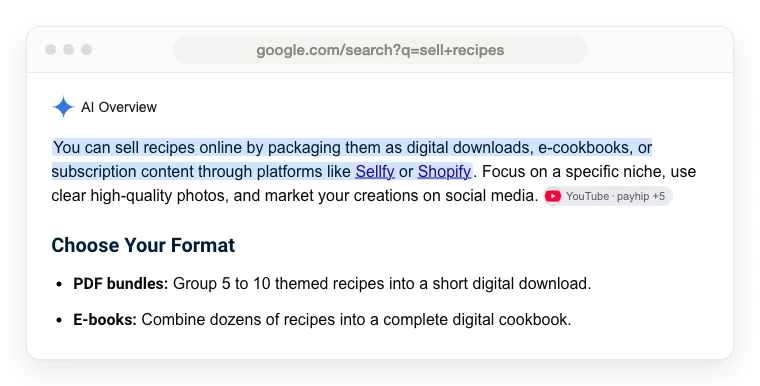
What Google recommends, and what it costs
Sellfy and Shopify are both subscription platforms, which is a strange fit for a product with a $3.80 median price. Sellfy’s own pricing page advertises “Plans From $29/mo” in its page title. Pay month to month and the entry plan is $39, because the $29 requires paying for a full year upfront. Its cheapest tier also caps you at $10,000 in sales a year.
At $3.80 a sale, after card processing you keep $3.39. A $39 monthly bill means 12 sales every month before you keep a single cent. Some sellers clear that easily. Plenty do not.
What each route keeps on a $3.80 sale
The same $3.80 sale leaves you between $2.51 and $3.39 depending on the route. Card processing of 2.9% + $0.30 is included everywhere except Etsy, which runs its own payment system at a different rate. Etsy’s numbers come from its own fees and payments policy.
On a single $3.80 sale, Gumroad takes $1.29, Etsy takes $0.61 and Payhip’s free plan takes $0.60. On a platform with no per-sale cut the sale still loses $0.41, and every cent of that is the card processor rather than the platform.
| Route | What it charges | Fee on $3.80 | You keep | Monthly cost |
|---|---|---|---|---|
| Etsy | 6.5% + 3% + $0.25 | $0.61 | $3.19 | None, but $0.20 per listing either way |
| Gumroad | 10% + $0.50, card processing on top | $1.29 | $2.51 | None |
| Payhip free plan | 5%, card processing on top | $0.60 | $3.20 | None |
| Sellfy Starter | No per-sale cut | $0.41 | $3.39 | $39, or $29 paid yearly |
| CartMango | No per-sale cut | $0.41 | $3.39 | Free until October 2026, then from $10 a year |
I should be straight with you: CartMango is my platform, which is why its row is the last one and its numbers are the same card-processing numbers as Sellfy’s rather than something magically lower.
The costs the table does not show
The table leaves out 4 costs that matter at this price.
Etsy is the only route that brings its own shoppers. Every other row means you bring all the traffic yourself. For a lot of people that alone settles it, and the fee is the price of the audience. Read the honest version of that trade in my breakdown of selling digital products on Etsy.
Etsy’s $0.20 listing fee is charged whether the item sells or not, and again every 4 months when the listing renews. List 30 separate recipe products and that is $6 every 4 months before anyone buys anything.
Etsy also runs Offsite Ads. Under $10,000 in sales over 365 days you pay 15% on orders the ads bring in, and you may opt out. Cross $10,000 and the rate drops to 12%, but in Etsy’s own words you “will be required to participate” at that rate “for the lifetime of your shop”. Drop back below the threshold later and the 12% still applies.
Gumroad’s headline of 10% + $0.50 is not the whole cost. Its own help center spells this out: the fee “does not include: Credit card processing (2.9% + $0.30)”. On a $3.80 product that stacks to 34%.
I ran the full numbers in my Gumroad pricing breakdown, and the effective rate falls as the price rises. Percentage fees hurt cheap products most, and recipes are cheap products.
Payhip charges 5% on its free plan with no monthly bill, which makes it the cheapest way to start with no upfront commitment. The Payhip pricing detail covers where the free plan stops making sense.
What changes if you charge $12
The same sale at $12 instead of $3.80 changes the picture: Etsy takes $1.39, Gumroad $2.35, Payhip $1.25, and CartMango $0.65, which is card processing only. Raise the price and Gumroad’s flat $0.50 and Etsy’s flat $0.25 stop mattering so much. That is the strongest argument for selling a real collection rather than single recipes.
Selling or licensing recipes to a restaurant or food brand
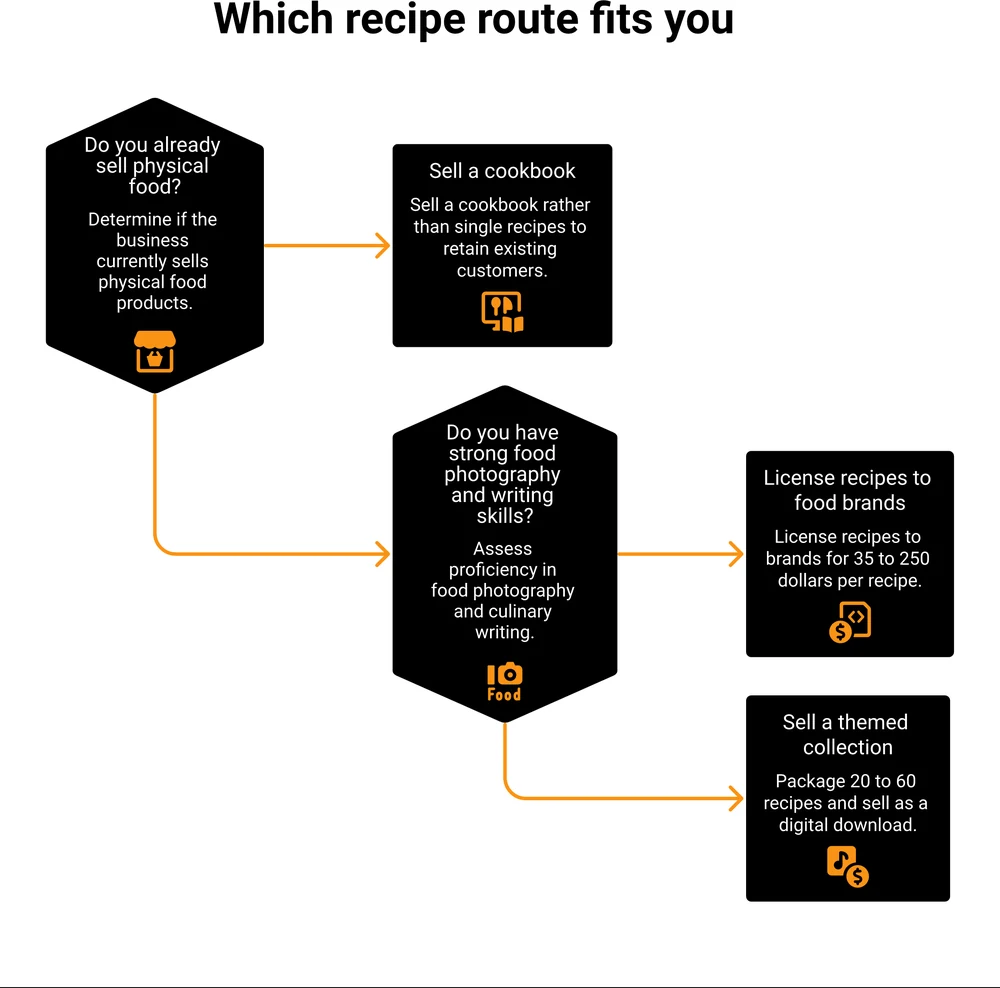
Licensing recipes to a company is the route with the real money in it, and only 1 page on Google’s first page puts numbers on it. Sellfy’s guide does have a section on selling to a food business, but it names no rates.
Jason Logsdon, writing on Dianne Jacob’s food-writing blog, publishes his real rates. He charges between $35 and $250 per recipe for a 1 year license, and lists deals he has signed:
The 3 deals he names pay wildly different amounts per recipe, and the biggest bundle paid the least.
| Deal | Total paid | Per recipe |
|---|---|---|
| 3 recipes with photos | $150 | $50 |
| 100 recipes with photos | $10,000 | $100 |
| 200 recipes with photos | $5,000 | $25 |
He also separates 2 things most people run together. Selling means the company keeps all the rights and you cannot use the work again. Licensing means you keep the rights and agree not to let anyone else use it for a set period, after which it comes back to you and can be licensed again. He licenses almost exclusively for that reason.
Who buys? In his account: kitchen equipment manufacturers wanting a recipe booklet in the box, companies wanting content for their websites and apps, and brands paying for a full cookbook released under their own name.
Note what makes this work. He is being paid for recipes plus photographs plus the written explanation, which is precisely the bundle that copyright does cover. The ingredient lists are the part he cannot sell exclusively, and no buyer is paying for those alone.
A caveat, because the page is a 2021 guest post: these are a single writer’s rates in a single niche, not a market survey. Treat the range as a starting point for what to ask, not a price list.
How you actually reach these buyers: look at the brands whose equipment or ingredients your recipes already use, find the marketing contact rather than the general inbox, and send 3 finished recipes with your own photographs attached. Let the samples argue for you. Ask for a license with a term on it rather than a flat sale, so the work comes back to you.
How to package recipes so there is something to buy
Since the formula is free to copy and the writing is not, the package is where the value sits. The formats people actually pay for:
- A themed collection. 20 to 60 recipes with a narrow promise. Narrow beats big here, always.
- A meal plan. Recipes plus a weekly schedule plus a shopping list. The planning is the work you are selling, and it is fully yours.
- A print-ready cookbook PDF. Designed, photographed, laid out. The design and photos are protected even where the recipes are not.
- A paid recipe subscription. New recipes monthly, which turns 1 sale into recurring income. Worth knowing that the same $3.80 problem does not apply, because subscribers pay repeatedly.
- Templates rather than recipes. Blank recipe cards, meal planners and cookbook templates for other people to fill in. Several of the higher-priced listings in my sample were templates, not recipes.
If a cookbook is where you are heading, we have a full walkthrough of how to make and sell an ebook, and the pricing side is covered in how to price digital products.
Should you sell recipes if you already sell the food?
Sellers who already sell the physical food get a loud “no” from other sellers on this question, and it deserves a hearing, because it is right for exactly that group.
On a thread in r/Baking, a seller running an online bakery asked whether selling their recipes would add a second income stream. The replies were near-unanimous. The most direct one:
Absolutely do not sell your recipes. You are supplying your own competition. Never sell out tomorrow for gain today.
The same commenter explained why, from the buyer’s side: they buy baked goods because their own do not turn out as well, and a one-time recipe purchase would end that habit permanently.
The top-voted reply, from a professional pastry chef, drew a sharper line. They would not sell individual recipes, but they had no problem with collecting them into a cookbook and selling that.
That distinction is the whole answer, and which side you land on comes down to what you already sell:
- You sell the physical food. Every recipe you sell teaches a customer to stop buying from you. The cookbook version is safer because it sells your voice and your curation, not the one item people queue for.
- You are a home cook, blogger or recipe developer. You have no product to cannibalise. The advice above does not apply to you at all.
Nobody on that thread was wrong. They were answering a bakery owner’s question, and most people searching for this are not bakery owners.
Getting paid and delivering the file
Whichever route you pick, 3 practical things:
Delivery has to be automatic. Emailing files by hand stops working the moment you get busy, and it fails at 2am when the buyer is awake and you are not. Every platform in the table above handles this.
Your download link will get shared. Recipes are among the easiest things to forward. Link protection stops a shared URL from working for a stranger, and it is standard on Etsy, Gumroad, Payhip, Sellfy and CartMango. It will not stop somebody retyping your recipes, and now you know the copyright reason why. My guide to protecting digital downloads covers what each method really achieves.
You do not need a website. Etsy, Gumroad, Payhip, Sellfy and CartMango all host a page you can send people to. If a site of your own feels like the blocker, it is not one, and I cover the whole path in selling digital products without a website.
Start with 1 collection rather than 30 single recipes. It costs less in listing fees, it survives the price comparison better, and it is a lot easier to explain.
FAQ
Can I make money selling recipes?
Yes, though the amounts differ hugely by route. Digital downloads are a low-price market: the median recipe ebook on Etsy asks $3.80, so income comes from volume or from a much better package than average. Licensing recipes to food brands pays $35 to $250 per recipe in published rates, which is why people with photography and food-writing skills lean that way.
Where can I sell my recipes and how do I start?
4 realistic places. Etsy brings you shoppers and charges 6.5% plus 3% + $0.25 plus a $0.20 listing fee. Gumroad, Payhip and CartMango let you sell direct, with no marketplace audience attached.
Licensing means pitching food brands and equipment makers directly rather than listing anywhere. Start by picking 1 narrow theme and building a single collection to sell.
Can you copyright a recipe?
Not the recipe itself. The US Copyright Office states that a mere listing of ingredients or a simple set of directions is uncopyrightable and cannot be registered. Your creative explanation of the process, your headnotes and your photographs can be protected. In practice that means anybody may copy your ingredient list, and copying your written text or images is a different matter.
Can I sell home cooked meals from my house?
That is a different question with a different answer, and it sits outside what this guide covers. Selling the food itself is governed by cottage food laws that vary by US state and by country, usually covering which foods qualify, kitchen inspection and labeling. Selling recipes is an intellectual property question, while selling meals is a food safety one. Check your state or local health department before you cook to sell.
What is the easiest food product to sell?
If you mean physical food, that depends on your local cottage food rules, so start there. If you mean the easiest recipe product to sell, it is a themed collection aimed at a specific person with a specific problem. Narrow themes sell better than large general bundles, which is the reverse of what the $2 mega-bundles on Etsy would suggest.
What decides whether you can sell recipes profitably
The recipe you cannot own is still the easy half. What decides the outcome is the number sitting next to it: $3.80 a sale, minus whatever the platform takes.
At that price you have 2 levers. Charge more by selling a collection with a promise attached, and earn more from each buyer who is already checking out. A bundled second product, a bigger version offered at the moment of purchase, an add-on the buyer never had to go looking for. That is the whole job CartMango was built to do, and it costs nothing until October 2026, then $10 a year.
About the Author

👋 I’m Welly, founder of CartMango (the site you’re on), a checkout platform for digital product sellers. We’ve previously processed $179M+. I also run BirdSend (email marketing tool, 3.1B+ emails sent). On the side I show other non-techie digital sellers how I use AI workflows to automate 50%+ of my operations. Find me on LinkedIn.
Related Reading
- How to sell PDFs: the same net-payout math for worksheets, guides and workbooks, handy if you sell recipes as PDFs
- Competitors of Etsy: 15 places to sell besides Etsy, with real fees for each
- Platforms to sell ebooks: where a finished cookbook can live once you have written it
- Best Gumroad alternative: for readers ready to compare checkout tools properly