
To sell embroidery designs online, digitize each design in embroidery software, export it in the main machine formats (PES, DST, JEF, EXP, VP3 and XXX) in several hoop sizes, stitch-test it, then sell the files on Etsy, a curated embroidery shop or your own checkout. Hand embroidery patterns sell as printable PDFs.
On Etsy’s first 2 pages, machine embroidery files had a median price of $3.99 and hand embroidery PDFs $6.91. After fees, a $3.99 file leaves you $3.16 on Etsy (9.5% + $0.45), $2.68 on Gumroad (10% + $0.50), $3.37 on Payhip’s free plan (5%) and $3.57 on CartMango, which I run (0%, free right now, from $10 a year once paid plans start in November).
I read every listing on Etsy’s first 2 pages for “machine embroidery design”. 115 of them. 7 were bundles claiming 1,000 designs or more, and the biggest promised 1 million designs for $5.28.
92 of the 107 file listings also showed a crossed-out “original” price, at a median of 50% off.
So this guide does 2 jobs. It covers the file itself: the formats buyers need, the test stitch-out, and a price that holds up on Etsy.
Then it takes 14 places a new seller gets pointed to, 12 named by Google and Reddit plus 2 checkouts, and cuts them down to the 6 worth your files.
Key Takeaways
- On Etsy, zip every format together. Etsy accepts embroidery files only inside a ZIP, up to 5 files of 20MB each per listing.
- Show a real stitch-out, the design stitched on fabric. Creative Fabrica asks designers for that photo, and a commenter on r/Machine_Embroidery called mockups suspicious.
- The going price is low. Machine embroidery files on Etsy’s first 2 pages had a median price of $3.99, hand embroidery PDFs $6.91.
- 8 of the 14 usual places drop out. They cannot sell a download, give new sellers no normal shop, or keep a quarter of a sale.
- Fees bite hardest on cheap files. On a $3.99 file you keep $3.16 on Etsy, $2.00 on Creative Market and $3.57 on CartMango.
How to sell embroidery designs online, starting with the file
Selling embroidery designs online means selling 1 of 2 different products. Machine embroidery designs are stitch files made by digitizing, which means turning artwork into instructions that tell an embroidery machine where every stitch goes. Hand embroidery patterns are printable PDFs, usually a line drawing plus a stitch guide.
New to selling files of any kind? The setup mistakes that cost first-time sellers money have nothing to do with thread, and the Online Selling Mistakes Challenge walks through 5 of them over 5 days, free.
Most of this guide is about machine files, because they come with the extra work: formats, hoop sizes and testing. Hand pattern sellers can skip straight to pricing and where to sell.
Digitizing the design
Digitizing happens in embroidery software. Hatch, the company behind the top-ranking page for this search, sells a digitizing program. Ink/Stitch is a free option, built “entirely on free, open-source software”, according to its own site. Hatch’s page lists auto-digitizing among its features, which converts a picture into stitches automatically. Treat that output as a first draft. Oregon Patchworks, a curated embroidery shop, says it looks for “high quality manually digitized designs”. A commenter on r/Machine_Embroidery complained about sellers “who use free programs to create designs with no experience and experiment with their customers’ machines.”
The formats buyers’ machines read
Each machine brand reads its own file format, so 1 design has to be exported several times. The brands below come from the EduTech Wiki format list, and the export column from Ink/Stitch’s file formats page.
Brother and Baby Lock machines read PES, Janome reads JEF and Tajima reads DST, and the free tool Ink/Stitch can export 6 of these 7 formats, all except HUS.
| Format | Made for | Ink/Stitch can export it |
|---|---|---|
| PES | Brother, Baby Lock | Yes |
| DST | Tajima | Yes |
| JEF | Janome | Yes |
| EXP | Melco, high-end Bernina models | Yes |
| VP3 | newer Pfaff machines | Yes |
| HUS | Husqvarna Viking | No, it can only open HUS files |
| XXX | Singer, Compucon | Yes |
Sellers also export each design in several sizes so it fits common hoops. Of the 107 Etsy file listings I read, 24 named hoop sizes or a size count in the title, things like “4×4 5×7” and “5 sizes”. 31 named their formats.
Then package it to the platform’s rules, which do not agree with each other. Etsy’s digital listing rules allow up to 5 files per listing at 20MB each. Its list of supported file types includes .zip but no embroidery formats, so on Etsy every format goes inside a ZIP.
Creative Fabrica’s embroidery guidelines say you can skip the ZIP: “You do not need to compress folders into a ZIP.” It asks for the files plus 1 PDF with the sizes, the total stitch count and an image of the stitching.
Before you list: stitch it out, then price it against Etsy
A machine embroidery design is only finished once it has been stitched on real fabric, which sellers call a stitch-out. A file can look fine on screen and still stitch badly. Google’s AI Overview for this search warns that automatic digitizing “often creates excess jump stitches or tension errors that need manual cleanup.”
Some buyers check for it. On a r/Machine_Embroidery thread where a new seller asked why their Etsy designs were not selling, a reply put it simply: “A digitized design is only as good as it stitches.” Another commenter said listings that use obvious mockups make them suspicious. Creative Fabrica’s guidelines tell designers to “Include a high-quality photo of the actual stitched-out product to build customer trust.” Oregon Patchworks asks applicants which machines their designs were tested on.
So stitch every design once, photograph it in good light, and make that photo the first image. A short stitch-out video helps too, and the seller who started that thread said they try to include one in every listing. In the title, name the design, the formats and the hoop sizes, the way 24 of the 107 listings counted above do. The same AI Overview adds a fair point: say clearly in the listing “that it is a digital file, not a physical item.”
What embroidery designs sell for on Etsy
I counted every listing on Etsy’s first 2 pages of results for 2 searches, 225 listings in all, and every price was in US dollars. The median is the middle price when all the prices are lined up. Machine embroidery files had a median price of $3.99 there, against $6.91 for hand embroidery PDFs.
| Search | Files read | Median price | Single designs | Bundles | Showing a “sale” |
|---|---|---|---|---|---|
| machine embroidery design | 107 | $3.99 | $3.79 | $5.80 | 92 of 107 |
| hand embroidery pattern pdf | 109 | $6.91 | $5.63 | $11.68 | 69 of 109 |
The machine search also returned 8 listings that were not design files at all: 6 custom digitizing services priced from $0.50 to $2.00, 1 software licence and 1 USB stick of “150,000+” designs.
- The sale price is the real price. 92 of the 107 machine file listings showed a crossed-out “original” price, at a median 50% off. At the medians, that is a $7.98 tag crossed out to $3.99. Pricing a single design at $8 with no sale running puts you at twice the going rate.
- You cannot win on volume. 7 listings claimed 1,000 designs or more: 2,000 for $1.97, 2,700 for $1.23, 4,500 for $2.70, 10,000 for $4.40, 30,000 for $2.70, 800,000 for $14.99 and “1 Million+” for $5.28. A person who digitizes and tests their own designs cannot make a million of them, so do not price against those listings.
- Hand patterns hold their price better. The hand embroidery PDF median sat at $6.91, and fewer than 2 in 5 were under $5, against 2 in 3 for machine files.
What this means for your pricing: a single tested machine design sits at $3 to $5 on Etsy, and bundles earn more per sale, at a median of $5.80. Crochet patterns sell in the same range, with a median of $3.84 in the price study in our guide on how to sell crochet patterns. For the thinking behind a price that is more than a copy of the going rate, see how to price digital products.
The 14 places Google and Reddit point you to
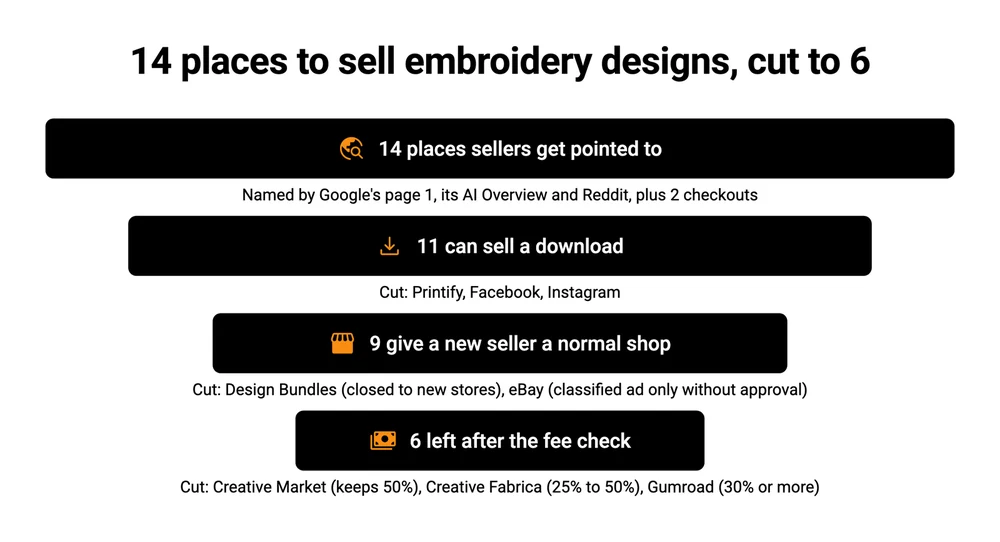
Google’s first page, its AI Overview and the top Reddit thread on this search name 12 places to sell embroidery designs. I added 2 checkout tools that sell files directly, which makes 14.
- Named by Hatch’s blog, the top-ranking page: Etsy, Instagram, Facebook Marketplace and Shops, eBay, Shopify and Creative Market.
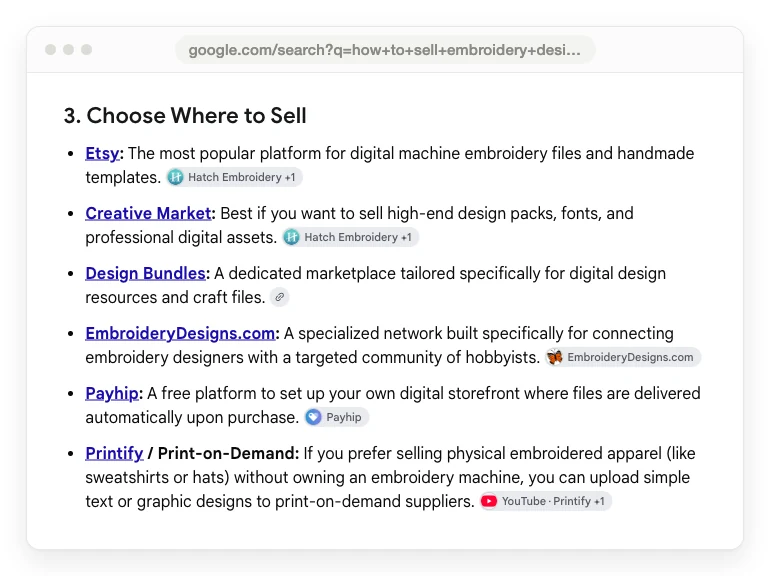
- Added by Google’s AI Overview: Design Bundles, EmbroideryDesigns.com, Payhip and Printify.
- Added by commenters on the Reddit thread: Creative Fabrica and Oregon Patchworks.
- The 2 I added: Gumroad and CartMango. I run CartMango, so weigh its place on this list with that in mind. It is a checkout with no marketplace of its own.
Hatch’s post names 6 channels without a single fee. None of the ranking pages I could read compares what each of these 14 keeps from a sale, or checks which ones will take a new seller. The 3 cuts below do both, using each platform’s own pages.
Cut 1: drop anything that cannot sell a download
Printify, Facebook and Instagram cannot sell an embroidery file at all, which leaves 11.
Printify is print-on-demand for physical goods. Google’s own AI Overview lists it as the route for people who “prefer selling physical embroidered apparel”, which is a different business from selling files. Facebook and Instagram are ruled out by Meta’s own rules. Meta’s Commerce Policies cover Facebook Marketplace and Shops on Facebook and Instagram. They say commerce content may not promote buying or selling “downloadable digital content”. Both still work for sending followers to a shop somewhere else, as our guide to selling digital products on Instagram shows.
Cut 2: drop anything that will not give a new seller a normal shop
Design Bundles and eBay will not give a new seller a normal shop, which leaves 9.
Design Bundles is where Google’s AI Overview for this exact search sends you, calling it a dedicated marketplace “for digital design resources and craft files”, and a ranking embroidery blog says it has a section for embroidery files.
Design Bundles’ own help center says otherwise. Its help center article on opening a store says “as of now, we are not accepting new store applications”, and that “we do not have plans to open applications for the foreseeable future.” A new seller who follows Google’s advice here gets nowhere.
eBay gives a new seller only a classified ad. Its electronically delivered items policy says these goods “can only be listed by eBay approved sellers”. Sellers without that approval list in “Everything Else > Information Products” “in the classified ad format”.
Cut 3: drop anything that keeps a quarter of a $3.99 file
Creative Market, Creative Fabrica and Gumroad each keep a quarter or more of a $3.99 file, counting card fees, which leaves 6. I used $3.99 because it is the median price from the Etsy sample above, and I could only test the places that publish a per-sale rate.
On a $3.99 machine embroidery file, Creative Market and Creative Fabrica’s own marketplace sales each take $1.99 and Gumroad takes $1.31 on a direct sale, while CartMango takes nothing and the card processing fee is $0.42.
| Where | What it takes | Fees per sale | You keep |
|---|---|---|---|
| Creative Market | 50% of list price, card fees included | $1.99 | $2.00 |
| Creative Fabrica, a sale it brings in | 50%, plus any card fees | $1.99 | $2.00 |
| Creative Fabrica, a sale you bring in | 25%, plus any card fees | $1.00 | $2.99 |
| Gumroad, direct sale | 10% + $0.50, plus card fees 2.9% + $0.30 | $1.31 | $2.68 |
| Etsy | $0.20 listing renewal, 6.5%, 3% + $0.25 | $0.83 | $3.16 |
| Payhip free plan | 5%, plus card processing 2.9% + $0.30 on Stripe | $0.62 | $3.37 |
| CartMango | 0% per sale, plus card processing 2.9% + $0.30 on Stripe | $0.42 | $3.57 |
These are per-sale figures. CartMango also has a yearly plan from November, $10 to $30, which at 30 sales a month adds about $0.03 to $0.08 a sale. Gumroad and Payhip’s free plan have no yearly fee.
Creative Market’s help center says “By default, shops will earn 50% of their list price for each sale”, noting rates vary by shop. Creative Fabrica’s seller page offers “75% for sales you refer, 50% for sales we refer”, plus a share when its subscribers download your files. So even on a sale you send it yourself, Creative Fabrica keeps exactly a quarter.
Gumroad’s pricing page lists 10% + $0.50 on direct sales. Its fee help article adds that card processing of 2.9% + $0.30 is not included. Discover, Gumroad’s own marketplace, takes a flat 30% with card fees included, so on a $3.99 file a Discover sale leaves $2.79, more than a direct sale does. Price matters here: on a $10 file, Gumroad’s direct fees come to 21%, under the line.
Etsy passes this cut on an ordinary sale, keeping 21%. Its fees policy charges $0.20 per listing, renewed “at $0.20 after each of the items sells”, plus a 6.5% transaction fee. Its payments policy sets US card processing at “3% + 0.25 USD”.
A sale that an Offsite Ad brings in costs another 15%. Offsite Ads are ads Etsy buys for your listings on other websites, and that 15% leaves you $2.56 of a $3.99 file, less than a direct Gumroad sale. Etsy stays on the list because an ordinary sale passes this cut, and shops under $10,000 in yearly sales can opt out of the ads. Bigger shops pay 12% with no opt-out. Our guide to Etsy for digital products covers the rest of Etsy’s fees.
If Gumroad was on your list, our roundup of Gumroad alternatives compares 7 options.
The 6 that are left, and who each one suits
6 places survive the 3 cuts, and they split by who finds the buyer: Etsy’s search finds them on Etsy, 2 curated embroidery shops bring them once you are accepted, and on Shopify, Payhip and CartMango you find them yourself.
| Option | Who brings the buyer | Cost on a $3.99 file | What it still does not do |
|---|---|---|---|
| Etsy | Etsy search | $0.83, plus 15% on Offsite Ads sales | accept raw .pes files, ZIP only |
| EmbroideryDesigns.com | Its shop, after an application | “Competitive royalty”, no figure on its seller page | show the royalty before you apply |
| Oregon Patchworks | Its shop, after an application | No figure on its store page | accept you without 10 or more sample designs |
| Shopify | You | A monthly plan, plus card fees | deliver files without its free Digital Products app |
| Payhip | You | $0.62 on the free plan, card processing included | bring you buyers |
| CartMango | You | $0.42 card processing fee, nothing to CartMango, plus $10 to $30 a year from November | bring you buyers, there is no marketplace |
CartMango fits the seller who already has people to send: CartMango takes 0% of each sale and is free right now, then from November costs $10 a year for up to 10 products, $20 for 25 or $30 for unlimited. A catalog of single designs outgrows CartMango’s 10-product tier fast, so plan on $20 or $30, or sell in themed sets.
EmbroideryDesigns.com and Oregon Patchworks passed Cut 3 only because their seller pages show no split to test, and Shopify charges a monthly plan, which this cut does not measure. The split is the share of each sale you keep, so ask the 2 curated shops for theirs before you send work. Shopify cannot deliver a file on its own, so it needs Shopify’s free Digital Products app, a setup our guide to selling digital products on Shopify walks through.
Which one should you start with? The curated shops want proof first. Oregon Patchworks’ store page asks for “10 or more sample designs” with a PES file and a color chart for each. EmbroideryDesigns.com’s seller page promises “competitive royalty percentages” and no setup or listing fees, but its application sits behind an account login.
A sensible order for a new seller:
- Open an Etsy shop, because buyers already search there and the fees are fixed and published.
- Build up 10 or more tested designs with real stitch-out photos.
- Ask EmbroideryDesigns.com or Oregon Patchworks for their split, then apply with that body of work.
- Once people follow you, send them to your own checkout, where Payhip and CartMango both leave more of each $3.99 sale with you than Etsy does, before CartMango’s yearly plan.
The own-checkout route only pays if you bring the buyers. Commenters in the Reddit thread name the usual ways: a Facebook page or group, free design giveaways in groups such as “FREE MACHINE EMBROIDERY Design Links”, design hops, where digitizers promote each other’s groups, and a presence on Instagram and TikTok.
Who owns the design you are selling
Digitizing something you do not own can cost you the whole shop. Etsy’s intellectual property policy says it “terminates selling privileges of members who are subject to repeat or multiple notices of intellectual property infringement in appropriate circumstances and at Etsy’s discretion.” Its digital listing rules also say digital items “must be made and/or designed by you, the seller.”
That risk is already on page 1. 6 of the 115 machine embroidery listings I read named or pointed at characters, teams or books owned by someone else. They included a Disney bundle, a Grinch design, 2 sets of 32 football teams and a “Princess Inspired” castle with a mouse-head outline. The seller who started the Reddit thread said it is “so difficult to break through and compete against the people selling 5,000 copyright infringing designs.”
Then decide what your buyers may do with your file, and say it in every listing. Embroidery Library, a large design shop, publishes its licence terms, and they make a useful model. Its buyers may sell items they stitch “at craft shows, craft fairs or through personal or peer-to-peer e-commerce websites”. They may not use the designs “for mass production or factory production”, and may never resell or share “the Design files”. On Creative Fabrica the choice is made for you. Its product guidelines say “Do not include your own licensing files or info,” because every product falls under its own licence.
Copying is a real cost even with good terms. A Reddit commenter warned that “People buy your designs for $3, rip them off and re-sell them on etsy or their own subscription model store.” Protected download links stop casual link sharing, though not a buyer who copies the file itself. Our guide to protecting digital downloads covers 8 ways to make sharing harder.
Why a lower price loses to the 1 million-design bundle
Price cutting is already the norm on Etsy’s first 2 pages. 92 of the 107 file listings show a sale price, and the cheapest bundles sell thousands of designs for less than $3. Dropping a single tested design from $3.99 to $1.99 on Etsy cuts what you keep from $3.16 to $1.35. More than half gone, and the bundle sellers are still cheaper.
The 2 seller results in this research sit at opposite ends, and they are only 2 anecdotes. The show notes for episode 208 of the How to Sell Your Stuff on Etsy podcast say embroidery designer Lori Thompson’s shop passed 3,500 sales in 3 years of selling embroidery files on Etsy. They credit social media, including 1 viral TikTok video, for a big spike in sales. In the same Reddit thread, a seller of rhinestone designs said they had “sold about 6 things in 2 years” on Etsy. Another commenter there put the pattern plainly: “The most successful embroidery digitizers have a cult-like following they acquired using social media.”
So keep your price in the normal range and put a real stitch-out first in every listing. Spend the hours you would have spent cutting prices on social media and the groups where machine embroiderers swap designs, finding people who will buy your next design too.
FAQ
Is selling embroidery designs profitable?
Each sale is small. At Etsy’s $3.99 median you keep $3.16 a sale, so $100 a month takes about 32 sales. Through CartMango the same $100 takes about 28 sales before its yearly plan, and through Payhip’s free plan about 30, but there you bring every buyer yourself. The 2 results in this research are far apart: an embroidery shop with over 3,500 sales in 3 years, and a rhinestone designer with about 6 sales in 2 years.
Where can I sell my embroidery designs?
Etsy is the open marketplace with built-in buyers. EmbroideryDesigns.com and Oregon Patchworks take embroidery designers by application, and Creative Fabrica does too, though it keeps half of the sales it brings you. To sell directly to your own followers, a checkout like Payhip or CartMango delivers the files after payment. Skip Design Bundles, whose help center says it is not accepting new store applications.
What embroidery designs sell the most?
Seasonal designs led the sample I read: 43 of the 107 machine file listings on Etsy’s first 2 pages were Christmas or holiday designs. Next came floral designs (17), Halloween, fall and gothic themes (16), applique (14), fonts and monograms (12), free-standing lace (FSL) pieces (13) and in-the-hoop (ITH) projects such as key fobs and bookmarks (9).
Does embroidery sell well on Etsy?
Embroidery files sell on Etsy at low prices against a crowd. The median machine file on Etsy’s first 2 pages was $3.99, 92 of 107 file listings showed a sale price, and 7 were bundles of 1,000 designs or more. A shop in this research with over 3,500 Etsy sales credits social media for a big spike in sales.
How do I find embroidery clients?
Many people asking this mean custom digitizing, turning a customer’s logo into a stitch file. Etsy’s first 2 pages carried 6 digitizing services with starting prices from $0.50 to $2.00, so custom work listed there competes with those prices. Outside Etsy, start with people who already need a logo stitched, such as local businesses, sports teams and schools, and show them a real stitch-out of your work.
What are some profitable things I can embroider to make money?
Hats, towels, apparel and home decor are the usual finished items, but stitched goods are a different business with materials and shipping. This guide covers selling the design files. In-the-hoop projects bridge the 2, because 1 file can be sold as a download and also stitched into a product to sell.
Do I need to zip my embroidery files?
On Etsy, yes. Etsy accepts up to 5 files of 20MB each, and its supported file types include .zip but no embroidery formats. Creative Fabrica says you can skip the ZIP and upload the files directly. On your own checkout, 1 ZIP per design is the simplest download for a buyer.
When people come to you for the next design
If you are still working out how to sell embroidery designs online, start with the file and the stitch-out, then pick the shop. Selling gets easier once buyers know your name, and a follower who trusts your stitch-outs does not need Etsy’s search to find you.
For those buyers, CartMango gives you a checkout that takes 0% of each sale, delivers the ZIP through a protected download link, and lets you add an order bump at checkout, such as the matching alphabet. CartMango is free right now, and paid plans start in November at $10 to $30 a year.
About the Author

👋 I’m Welly, founder of CartMango (the site you’re on), a checkout platform for digital product sellers. We’ve previously processed $179M+. I also run BirdSend (email marketing tool, 3.1B+ emails sent). On the side I show other non-techie digital sellers how I use AI workflows to automate 50%+ of my operations. Find me on LinkedIn.
Related Reading
- How to sell crochet patterns: 191 Etsy listings priced and every platform fee read at the source
- Etsy for digital products: what you keep after Etsy’s fees on a cheap file
- How to sell clipart: marketplace versus own-checkout fee math for small design files
- Protect digital downloads: 8 ways to make file sharing harder
- Best Gumroad alternative: 7 options for selling files directly