

You can sell resume templates 2 ways: on a marketplace like Etsy or Creative Market, which brings you buyers, or through your own checkout, which does not. Fees decide the rest. On a $5 sale, Creative Market leaves you $2.50, Gumroad $3.55, Etsy $4.07 and CartMango $4.55.
Nobody tells you what a resume template actually sells for before you spend a weekend designing one. The number is lower than you would guess, and the fees stacked on top of it vary far more than page 1 of Google admits.
My first business was putting on motivational seminars. We started selling speaker training into companies and got nothing back. No sign-ups at all, with speakers everybody had heard of.
We were pitching companies that could not afford what we were asking. Once we only approached the ones with the budget, sales started. Who we aimed at decided everything, and the product never changed.
Resume templates punish the same mistake, because most of them are aimed at everybody and sit next to free ones. So here is what they sell for, what each route leaves you, and which fee numbers on page 1 are wrong.
Key Takeaways
- The median asking price for a resume template on Etsy’s first page is $5, and 56 of 64 listings sit under $10.
- Etsy charges 6.5%, not the 5% a top-ranking guide for this search still quotes.
- Creative Market and Envato both take exactly half of every sale, nearly 3 times what Etsy takes at the $5 median.
- Fixed fees hurt most on cheap products. Gumroad takes 29% of a $5 sale, more than Etsy’s 18.6%, because $0.80 of it never shrinks.
- Design Bundles, recommended by a page-1 guide, is not accepting new store applications at all right now.
What a resume template actually sells for
The median asking price for a resume template on Etsy’s first page is $5.
I pulled every listing on that page and read the current price off each one. 64 listings, 1 price each, sorted.
The middle of the pack sits between $4.99 and $5.00. A quarter of the page asks $2.81 or less, and 3 quarters ask $7.49 or less.
Only 8 of those 64 are priced above $10, and the highest is a $4,999 company licence unlike anything else on the page. So the working number here is $5, not the $12 to $25 most advice implies.
A second number matters more, and no guide on the first page of Google mentions it. 42 of those 64 listings were showing a marked-down price, and the average discount was 54% off the stated original. 2 thirds of your competition is permanently on sale, at roughly half of its own list price.
Want the short version of what usually goes wrong before any of this matters? The free 5-day Online Selling Mistakes Challenge walks through the 5 mistakes that cost solo sellers the most.
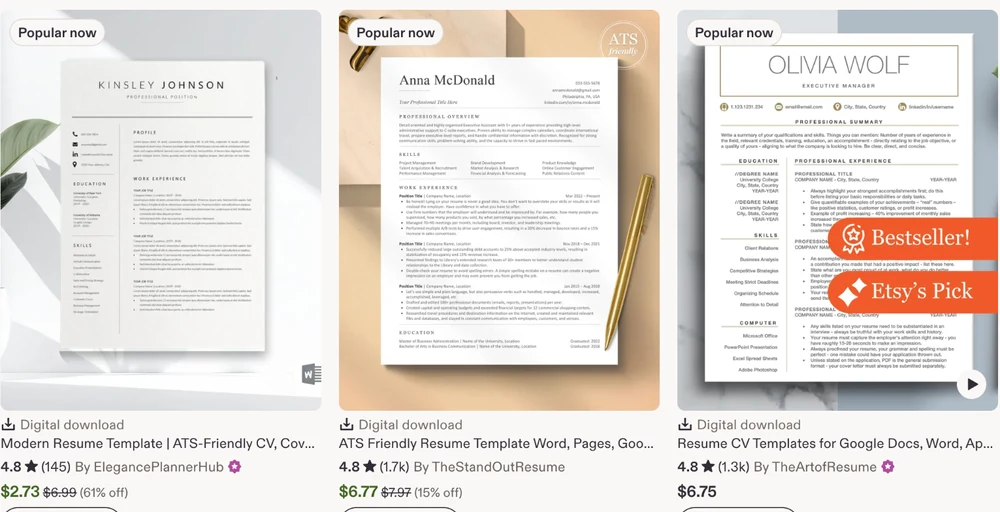
Those discounts change how you price. If you list at $12 and never discount, you are the most expensive thing on a page where the buyer can see “61% off” on the listing next to yours.
The sellers doing well here compete on being findable and on giving the buyer something the $2.99 listings do not.
How much sellers actually make
Ana Colak-Fustin, a former recruiter who runs the Etsy shop ByRecruiters, has made over $70,000 in revenue selling resume templates, and she told Business Insider how long it took.
Her first 15 months produced $4,000. That is about $267 a month, running on Etsy’s algorithm alone. She describes that stretch plainly as a sign she needed to change something.
What changed was Pinterest. She started using it to drive traffic into her Etsy shop, and it now accounts for 35% of her traffic. Pins she made 4 years ago still bring people in. She did not quit her HR job until the shop averaged $2,000 a month.
Read 2 things carefully in those numbers. The first is that $70,000 is revenue, not profit, spread across roughly 6 years, and Etsy’s cut plus her ad spend comes out of it.
The second is how uneven the growth was. Nothing much happened for over a year, then an outside traffic source changed the business.
She also says she now sells resume templates directly from her own website, alongside her Etsy shop.
She only makes new templates 2 or 3 times a year. This is not a volume game.
The early-stage view looks similar from the inside. A seller posting in r/EtsySellers reported 44 active resume-template listings and 107 total sales after 6 months, with a conversion rate around 6% and monthly views in the low-to-mid hundreds.
Their own read was that conversion was fine and traffic was the ceiling. The replies pushed back on something else: the templates “look like every other resume template on offer, including free templates on Canva”. That is the actual competition, and it is free.
Where to sell resume templates, and what each route keeps
On a $5 sale, Creative Market and Envato each take $2.50, Gumroad takes $1.45, Etsy takes $0.93, and CartMango takes $0.45, which is the card processing and nothing else.
| Where you sell | Platform cut | Card processing | You keep on $5 | You keep on $15 |
|---|---|---|---|---|
| Creative Market | 50% of list price | included in the 50% | $2.50 | $7.50 |
| Envato (GraphicRiver) | 50% author fee | included | $2.50 | $7.50 |
| Gumroad | 10% + $0.50 | 2.9% + $0.30 on top | $3.55 | $12.26 |
| Etsy | 6.5% + $0.20 listing fee | 3% + $0.25 | $4.07 | $13.12 |
| Payhip (free plan) | 5% | 2.9% + $0.30 on top | $4.30 | $13.51 |
| CartMango | no per-sale platform fee | 2.9% + $0.30 on top | $4.55 | $14.26 |
I should say plainly that CartMango is mine, so read that bottom row with that in mind. CartMango is free until October 2026 and starts at $10 a year after that, and CartMango takes no cut of a sale.
Every other rate above was read at the platform’s own pricing or policy page while writing this. Watch the middle column, because the routes are not measured the same way.
Creative Market says outright that it covers the card processing out of its half. Etsy, Gumroad, Payhip and CartMango all sit on top of a separate processing fee, so a headline percentage on those 4 is never the whole cost.
Envato needs 1 extra note. Its 50% comes off the item price you set, and then Envato adds a separate buyer fee on top of that price, so the buyer pays more than your listed figure and your share of what they actually paid is under half. Envato’s own worked example also deducts withholding tax from the author’s share.
Another page-1 recommendation is not available at all right now. Design Bundles, listed as a top-5 platform by the guide ranking fifth for this search, says on its own seller signup page: “At the moment, we are not in the process of accepting new store applications.” You cannot open a shop there today no matter how good your templates are.
Why the option with no monthly fee costs more than Etsy at $5
Gumroad takes 29% of a $5 sale. Etsy takes 18.6% of the same sale.
That result surprises most people, because Gumroad charges no monthly fee and nothing to list, while Etsy charges $0.20 for every listing and runs a marketplace on top. The reason is the fixed part of the fee.
Gumroad’s cut is 10% plus a flat $0.50, and card processing adds another flat $0.30 on top of its 2.9%. That $0.80 does not shrink when your product is cheap, so on a $5 sale the flat fees alone come to 16% before a single percentage applies. Our Gumroad pricing breakdown goes through the full stack.
Raise the price to $15 and Gumroad’s take drops to 18.3%. Percentages scale with your price and flat fees do not, so on a cheap product the flat fees are the first thing to check.
The honest part: Etsy’s cut buys you something
The gap between Etsy and your own checkout on a $5 sale is $0.48.
That is the whole difference, and a fee table on its own makes the own-checkout column look more obvious than it really is.
Etsy has buyers already searching for resume templates. Your own checkout has nobody until you bring them.
On 100 sales the fee saving is $48. If Etsy would have found you even 12 extra buyers at $5 across those same 100, Etsy wins outright.
The comparison worth more of your attention sits between the marketplaces themselves. Creative Market and Envato take nearly 3 times what Etsy takes on a $5 sale, and about 4 times as much on a $15 one, without obviously bringing 3 times the buyers.
Most of the money leaks there. If you want a wider view of the marketplace options, we compared Etsy alternatives by category.
Ana’s route is the one that worked for her: earn the traffic somewhere you control, like Pinterest, then decide where the checkout lives. Selling digital products on Etsy and selling direct are not a choice you have to make once.
The fee numbers most guides get wrong
3 of the platform fees quoted by the guide ranking fifth for this search do not match what those platforms currently publish.
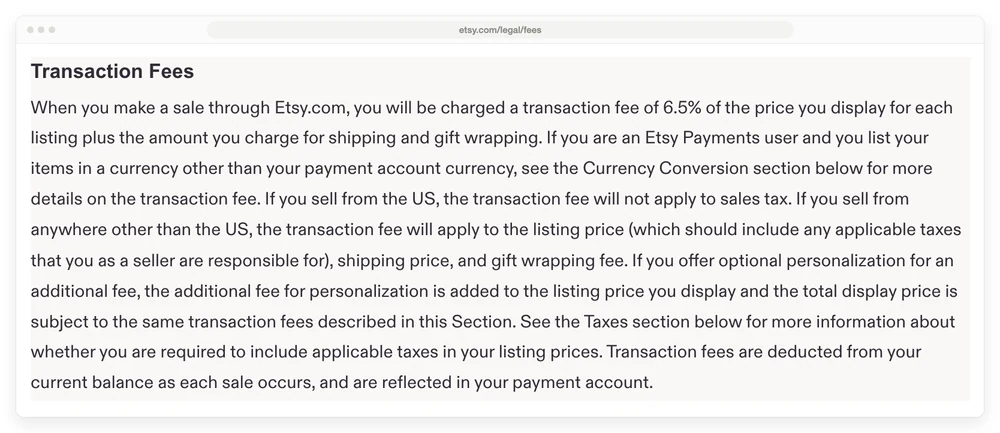
Etsy is 6.5%, not 5%. The guide states Etsy “deduct a 5% transaction fee from the total sale price”. Etsy’s own Fees and Payments Policy reads: “you will be charged a transaction fee of 6.5% of the price you display for each listing”. Etsy raised it from 5% in April 2022.
Creative Market’s default split is 50/50. The guide says Creative Market “takes a 50%-70% commission fee on each sale”. Creative Market’s own help centre says: “By default, shops will earn 50% of their list price for each sale”, with a note that rates vary by shop and product. Half is a lot, and it is not 70%.
Envato’s exclusivity tiers are gone. The guide describes GraphicRiver author fees ranging from 55% to 37% for non-exclusive authors and 70% to 37% for exclusive ones. Envato’s author help centre now states a single rule: “Envato charges an Author Fee of 50%.” The rate is flat and the exclusivity choice is gone.
Take that as a warning about fee pages rather than about the author, who is a genuinely successful seller. The same person quotes 6.5% correctly in her Business Insider interview while her own guide still says 5%.
Platform fees change faster than anyone updates a blog post. Read the fee at the platform’s own policy page on the day you set your price.
Can you legally sell a resume template you designed?
Yes, if the design is yours and every asset inside it is licensed for you to hand over. In practice the fonts are what trip sellers up.
A resume template is an editable file, so your buyer needs the fonts to open it looking right. You either build with fonts the buyer already has, or you pass the font file along. Passing the file along is a separate permission from using the font yourself.
Fonts under the SIL Open Font License are the safe path. Its own summary states you can “freely modify and redistribute OFL fonts”, which is exactly the permission a template needs.
For any other font, answer 1 question before you list: does its licence let you give the file to a stranger who paid you $5? The answer lives in the licence you agreed to when you bought it.
Canva has its own rules and they catch people out. Canva’s Content License Agreement licenses Pro content for use in a single design and states: “You may not copy, download or distribute the Pro Content as a standalone item.” If your template leans on Pro elements, read our full guide to how to sell Canva templates before you list anything.
The simplest way to avoid all of it is to design from scratch with open-licence fonts and your own layout. That is also what makes the template yours to sell on any platform you like.
What makes a resume template sell
Buyers search for “ATS friendly” more than they search for “beautiful”, and almost no guide explains why.
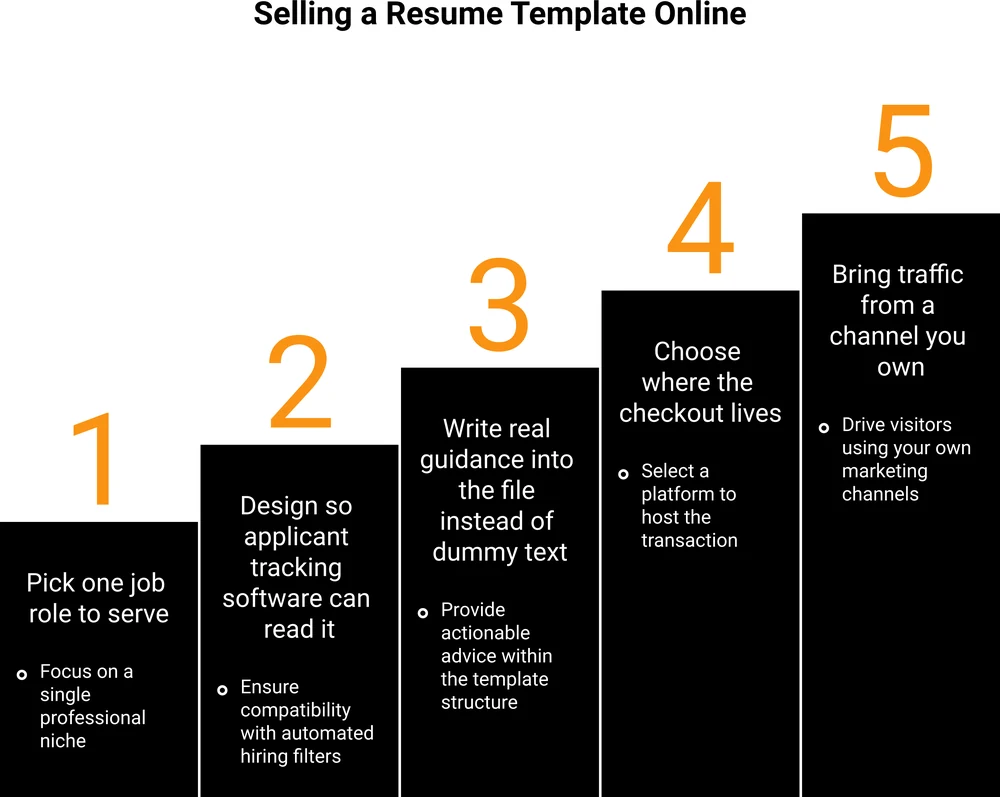
An applicant tracking system is the software an employer uses to read incoming resumes before a person sees them. Heavily designed templates break it.
Text inside a graphic, 2-column layouts, tables, headers and text boxes can all come back scrambled or missing to the system doing the reading. A buyer who gets rejected silently blames your template.
So the design brief is narrower than it looks. Single column, real text rather than images of text, standard section headings, no critical information trapped in a sidebar. Then say so in your listing title, because that phrase is what the buyer types.
The second thing is what goes inside the file. Ana’s stated differentiator is that her templates carry no “lorem ipsum”.
Where the dummy text would go, she puts guidance that walks the buyer through writing that section. Her HR background is the product and the template is how it gets delivered, which is very hard for a $2.99 competitor to copy.
Third, pick a job rather than a look. This is the same mistake I made with the seminars, in template form: “Modern resume template” competes with everything on that page.
A resume template built for nurses, or for a career changer moving into tech, or for an academic CV competes with far less and can honestly charge more. That was the strongest advice the r/EtsySellers thread gave too: make each listing answer 1 very specific search, like an ATS resume for a project manager, instead of competing as a general resume template.
Our guide to how to price digital products covers setting that number once you have picked the niche.
If you already sell other files, the same buyer often wants a matching cover letter, a reference sheet, and a LinkedIn summary. That is how the $5 median turns into a $15 order, which the table above shows is where the fee math starts to matter.
FAQ
Can you sell resume templates?
Yes. Resume templates are a normal digital product and every major marketplace has a category for them. What you need is the right to hand over everything inside the file, which in practice means fonts you are licensed to redistribute and a layout you designed yourself. You can sell on a marketplace, through your own checkout, or both at once.
Are paid resume templates worth it for buyers?
Buyers keep paying for them, which is the answer a seller needs. Free templates exist in Word, Google Docs and Canva, so a paid one has to be better at something specific. The listings selling well add the parts free templates leave out: guidance on what to write in each section, formatting that survives applicant tracking systems, and matching cover letter and reference pages.
How much do resume templates sell for?
The median asking price for a resume template on Etsy’s first page is $5, with a quarter of listings at $2.81 or below and 3 quarters at $7.49 or below. Bundles of several templates reach $15 to $25. Anything above that on the first page is unusual.
Is Etsy still worth it for resume templates?
At the median price Etsy takes 18.6% of the sale, which is the lowest cut of any marketplace here, and it brings buyers you would otherwise have to find yourself. The catch is that it is crowded and permanently discounted. Etsy works best as the shop window while you build a traffic source you own, which is exactly the path the $70,000 seller above describes.
Where the fee actually goes
You can control 2 numbers in this business: the price you set, and the share of it that reaches your bank account.
The market mostly decides the first for you, and at a $5 median it is not generous. The second is entirely your choice, which is why it pays to know what each route takes before you sell resume templates anywhere.
CartMango is the checkout I built for exactly that second number: no cut of your sale, order bumps and upsells so a $5 buyer can become a $15 one, and every buyer dropped straight into your email tool so you can sell to them again. CartMango is free until October 2026, then $10 a year.
About the Author

👋 I’m Welly, founder of CartMango (the site you’re on), a checkout platform for digital product sellers. We’ve previously processed $179M+. I also run BirdSend (email marketing tool, 3.1B+ emails sent). On the side I show other non-techie digital sellers how I use AI workflows to automate 50%+ of my operations. Find me on LinkedIn.
Related Reading
- How to sell Canva templates: the licensing rules if your template is built in Canva
- Selling digital products on Etsy: honest fee math by price point, and the lock-in nobody mentions
- How to sell Excel templates: the same price study run on a different template market
- How to price digital products: setting a number once you have picked a niche
- Gumroad pricing: why the 10% headline is not what you actually pay if you sell resume templates there