

Whop charges 2.7% plus 30 cents with no monthly fee, so most Whop alternatives cost more per sale. Skool runs a paid community from $7.50 a month, Gumroad sells files at 10% plus 50 cents, and CartMango handles checkout only from $10 a year. Every price was read live, and the right swap depends on which job Whop was doing.
Every guide on page 1 of Google tells you Whop is expensive. Then they each quote a different number. One says 5.7%. One says a flat 3%. One says Whop takes 5% of your sales.
I read Whop’s own pricing page and its own fee documentation to see which was right. The honest answer is none of them. Whop is cheaper than Stripe on card processing, which makes almost every “switch and save” argument on that page collapse.
There is still a real reason to look at alternatives, and it has nothing to do with the percentage. It is what happens to your money between the sale and your bank account. Below is what each platform actually charges, what Whop’s own documents say about holding your balance, and which swap fits which job.
Key Takeaways
- Whop charges 2.7% plus 30 cents per card sale, with no monthly fee. That undercuts Stripe at 2.9% plus 30 cents and PayPal Checkout at 3.49%.
- 3 page-1 guides state 3 different Whop fees, at 5.7%, 3% and 5%. None matches Whop’s own published rate, and none mentions the 30 cent fixed fee.
- Whop is the merchant of record, so Whop is the legal seller, holds the balance and decides refunds. You are not the one holding the money.
- Whop’s own creator guide documents a reserve that holds 25% to 100% of every sale for 30 to 90 days, based on a risk score. Not 1 ranking page mentions it.
- The right swap depends on the job: Skool or Circle for a community, Podia or Teachable for courses, Gumroad or Stan Store for products, CartMango if you only need billing.
Selling on Whop, or clipping for Whop?
Whop is 2 products wearing 1 name, and the search results mix them together.
The first is a place where creators sell access to a Discord server, a course or a digital product. The second is Content Rewards, where people get paid to clip other people’s videos. If you came here for a better clipping platform, this guide will not help you. Search for Content Rewards alternatives or clipping platforms instead, and you will land in the right place.
Everything below is for the first group: you sell something on Whop, and you are wondering what else is out there.
Before you go further, if you want the short version of where solo sellers quietly lose money, grab the free 5-day Online Selling Mistakes Challenge. It covers the leaks that show up on any platform, not just this one.
What Whop actually charges
Whop’s pricing page states 1 rate: 2.7% plus 30 cents for every successful domestic card transaction. International cards add 1.5%. Currency conversion adds another 1%. There is no monthly fee and no setup fee.
Its own FAQ puts it more bluntly. Whop is 100% free to sign up, it charges 2.7% plus 30 cents per transaction, and there is no monthly or SaaS fee to use Whop.
Compare that to the 2 rails most other platforms sit on. Stripe’s published standard rate is 2.9% plus 30 cents per successful transaction for domestic cards. PayPal Checkout’s published US rate is 3.49% plus a fixed fee. Whop comes in under both.
So when a comparison page tells you that moving off Whop will cut your fees, check the arithmetic before you believe it.
The 3 numbers page 1 cannot agree on
Here is what the ranking guides actually say. Outseta’s own comparison page states Whop charges a 2.7% transaction fee plus an additional 3% platform fee for managing Discord roles, and adds it up to 5.7% per transaction. Talkspresso puts a flat 3% in its comparison table. Virlo writes that the platform takes a 5% cut of your sales.
I read both of Whop’s current fee pages in full. Neither lists a Discord role fee, a platform fee, or a 5% cut. What they list is the 2.7% plus 30 cents, and then a menu of separate charges you can switch on.
That gap matters more than it looks. Talkspresso builds a worked example on its 3% figure: 100 sales at $29 comes to $2,900, and after the fee you keep $2,813. Run the same 100 sales at Whop’s real rate and you keep $2,791.70. The 30 cent fixed fee adds $30 that a percentage-only number never shows, and Whop’s lower 2.7% hands $8.70 of it back, so the real gap is $21.30.
What the swaps cost against it
On a $50 sale, Whop’s base rate takes $1.65, Skool’s Hobby plan takes $5.30, Gumroad takes $7.25 once card processing is added, Podia Mover takes $2.50, and Stan Store and CartMango take nothing beyond what Stripe or PayPal charges you. Every monthly price below is the annual-billing rate, so the comparison stays on 1 basis.
| Platform | Replaces | Per month | Cut per sale |
|---|---|---|---|
| Whop | Marketplace, community and checkout | $0 | 2.7% + $0.30, all in |
| Skool Hobby | Paid community and courses | $7.50 | 10% + $0.30, all in |
| Skool Pro | Paid community and courses | $82 | 2.9% + $0.30, all in, 3.9% above $900 |
| Gumroad | One-off digital files | $0 | 10% + $0.50, plus 2.9% + $0.30 processing |
| Stan Store Creator | Link-in-bio storefront | $25 | 0%, plus your Stripe or PayPal rate |
| Podia Mover | Courses, community and a site | $42 | 5%, plus your Stripe or PayPal rate |
| CartMango Silver | The checkout only | $0.83 | 0%, plus your Stripe or PayPal rate |
I should be upfront: CartMango is my platform, and it is the narrowest option in that table. CartMango does the billing and nothing else.
The charges that are easy to miss
Beyond the base rate, Whop’s fee page lists billing automation at 0.5% per transaction, payment orchestration at 0.8%, tax calculation and remittance at 2% when tax is collected, affiliate processing at 1.25%, and financing through Klarna or Afterpay at 15%. Disputes cost $15 each and an early dispute alert costs $29.
Payouts are priced separately too. A next-day ACH transfer costs $2.50. An instant bank deposit costs 4% plus $1.
Crypto and Venmo payouts cost 5% plus $1. A bank wire costs $23. Standard payouts take up to 5 business days.
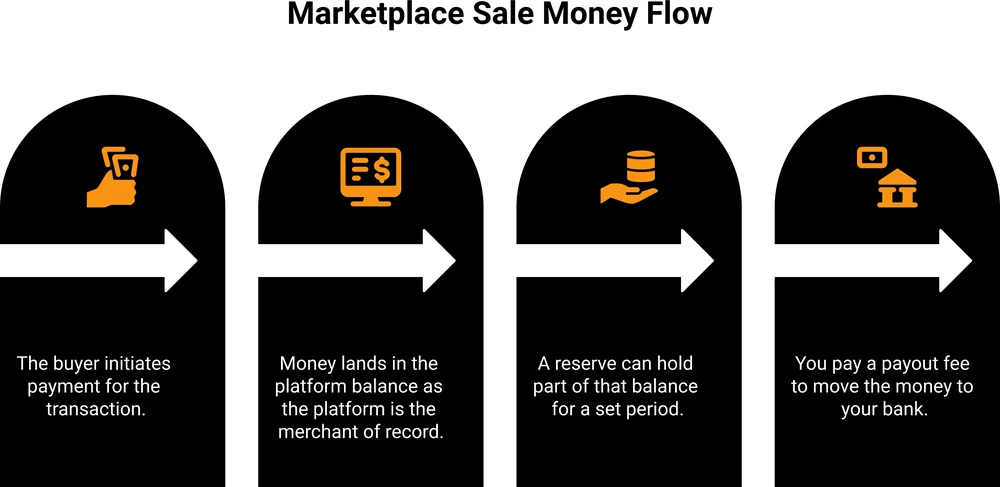
The path your money takes on any platform that is the merchant of record. The payout at the end is a separate charge.
Stack a few of those and the real rate climbs well past 2.7%. Stack none of them and Whop is the cheapest row in the table.
The affiliate default worth checking
Whop’s affiliate documentation is worth 30 seconds of your time. You switch the affiliate program on yourself, and when you do, the global affiliate rate defaults to 30%. You can change it to any percentage you like, and 30% is what sits there until you do. Whop then waits 30 days after the referred customer pays before releasing the commission.
None of the ranking guides mentions this. If you turned the program on and never touched the rate, a $297 sale referred by an affiliate is paying out around $89 before anything else comes off.
The line Whop’s pricing page leaves out
Whop’s pricing page says there is no monthly or SaaS fee. Whop’s own guide for creators says something different: Whop charges a platform fee on most transactions, plus any standard payment processing fees, and may also charge a service fee at checkout depending on how your account is set up.
2 Whop pages, 2 answers. That alone is worth knowing before you build a business on either one.
The bigger item is on that same creator page, and no page-1 guide mentions it at all. Whop holds back a percentage of every sale for a set period, scaled to a Dispute Risk score.
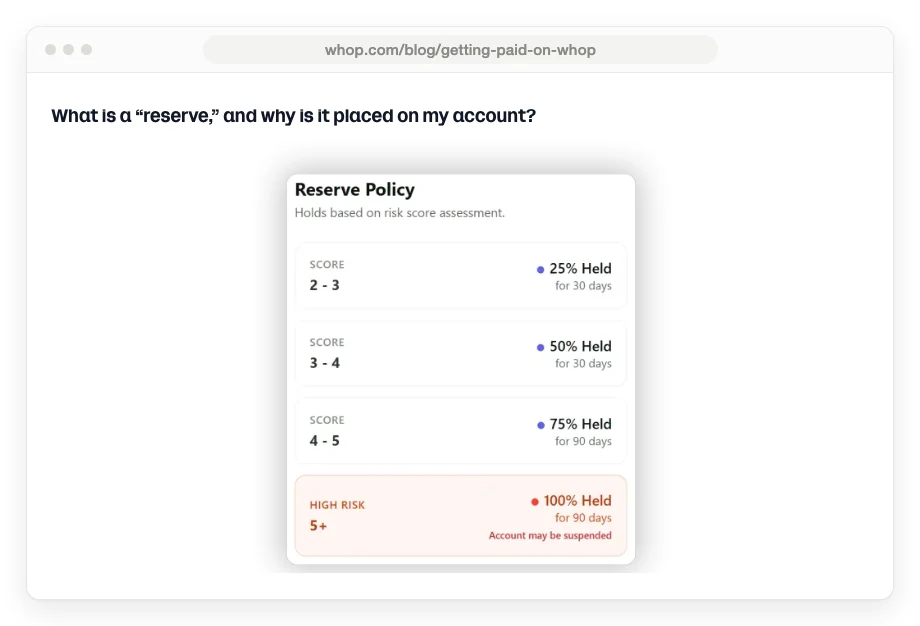
Whop’s own creator payments guide. Read the bottom row: 100% held for 90 days.
Whop’s own wording is that a reserve holds back a percentage of each sale for a set period. The published schedule runs from 25% held for 30 days at a score of 2 to 3, up to 100% held for 90 days at a score of 5 or above, where the account may also be suspended. The same page says a review is triggered by your first-ever sale, your first-ever withdrawal, and at revenue milestones like $1,000 and $5,000.
This is normal for a merchant of record, and Whop is one. Whop’s payout documentation states plainly that on Whop Payments, Whop is the Merchant of Record. Whop is the legal seller, Whop holds the balance, and Whop decides the refunds.
What that looks like from the seller’s side
2 sellers have written up the experience in r/whop, and both are worth reading in full.
One posted a warning after their reserve was extended at the 30-day review they had been told to wait for. They listed a 0.80% chargeback rate and an account health score of 0.5 on Whop’s own metric. The reply they quote from support reads: “The funds held in your reserves will be open on September 6th, aka when 90 days from today have passed. I cannot go into details on my end on the ruling but know that this was looked into and this decision is final.”
Another seller described a $1,471.56 balance held for 120 days after passing a compliance audit, with written confirmation they could withdraw, and no chargebacks or disputes on the account.
Plenty of sellers get paid on time, and 2 posts do not make a pattern. They do show what the risk looks like, and it is the thing worth checking on any platform that holds your balance: how long can the money sit there, who decides, and can you appeal.
Best Whop alternatives for a paid community
If Whop is mostly gating a Discord server or hosting a paid group for you, Skool and Circle are the 2 swaps people actually make.
Skool’s Hobby plan is $7.50 a month on annual billing and takes 10% plus 30 cents per transaction. The Pro plan is $82 a month on annual billing and drops that to 2.9% plus 30 cents, rising to 3.9% plus 30 cents on transactions above $900. Skool’s fee is all in, which is why it can beat Stripe on international cards and subscriptions. Payouts land every Wednesday, and the first one can take up to 14 days.
Circle sits at $89 a month for Professional and $199 for Business, both on annual billing, and takes its own cut on top of Stripe. It is the better fit when you want the community to look like your brand rather than someone else’s product. We have written up Skool and Circle side by side and a longer list of other paid community platforms if neither fits.
On raw fees at low volume, Skool Hobby is the most expensive row in the table above. At 10% plus 30 cents, a $50 sale costs you $5.30 where Whop costs $1.65.
It buys you a community, courses and a members area, which a Whop marketplace listing does not. That is the trade, and it is a fair one if the community is what you actually sell. What community platforms really cost goes through the rest of the field.
Best Whop alternative for online courses
Podia covers a structured course at $42 a month on annual billing, with a 5% fee on that plan. Whop was never the natural home for a course, so this is the easiest category to move.
Podia’s Mover plan is $42 a month on annual billing, which Podia bills as $504 a year, and it charges 5% on top. Shaker is $84 a month, billed as $1,008 a year, with no Podia fee. Both include courses, a community, a website and a checkout. Teachable, Thinkific and Kajabi all cover the same ground with different limits and different transaction fees, and we have gone through Teachable alternatives and Kajabi alternatives in detail.
Check where the transaction fee sits before you commit. Podia Shaker removes the 5% but costs $42 a month more than Mover, so the crossover lands at $840 a month in sales, which is the point where 5% equals that $42 gap. Below $840 a month, the cheaper plan wins even with the fee attached.
Best Whop alternative if you only need the checkout
Gumroad, Stan Store and CartMango all handle billing with no community, course player or marketplace attached. Some sellers need nothing more than that. They already have the audience, they already have the product, and Whop is really just the billing.
Gumroad charges no monthly fee and takes 10% plus 50 cents on a direct sale. Card processing is not included in that. Gumroad’s own fee article says so directly: the fee does not include credit card processing at 2.9% plus 30 cents.
So a direct sale really costs about 12.9% plus 80 cents. Gumroad also drops the direct rate to 5% plus 50 cents once your paid sales pass $20,000 in a calendar month, which is worth knowing if you are near that line.
Sales through Gumroad’s own Discover marketplace are a flat 30% instead, and that one does include processing. How Gumroad’s fee stacks up has the full breakdown, and the Gumroad alternative roundup covers the swaps.
Stan Store is a link-in-bio storefront at $29 a month, or $300 a year, with no free plan. It takes no platform fee, so you pay only Stripe or PayPal. The Creator Pro plan at $99 a month, or $948 a year, adds upsells, order bumps and affiliate tools. The Stan Store alternative guide compares it against the rest.
CartMango is the narrow one. CartMango is free until October 2026, then $10 a year for the Silver plan, and it takes 0% of your sales. CartMango payouts go straight to your own Stripe or PayPal account rather than sitting in a platform balance, which is the specific thing this post has been about.
CartMango does not host courses, has no community feature and has no affiliate manager. Affiliate management is planned for September 2026, and the course system and community are planned for October 2026, all on the $30 a year Platinum plan. If you need any of them today, pick one of the platforms above instead.
What each one costs on $2,000 a month
At $2,000 a month in sales, Whop costs $66 a month all in and Gumroad costs $290. Say you sell a $50 product 40 times a month, and your own processor charges the Stripe standard rate of 2.9% plus 30 cents where a platform does not bundle processing.
Podia moves from Mover to Shaker in this table, because $2,000 a month sits above the $840 crossover from the courses section.
On $2,000 a month, Whop costs $66, CartMango costs $70.83, Stan Store Creator costs $95, Skool Pro costs $152, Podia Shaker costs $154, Skool Hobby costs $219.50 and Gumroad costs $290. Whop is the cheapest option on this table, which is the opposite of what page 1 says.
| Platform | Plan cost | Fees on 40 sales | Total a month |
|---|---|---|---|
| Whop | $0 | $66.00 | $66.00 |
| CartMango Silver | $0.83 | $70.00 | $70.83 |
| Stan Store Creator | $25.00 | $70.00 | $95.00 |
| Skool Pro | $82.00 | $70.00 | $152.00 |
| Podia Shaker | $84.00 | $70.00 | $154.00 |
| Skool Hobby | $7.50 | $212.00 | $219.50 |
| Gumroad | $0 | $290.00 | $290.00 |
Read that table honestly. On fees alone, staying on Whop is the cheapest thing you can do at this volume, and it stays cheapest as you grow, because 2.7% sits under 2.9%. Anyone telling you to switch to save money is selling you something.
Over 12 months at that volume, Whop costs $792 and CartMango costs $850.
So a year of holding your own balance costs $58. That is the whole decision, and $58 is a small enough number that it should be an easy one either way.
Moving off Whop without losing your members
Migration is harder for subscriptions than for one-off products, and the gap is bigger than most sellers expect.
A one-off product moves in an afternoon. Upload the file somewhere new, build a checkout, change the link. Nobody has to do anything.
Subscriptions are different. Your members’ card details live with the old platform’s processor, and on most platforms they cannot be exported to you. That means every existing member has to re-subscribe by hand on the new platform, and some share of them simply will not.
Before you move, ask the new platform 1 question: if I leave you later, do my recurring payments come with me? Who keeps your members if you leave walks through which platforms answer yes.
Run both in parallel for a month if you can. Point new buyers at the new checkout, leave existing members where they are, and let the old subscriptions expire naturally rather than cancelling them in a batch.
FAQ
What is better than Whop?
Nothing is better at everything, because Whop bundles a marketplace, community gating and checkout into 1 product. Skool or Circle wins if you mainly run a community. Podia or Teachable wins if you sell structured courses. Gumroad or Stan Store wins for one-off products with your own branding. On card fees alone, Whop is cheaper than all of them.
Can you actually make money with Whop?
Yes, and Whop’s own creator guide says it has paid out over 2 billion dollars to creators. Plan for the timing rather than for whether the money arrives. Standard payouts take up to 5 business days, reviews are triggered at your first sale, your first withdrawal and at revenue milestones, and a reserve can hold part of your balance for 30 to 90 days.
Does Whop charge a platform fee on top of the 2.7%?
Whop’s pricing page and its fee documentation list no separate platform fee. Whop’s creator payments guide does say Whop charges a platform fee on most transactions plus standard processing, and may charge a service fee at checkout depending on your account setup. The 2 pages disagree, so check your own dashboard rather than trusting either page or any comparison guide.
What happens to my subscribers if I leave Whop?
Whop is the merchant of record, so the payment relationship with your buyer belongs to Whop rather than to you. In practice that means existing subscriptions do not transfer to a new platform on their own, and members have to re-subscribe. Check the answer for whichever platform you move to before you move, because it varies a lot.
Are there free Whop alternatives?
Gumroad has no monthly fee, and neither does Whop, so both are free to start and take a cut of each sale instead. Payhip has a free tier that charges 5% per transaction. A plain checkout is the cheapest fixed cost of the group: CartMango is free until October 2026 and $10 a year after that. Free always means you pay per sale instead, so work out which one suits your volume.
Where your money sits between the sale and your bank
One seller in r/whop waited 120 days for $1,471.56, on an account with no chargebacks and no disputes. Any platform that becomes the merchant of record can do that. What changes between them is how long, and who decides.
If you only need billing, and you want the money to land in your own account without passing through a platform balance first, that is the specific job CartMango does. CartMango payouts go directly to your own Stripe or PayPal account, CartMango takes 0% of your sales, and if you ever leave, your recurring payments keep paying you. CartMango is free until October 2026 and $10 a year after that.
If you need the community, the course player or the marketplace that Whop gives you, go back up the page and pick from the Whop alternatives grouped by job. CartMango will not cover any of those 3, and neither will a plain checkout from anyone else.
About the Author

👋 I’m Welly, founder of CartMango (the site you’re on), a checkout platform for digital product sellers. We’ve previously processed $179M+. I also run BirdSend (email marketing tool, 3.1B+ emails sent). On the side I show other non-techie digital sellers how I use AI workflows to automate 50%+ of my operations. Find me on LinkedIn.
Related Reading
- Patreon alternatives priced at $1,000 a month: the break-even for 11 platforms, if memberships are your main product
- What affiliate software actually costs: useful before you turn on any platform’s built-in affiliate program
- Skool pricing broken down: Hobby against Pro, and the fees the pricing page leaves out
- Stan Store pricing in full: both plans, the payout timing and the Stripe account you never own