

Circle, Mighty Networks, Heartbeat, Kajabi and Discord are the main Skool alternatives. Each takes a cut of your member payments on top of its monthly plan: 2% for Circle and Mighty Networks, 5% for Heartbeat, 16% for Discord, card processing only for Kajabi. Pick by what you need it to do, because the cheaper sticker price usually is not cheaper.
I ran this exact search and read what Google put at the top. It named 4 platforms with 4 prices, and every one of those prices was the annual-billing rate written as though it were the monthly one. None of them mentioned that these platforms also take a percentage of what your members pay you.
Which is odd, because the fee is the reason most people go looking for a Skool alternative to begin with.
So I opened all 7 pricing pages myself. Below you get the real monthly price and the real cut for each platform, the questions the roundups skip (what happens to your leaderboard, whether “free” survives contact with money), and a plain way to pick.
Key Takeaways
- The prices in Google’s answer are annual rates. Circle is $99 a month, not $89. Mighty Networks is $95, not $79. Heartbeat is $49, not $40.
- Every alternative takes a cut too. Circle and Mighty Networks take 2%, Heartbeat takes 5%, and both stack on top of Stripe’s 2.9% plus 30 cents.
- Heartbeat charges 5% on its cheapest plan, the highest transaction fee of any paid platform here and nearly double Skool Pro’s 2.9%.
- Discord is free to run and takes 16% to charge, made of a 10% platform fee plus 6% processing. On iOS in year 1 it reaches 40%.
- Skool has no free plan, and paid subscriptions on Discord only work if you bank in the United States.
- You can keep your leaderboard. Circle, Mighty Networks and Heartbeat all build in points or badges, so gamification is no reason to stay.
What every Skool alternatives list leaves out
Only 1 page ranking for this search publishes what the alternatives charge per transaction, and even that one has holes. Teachery’s comparison table does the job for Circle, Podia and Kajabi. It also leaves Mighty Networks’ fee as “Not listed”, skips Heartbeat and Discord entirely, and prints Circle’s annual rate in a column headed Starting Monthly Price.
The other 4 give you no fee number for any alternative at all. I checked each by searching the page for the words.
Circle’s own guide runs 3,853 words without a fee figure for any platform, including Circle. LinoDash covers 6 platforms and never mentions that Skool Pro exists at $99 a month. Mighty Networks gets closest, working out that a $1,000 month on Skool Hobby costs $109, then stops short of its own 2%.
Part of the reason is who wrote them. Of the 7 results I read on page 1, 4 are published by one of the alternatives: Circle, Mighty Networks, Teachery and TagMango all rank with their own comparison. That is ordinary marketing, and it explains the hole. A platform writing a list of alternatives has little reason to print its own transaction fee in it.
Google’s AI Overview reads those pages and passes the summary along.
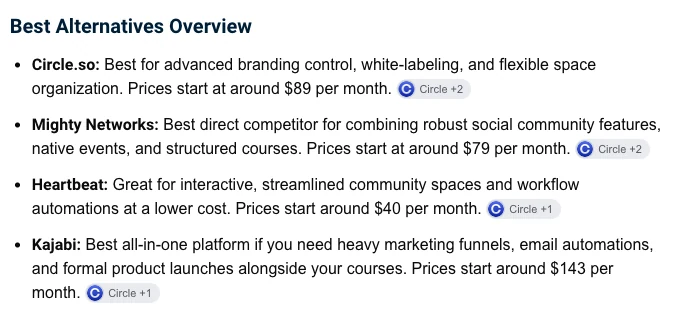
Read the 4 prices in that box, then read what the pricing pages say.
Every one of those figures is real. Every one is also the price you pay only if you commit to a full year upfront. Kajabi is the clearest case: its pricing page prints “$143 /mo” in large type with “Billed annually ($179/mo)” underneath in small type. The summary kept the big number and dropped the small one.
Google’s answer understates the real monthly price on all 4 platforms, by 10% on Circle and 20% on Kajabi, and it lists no transaction fee for any of them:
| Platform | Google’s answer says | Billed monthly | Billed annually | Cut of member payments |
|---|---|---|---|---|
| Circle Professional | around $89 per month | $99 | $89 | 2% plus Stripe |
| Mighty Networks Launch | around $79 per month | $95 | $79 | 2% plus Stripe |
| Heartbeat Build | around $40 per month | $49 | $40 | 5% plus Stripe |
| Kajabi Basic | around $143 per month | $179 | $143 | card processing only |
The last column is the one that costs you real money. A monthly plan stays flat as you grow. A percentage does not.
New to charging for access to your own thing? The free 5-day Online Selling Mistakes Challenge covers the pricing and checkout mistakes that quietly cost solo sellers the most.
What Skool actually costs, so you know what you are comparing against
Skool has 2 plans and both take a percentage. Hobby is $9 a month with a 10% transaction fee. Pro is $99 a month with a 2.9% fee, which rises to 3.9% on any single payment of $900 or more.
Both add 30 cents per transaction. Neither of those 2 details appears on the pricing page.
3 more things drive the real bill.
Every community is billed separately. Run 2 paid groups on Pro and you pay $198 a month, not $99.
Skool is the merchant of record. You cannot connect your own Stripe account, so the payment relationship belongs to Skool and payouts land weekly. That cuts both ways: Skool absorbs chargebacks and sales-tax filing, and its 2.9% is genuinely flat whoever your member banks with, which beats Stripe’s own international card rate.
And Growth Boost takes 30%. When a member finds you through Skool’s discovery feature, Skool keeps 30% of what that member pays for as long as they stay subscribed. The full arithmetic, including the 2 Skool help docs that disagree about whether it is switched on by default, is in the Skool pricing breakdown.
That piece also produces a number worth carrying into any comparison: Pro only starts beating Hobby at about $1,268 a month in member payments. Below that, the $9 plan wins even with its 10% cut.
For the full cost math across every platform on this page at 20, 100 and 400 members, there is a side-by-side comparison of community platform costs. This post is about which one to pick and what the lists get wrong, so I will not rebuild that table here.
The best Skool alternatives, grouped by what you actually need
Circle suits a brand, Mighty Networks suits engagement, Heartbeat suits a small group, Kajabi suits a marketing operation, and Discord suits a standing start. There is no single winner, which is why all 5 roundups on page 1 name a different one.
Each pick below carries a different cost once the percentage is counted, and the cheapest plan is rarely the cheapest platform:
| If you are leaving because | Pick | Costs | Watch out for |
|---|---|---|---|
| Skool looks generic next to your brand | Circle | $99 a month, $89 annually | 2% cut on top of Stripe |
| You want deeper engagement, same idea | Mighty Networks | $95 a month, $79 annually | 2% cut, and events cost extra |
| Your community is small and simple | Heartbeat | $49 a month, $40 annually | 5% cut, the highest here |
| You need email and funnels in one place | Kajabi | $179 a month, $143 annually | plan cost, and a 5-product cap |
| You want to start at zero | Discord | free to run | 16% to charge, and US only |
CartMango is not in that table on purpose. It is my own platform and it cannot host a community today, so it has no honest row here. More on where it does fit further down.
Circle: better branding, and a 2% cut you have to go looking for
Circle Professional is $99 a month billed monthly, $89 if you pay for a year, and it takes 2% of every member payment on top of Stripe. Business is $219 monthly or $199 annually and drops the cut to 1%.
What you get is the thing Circle is genuinely good at. Custom domain, your own colours and logo, white labelling, branded mobile apps on the top tier, and spaces you can organise properly instead of 1 flat feed. If your community sits next to a real brand and Skool’s fixed layout embarrasses you, this is the upgrade.
The 2% is worth finding before you switch, because of where it lives. The plan cards do not show it. You open “Compare plan features” and scroll to the Transaction fees row, where Circle’s own tooltip says it is “in addition to the standard Stripe processing fee”.
Together that is 4.9% plus 30 cents per payment, against Skool Pro’s flat 2.9% plus 30 cents. Circle is a branding upgrade that costs about 2 points of margin, which is a fair trade and not the one the roundups describe.
Mighty Networks: the closest like-for-like swap
Mighty Networks Launch is $95 a month billed monthly, $79 annually, with the same 2% cut as Circle, also tucked into the compare table. Scale is $215 monthly or $179 annually.
This is the nearest thing here to a straight swap. Courses, events, badges and gamification all sit on the entry Launch plan, aimed at the same person Skool is aimed at.
Check the plan boundary before you commit, because it is an odd one. Charging for events, automated polls and the Kit email hookup all sit on Scale, so a community that sells a paid workshop needs the $215 tier rather than the $95 one.
Mighty Networks also earns a little credit for honesty. Its own alternatives guide is the only page on the first results page that does any Skool fee math at all, pointing out that 10% of a $1,000 month is $100 on top of the plan. It just never turns the same lens on its own 2%.
Heartbeat: the cheapest plan and the most expensive fee
Heartbeat charges 5% on its cheapest plan, the highest transaction fee of any paid platform in this comparison. Build is $49 a month billed monthly, or $40 if you pay $490 for the year, and covers up to 350 members. Grow is $149 monthly, $124 annually, up to 5,000 members, and halves the fee to 2.5%.
To its credit, Heartbeat says so plainly, which is more than most of this list manages.
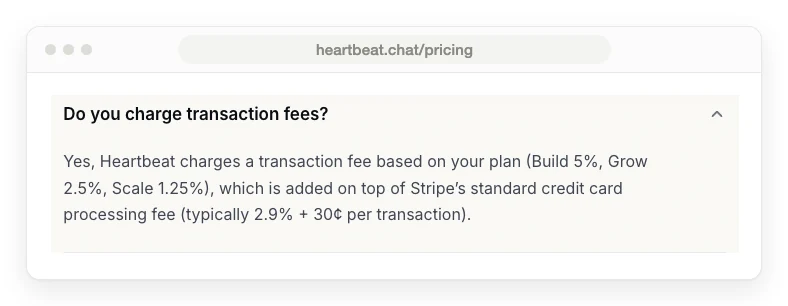
Add Stripe’s published 2.9% plus 30 cents and a Build-plan payment costs 7.9% plus 30 cents. That is more than double Skool Pro, and it is how a $49 plan turns into the most expensive paid option once you are taking real money.
None of that makes Heartbeat a bad product. It is the simplest of these to set up and the layout is clean, which counts for a small group.
On monthly billing it genuinely costs less than Skool Pro until you pass roughly $1,000 a month in member payments. Past that the 5% eats the saving and keeps eating.
Kajabi: a marketing suite with a community attached
Kajabi Basic is $179 a month billed monthly, or $143 for the year, and it takes no revenue share when you use Kajabi Payments. Growth is $249 monthly, Pro is $499.
Kajabi is barely competing with Skool. It is a whole business platform: email marketing, sales funnels, landing pages, a website builder and a real course player, with community as 1 feature among many. Basic caps you at 5 products, 2,500 contacts and 1 community.
2 things to check before the price settles it. The pricing page says “No hidden fees. No revenue sharing” and carries an asterisk reading “Processing fees apply”, and bringing your own payment processor instead of Kajabi Payments adds 0.5% to 5%.
There is also a cheaper plan than the 3 cards show you: a Kickstarter tier at $89 a month that no longer has a price anywhere on the pricing page. I went through all of it in the Kajabi pricing breakdown, and the wider set of options in the Kajabi alternatives roundup.
Buying the marketing machinery makes Kajabi fair value. Buying a place for 100 people to talk means paying for a lot of software you will never open.
Will you lose your points, levels and leaderboard?
No. Circle, Mighty Networks and Heartbeat all build in gamification of their own, and most of the roundups will tell you that much.
What they do not tell you is what happens to the points your members have already earned.
Circle’s knowledge base documents points, levels and a leaderboard, with points awarded automatically for likes and actions plus the option to hand them out through workflows. Mighty Networks lists Badges and Tags and Gamification as standard on its entry Launch plan. Heartbeat lists member badges and gamification on its entry Build plan.
None of them documents a way to import points or levels from another platform. So plan for your members starting from zero on day 1, tell them before they find out on their own, and consider handing your top members a level manually if the leaderboard is doing real work in your community.
Is there a genuinely free Skool alternative?
Discord is the only real one, it costs nothing to run, and it takes 16% the moment you charge for access. “Free skool alternative” is one of the most common follow-ups on this topic, so it is worth being exact about where the bill appears.
Running a Discord server is genuinely free for any number of people. Charging for it is the part that costs, and the headline number people quote is only half of it.
Discord’s Creator Revenue FAQ describes a 90/10 split and mentions other fees without naming them. Schedule 1 of Discord’s Monetization Terms names them: on desktop and browser, a 6% payment processing fee sits alongside the 10% platform fee, so the real cut is 16%.
On mobile it climbs. An iOS purchase carries 30% app-store processing in the first year plus the 10% platform fee, which is 40% of what your member pays. After a year on the same tier that processing drops to 15%, so 25%.
There is a second limit almost nobody repeats: Server Subscriptions “will not be available outside the United States”, and switching them on needs US banking details plus a Stripe account.
So Discord charges more than Skool Hobby’s 10%, on a platform with no courses, no landing page and no checkout. The common workaround is bolting on a paid gatekeeper that sells access and hands out the invite, which puts you back to paying a platform.
Substack gets suggested for the same reason and behaves the same way. Publishing is free to any number of subscribers. Turn on paid subscriptions and Substack’s own pricing page lists 10% to Substack, Stripe’s 2.9% plus 30 cents, and a further 0.7% recurring billing fee, which lands near 13.6% plus 30 cents per payment.
Be careful with the “free alternatives” listicles too. Several rank for this term by listing course tools that happen to have free tiers, which is a different category from a community platform. Some leave Discord out of a free-alternatives list entirely.
There is a related habit worth knowing about, because it says what people are really optimising for. On the r/SKOOL subreddit, someone asked why communities listed as “Free” turn out to need a purchase first. 2 separate commenters gave the same answer: owners take payment through an outside checkout, and 1 noted they “skip Skool’s transaction fee in the process” while still using Skool’s discovery to get found. You can read the r/SKOOL bait-and-switch thread in full.
Read that as a signal. When enough owners route payments around a platform to dodge the fee, the fee is the product problem.
And to answer the question people actually type: Skool has no free plan. There is a 14-day trial, then $9 a month at the least, per community.
Is Circle or Skool better?
Circle is better when branding and structure matter most, and Skool is better when cost and simplicity matter more.
Circle wins on custom domains, white labelling, branded apps, organised spaces and a course builder that can carry a structured programme. Skool wins on cost at any serious volume, on 1 flat payment cost with no separate processor to reconcile, and on being plain enough that members work it out without help.
The tiebreaker is usually who your members are. Selling to businesses, where your community sits beside your brand, points at Circle. Selling to individuals who want the thing and the group chat points at Skool.
Weighing the wider field, the membership site platform breakdown covers who keeps your subscribers when you leave, which is the part that bites hardest.
When the answer is not a community platform at all
Some people shopping for a Skool replacement do not need a community platform at all, and the tell is easy to check. Count how many members posted anything last month. If the honest answer is close to nobody, you are paying community prices for what is really a checkout.
Plenty of people paying Skool $99 a month have a discussion tab nobody posts in. Their members bought a product, and the group came free with it. What that person needs is a way to sell the thing and deliver it, and every platform on this page is built for a different job.
I should say plainly that I run CartMango, a checkout platform for solo digital sellers, so I am not neutral here. CartMango is also not a Skool replacement today and I am not going to pretend it is: CartMango hosts no community and no courses right now. Both are in build, with community and an LMS due in October 2026 and affiliate management in September 2026.
What CartMango does today is the payment half. CartMango is free until October 2026, then starts at $10 a year, and CartMango takes 0% of your sales, so you pay your card processor and nothing else.
You connect your own Stripe or PayPal, so the subscription belongs to you rather than the platform, and your recurring payments keep running if you ever leave. Mini Pages hosts the sales page, so no website of your own is needed.
The catch is the whole catch: no community, no course player, no discovery feed. If you want those, pick 1 of the platforms above and pay for it.
Selling the course itself rather than hosting the group is a different job, covered in the guide to selling online courses and the breakdown of what course platforms really take.
How to move off Skool without losing members
Get your member list out first, before you touch anything else. Your members and their email addresses are the only asset here that no platform can keep from you, so make sure you hold a copy somewhere you control.
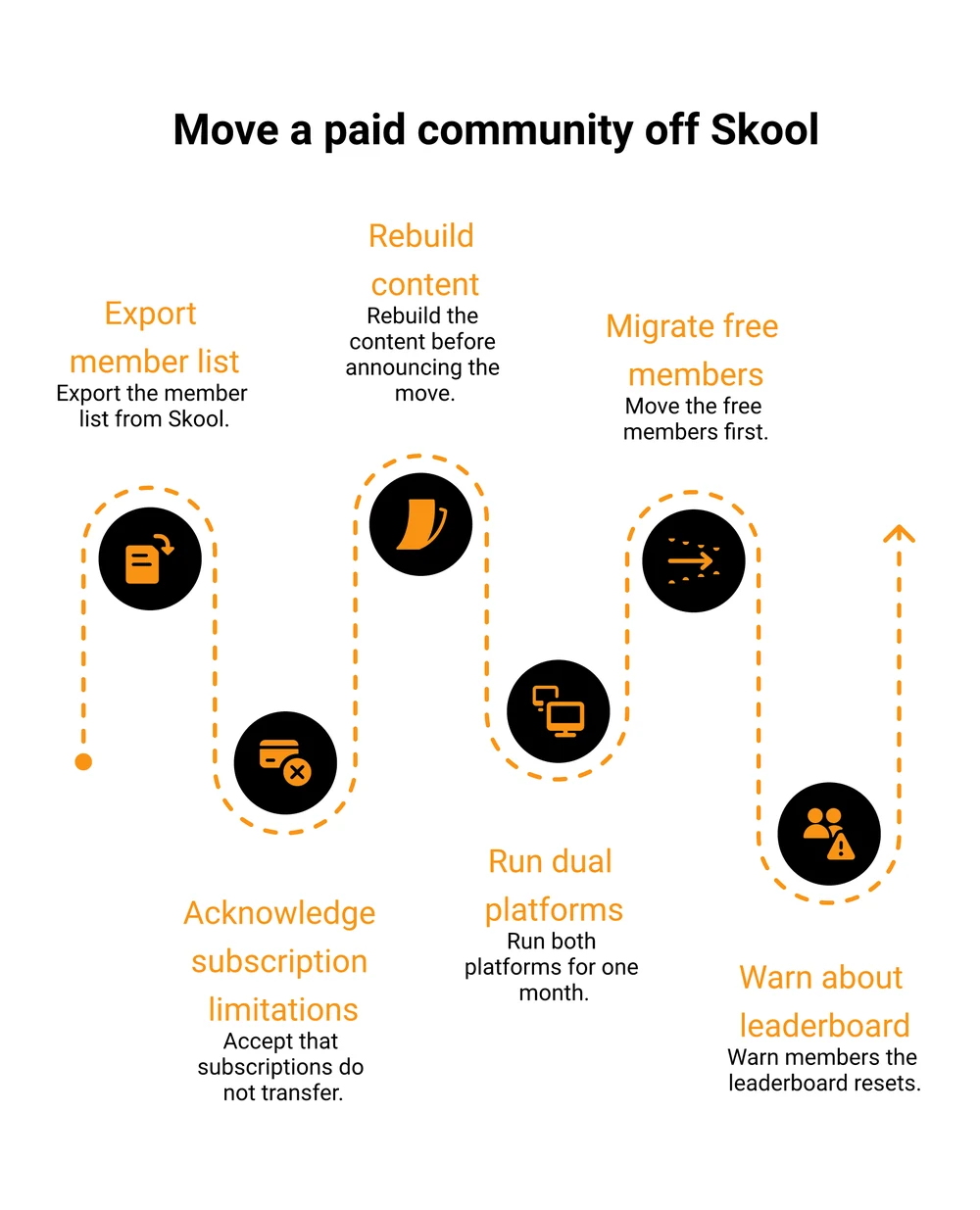
Then work through it in this order.
- Accept that subscriptions do not transfer. Skool is the merchant of record, so billing sits in Skool’s payment account rather than yours. Paying members have to re-subscribe on the new platform. This is the single biggest cost of moving and everything else is admin.
- Rebuild the content before you announce. Courses, modules and pinned resources get re-uploaded by hand. Heartbeat, Circle and Mighty Networks all include some migration help on their paid plans, so ask before you start pasting.
- Run both for a month. Keep Skool alive while people cross over. Paying 2 subscriptions for 30 days is cheaper than a hard cutover that scares off the members who were on the fence.
- Move the free members first. They have nothing to re-subscribe to, so they fill the new place and make it feel alive before the paying members arrive.
- Warn people the leaderboard resets. Points and levels do not travel. Say it upfront and hand your top members a starting level if it matters to them.
- Give a reason people believe. “A proper app and better courses” travels. “Lower fees” does not, and after the numbers above it may not even be true.
The re-subscribe step is what kills most migrations. Say you lose a fifth of your paying members in the move: work out what that costs over a year, then hold it next to the fee saving you are chasing. On these numbers the saving rarely wins.
FAQ
What is better than Skool?
Nothing is better across the board, which is why each roundup picks a different winner. Circle is better for branding and structured programmes. Mighty Networks is better for engagement features and events.
Kajabi is better if you want email and funnels in the same tool, and Heartbeat is better for a small community. On cost alone at higher volume, Skool Pro is still hard to beat.
Is Circle or Skool better?
Circle for branding, custom domains and a serious course builder. Skool for cost and simplicity. Circle Professional is $99 a month billed monthly plus a 2% cut on top of Stripe, against Skool Pro at $99 with a flat 2.9% and no separate processor fee.
Is there a free version of Skool?
No. Skool runs a 14-day free trial, then charges $9 a month for Hobby or $99 for Pro, billed per community. Communities listed as free on Skool are free to the member, not to the person running them.
Is Substack similar to Skool?
Only loosely. Substack is built around publishing a newsletter with comments attached, and Skool is built around a discussion feed with courses attached.
Both let you charge a recurring fee for access. Substack takes 10% plus Stripe’s fees and a 0.7% billing fee. If your main output is writing, Substack fits.
Skool vs Heartbeat, which is cheaper?
Heartbeat below about $1,000 a month in member payments, Skool Pro above it, comparing both on monthly billing. Heartbeat Build looks cheaper at $49 a month against $99, and its 5% cut plus Stripe comes to 7.9% plus 30 cents against Skool Pro’s flat 2.9% plus 30 cents. The plan saving disappears as soon as the percentage has enough revenue to work on.
Do all the alternatives charge transaction fees?
The paid ones do, apart from Kajabi. Circle and Mighty Networks take 2% on their entry plans, Heartbeat takes 5%, and Discord takes 16% when you charge for access, all on top of card processing where it applies. Kajabi takes no revenue share on Kajabi Payments, though it charges more for the plan and adds 0.5% to 5% if you bring your own processor.
Can I keep my Skool subscribers when I switch?
No. Skool is the merchant of record, so subscriptions live in Skool’s payment account and cannot be moved. Every paying member enters their card again on the new platform.
Budget for losing some of them, and run both platforms side by side for a few weeks to keep that number down. That re-subscribe cost is the real price of the Skool alternatives on this page, and it is the number none of them advertises.
If the community turned out to be the part you do not need, that changes what you should be shopping for. Every community platform on this page takes a percentage of each member payment, and the 1 that does not, Kajabi, charges $179 a month instead. CartMango does neither: you connect your own Stripe or PayPal, CartMango takes 0% of your sales, and the subscriptions you set up keep paying you even if you leave.
About the Author

👋 I’m Welly, founder of CartMango (the site you’re on), a checkout platform for digital product sellers. We’ve previously processed $179M+. I also run BirdSend (email marketing tool, 3.1B+ emails sent). On the side I show other non-techie digital sellers how I use AI workflows to automate 50%+ of my operations. Find me on LinkedIn.
Related Reading
- What Skool really charges: the 30 cents, the 3.9% tier and the 30% Growth Boost commission, in full
- What community platforms really cost: 7 platforms priced at 20, 100 and 400 members
- Membership site platform costs: who keeps your subscribers when you leave
- The best recurring revenue businesses: 20 models, for readers deciding what to charge for in the first place