

Ko-fi and Buy Me a Coffee charge 5% where Patreon charges 10%, so they win at any size, and CartMango takes no platform cut. The flat-fee Patreon alternatives only pull ahead past a threshold: $120 a month for Ko-fi Gold, $290 for Ghost, $961 for Memberful, $1,219 for Circle. Every fee below comes from the platform’s own pricing page.
I went looking for a straight answer on this and could not find one.
Every result on the first page of Google for this search, apart from the Reddit threads, is published by a company selling one of the alternatives.
Circle recommends Circle. Podia recommends Podia. Ghost, Ko-fi, Sellfy and BuddyBoss all rank with their own product as the pick.
None of them are lying to you. They just have no reason to run the one calculation that settles this, which is what a monthly fee and a percentage cut cost each other at the revenue you are on right now.
A platform charging $89 a month and a platform charging 10% swap places somewhere. Nobody on that page tells you where.
So I priced every option at the same revenue level, from each platform’s own fee documentation, and worked out the crossover for each one.
Key Takeaways
- Patreon’s standard plan takes 10% plus 2.9% and $0.30 per pledge. On $1,000 a month across 200 patrons you keep $811.
- Ko-fi and Buy Me a Coffee cost less than Patreon at every revenue level. The flat-fee platforms only win once you clear a threshold, and each threshold is different.
- Memberful is owned by Patreon. Google’s AI Overview names it as a top alternative without saying so, and its platform cut lands $2 a month below Patreon’s.
- Ghost’s own Patreon page advertises “From $15/mo”. That plan cannot take a paid subscription at all. The cheapest Ghost plan that can is $29 a month.
- Circle keeps you $795 of $1,000 a month, which is less than Patreon keeps you. Circle only pulls ahead above $1,219 a month.
Before we get into the numbers: if you want to find the money leaking out of your setup on any platform, the free 5-day Online Selling Mistakes Challenge walks through the 5 mistakes that cost solo creators the most.
Why creators are looking for a Patreon alternative
Patreon changed what it charges new creators. Any creator page published after 4 August 2025 sits on the standard plan, which takes a flat 10% of your earnings, plus payment processing of 2.9% and $0.30 on every individual pledge.
Older pages kept their old rates. Patreon’s legacy plans are Founders at 5%, Pro at 8% and Pro plus Merch at 11%. Those are closed to new creators, and there is a trap in how you keep one: unpublish your page even once and you move to the standard 10% permanently.
That is the short version. The full stack, including the payout fees Patreon leaves out of your earnings dashboard, the 2.5% currency conversion charge and the micropayment rate new creators no longer get, is in our Patreon fees breakdown.
3 other things push people to search this:
- Apple takes 30% of anything bought inside the Patreon iOS app. Apple’s own developer documentation puts it plainly: “During a subscriber’s first year of service, you receive 70% of the subscription price at each billing cycle.” Patreon’s default is to raise the price your fan sees rather than cut what you earn, which makes your iPhone price about 43% higher than your web price.
- Patreon does not bring you fans. There is no meaningful discovery. Every patron you have is one you brought yourself, which is the same job you would be doing on any of the alternatives.
- The tooling stops at memberships. No course builder, no member-to-member community beyond comments and chats, no custom domain.
The November 2026 Apple deadline is smaller than the roundups make it sound
Several of the guides ranking for this search point at an Apple deadline of November 2026 as a reason to get out now. The deadline is real. Apple reimposed a mandate in January 2026 requiring Patreon to move creators onto subscription billing through Apple’s in-app purchase system.
What those guides leave out is who it lands on. TechCrunch reported that the change “will only impact the 4% of creators who are still using Patreon’s legacy billing models”. If you started on Patreon any time recently you are already on subscription billing, already paying Apple’s 30% on in-app purchases, and nothing changes for you in November.
Patreon is not happy about it either. Its own statement, quoted in that piece, calls it “the third such change from Apple in the past 18 months”. That churn is a fair reason to want less exposure to any one platform. It is not a 30% bill arriving in your inbox this year.
None of that answers the question you came with, which is whether moving actually saves you anything. So here is the money.
What the main Patreon alternatives cost at $1,000 a month
From $1,000 a month, Ko-fi leaves you $861 and Buy Me a Coffee $851, against Patreon’s $811. Substack leaves you $804 and Gumroad $711, so both cost more than Patreon does.
| Platform | Its cut | Processing on top | You keep from $1,000 |
|---|---|---|---|
| Patreon, standard plan | 10% | 2.9% + $0.30 per pledge | $811 |
| Ko-fi, free plan | 5% on memberships | 2.9% + $0.30 per pledge | $861 |
| Buy Me a Coffee | 5%, plus 0.5% on subscriptions | 2.9% + $0.30, plus 0.5% payout | $851 |
| Substack | 10% | 2.9% + $0.30, plus 0.7% Stripe Billing | $804 |
| Gumroad | 10% + $0.50 per sale | 2.9% + $0.30 per sale | $711 |
The scenario is 200 members paying $5 a month, US cards, US dollar payouts. Every rate comes from the platform’s own fee page, read live. Where a platform documents an extra charge on recurring billing I have counted it, and where the documentation is silent I have not, so a row could be a few dollars worse in practice than it looks here.
2 things in that table are worth slowing down on.
Gumroad is the worst option on this list for small recurring pledges, and it is the one Google’s AI Overview recommends for digital sales. On a $5 pledge the flat $0.50 costs exactly what the 10% costs, which puts Gumroad’s platform fee at 20% of that sale before anything else. Add card processing and Gumroad’s real cost per sale reaches 28.9%. Gumroad’s own help centre is clear that the 10% and $0.50 “does not include” credit card processing of 2.9% and $0.30.
Substack costs more than Patreon. If a paid newsletter is where you are heading anyway, our guide to monetizing a newsletter covers the income side of that decision. On fees, both take 10%, and Substack adds a 0.7% Stripe Billing charge on recurring payments that Patreon does not have. Substack says in the same document that this charge “is not included in the ‘Stripe processing fee’ amount”, so it does not show up where you would look for it. Our full Patreon vs Substack breakdown runs the rest of that comparison, including who holds the billing relationship.
The 2 numbers in Google’s AI summary are both incomplete
Google’s AI Overview for this search gives exactly 2 figures. It says Ko-fi “charges 0% platform commission on one-time donations” and that Buy Me a Coffee has “a simple 5% fee”.
Both figures are accurate. Both describe a payment type you will not be taking if you are replacing a Patreon membership.
Ko-fi’s 0% applies to one-off tips. If you are replacing Patreon you are running membership tiers, and Ko-fi’s own fee page charges 5% on membership tiers on both of its free settings. Buy Me a Coffee’s “simple 5%” is the platform cut only. Buy Me a Coffee’s own fee page then adds Stripe at 2.9% and $0.30, a 0.5% payout processing fee and another “+0.5% for subscription payments”, which is 8.9% and $0.30 all in on a recurring US payment.
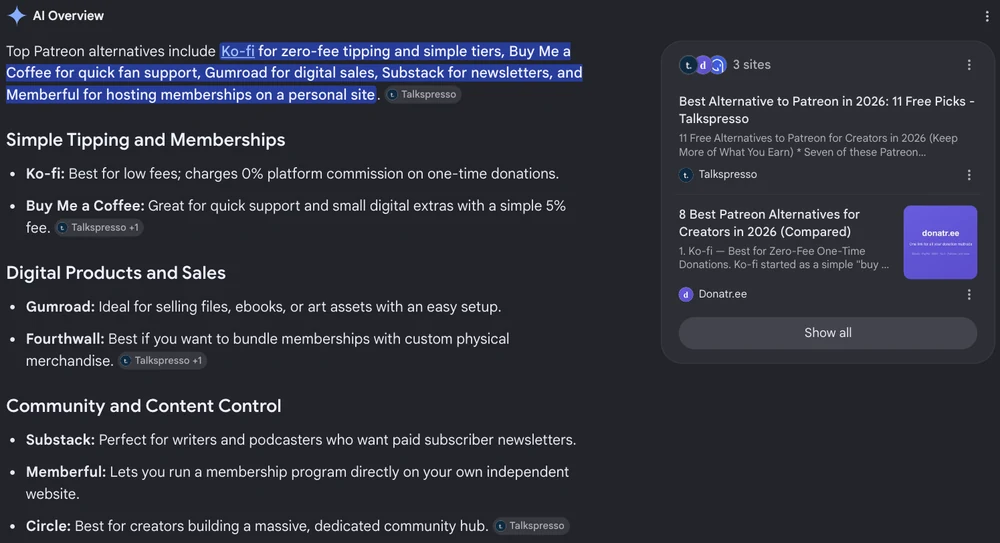
The gap between Patreon and the cheap options is real. It is just a lot narrower than 5% against 10%.
The flat-fee platforms, and where each one starts winning
Every flat-fee platform loses to Patreon below a break-even point. Ko-fi Gold clears at $120 a month, Ghost at $290, Memberful at $961, Circle at $1,219, and CartMango’s $10 a year at about $8.
| Platform | What it costs | Its cut | You keep from $1,000 | Beats Patreon above |
|---|---|---|---|---|
| Circle, Professional | $89/mo billed yearly | 2%, plus 0.7% Stripe Billing | $795 | $1,219/mo |
| Memberful | $49/mo | 4.9% | $813 | $961/mo |
| Ghost, Publisher | $29/mo billed yearly | none | $882 | $290/mo |
| Ko-fi Gold | $12/mo | none | $899 | $120/mo |
| CartMango | $10/year, free until October 2026 | none | $910 | $8/mo |
The “you keep” column runs on the same basis as the first table, so card processing of 2.9% and $0.30 a pledge is already deducted from every row even though this table only shows each platform’s own charge. Circle also carries a 0.7% Stripe Billing charge because Circle’s documentation names one, and the other 4 rows carry no equivalent because theirs do not mention one. Take that 0.7% back out and Circle’s break-even falls from $1,219 to roughly $1,113.
I run CartMango, so read that last row with that in mind. It is a checkout, not a community platform, and the section below is honest about what it does not do.
This is the calculation none of the ranking pages run, and it is the whole decision. Circle’s own roundup says a creator earning around $10,000 a month saves $600 to $800 monthly by moving off Patreon. That checks out: at $10,000 a month Circle costs $1,249 against Patreon’s $1,890, so the saving is $641. At $1,000 a month the same comparison flips and Circle costs you $16 more than Patreon.
Circle’s transaction fee is not on Circle’s pricing page. That page lists Professional at $89 and Business at $199 and says only “Lower transaction fees” in the feature grid. The actual percentages sit in the help centre, where Circle publishes the real percentages as 2%, 1% and 0.5%, each on top of Stripe, with a further 0.7% Stripe Billing charge on subscription pricing.
Memberful is owned by Patreon
Memberful is a Patreon company. It says so in the footer of its own pricing page.
Google’s AI Overview names Memberful as one of 5 top Patreon alternatives, for “hosting memberships on a personal site”. So do 2 of the roundups ranking on page 1, and so does the page the AI Overview cites first. Of those 4 sources, 1 mentions who owns it, and that one is Podia’s guide.
Nothing shady is going on here. Patreon bought Memberful years ago and has left it running as a separate product, and plenty of publishers are happy on it. It is worth knowing before you migrate, because “leaving Patreon” and “moving to a different Patreon product” are different plans, and only one of them changes who your business depends on.
The pricing makes the same point. Memberful charges $49 a month plus a 4.9% transaction fee, so at $1,000 a month its platform cut is $98. Patreon’s is $100.
The break-even between them sits at $961 a month. A creator earning less than that pays Memberful more than they were paying Patreon, for a product with the same owner.
Ghost’s cheapest plan cannot take a subscription
Ghost’s cheapest plan, Starter at $15 a month billed yearly, cannot take a paid subscription. Ghost’s own page for this exact search is titled “The best Patreon alternative with 0% fees” and advertises “From $15/mo”.
That $15 is real. It is the Starter plan, billed yearly.
Open Ghost’s pricing page and read Starter’s feature list: your own website, a free custom domain, an email newsletter, simple design settings, 1,000 members. Paid subscriptions are not on it. They appear in the next column along, on Publisher.
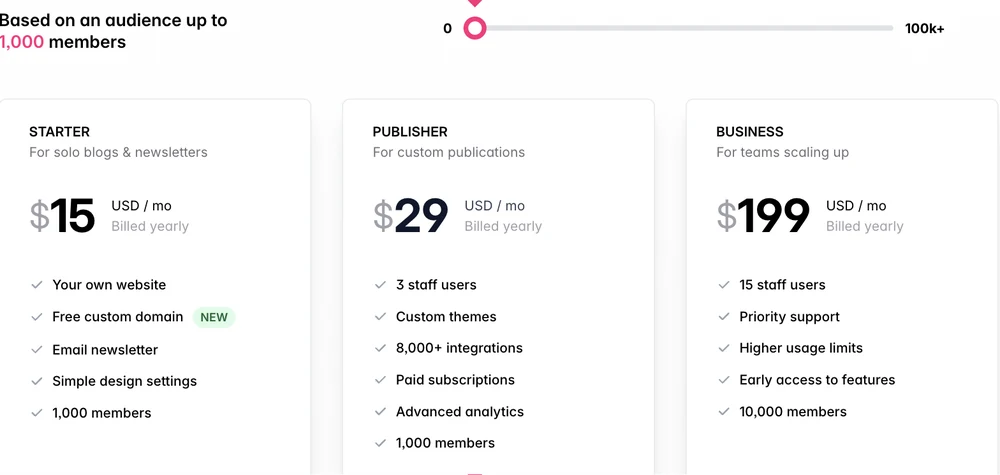
So the cheapest Ghost plan that can take a single dollar from a member is Publisher, at $29 a month billed yearly, or $35 if you pay monthly. That is $348 a year against the $180 the headline implies.
The same Ghost page describes Patreon’s cut as “5-12% of your revenue”. No new creator pays that. Both ends of that range are gone: 5% is the closed Founders plan, and there is no 12% plan on Patreon’s current table at all.
Ghost is still a strong pick, and at $29 a month it beats Patreon from $290 a month of revenue, which is a low bar. The 0% claim is also true, because Ghost really does take nothing from your payments. Just start the maths from $29, not $15.
Pick by the job, not by the fee
The fee only matters once the platform can do the job. Circle and Podia are the 2 rows built around members talking to each other, Ghost and Memberful put the paywall on a site you already own, and CartMango bills the members without giving them anywhere to gather.
| Platform | Built for | What it adds over Patreon | What you give up |
|---|---|---|---|
| Ko-fi | Tips and small membership tiers | Cheaper on memberships, one-off tips at 0%, instant payouts to your own Stripe or PayPal | Basic customisation, thin member-to-member tools |
| Substack | Writers and podcasters | Real discovery through Notes and recommendations, an audience network | A higher all-in fee than Patreon, no API, limited branding |
| Ghost | Independent publishers | Your own site and domain, 0% on payments, open source if you self-host | No community features, no course builder |
| Memberful | Memberships bolted onto a site you already run | Runs on your own WordPress site or podcast feed, you keep the branding | Owned by Patreon, no community, no courses, needs an existing site |
| Circle | Community-first businesses | Threaded spaces, live events, a course builder, branded apps | $89 a month before anyone has paid you, and a fee it does not print on its pricing page |
| Podia | Selling courses alongside memberships | Courses, downloads, email marketing and a site builder in one place | $49 a month plus 5% on the entry plan, basic community tools |
| CartMango | Billing members directly, with no platform cut | Recurring subscriptions on every plan, 0% platform fee, a hosted Mini Page, and your subscriptions keep paying you if you leave | No community or course hosting, not yet, both planned for October 2026 on the $30 a year plan. No affiliate system, planned for September 2026. No discovery, and 10 products on the $10 tier |
Full disclosure, since it is my product in that last row: CartMango is a checkout. It bills your members and hands you the money. It will not give you a feed, a comment thread or a classroom, and the community and course features are in development for October 2026 on the $30 a year plan. If the thing you value about Patreon is the space your fans hang out in, one of the rows above it is your answer, not this one.
3 more worth naming that are not in the tables. Skool is the simplest community-plus-classroom setup and starts at $9 a month with a 10% cut. Mighty Networks is the social-network-shaped option and starts higher. We have priced both, along with what community platforms really cost across the category.
Fourthwall is the third, and Google’s AI Overview names it for bundling memberships with physical merch. Its own pricing FAQ is worth reading before you upgrade: digital products carry a 5% fee that the $15 a month Pro plan, billed yearly, removes, and directly below that line sits “Subscription memberships. 5% flat fee” with no Pro exemption attached. If memberships are the reason you are moving, Pro buys you nothing on the part you care about.
What you actually give up when you leave Patreon
Leaving Patreon costs you 3 things no fee table shows: a brand your fans already recognise, sales tax handled on your behalf, and a platform that does the whole job rather than sitting in front of your own Stripe account. The fee is the easy part to measure, which is why every roundup leads with it.
Patreon is a word people recognise. In an r/artbusiness thread about this exact move, a creator described paying for a business consultation about it. The advice they were given was to run both, because Patreon has name recognition and the alternatives do not. Their summary of it: if you say “here’s my patreon” people instantly know what that is for, and with anything else you are doing more explaining and more work to drive your own traffic.
Patreon handles your sales tax. It acts as the merchant of record, so VAT and sales tax on your memberships are its problem. On Ghost, Memberful, Circle and CartMango you connect your own Stripe account, which means the tax handling is yours. For a creator with international patrons that is either an accountant’s bill or an afternoon you did not plan on.
Most of the alternatives are not doing what Patreon does. A creator in the r/patreon thread about the pricing change put it well: most of the options are a layer sitting in front of your own PayPal or Stripe account rather than something that processes payments for you, and the ones that come closest “are not even a fraction of Patreon’s convenience and features”.
That is a fair description and it cuts both ways. A layer in front of your own Stripe account is exactly what you want if the thing you disliked was somebody else holding your money. It is the wrong answer if what you wanted was a platform that handles everything for you.
How to move your patrons without losing half of them
You cannot transfer a subscription. Card details live with the old platform’s payment processor, so every patron has to enter their details again on the new one, and some of them will not bother. That is the real cost of switching and it is the one the fee tables cannot show you.
5 steps that keep the damage down:
- Export your patron list first. Names, email addresses, tier and start date. Do this before you announce anything, while the account is healthy.
- Build the new page and test a real payment on your own card before a single patron sees it.
- Announce on the old platform. That is where they already read you. A post on the new platform reaches nobody yet.
- Run both for at least 2 billing cycles. Move your highest tier first, since those patrons are the most motivated to follow you, and leave the cheapest tier until last.
- Do not double charge anyone. Cancel a patron’s old pledge yourself the moment their new one goes through, rather than trusting them to remember.
Circle, Ghost and Podia all offer some form of migration help, which is worth asking about before you pay for a year. None of them can move the card details.
You do not have to pick just one
The Reddit adviser’s answer was to run Ko-fi and Patreon side by side and offer the same rewards on both. That is a better answer than it sounds, and almost no roundup gives it.
Years ago I wanted instant noodles for supper. Indomie, if you know it.
I went to the kitchen and the propane tank for the stove was empty, which is normally fine because we keep a spare. The spare was empty too. Somebody, possibly me, had forgotten to order it.
No noodles.
In business, always have a backup. The part that stung was that we had one, and nobody had checked it since the last refill.
A second platform you opened 2 years ago and never sent anyone to is that spare tank. If a single platform is collecting 100% of your recurring income, then a policy change, a plan change or an account review costs you the whole month, and finding out at that moment that the backup was never really wired up is the expensive version. Patreon has already shown creators what a rule change feels like: the 4 August 2025 cutoff moved every new page to 10%, and unpublishing once takes a legacy rate away for good.
So run the second one now, while you do not need it. Keep the Patreon page where your existing patrons already are, put your next tier launch on a second platform, and see where new people actually sign up. Memberships are only 1 of the recurring revenue models open to a solo creator, and the second platform does not have to be another membership page at all. You will learn more from 3 months of that than from any comparison table, including mine.
FAQ
Is there a better alternative to Patreon?
For cost, yes, at almost any size. Ko-fi’s free plan charges 5% on memberships against Patreon’s 10%, and it wins from your first dollar. For everything else it turns on what you need. Patreon still beats most alternatives on convenience, on tax handling and on being a name your fans already trust.
Is Substack or Patreon better?
On fees, Patreon, narrowly. Both take 10%, and Substack adds a 0.7% Stripe Billing charge on recurring payments that Patreon does not. Substack wins on discovery, since its recommendation network genuinely sends writers new paid subscribers, and Patreon wins on tax, since it is the merchant of record and Substack is not.
What is the best free Patreon alternative?
Ko-fi’s free plan, if you want the lowest cost with no monthly commitment. It takes 5% on memberships, 0% on one-off tips, and pays into your own Stripe or PayPal account. Buy Me a Coffee is the closest equivalent at 5%, with an extra 0.5% on subscriptions and 0.5% on payouts.
Can I sell courses alongside memberships?
Not on Patreon, which has no course builder. Podia, Circle, Skool and Kajabi all include one. On a pure checkout you would host the course elsewhere and sell access through the checkout, which works and is more moving parts.
What are the alternatives for adult content creators?
Patreon restricts some adult content and has removed creators over material posted on other platforms, which is a common reason for leaving. The platforms serving that market are different ones, SubscribeStar and Fansly among them, and the constraint underneath is card network rules rather than any single platform’s policy. I have not fee-tested those platforms, so this post does not rank them.
What is the best Patreon alternative for artists?
Ko-fi, on cost and on fit. It handles commissions as a first-class thing, which no other platform on this list does, and it takes 5% on memberships against Patreon’s 10%. Buy Me a Coffee is the lighter version of the same idea. If you sell prints or merch alongside the memberships, Fourthwall is built for that combination.
Is there an open source Patreon alternative?
Ghost. The software is open source and you can self-host it for the cost of a server, which drops your platform bill to nothing and leaves only Stripe’s cut. Ghost(Pro) is the hosted version of the same thing, and the $29 a month Publisher plan is what you pay to skip running it yourself.
Where your revenue puts you
Take what your patrons pay you in a normal month and put it against the break-even column above. That single number sorts the Patreon alternatives faster than any feature list.
Below $290 a month, Ghost, Memberful and Circle all cost more than Patreon does. What pays at that size is Ko-fi’s free plan, Buy Me a Coffee, Ko-fi Gold from $120 a month, or CartMango from about $8. Over $1,200 a month almost all of them come out cheaper than Patreon, and the question turns into which one does the job you need.
If the job you need is just billing your members and keeping the money, that is the narrow thing CartMango is built for. CartMango puts recurring subscriptions on every plan and takes no platform cut on any of them. If you leave CartMango, those subscriptions carry on paying you instead of dying with the account.
About the Author

👋 I’m Welly, founder of CartMango (the site you’re on), a checkout platform for digital product sellers. We’ve previously processed $179M+. I also run BirdSend (email marketing tool, 3.1B+ emails sent). On the side I show other non-techie digital sellers how I use AI workflows to automate 50%+ of my operations. Find me on LinkedIn.
Related Reading
- Patreon vs Substack fees compared: the head-to-head, and who holds the billing relationship
- What Ko-fi really takes: the 5% that is switched on by default for new accounts
- What community platforms really cost: Skool, Circle, Mighty Networks, Heartbeat and Discord priced side by side
- Membership platform costs at 100 members: 8 more Patreon alternatives priced at a fixed member count, the renewal trap, and who keeps your subscribers if you leave