

Skool vs Circle comes down to what each takes from a member payment. Skool charges 10% on its $9 plan and 2.9% on its $99 plan, with card processing included. Circle charges 2% on top of Stripe’s 2.9%. Skool suits a discussion-first group, Circle a branded operation. This comparison prices both at the same member volume.
I went looking for a straight answer on what these 2 platforms cost and could not find one. Not on the pages ranking for this search, and not in Google’s own answer box.
Every comparison walks you through single feed against Spaces, gamification against customization, then waves at the price and stops. Your bill is decided by the percentage each platform takes out of every payment your members make. Only 1 of these 2 companies prints that number where you can see it.
So this post does the arithmetic nobody else did. What each one takes per payment, what your real monthly bill looks like at 3 different sizes, and the exact volume at which the cheaper-looking option starts costing you more.
Key Takeaways
- Skool prints its transaction fee on the pricing card. Circle does not. Circle’s 2% appears only after you open a “Compare plan features” panel further down the page.
- Circle’s 2% sits on top of Stripe’s 2.9% plus 30 cents, so a Circle Professional payment costs 4.9% plus 30 cents. Skool Pro’s 2.9% plus 30 cents is the whole bill.
- Skool Pro costs less than Circle Professional above $500 a month in member payments. Circle’s plan is $10 a month cheaper and its cut is 2 points higher.
- Circle has retired its Basic and Enterprise tiers. 3 of the 5 independent pages ranking for this search still price Circle using plan names it no longer sells.
- White labelling is not on Circle’s $89 plan. It needs Business at $199 a month.
- Google’s AI Overview for this search carries no price and no fee at all, across all 3 of the sections it writes.
Skool vs Circle at a glance
Skool Pro takes 2.9% plus 30 cents of a member payment and Circle Professional takes 4.9% plus 30 cents once Stripe is added under Circle’s 2%, so the plan with the higher sticker price takes less.
| Plan | Price | Its cut | On top of Stripe? | Fee on the pricing card |
|---|---|---|---|---|
| Skool Hobby | $9/mo | 10% + 30c | No, all in | Yes |
| Skool Pro | $99/mo | 2.9% + 30c | No, all in | Yes |
| Circle Professional | $89/mo yearly | 2% | Yes | No |
| Circle Business | $199/mo yearly | 1% | Yes | No |
| Circle Plus | Custom | 0.5% | Yes | No |
The free 5-day Online Selling Mistakes Challenge covers the pricing traps that catch solo sellers, this one included.
Back to that table. 2 notes before anything else rests on it.
Skool’s $9 and $99 are its month-to-month rates. Switch its pricing toggle to yearly and they become $7.50 and $82 a month, with “2 months free” printed above the toggle.
Circle’s $89 and $199 are annual-billing rates, and they are the only rates Circle publishes. There is no monthly toggle on the pricing page.
Monthly billing does exist, because Circle’s own help centre walks you through switching a plan between annual and monthly. The page where you decide whether to sign up will not tell you what monthly costs. So every number below uses Circle’s $89, which is the friendliest price Circle offers.
Both platforms give you a 14-day free trial. Neither has a free plan.
What every Skool vs Circle comparison leaves out
Not 1 page ranking for this search states both platforms’ current fees correctly, and Google’s AI Overview states neither.
Start with Google’s answer, because it is the first thing most people read. It runs 3 sections, Community Structure and Design, Courses and Content, and Gamification and Events, and it does not contain a single dollar sign.
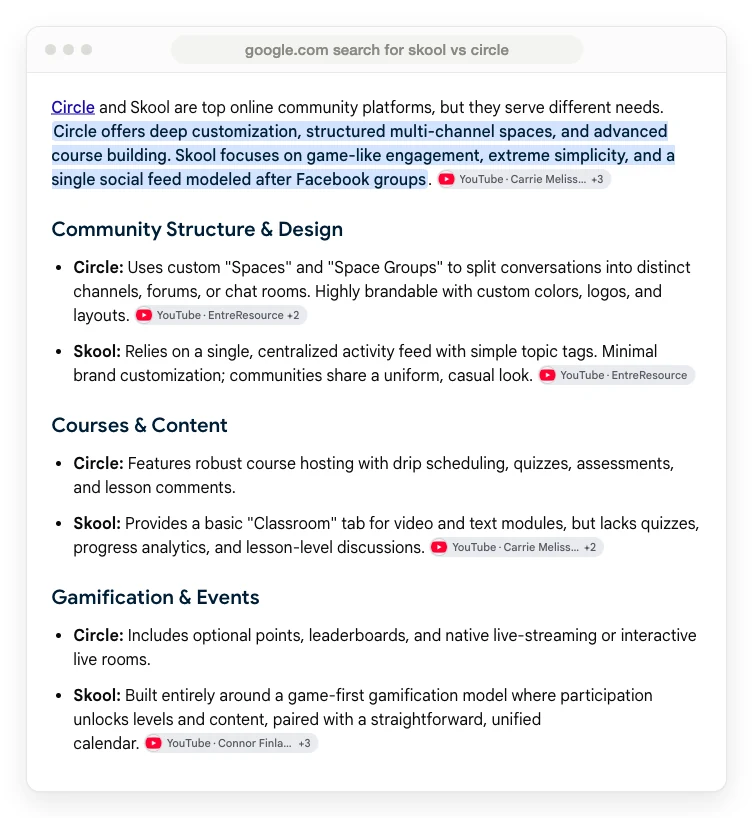
The third most common follow-up question on that same results page is “How much does Circle cost a month?”, and the answer box does not answer it. Google’s own support pages are upfront that AI responses may include mistakes. Nothing here looks wrong, which is why most readers never think to check.
The written pages do not close the gap. Here is what each one says, read live.
Across the 6 pages, 2 state no fee at all, 1 states its rival’s fee and not its own, and 3 give Circle plan names Circle no longer sells.
| Page | Skool’s fees | Circle’s fees |
|---|---|---|
| BloggingX, ranked 1st | Not stated | Not stated. Lists “the transaction fee is not disclosed in the pricing page” under a heading called 3 shady things |
| Circle’s own comparison, ranked 2nd | 10%, with the dollar math worked out | Never stated anywhere on the page |
| Carrie Melissa Jones, ranked 3rd | Not stated | Not stated. The page carries no dollar figure at all |
| WithHimanshu, ranked 5th | Correct | “Basic” $89 to “Enterprise” $399, fees “0.5% to 7%” |
| Mihael Cacic, ranked 7th | “One premium plan for $99/month. No annual plan” | Basic $49, Professional $99, Business $219, Enterprise $399 |
| LinoDash, ranked 8th | “a single pricing plan at $99 per month”, a “flat 2.9%… with no hidden fees” | Basic 4%, Professional 2%, Business 1%, Enterprise 0.5% |
3 of those rows are worth sitting with.
The 2 pages describing Skool as having 1 plan have both missed the $9 Hobby tier and its 10% fee, which is the single biggest number in this whole comparison. A reader trusting either page thinks Skool’s cheapest way in is $99.
The 3 pages pricing Circle at Basic and Enterprise are quoting a lineup Circle has retired. Circle’s pricing page today sells Professional, Business and Circle Plus. There is no $49 plan left to sign up for.
BloggingX, the page ranking first, gets closest. Under a heading called 3 shady things it lists that all Circle plans are billed annually and that the transaction fee is not disclosed on the pricing page. It then never says what the fee is.
2 of the pages also contradict themselves. LinoDash puts Circle Professional at “$129 per month, or $89 billed annually” in its summary table and “$99 per month” in its pricing section. WithHimanshu’s comparison table says Circle starts at $89 and its own FAQ, further down the same article, says Circle starts at $49.
What each platform takes from a payment
Skool takes 2.9% plus 30 cents on Pro with nothing added underneath, and Circle takes 2% plus whatever Stripe charges you, which is where these 2 platforms genuinely part company.
Circle’s 2% is real and it is on Circle’s pricing page. It is just not on the plan cards. You scroll past the plans, open a panel called “Compare plan features”, and find the Transaction fees row. The information icon beside it says, in Circle’s own words: “This is in addition to the standard Stripe processing fee.”
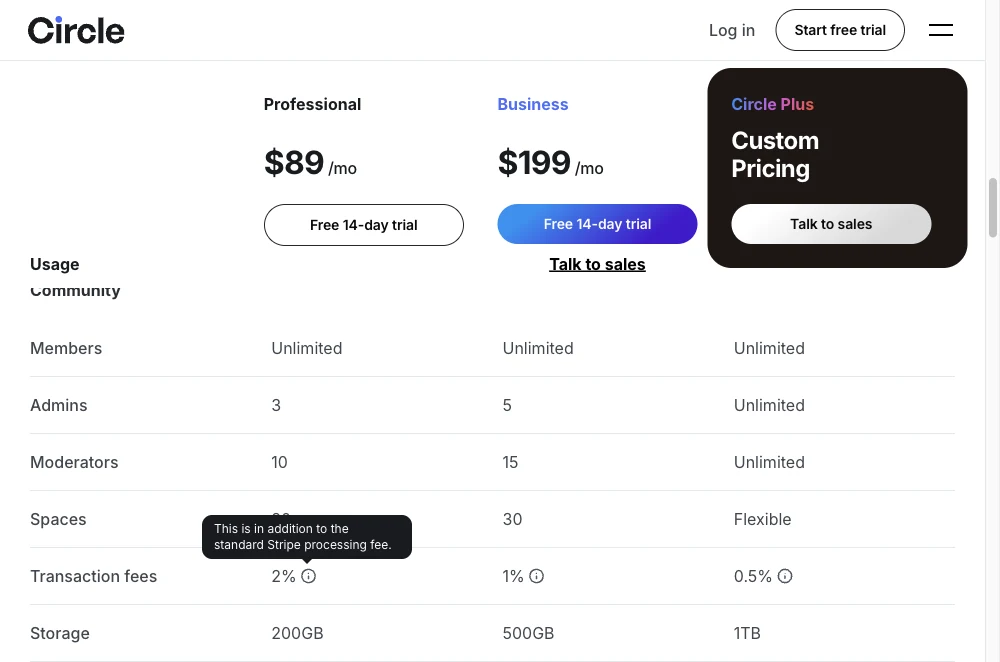
Circle does not process your payments. You connect your own Stripe account, Stripe takes its cut, and Circle takes 2% after that. Stripe’s published pricing is 2.9% plus 30 cents on a domestic card, with another 1.5% on international cards and 1% more when a currency conversion is needed.
Stack Circle’s 2% on top and a Circle Professional payment costs you 4.9% plus 30 cents.
Skool works the other way round. Skool is the merchant of record, which means the payment relationship belongs to Skool rather than to you. Its payments help doc says every charge runs on Skool’s own merchant account and that you cannot connect your existing Stripe account at all. So Skool’s 2.9% is the whole cost, with nothing added underneath it.
Skool Pro takes $3.20 from a $100 member payment and Circle Professional takes $5.20, so the platform charging 2.9% is cheaper per payment than the platform charging 2%.
| Plan | Platform cut | Stripe on top | Total fee | You keep |
|---|---|---|---|---|
| Skool Hobby | $10.00 | none | $10.30 | $89.70 |
| Skool Pro | $2.90 | none | $3.20 | $96.80 |
| Circle Professional | $2.00 | $2.90 | $5.20 | $94.80 |
| Circle Business | $1.00 | $2.90 | $4.20 | $95.80 |
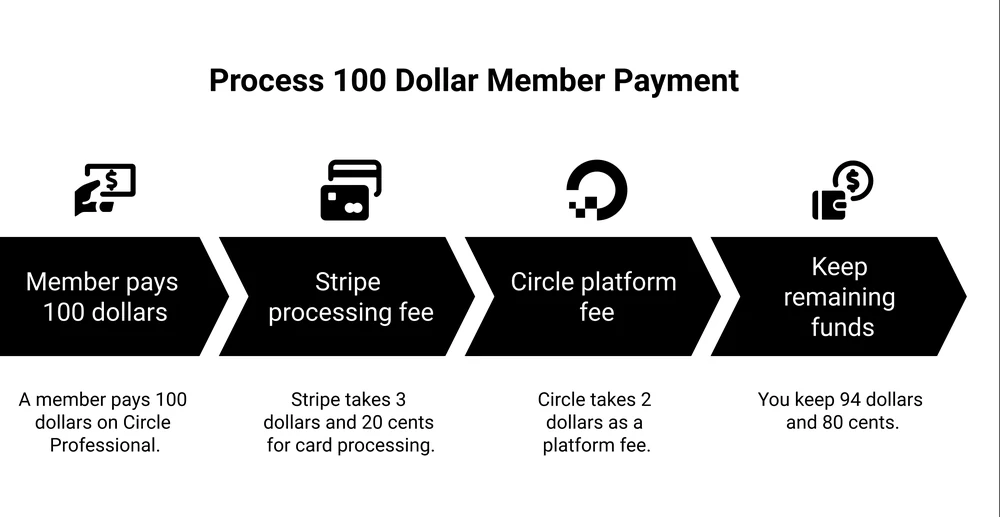
All rows include the 30 cents per transaction. Skool’s help doc adds 1 detail its pricing page leaves off: on Pro, the 2.9% becomes 3.9% on any single payment of $900 or more. Sell a $997 cohort seat and the rate on the card is not the rate you pay.
The rest of Skool’s fee schedule, including the 30% commission it charges on members its own directory sends you, is in this Skool pricing breakdown.
What it costs at $1,000, $2,500 and $10,000 a month
At the $1,000 a month Circle picked for its own example, Skool Hobby costs $121, Skool Pro costs $140 and Circle Professional costs $150, so the number Circle chose is the one where Circle comes out most expensive of the 3.
| Monthly member payments | Skool Hobby | Skool Pro | Circle Professional | Circle Business |
|---|---|---|---|---|
| $1,000 (40 x $25) | $121 | $140 | $150 | $250 |
| $2,500 (100 x $25) | $289 | $201.50 | $241.50 | $326.50 |
| $10,000 (400 x $25) | $1,129 | $509 | $699 | $709 |
Those totals are the plan price plus the percentage plus 30 cents a payment, at 40, 100 and 400 members paying $25 a month.
Circle’s comparison page says this about Skool: “The Hobby plan is $9/month but takes a 10% cut of all revenue. At just $1,000/month in membership income, that’s $100 gone.” True, and the same page never runs the equivalent line for Circle. Count everything and the $100 Circle points at is still the cheapest total on the page.
To be fair to Circle, you get more platform for that $150. Separate spaces, a website builder, live rooms and a real course builder are all on that plan and none of them exist on Skool. Circle still wrote the fee comparison, chose the number, and left itself out of it.
Read the $10,000 row and the pattern is easier to see. Skool Pro costs $509 and Circle Professional costs $699, a difference of $190 a month or $2,280 a year, on plans whose sticker prices are within $10 of each other.
Where each plan stops being the cheap one
4 crossover points fall out of that arithmetic, and I could not find any of them published anywhere else.
$500 a month in member payments: Skool Pro overtakes Circle Professional. Circle’s plan saves you $10 a month and its extra 2% costs you $20 for every $1,000 you collect. Below $500 a month Circle Professional is cheaper. Above it, Skool Pro is, and the gap grows by $20 for each extra $1,000.
$1,268 a month: Skool Pro overtakes Skool Hobby. Pro costs $90 a month more and saves 7.1% of every payment. Below that number the $9 plan really is the cheap one.
$1,569 a month: Circle Professional overtakes Skool Hobby. Circle’s plan costs $80 a month more than Hobby and saves 5.1% per payment.
$11,000 a month: Circle Business overtakes Circle Professional. Business costs $110 a month more and drops the cut from 2% to 1%.
1 caveat on the $500 figure, and it runs in Circle’s favour. Those numbers use Skool’s month-to-month price of $99 against Circle’s annual-billing price of $89, because Circle publishes no monthly rate. Put both on yearly billing, where Skool Pro is $82 a month, and Skool overtakes Circle at $350 a month instead of $500. There is a cash-flow difference too: Circle’s $89 means paying for a year up front, and Skool’s $99 does not.
A single feed or Spaces: how each platform is built
Skool gives every community 1 activity feed and Circle gives you Spaces you group and arrange yourself, and that single decision explains most of what people like and dislike about each one.
Skool’s whole layout is a feed with topic tags, a Classroom tab, a calendar and a leaderboard. There is nothing to configure, which is the point. Members who have used a Facebook group know where everything is within a minute.
Circle splits conversation into Spaces, and Spaces into Space Groups. Circle Professional includes 20 of them and Business includes 30, with extra spaces at $20 a month per 10. You can run a members area, a coaching track, a paid cohort and a free tier as separate rooms inside 1 community.
The trade shows up in the community-manager threads. On r/CommunityManager, a manager who says they have used them all puts it in a sentence: “Skool is my favorite for most use cases and creator focused businesses. Circle makes the most sense for businesses looking to white label.” A second commenter in the same thread flags the limit that bites first, that Skool “only has one chat thread per community”, so subniches have nowhere to go.
Sizing matters here more than preference. A 40-member coaching group split into 20 Spaces is 20 quiet rooms. A 2,000-member community in 1 feed is a wall nobody can follow.
Courses: a Classroom tab against a course builder
Circle’s course tool is the more capable of the 2, and Circle includes it on the $89 Professional plan rather than holding it back for a higher tier.
Circle gives you modules, drip scheduling, quizzes and comments at the lesson level, each documented in its own course help section. Skool gives you a Classroom tab that holds video and text modules in order.
Skool’s help centre files that tab under courses and the rules that open content up to members. It documents no quiz, no assessment and no progress tracking.
The commenter who flagged Skool’s single chat thread put the same point more bluntly. They recommend Skool for engagement, then add a warning: “I just wouldn’t recommend it for people who are too focused on education as Skool is misleading on the name, and actually is lacking a lot as an education platform in regards to online courses features.”
That is the right way to read Skool’s Classroom. It is a place to put the material your group discusses. If the course itself is the product and the group came free with it, a dedicated course platform will cost less than either of these once you count the cut. Our breakdown of what a course platform really takes prices 7 of them, and what it costs to create an online course covers the bill before you ever pick a platform.
Gamification and live events
Skool builds its whole product around points and levels, and Circle now offers the same thing with meters on the live side.
Skool’s leaderboard is core rather than a setting you switch on. Points come from likes and participation, levels open up content, and Skool gives leaderboards their own help-centre category alongside Community and Classroom. Its calendar category covers events, Skool calls and going live.
Circle matches the gamification and carries more live capacity, with live streams and live rooms built in. What Circle meters is how much of it you get.
Professional covers 100 live-stream attendees, 15 people in a live room and 10 hours a month, and Business raises that to 200, 20 and 15. Past those caps, extra attendees cost $20 a month per 100 and extra hours cost $50 a month per 10.
Gamification is no longer a reason to pick between them. Live capacity is, if you run big sessions.
The white labelling is on the $199 plan, not the $89 one
Circle’s white labelling, the most common reason people give for choosing Circle over Skool, is not included on Circle’s Professional plan. The Compare plan features panel marks “White-labeled community” with a cross on Professional and a tick on Business at $199 a month.
Professional does give you a custom domain, your own colours and a logo, so your community can look like yours. What it cannot do is remove Circle’s own branding. Circle’s plan cards say as much in a quieter way, listing “Remove Circle branding” as one of the things Business adds on top of Professional.
2 more items on that panel are priced separately on Professional rather than included. Customizable profile fields cost $49 a month and sender email customization costs $40 a month. Both are ticked on Business.
Circle’s own comparison page lists “Built-in email marketing and broadcasts” as an advantage over Skool. Circle’s Email Hub is an add-on charged on top of your community plan, starting at $99 a month for 10,000 contacts, and it is bundled only into the custom-priced Circle Plus tier.
So a Circle setup matching what the marketing describes is not $89 a month. Business at $199 plus Email Hub at $99 is $298 a month before a single member pays you.
Who holds the money, and what happens when you leave
Skool holds your members’ payment relationship and Circle leaves it in your own Stripe account, which decides how easily you can leave: Skool subscriptions cannot move with you, and Circle’s can.
Skool being the merchant of record buys you real things. Skool files and remits EU VAT, so you never register for it. Skool absorbs the chargeback and tax admin too.
Its 2.9% is also flat whoever your member banks with. That beats running your own Stripe when your buyers are spread across countries, because Stripe adds 1.5% for an international card.
It costs you the relationship. You cannot connect your own Stripe account, and payouts land every Wednesday through a Stripe Express account Skool creates, with the first one taking up to 14 days.
Skool also adds VAT on top of your price rather than inside it. Its payments doc uses Germany as the example: a $100 a month product becomes $119 a month for a German member.
The part that matters when you switch is that subscriptions billed on Skool’s merchant account cannot move with you. Your members have to re-subscribe somewhere else. Circle’s arrangement, where the card is already in your own Stripe account, is easier to leave. We worked through this question in detail on who keeps your members if you leave across 8 membership platforms.
There is 1 more Skool number worth checking before you sign up, because it is switched on by default. Growth Boost puts your group in Skool’s public directory and runs ads for it, and Skool then keeps 30% of what any member it sends you pays, for as long as they stay subscribed. You can turn it off in Settings under Discovery.
Which one to pick
Pick Skool when the group is the product, and pick Circle when your brand is.
Skool fits a single paid community where discussion is the value, a coaching program, a mastermind, anything moving off a Facebook group. It fits harder if your members are spread across countries, because the flat 2.9% quietly beats Stripe’s international rate. And it fits above $500 a month in member payments, where its cut is simply lower.
Circle fits a business running several things at once that need separate rooms, a brand that cannot look like everyone else’s, or a course that is a real course rather than a video tab. Take the $89 plan at face value only if you can live with Circle’s branding, and budget $199 if you cannot.
Under $500 a month in member payments, Circle Professional is the cheaper of the 2 paid options. At that volume its $89 plan saves you more than its extra 2% costs you.
Neither is a good answer if you have not sold anything yet. Both cost real money from month 1, and how to sell online courses is a cheaper first problem to solve than which platform hosts them.
When you do not need either one
You need neither platform if nobody in your group posts anything, and the check takes a minute: count how many members posted last month.
I see this often enough to raise it. Somebody buys the thing, the group comes free with the thing, and the discussion tab sits there while you pay $99 a month and hand over a percentage of every renewal. A community platform is worth its cut when the community is the reason people stay.
I had a call once with someone who wanted to buy a service I was selling at the time, for getting emails out of Gmail’s Promotions tab. Partway in it was clear he did not have the problem. His emails were already landing where he wanted them and he had not realised it.
He was already a customer of mine, so it would have been an easy sale. I told him instead, and we ended the call early. That is easier to say than to do, which is why I want to be straight about my own position here.
I run CartMango, a checkout platform for solo digital sellers, so I am not a neutral party. I will also say plainly that CartMango is not a Skool or Circle replacement today.
CartMango hosts no community and no courses right now. CartMango is building both, and they arrive on the $30 a year plan in October 2026. Until then, if you need a community, one of these 2 is your answer and I would rather you picked the right one.
A fuller version of this comparison, priced across 6 platforms including Mighty Networks, Heartbeat, Patreon and Discord, is in what community platforms really cost.
FAQ
How much does Circle cost a month?
Circle Professional is $89 a month and Circle Business is $199 a month, both on annual billing, which is the only billing Circle prices on its pricing page. Circle Plus is custom priced. On top of the plan, Circle takes 2% of every member payment on Professional and 1% on Business, and Stripe’s 2.9% plus 30 cents applies underneath that.
Does Skool or Circle take a cut of my revenue?
Both do. Skool takes 10% plus 30 cents on its $9 Hobby plan and 2.9% plus 30 cents on its $99 Pro plan, rising to 3.9% on any single payment of $900 or more. Circle takes 2% on Professional and 1% on Business, charged on top of Stripe’s own 2.9% plus 30 cents rather than instead of it.
Is Circle worth it compared to Skool?
Circle earns its price when you need separate Spaces, a proper course builder, or a community carrying your branding rather than Circle’s. It is worth less if you run 1 discussion group and collect more than $500 a month, because its all-in 4.9% costs more per payment than Skool Pro’s 2.9%. The white labelling most people want Circle for needs the $199 plan.
Who is Circle’s biggest competitor?
Skool is the one Circle names, since Circle publishes a dedicated comparison page against it. Mighty Networks, Heartbeat, Patreon and Discord all compete for the same buyer, and they price very differently once you count what each takes per payment. All 6 are priced side by side in our community platform comparison.
What is better than Skool?
For branding and structure, Circle. For a real course with quizzes and progress tracking, a dedicated course platform. For a free start, Discord, though it takes 16% once you charge for access, a 10% platform fee plus 6% processing, and 40% when the member subscribes through the iOS App Store. Skool is hard to beat on cost above $500 a month in member payments, and on being plain enough that members work it out without help.
Is Skool’s public directory good or bad for a paid group?
Members who arrive through that directory cost you a 30% recurring commission unless you turn Growth Boost off, so the answer comes down to what those joins are worth to you. BloggingX describes Skool’s Discover feature as a source of organic joins, similar to a Facebook group. Circle’s own comparison page describes the same directory as listing your brand “right next to MLM schemes”. Neither of them states the commission.
Selling the thing is a separate job from hosting the room
A community platform charges a percentage for running the room your members live in. A checkout has a narrower job: take the money, hand over the file, and keep the buyer on a list you own. CartMango does that job for solo digital sellers with no per-transaction platform fee on any plan, so the only cut is your card processor’s. CartMango is free until October 2026, then $10 a year.
About the Author

👋 I’m Welly, founder of CartMango (the site you’re on), a checkout platform for digital product sellers. We’ve previously processed $179M+. I also run BirdSend (email marketing tool, 3.1B+ emails sent). On the side I show other non-techie digital sellers how I use AI workflows to automate 50%+ of my operations. Find me on LinkedIn.
Related Reading
- What community platforms really cost: the Skool vs Circle fee math extended across 6 platforms including Mighty Networks, Heartbeat, Patreon and Discord
- Skool pricing breakdown: every Skool fee including the 30% commission and the rate its pricing page leaves off
- Membership site platform costs: 8 platforms priced at 100 members, and who keeps your subscribers if you leave
- What a course platform really takes: real fees for 7 course platforms and the crossover point on every entry plan