

The best Stan Store alternative depends on what you need. Gumroad and Payhip sell digital products with no monthly fee. CartMango is a low-cost own checkout with upsells. Podia or Kajabi fit courses and community. Most switchers cite Stan’s $29 to $99 a month price, not its features.
Stan Store made link-in-bio selling simple, and for a lot of creators that was the on-ramp. Then the bill arrives. The Creator plan runs $29 a month, and the Pro plan jumps to $99. That is $300 to $948 a year for what is, underneath, a single-page checkout with a link in your bio. Plenty of sellers hit that price wall, look at how little they sell each month, and start asking what else is out there. Some want the same all-in-one feel for less. Others realize they never needed the bundle and just want a cheap, simple way to take payments. This guide sorts the real Stan Store alternatives by what you are actually trying to do, with honest pricing and fee math for each, so you pick the right tool instead of the loudest one.
Key Takeaways
- Price is the top reason creators leave Stan Store: $29 to $99 a month ($300 to $948 a year) is steep for a single-page link-in-bio checkout.
- Stan does not charge a platform cut, only Stripe and PayPal’s standard 2.9% plus $0.30. So switching to “lower fees” rarely means lower per-sale fees, it means a lower monthly bill.
- Decide what you need first: a link-in-bio store, a full course and community platform, or just a cheap checkout. The right alternative is different for each.
- Free or near-free options exist: Gumroad and Payhip have no monthly fee, and CartMango is free during beta then $10 a year.
- Most “Stan Store alternative” lists push another expensive all-in-one. Check whether you actually use the bundle before paying for it again.
Why creators look for a Stan Store alternative
Stan Store is a link-in-bio tool. You get one page, you drop your products and booking links on it, and you share that link from your social bio. For a creator selling a couple of digital products to an Instagram audience, that is genuinely enough to start.
The reasons people start hunting for a Stan Store alternative are pretty consistent.
The price. This is the big one. Stan’s Creator plan is $29 a month and Creator Pro is $99 a month (a bit less if you pay yearly). If you are doing $200 a month in sales, a $29 to $99 monthly fee eats a huge chunk of that. And most creators are at that level: the Influencer Marketing Hub Creator Earnings Report 2025 found more than half of creators earn under $15,000 a year. Creators on Reddit’s r/digitalproductselling and r/thesidehustle regularly compare notes on this, with the same theme: the monthly cost outpaces what a small store brings in.
The single-page limit. Everything lives on one link-in-bio page. That is simple, but it caps how you organize products, and it gives you almost nothing to rank in search. If you ever want a real website or content that pulls in traffic, the structure works against you.
Branding and customization. Lower tiers keep you inside Stan’s layout and put a “Powered by Stan” badge on your store. Custom domains and deeper design control sit behind the higher plan.
Outgrowing the bundle. Stan tries to do storefront, courses, bookings, and email in one place. As your course or community needs grow, the built-in versions can feel thin compared with dedicated tools.
None of this makes Stan Store bad. It makes it a specific tool at a specific price. The question is whether that tool and that price still fit you.
Want to plug the profit leaks before you switch platforms? My free 5-day Online Selling Mistakes Challenge walks through the 5 mistakes that quietly cost solo sellers the most. It is free to join.
First, decide what you actually need
Here is the trap with most “best Stan Store alternative” lists. They are written by platforms, and every one of them concludes that the answer is their platform, which usually means another $29 to $149 a month all-in-one. You leave one bundle and sign up for a slightly different bundle.
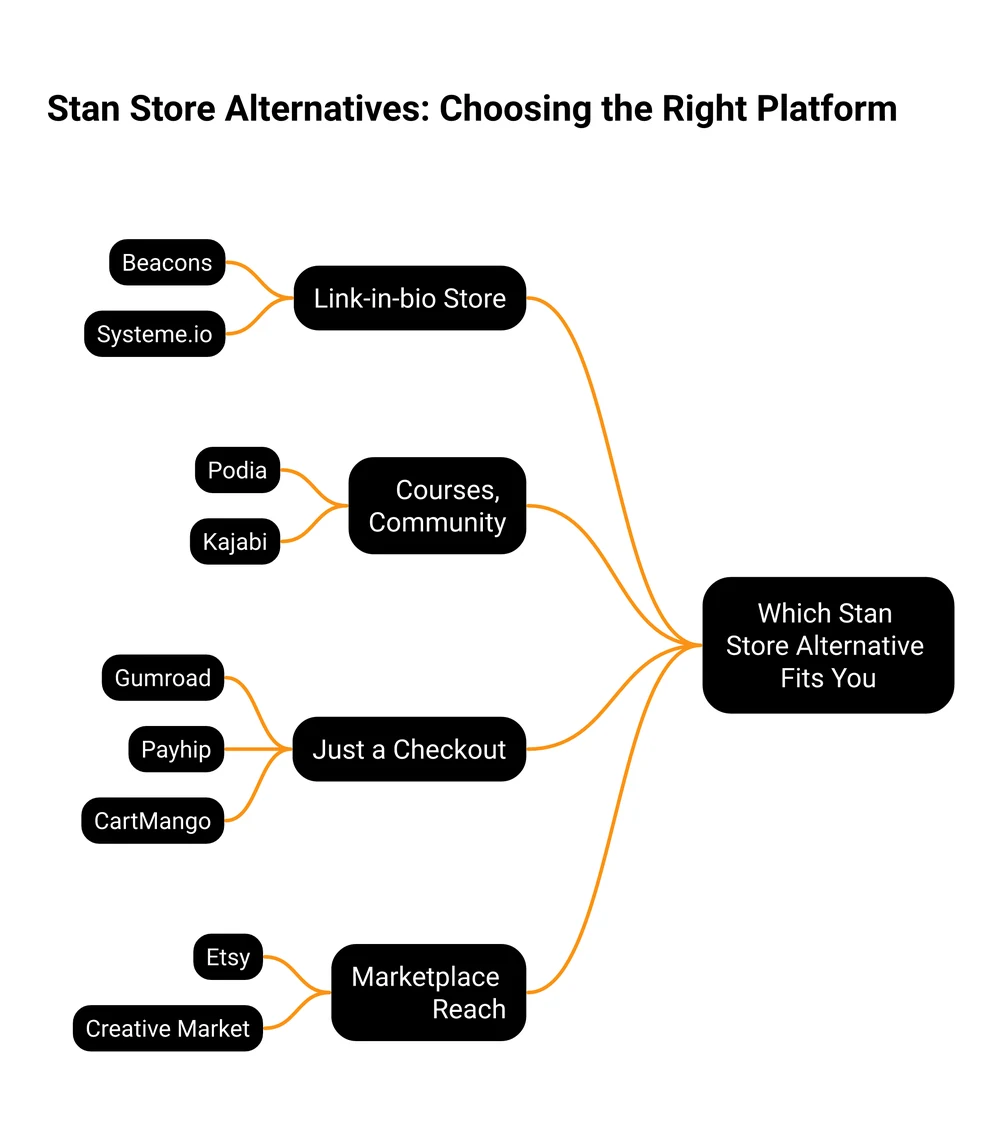
Before you do that, figure out which of these you actually are.
- You want a link-in-bio store, just cheaper or prettier. You like the Stan setup. You just want lower cost or more design control. Look at Beacons, Systeme.io, or a Linktree-plus-checkout setup.
- You want a real course and community platform. You are building structured courses, drip content, memberships, or a community. This is where Podia, Kajabi, GroupApp, Circle, or Skool earn their cost.
- You just want to take payments for digital products. You do not need the link-in-bio page, the LMS, or the community. You want a simple checkout that keeps your costs low and helps you sell more per buyer. This is the Gumroad, Payhip, Sellfy, and CartMango lane.
- You want marketplace reach. You want buyers to find you, not just to check out. Etsy or Creative Market put you in front of existing shoppers, with their own fee tradeoffs.
Most Stan Store users who feel the price pinch are actually in group 3. They bought an all-in-one, use a fraction of it, and are paying all-in-one prices. If that is you, a dedicated checkout costs a fraction of what a bundle does.
I will say upfront that I run CartMango, a checkout platform in that third group, so I have a horse in this race. I will keep the pricing honest and tell you where CartMango is the wrong pick, because it often is.
What to look for in a Stan Store alternative
Once you know which group you are in, a handful of things separate a good switch from a lateral move to another overpriced tool. Run any candidate through these.
The cost model, not just the price. A flat monthly fee, a per-sale percentage, and a tiny annual fee are three different shapes. A $0-a-month tool that takes 10% per sale can cost more than a $29-a-month tool once you sell enough. Match the model to your volume, not to the sticker price.
What you are actually selling. One-off downloads, subscriptions, coaching calls, and full courses each have a best-fit tool. A checkout that nails digital downloads may have no course player at all. Buy for what you sell, not for the longest feature list.
Who owns the customer. Some platforms keep the buyer relationship inside their walls. You want your buyer emails exporting into your own email tool so you can sell to those people again without asking permission.
Branding and your own domain. If a “Powered by” badge or a locked layout bothered you on Stan, check whether the alternative lets you use your own domain and remove its branding, and on which plan.
Upsell and order-bump support. The fastest way to earn more without more traffic is selling more to the buyer already at checkout. Not every tool offers one-click upsells or order bumps. If raising your average order value matters, make this a requirement.
How easy it is to leave. Yes, check the exit before you enter. A platform that lets you export products and customers cleanly is one you can leave later without the pain you are feeling now.
The best Stan Store alternatives by what you need
If you want a link-in-bio store (cheaper or more flexible)
Beacons is the closest like-for-like to Stan. Link-in-bio page, store, email, and a free tier to start. Good if you want the Stan feel without the Stan monthly fee on day one.
Systeme.io is a free all-in-one that covers funnels, courses, and email. More moving parts than Stan, but the free plan is generous if you want to grow into it.
These keep the link-in-bio setup you already know.
If you want courses and community
Podia is the simple end: courses, memberships, and digital downloads without a steep learning curve, good for solo creators.
Kajabi is the heavy end: full course hosting, funnels, email, and pipelines, built for creators running a complete business. It is also the most expensive option here, so only go there if you will use it.
GroupApp, Circle, and Skool lean into community and cohort learning if that is your core, rather than one-off product sales.
This is the group that genuinely replaces Stan’s “do everything” promise. If you use Stan’s courses and community, stay in this lane.
If you just want a cheap, simple checkout
This is where most price-sensitive switchers land. You are selling digital products, templates, ebooks, presets, or one-off downloads, and you want to keep costs low and sell more per buyer.
Gumroad is the fastest start. No monthly fee, a 10% plus $0.50 cut per sale, and it acts as Merchant of Record so it handles sales tax for you. Great for first sales, expensive once volume grows.
Payhip has a free plan (5% per sale), and paid plans that drop the fee as you scale. Clean and beginner-friendly.
Sellfy is subscription-based with no extra per-sale cut, aimed at creators who want a fuller store.
CartMango is the one I built, so treat this as disclosure not neutrality. It is a dedicated checkout with one-click upsells, downsells, and order bumps, free during beta and $10 a year after, with no platform cut on top of Stripe. It does not do link-in-bio pages, course hosting, or community. If you need those, pick from the group above instead.
If you want marketplace reach
Etsy and Creative Market are not really Stan replacements, they are marketplaces. You trade higher fees for built-in buyer traffic. Worth it if discovery is your bottleneck, not checkout.
Stan Store alternatives compared: cost and fees
Here is the honest money picture across the most common picks for the “just want a checkout” group, plus Stan itself as the baseline. Every platform below also pays the payment processor’s standard cut, which is Stripe’s 2.9% plus $0.30 per transaction in the US, so that is not the differentiator. The plan cost and the per-sale cut are.
| Platform | Best for | Plan cost | Per-sale cut* |
|---|---|---|---|
| Stan Store | Link-in-bio all-in-one | $29 to $99/mo ($300 to $948/yr) | None beyond Stripe |
| Gumroad | First sales, zero setup | $0/mo | 10% + $0.50 per sale |
| Payhip | Free start, lower fee as you grow | $0 to $99/mo | 5% free, 2% Plus, 0% Pro |
| CartMango | Cheap own checkout + upsells | Free in beta, then $10/yr | None beyond Stripe |
*Fees from each platform’s public pricing. All four also pay Stripe or PayPal’s standard 2.9% + $0.30 per sale.
The table makes the real tradeoff obvious. Stan and CartMango both take no platform cut per sale, so on fees alone they are even. The gap is the plan cost: Stan is $300 to $948 a year, CartMango is free during beta then under $10 a year. Gumroad and Payhip flip it the other way, no or low monthly cost but a slice of every sale.
I will be upfront here. CartMango is my platform, built for sellers who want to keep more of each sale and add upsells without paying all-in-one prices.
How much each really costs at your sales volume
Fee tables lie a little, because the “best” option flips depending on how much you sell. Run your own numbers, but here is roughly how it goes.
- Under $500 a month in sales: a monthly fee hurts most. Gumroad’s no-monthly-fee model or CartMango’s near-zero annual cost beat Stan’s $29 to $99 a month easily. Payhip’s free plan works too.
- $500 to $3,000 a month: the per-sale cut starts to matter. Gumroad’s 10% on $2,000 is $200 a month, which is more than Stan’s whole Creator plan. A flat-cost checkout like CartMango, or Payhip’s paid tier, pulls ahead.
- $3,000 a month and up: flat or zero per-sale cost wins clearly. Paying 10% of $5,000 is $500 a month. A platform that charges a small flat fee and takes nothing per sale keeps that money with you.
Put real numbers on it. Say you sell $1,000 a month in digital products, 50 sales at $20 each. Before Stripe’s processing, which every option charges, here is roughly what the platform itself takes each month:
- Stan Store (Creator): $29 flat, no per-sale cut. You keep $971.
- Gumroad: 10% plus $0.50 a sale, so $100 plus $25, which is $125. You keep $875.
- Payhip (free plan): 5% per sale, so $50. You keep $950.
- CartMango: free during beta, then under $1 a month at $10 a year, no per-sale cut. You keep about $999.
At this volume Gumroad costs the most, because a 10% cut on every sale adds up faster than a small flat fee. A low flat-cost checkout keeps the most in your pocket. At very low volume Gumroad’s free model wins because there is no fee to spread. Your number, not mine, decides it.
The lesson is not “this one platform always wins.” It is that Stan’s flat monthly fee only makes sense if you are selling enough to spread it across, and you actually use the link-in-bio, course, and booking features you are paying for. If you are not, you are overpaying for a bundle.
How to migrate off Stan Store without losing sales
Switching platforms sounds scarier than it is. The order that keeps your income steady:
- Export your products and customer list first. Download your digital files and your buyer emails from Stan before you cancel anything.
- Set up the new checkout in parallel. Build your products on the new platform while Stan is still live. Test a real checkout end to end.
- Move your email list. If your buyers were syncing into Stan’s email tool, get them into your own email platform so you still own the relationship.
- Update your link in bio last. Once the new store is tested, swap the link in your social bio. This is the actual switch. Do it after everything else works.
- Tell your audience. A quick “new store, same products” post avoids confusion for repeat buyers.
- Cancel Stan only after the new store has taken real sales. Keep the overlap short, but do not cancel until money is flowing through the new setup.
If you are also rethinking where you sell beyond a single link, this guide on selling digital products without a website and this one on digital product pricing pair well with a platform switch.
FAQ
Is there a free Stan Store alternative?
Yes. Gumroad has no monthly fee and charges 10% plus $0.50 per sale. Payhip has a free plan with a 5% per-sale fee. CartMango is free during its beta, then $10 a year. Beacons and Systeme.io also have free tiers if you want the link-in-bio setup. Each still pays standard Stripe or PayPal processing on top.
Does Stan Store charge transaction fees?
Stan Store does not add a platform transaction fee on its paid plans. You still pay Stripe or PayPal’s standard 2.9% plus $0.30 per sale, which every platform charges. So Stan’s real cost is the monthly plan, $29 for Creator or $99 for Creator Pro.
What is the cheapest Stan Store alternative?
On plan cost, CartMango is among the cheapest at free during beta and $10 a year after, with no per-sale platform cut. On a pure no-monthly-fee basis, Gumroad and Payhip’s free plans cost nothing up front but take a percentage of each sale, so the cheapest option depends on your sales volume.
Can I move my Stan Store products to another platform?
Yes. Your digital files, product descriptions, and customer email list are yours. Export them from Stan, rebuild the products on your new platform, then redirect your link in bio. Keep both live briefly so you do not miss sales during the switch.
Is Stan Store worth it?
If you actively use the link-in-bio page, the courses, the bookings, and the email features, and you sell enough each month to justify $29 to $99, it can be. If you mostly sell a few digital products and use a fraction of the features, you are likely overpaying, and a dedicated checkout will cost far less.
Do I need an all-in-one platform to replace Stan Store?
No, and this is the most common overpay. Many Stan users only need a simple checkout for digital products, not the full bundle of storefront, courses, and community. If that is you, a dedicated checkout costs a fraction of an all-in-one and does the one job you actually need.
If you landed in the “I just want a cheap checkout” group, that is the Stan Store alternative I built CartMango to be. It is a dedicated checkout for digital sellers, with one-click upsells and order bumps so you earn more per buyer instead of paying all-in-one prices for features you never touch. Free while we are in beta, then $10 a year. No platform cut on top of Stripe. If you need link-in-bio, courses, or community, one of the platforms above will serve you better, and I would rather you pick the right tool.
About the Author

👋 I’m Welly, founder of CartMango (the site you’re on), a checkout platform for digital product sellers. We’ve previously processed $179M+. I also run BirdSend (email marketing tool, 3.1B+ emails sent). On the side I show other non-techie digital sellers how I use AI workflows to automate 50%+ of my operations. Find me on LinkedIn.
Related Reading
- How to sell digital products without a website – where to sell when you do not want a full site
- How to price digital products – the pricing method behind a healthy margin
- Platforms to sell ebooks – a focused look at one product type
- Best Gumroad alternative – for readers comparing the no-monthly-fee checkouts
- Payhip alternatives – if Payhip is on your shortlist