

Affiliate management software tracks who referred a sale, works out the commission and pays your affiliates. Standalone tools start at $49 a month, or $588 a year. Checkout platforms like Payhip, Gumroad and E-junkie include the same job at no extra cost, so most solo sellers never need to buy a separate tool.
I went looking for what these tools cost and hit a wall on the first 2 results.
Google’s AI Overview puts impact.com at the top of this category. impact.com has no pricing page. Type the URL in and it sends you to a demo request form instead. PartnerStack sits second, and its pricing page lists 3 plans with no numbers on any of them.
That tells you something before you read a single feature list. When a company will not print a price, you are probably not the customer it wrote the pricing for.
Below is every price I could actually find, read off each vendor’s own page. Then the part no roundup covers: how many extra sales the software needs to generate before it pays for itself, and the much cheaper option most solo sellers already have sitting inside their checkout.
Key Takeaways
- The floor is $49 a month. That is the cheapest published price in the whole category, or $588 a year before you sell anything.
- Google’s 2 top picks hide their pricing. impact.com has no pricing page at all, and PartnerStack shows plan names with no numbers.
- Your checkout may already do this. Payhip, Gumroad, E-junkie and Systeme.io all run affiliate programs at no extra charge.
- Do the break-even first. On a $27 product at 30% commission, a $588 tool needs 33 extra sales a year just to cover itself.
- Check the cap before the price. Entry plans stop at $5,000 a month in affiliate revenue, or 50 affiliates, or 500 conversions.
What affiliate management software actually does
Affiliate management software does 4 jobs: it tags the visitor an affiliate sent you, it credits that affiliate when the visitor buys, it shows the affiliate their own dashboard, and it pays them.
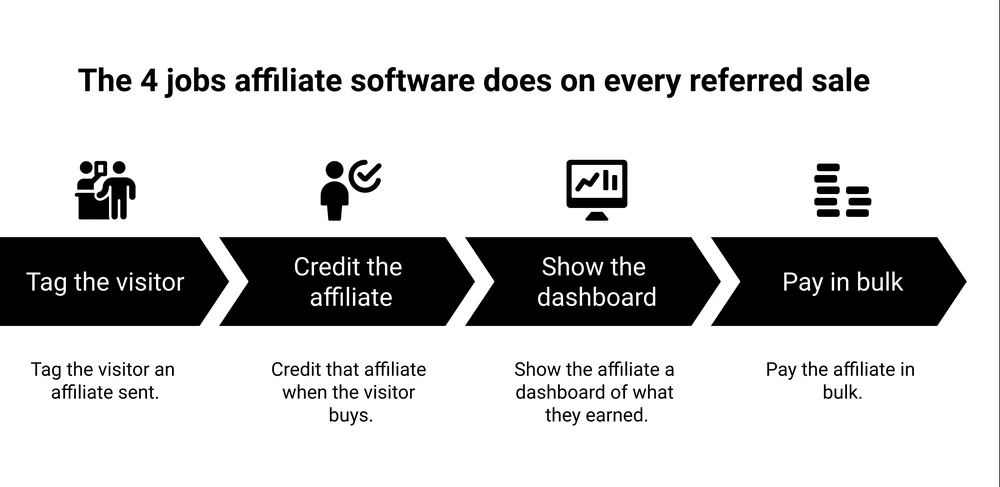
Sounds like something a spreadsheet could handle. It is, right up until the first awkward case.
A buyer clicks your affiliate’s link on Monday, does nothing, then buys on Friday from a Google search. Who gets paid?
A buyer refunds 3 weeks later, after you already paid the commission. Who eats it? An affiliate sends a customer onto a monthly subscription and expects a cut of every renewal for as long as it runs.
Those 3 cases are the whole product. Everything else is reporting.
I put together a free 5-day email course on the Online Selling Mistakes Challenge, covering the 5 things that quietly cost solo sellers money. Paying for tooling you do not need is one of them.
Why run an affiliate program at all
An affiliate program buys you reach you only pay for after it works, which is one of the few marketing channels a solo seller can add without spending money up front or hiring anyone.
Ads cost money whether or not they sell. A hire costs money whether or not they sell. An affiliate costs you nothing until a sale lands, and then costs you a share of a sale you would not otherwise have made.
3 other things come with it:
- Your affiliate lends you the trust of their audience, which converts better than a cold ad
- You reach people who were never going to find you through search
- The cost is fixed as a percentage, so the channel cannot lose you money the way a bad ad campaign can
The catch is that affiliates are not free traffic. Recruiting them, briefing them and keeping them interested is real work, and you should expect a small handful of partners to drive most of the results.
Where the tracking quietly breaks
Tracking is the part of affiliate software that fails silently, because a referral that goes untracked looks exactly like a sale that was never referred. Referral tracking leans on cookies, and browsers have spent years getting stricter about them.
In the r/SaaS thread ranking on page 1 for this term, a commenter warns that cookie blocking “quietly kills a chunk of conversions you never see in the dashboard.” He also discloses he is building a competing tool, so weigh it with that in mind.
FirstPromoter’s official account replied in the same thread to say their script sets first-party cookies on your own domain and confirms the sale server-side through your billing provider. That is the right question to put to any vendor you are considering, whoever raises it.
If you are earlier than all of this, and still working out how to get anyone promoting you at all, start with promoting digital products rather than buying tracking software for traffic you do not have yet.
What affiliate management software costs
Every figure in this table came off the vendor’s own pricing page. I read them all on the same day, because this category changes prices often and the roundups ranking above it do not keep up.
Rewardful, FirstPromoter and LeadDyno all start at $49 a month, Post Affiliate Pro and Tapfiliate at $89, Trackdesk at $399, and impact.com and PartnerStack publish no price at all.
| Tool | Entry price | What the entry plan caps | Free plan |
|---|---|---|---|
| Rewardful | $49/mo | $7,500/mo from affiliates | No, 14-day trial |
| FirstPromoter | $49/mo | $5,000/mo from affiliates | No, 14-day trial |
| LeadDyno | $49/mo | 50 active affiliates | No, 30-day trial |
| Post Affiliate Pro | $89/mo | 10,000 tracking requests | No, free trial |
| Tapfiliate | $89/mo | 50 affiliates, 500 conversions | No, 7-day trial |
| Trackdesk | $399/mo | $30,000/mo program revenue | No, 14-day trial |
| PartnerStack | Not published | Not published | Demo only |
| impact.com | Not published | Not published | Demo only |
3 things in that table are worth slowing down on.
Every entry plan has a ceiling. FirstPromoter’s $49 plan stops at $5,000 a month in affiliate revenue, and crossing it moves you to the $99 plan.
Tapfiliate’s entry plan allows 50 affiliates and 500 conversions a month, then charges $15 per extra 1,000 conversions. LeadDyno’s $49 tier caps at 50 active affiliates and 1 commission plan. Read the cap before you read the price, because the cap tells you how long the price lasts.
Some of those numbers are annual-billing rates in disguise. Trackdesk is $329 a month if you pay a year up front and $399 if you pay monthly. Tapfiliate is $74 annual and $89 monthly. One of the roundups ranking on page 1 lists Trackdesk as “From $329/month” with no note that the number needs a year of commitment attached.
The published prices drift. The same roundup puts Post Affiliate Pro at $97 a month. Post Affiliate Pro’s own page lists $89, with a promotion running at $60 until January 2027. Neither figure is $97.
Annualised, the floor is $588 and the ceiling on that table is $4,788, for the tool Google’s own summary singles out for “transparent, predictable pricing.”
The 2 tools Google recommends first will not tell you the price
Google’s AI Overview for this search names 5 platforms, and its first 2 picks do not publish a price anywhere on their sites.
impact.com is listed first. Its pricing URL does not resolve to a pricing page. It redirects to a sign-up page whose only 2 options are requesting a demo or joining as a partner. There is no dollar figure on it.
PartnerStack is listed second. It has a real pricing page, with named plans and full feature lists. Every plan’s button reads “Book your demo.” The only dollar amount anywhere on the page is a marketing statistic about revenue their customers earned.
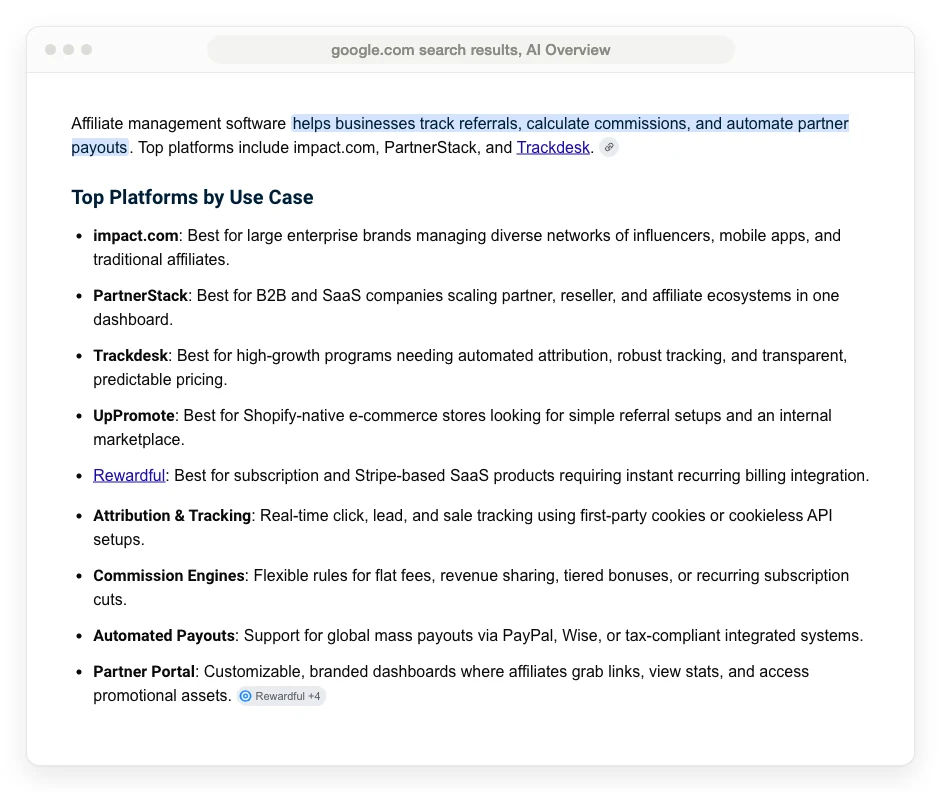
Read the descriptions in that screenshot again and notice who each one is built for:
- impact.com, for large enterprise brands
- PartnerStack, for B2B and SaaS companies
- Trackdesk, for high-growth programs
- UpPromote, for Shopify-native stores
- Rewardful, for Stripe-based SaaS products
Not one of the 5 is described as being for a person selling an ebook, a course or a set of templates. The summary is accurate about who these tools serve. That is who the category was built for, which is why the prices look the way they do.
“Contact sales” is a filter. It usually means the number moves depending on your size, and that a salesperson needs to work out how big you are first. For a business turning over millions in partner revenue, that is normal. For someone selling a $27 product, it is a clear signal to look elsewhere.
The break-even math nobody on page 1 does
The break-even question is the one every roundup skips: how many extra sales does the software have to bring in before it has paid its own bill? Neither editorial page ranking for this term works it out, so here it is.
Start with 1 sale. You sell a $27 product and your affiliate takes 30%, which is $8.10. That sits inside the 20% to 50% range that is normal for digital products, and there is more on that in our affiliate marketing statistics roundup.
Card processing takes roughly 2.9% plus $0.30, so $1.08. You keep $17.82.
At a $27 product and a 30% commission you keep $17.82 a sale, so a $588 a year tool needs 33 extra sales to break even and a $4,788 a year tool needs 269.
| Product price | You keep per affiliate sale | Sales to cover $588/yr | Sales to cover $4,788/yr |
|---|---|---|---|
| $27 | $17.82 | 33 | 269 |
| $47 | $31.24 | 19 | 153 |
| $97 | $64.79 | 9 | 74 |
Read the first row as roughly 3 extra sales a month, every month, before you are level. They also have to be sales you would not have made anyway.
That last part is the bit that catches people out. An affiliate sale to someone who already followed you and was going to buy on Friday is not a new sale. You just paid 30% of it away and added a software bill on top.
The $97 row is the interesting one. At a higher price point the software gets easy to justify fast, which is roughly the same conclusion you reach when you work through how to price digital products for any other reason. Cheap products make every fixed cost look expensive.
Your checkout probably already does this for free
Most checkout platforms built for digital sellers include affiliate management at no extra charge, which makes a separate $49 a month tool redundant for a lot of people reading this.
The top-voted reply in that same r/SaaS thread puts it in 7 words: “most affiliate tools are overkill early on.”
The person asking said they were launching an affiliate program for a SaaS. 2 of the substantive answers they got came from vendors, 1 pitching a trial and 1 from a founder who disclosed he was building a rival tool. That is what most research on this topic looks like.
Payhip, Gumroad, E-junkie and Systeme.io all run an affiliate program at no extra charge, ThriveCart puts it behind an $87 a month plan, and CartMango does not have it yet.
| Platform | Extra cost for affiliates | What you pay instead |
|---|---|---|
| Payhip | $0 | 5% of each sale on the free plan |
| Systeme.io | $0 | free plan, capped at 2,000 contacts |
| E-junkie | $0 | $8 a month, 10 products |
| Gumroad | $0 | 10% + $0.50 a sale, card processing on top |
| ThriveCart | $87/mo Pro+ | the $47/mo Standard plan has no affiliate tools |
| CartMango | not available yet, affiliate management launches September 2026 | free until October 2026, then from $10 a year |
I should be upfront that CartMango is my own checkout platform, and on this particular feature it is the row that loses. Every other platform in that table can run an affiliate program today and CartMango cannot.
A few notes on the rows that do.
Payhip runs its affiliate tool on every plan including the free one. Their own help page describes it as “Payhip’s free marketing tool”, and their pricing FAQ says every plan has every feature.
The cost is the 5% the free plan takes from each sale. That 5% only adds up to $588, the cheapest standalone tool’s yearly price, once you have sold $11,760. Below that number the percentage is the cheaper deal, and it buys you the checkout too. The full picture is in our breakdown of Payhip’s free plan.
Gumroad has affiliates built in and splits the fees proportionally. An affiliate on 30% carries 30% of that sale’s fees rather than walking off with a clean 30% of the price.
The affiliate tool itself is fine. The cost sits in the platform underneath it. Gumroad’s own help page states that the 10% plus $0.50 does not include card processing of 2.9% plus $0.30, which puts the real cost near 12.9% plus $0.80.
Run that on the same $27 sale. Fees come to $4.28, leaving $22.72 to divide.
You keep $15.90 and your affiliate takes $6.82, against the $17.82 you would keep on a checkout that charges no platform fee. We went through the full fee structure in Gumroad’s real fee.
E-junkie is $8 a month for up to 10 products, with no per-sale fee and an affiliate program included. It is the cheapest way I found to run a paid affiliate program at all. The interface looks its age.
Systeme.io includes an affiliate program on its free plan, and it is worth knowing what you are signing up for. Systeme.io is a full all-in-one, so it bundles courses, funnels, email and a checkout together. Moving to it for the affiliate tool means moving your whole business onto a different platform, which is a much bigger decision than adding a $49 a month tool.
ThriveCart advertises a built-in affiliate platform, and it sits on the $87 a month Pro+ plan. The $47 a month Standard plan has no affiliate section in its feature list.
Now the honest limitation, because a free bundled tool is not the same product. These built-in versions typically give you a commission rate per product, a signup link and a payout list, and little beyond that.
What they typically leave out is multi-tier commissions, recruitment campaigns, tax form collection, fraud scoring and a branded partner portal on your own domain. Check the specific one you use rather than taking that as read, because the bundled tools vary.
For most solo sellers that gap stays theoretical for a long time. It turns into a real problem in 2 situations: when you have enough partners that the admin eats real hours, or when you are courting a small number of high-value partners who will judge you on how professional the signup experience looks.
When paying for standalone software is the right call
Standalone affiliate software earns its price in 4 situations, and none of them describe a beginner.
You sell a subscription. Recurring commissions are where the dedicated tools are genuinely better. Rewardful and FirstPromoter both sit directly on top of Stripe and adjust commissions automatically when a customer upgrades, downgrades, cancels or refunds. A bundled checkout tool usually pays once and stops.
Your affiliates run paid traffic. Then attribution accuracy is money, and you need first-party tracking, postback support and fraud checks. This is the case the r/SaaS commenter was making.
You have crossed roughly 50 affiliates. That is the cap on most $49 plans and also, not coincidentally, the point where the manual work stops fitting in a spreadsheet.
You need tax forms. Collecting W-9 and W-8BEN forms from partners is a real compliance job in the US and none of the bundled tools do it.
One more thing that is easy to miss: check how affiliates actually get paid. Most of these tools push payouts through PayPal or Wise in bulk, and somebody pays the transfer fee. Our breakdown of PayPal’s fees covers what that costs on the receiving end, and your affiliates will notice.
If none of those 4 apply, the honest answer is that the tool your checkout already includes will do.
Which features you need on day 1, and which can wait
Google’s own summary lists 4 things to evaluate: attribution and tracking, commission engines, automated payouts and a partner portal. All 4 are real. Only 2 of them change anything for a solo seller on day 1.
Attribution and commission rules are the 2 features every seller needs from day 1, while payout automation and a branded portal only start earning their keep past roughly 20 affiliates.
| Feature | What it means | Needed on day 1? |
|---|---|---|
| Attribution window | how long after a click the affiliate still gets credit, usually 30 to 90 days | Yes |
| Commission rules | flat fee, percentage, or a cut of every renewal on a subscription | Yes |
| Refund handling | whether a refunded sale claws the commission back automatically | Yes |
| Payout automation | bulk transfers through PayPal or Wise instead of paying one by one | Past 20 affiliates |
| Partner portal | a branded dashboard where affiliates get links and see their own stats | Past 20 affiliates |
| Fraud scoring | flagging self-referrals and fake conversions | Only with paid traffic |
| Multi-tier commissions | paying an affiliate a cut of what the affiliates they recruited earn | Rarely |
Refund handling is the row people skip and then regret. If your tool pays a commission the moment a sale lands and your buyer refunds on day 20, you are out the commission if the tool does not reverse it. Check that behaviour before anything on the feature list that sounds more impressive.
Multi-tier commissions get heavy promotion because they demo well. Running them means recruiting recruiters, and that is a different business from selling a product.
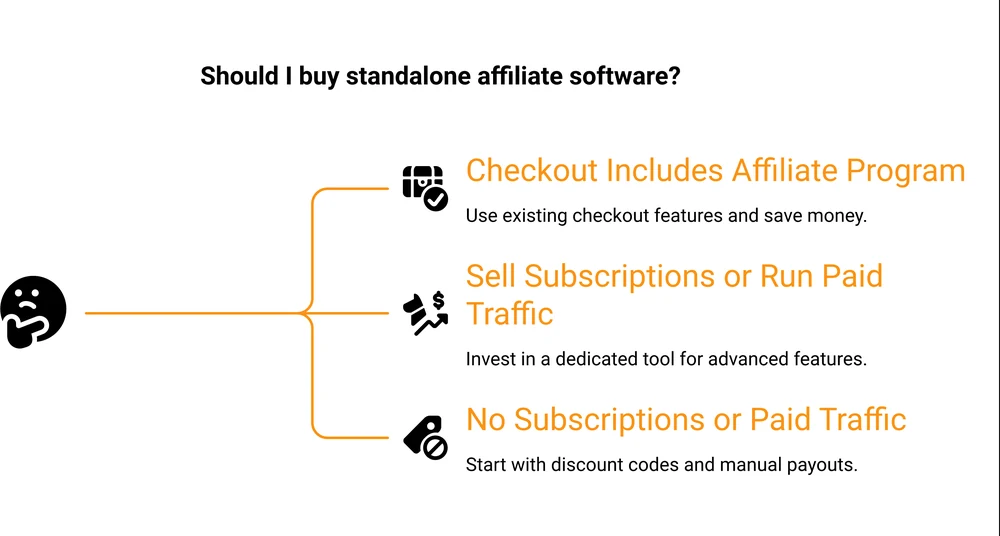
5 questions to ask before you pay
Ask these in order. The first 2 disqualify most tools in under a minute.
- Does it work with how I take payment? Rewardful needs Stripe or Paddle. If you sell through a marketplace or a hosted store, several of these tools cannot see your sales at all.
- Does my checkout already do it? Check the feature list of the platform you are on before you check anyone else’s pricing page.
- What is the cap, and what happens the day I cross it? Ask for the number, not the plan name. Affiliate revenue, affiliate count and conversions are 3 different caps and different tools use different ones.
- Is that price monthly or annual? Several of these show the annual rate by default and the difference runs 15% to 20%.
- Who pays the payout fee? You, or the affiliate, out of their commission. Decide it before your first payout, not after.
There is a 6th question that is not about the software: how many extra sales do I expect this to bring in? Go back to the break-even table. If your honest answer is under 33 a year on a $27 product, the software will take out more than it brings in.
FAQ
What is the best affiliate software?
There is no single best, because the tools split by what you sell. For a subscription on Stripe, Rewardful and FirstPromoter both start at $49 a month and handle recurring commissions properly. For one-off digital products, the affiliate tool already inside Payhip, Gumroad or E-junkie does the same job for nothing extra. For enterprise partner programs, impact.com and PartnerStack are the names, and neither publishes a price.
Is there free affiliate management software?
Yes, but it comes bundled rather than standalone. Payhip includes affiliates on its free plan and takes 5% of each sale instead. Systeme.io includes an affiliate program on its free plan. Gumroad includes affiliates and charges 10% plus $0.50 a sale with card processing on top.
Among the dedicated standalone tools I could not find a genuine free tier. Every one that publishes a price offers a free trial instead, running 7 to 30 days where the length is stated. The 2 that publish no price offer a demo.
Does affiliate tracking still work now that browsers block cookies?
Partly, and the answer varies by tool. Safari and most ad blockers restrict third-party cookies, which is where older affiliate tracking lived.
The current answer is first-party cookies set on your own domain plus server-side confirmation from your billing provider, which is what FirstPromoter described publicly when a commenter raised exactly this. Coupon codes and direct URL tracking sidestep cookies entirely. Ask any tool you are evaluating which of these it uses.
What commission should I pay affiliates?
Digital products and software commonly run 20% to 50%, and the high end is normal because the margins allow it. 30% is the most common starting point and it is the example Gumroad uses in its own fee documentation. Set it against your break-even, not against what feels generous.
Why do so many results about this ask how to make money as an affiliate?
Because 2 different audiences type similar things. Google’s People Also Ask box for this term is full of questions like how long it takes to make $5,000 a month from affiliate marketing, which are asked by people who want to BE an affiliate. This guide is for the other side, the seller recruiting affiliates to sell for them. Those questions are out of scope here on purpose.
Do I need affiliate management software to start an affiliate program?
No. You can run your first 5 affiliates with a unique discount code each and a monthly PayPal transfer. It breaks somewhere between 10 and 20 partners, and by then you will know whether the channel works well enough to pay for tooling. Starting manual also tells you what you actually need before you shop for affiliate management software.
Affiliate management software earns its price once you have partners in volume, subscription revenue to protect, or paid traffic to keep honest. Before that, the tool inside your checkout does the same job for nothing, and the money is better spent recruiting the affiliates in the first place.
CartMango is the checkout I built for solo digital sellers, and its whole job is helping you earn more from each buyer.
CartMango runs order bumps, upsells and downsells today, and drops every buyer straight into your email tool ready for the next offer. Affiliate management is the next CartMango feature to ship, on the timing in the table above. CartMango is free until October 2026, then $10 a year, with 0% commission on your sales.
About the Author

👋 I’m Welly, founder of CartMango (the site you’re on), a checkout platform for digital product sellers. We’ve previously processed $179M+. I also run BirdSend (email marketing tool, 3.1B+ emails sent). On the side I show other non-techie digital sellers how I use AI workflows to automate 50%+ of my operations. Find me on LinkedIn.
Related Reading
- Gumroad’s real fee: why 10% plus $0.50 works out closer to 12.9% plus $0.80
- Payhip pricing: what the free plan really costs once 5% compounds
- 49 affiliate marketing statistics: commission rates by industry and how much of online sales affiliates drive
- How to price digital products: your price point decides whether affiliate management software is worth its fixed cost
- What selling online actually costs: net payout on a $30 sale across 7 platforms