

The best Kajabi alternatives depend on which part of Kajabi you actually use. Systeme.io replaces the whole bundle from free, Thinkific and Teachable handle courses, Skool handles community, and a checkout tool like CartMango (free right now, from $10 a year once paid plans start in November, 0% per sale), Payhip (free plan with a 5% cut) or Gumroad (no monthly fee, 10% plus 50 cents a sale) covers selling alone. Prices below are read from each company’s own pricing page.
I went looking for Kajabi alternatives the way you probably did, and something odd showed up before I got to any of the platforms.
5 of the 8 results on page 1 are platforms ranking themselves. Esmerise, SamCart, Squarespace, beehiiv and Circle each publish a list of the best Kajabi alternatives, and each one puts its own product at the top. Google’s AI summary above them is built from those same pages, so it inherits the same picks.
Some of those posts are genuinely good. Every one of them was written by a company selling you something.
So this post does 2 things. It gives you the real price of every option, read at each company’s own pricing page. And it tells you which of those prices go up the more you sell, because on 3 of these platforms the cheap plan quietly becomes the expensive one.
Key Takeaways
- Kajabi’s cheapest live plan is Kickstarter at $89 a month, or $71 a month billed yearly, and Kajabi hides it from the public pricing table.
- On Skool, Teachable and Podia the cheapest plan takes a cut of every sale, so it overtakes the pricier plan once you sell enough.
- Skool’s $9 plan takes 10% plus 30 cents a sale, so at $2,000 a month it costs $221 all in, against $169 on the $99 plan.
- Systeme.io is the only option here that replaces most of Kajabi with a genuinely free tier and takes 0% of sales on every plan.
- Google’s AI summary for this search says Thinkific offers a free plan. Thinkific’s own pricing page says it does not have one.
Want the short version of what usually goes wrong before the platform is even the problem? The free 5-day Online Selling Mistakes Challenge walks through the 5 that cost solo sellers the most.
What you are actually replacing when you leave Kajabi
Naming which parts of Kajabi you actually use is the fastest way to cut your bill, because you only have to replace the parts you touch.
Kajabi bundles 5 separate jobs into 1 monthly price, and most sellers use only 2 or 3 of them.
| The job | What it means | Use it? |
|---|---|---|
| Website and sales pages | The pages people land on and buy from | Usually yes |
| Email marketing | Broadcasts, sequences, tagging | Often yes |
| Course hosting | Lessons, video, student progress | Only if you sell courses |
| Community | Discussion spaces, member feeds | Rarely |
| Checkout | Payments, order bumps, upsells, affiliates | Always |
Someone selling a single course to a small list uses 3 of those 5. Someone selling templates or an ebook uses 2. Kajabi charges the same either way.
This matters because nearly every alternatives list treats the question as a straight swap: 1 platform out, 1 platform in. If you only use 2 of the 5 jobs, a straight swap means paying for 3 you were already not using.
The Kajabi alternatives, side by side
Kajabi’s cheapest live plan costs $71 a month billed yearly, and Systeme.io starts at nothing. Skool advertises the lowest price on this table at $9 a month, and it also takes the biggest cut of your sales at 10%.
| Platform | Cheapest paid plan | Their cut | The catch |
|---|---|---|---|
| Kajabi (Kickstarter) | $71/mo billed yearly, $89 monthly | 0% on Kajabi Payments, 5% if you use your own Stripe | 1 product, 250 contacts |
| Systeme.io | Free, then $17/mo | 0% on every plan | free plan stops at 2,000 contacts |
| Thinkific | $40/mo billed yearly | 0% | no free plan, 30-day trial only |
| Teachable | $29/mo billed yearly | 7.5% on this plan, 0% from $69/mo up | 5 products |
| Podia | $42/mo billed yearly | 5% on this plan, 0% from $84/mo up | 100 email subscribers |
| Skool | $9/mo | 10% on this plan, 2.9% on the $99 plan | no real sales page builder |
| CartMango | Free until paid plans start in November 2026, then from $10 a year | 0% | no course hosting or community yet |
Card processing is extra on every row except Skool, and that exception matters. Stripe charges 2.9% plus 30 cents per successful domestic card payment, and PayPal Checkout runs 3.49% plus a fixed fee. Kajabi, Systeme.io, Thinkific, Teachable, Podia and CartMango all take their cut on top of that. Skool handles the payment itself, so its 10% or 2.9% covers the whole payment cost instead of sitting on top of a card fee.
Skool needs an extra note, because it changes the arithmetic later on. Skool’s pricing page shows the percentage and stops there.
Skool’s payments help pages add 30 cents to every transaction, and Skool’s own worked example confirms it. A $9 a month membership pays out $7.80, which is a 13.3% cut rather than 10%. That 30 cents barely registers on a $900 sale and bites hard on a $9 one.
Being straight with you: CartMango is my platform, so treat its row as the one I have a stake in. CartMango has no course hosting and no community, so it is missing from every recommendation in this post except the one for people who need neither.
Why most Kajabi alternative lists put themselves first
5 of the 8 results on page 1 of Google are published by a company selling a Kajabi alternative, and each of those 5 ranks its own product first. Esmerise calls itself the best overall platform. SamCart, Squarespace, beehiiv and Circle each open their list with themselves at number 1.
Companies write about their own markets all the time, and some of those posts are genuinely good. SamCart’s is the only one of the 8 that gets Kajabi’s current plan prices right. It also tells you Kajabi scrapped its $89 plan. That plan is still on sale, as the next section shows.
The problem is what happens next. Google’s AI summary sits above all of them and is built from their pages, so a wrong detail on 1 post gets repeated back as the answer.
Here is one, live on this search right now:
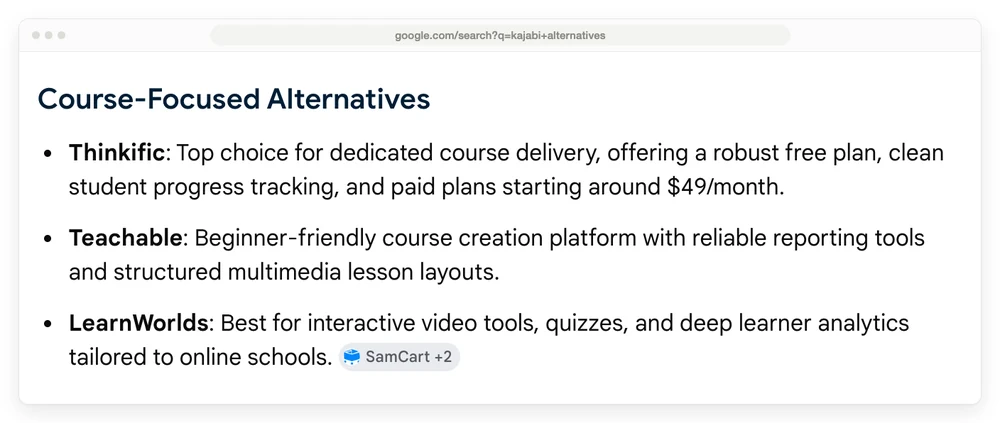
Google’s AI summary for this exact search. Read the Thinkific line.
It says Thinkific is “offering a robust free plan”. Thinkific’s own pricing page answers the question “Does Thinkific have a free plan?” with this: “No, instead, you can explore the whole platform with a 30-day free trial.”
So the first answer a searcher sees recommends a free plan that the company itself says does not exist. Thinkific’s cheapest paid plan is $40 a month billed yearly.
I run CartMango, which sells a checkout, so I am in this race too. What I can do about that is show you where every number came from and put my own product’s weakest point in the table above rather than under it.
Why people are leaving Kajabi in 2026
Kajabi raised prices 20% to 25% on 13 January 2026, the first change in 10 years. Basic went to $179 a month, Growth to $249 and Pro to $499.
The cheapest tier is the part that trips people up. Kickstarter costs $89 a month, or $71 billed yearly, and it is still live and still buyable. Kajabi just does not draw it on the public pricing page, so the page opens at $179 and most write-ups copy that as the entry price. Our full breakdown of Kajabi’s pricing shows where the tier sits and what you give up on it: 1 product, 250 contacts, no custom domain and Kajabi branding on your pages.
Then there is the fee almost nobody mentions. If you connect your own Stripe account instead of using Kajabi Payments, Kajabi takes a cut on top of whatever Stripe charges you. That cut is 5% on Kickstarter, 2% on Basic, 1% on Growth and 0.5% on Pro.
On Kickstarter that turns a $100 sale into roughly $8.20 of fees through your own Stripe, against $3.20 through Kajabi Payments.
The last squeeze is where features sit. An affiliate program needs the Growth plan, which is $199 a month billed yearly. If affiliates are part of your launch plan, your real entry price was never $71.
The cheap plan is often the expensive one
On Skool, Teachable and Podia the cheapest plan takes a percentage of every sale, while the pricier plan takes little or none. So the cheap plan overtakes the expensive one once your sales pass a certain point.
Take a seller making $2,000 a month from 40 sales of $50, and count card processing for everyone.
Priced that way, the 2 cheapest-looking plans are the 2 most expensive to run. Skool’s $9 plan costs $221 a month and Teachable’s $29 plan costs $249, against $141 on Kajabi’s $71 Kickstarter plan.
| Platform and plan | Plan | Their cut | Card processing | Total a month |
|---|---|---|---|---|
| Systeme.io Free | $0 | $0 | $70 | $70 |
| Teachable Builder | $69 | $0 | $70 | $139 |
| Kajabi Kickstarter | $71 | $0 | $70 | $141 |
| Skool Pro | $99 | $70 | included in the cut | $169 |
| Kajabi Basic | $143 | $0 | $70 | $213 |
| Skool Hobby | $9 | $212 | included in the cut | $221 |
| Teachable Starter | $29 | $150 | $70 | $249 |
Look at the 2 Skool rows. The $9 plan costs $221 a month at that level of sales, and the $99 plan costs $169, so the plan that advertises 11 times cheaper is $52 a month more expensive to run. Teachable is starker: its $29 Starter plan costs $249 against $139 on the $69 Builder plan, a difference of $110 every month.
Teachable’s own FAQ is what makes that gap real. It says there is “a 7.5% transaction fee on the Starter plan” and that “standard processing fees may still apply” on top. So the 7.5% is a layer above the card fee, not instead of it.
The crossover points are lower than people expect, and they are the numbers to write down. Teachable’s cheap plan stops being cheap at $533 a month in sales. Podia’s stops at $840. Skool’s holds out longest, until $1,268.
Worth saying plainly about that table. Systeme.io’s free plan costs $70 a month at this volume, and every cent of that is Stripe’s card fee rather than Systeme.io’s. CartMango lands in the same place for the same reason, because CartMango is free until paid plans start in November 2026 and about 83 cents a month after that, on top of the same $70 card fee.
Systeme.io gives you funnels and email with that, capped at 2,000 contacts. They are different products solving different halves of the problem. At this volume neither is charging you for the privilege.
A seller on the r/smallbusiness thread for this exact question put the general version well: “Kajabi feels expensive until you try to replace it, then you realize you need 2-3 tools to match it (email + funnels + checkout)… What helped me was actually breaking down the real monthly cost instead of just looking at the base price.” You can read the full thread on Reddit.
Take your own monthly sales number, multiply it by the percentage, then add the plan price. The ranking changes.
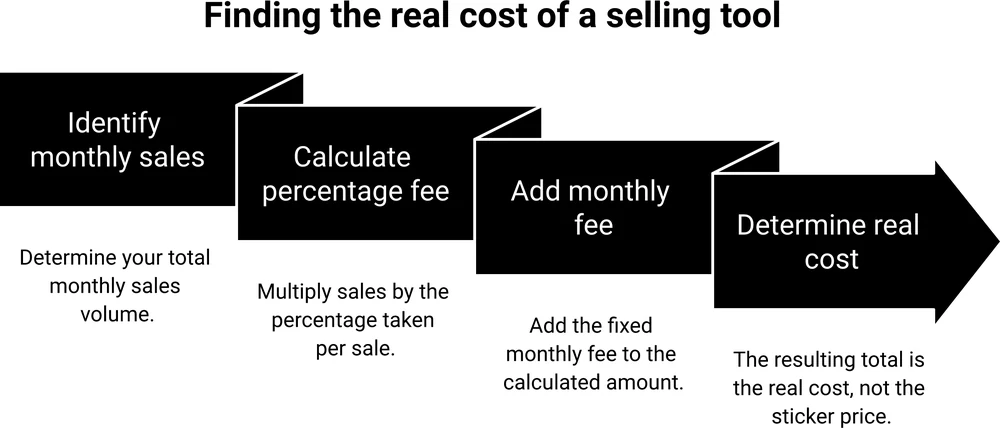
The 4 numbers to put together before you compare any 2 platforms.
Which alternative fits what you actually need
Match the alternative to the jobs you listed earlier, because the cheapest option is different for each one.
You need everything Kajabi does, for as little as possible. Systeme.io is the closest thing to a full swap. It has a free tier that holds 2,000 contacts with unlimited emails, then $17, $47 and $97 a month as you grow, and it takes 0% of sales on every plan including the free one. That is a genuinely unusual combination and it is why it keeps appearing near the top of these lists.
You need course hosting and nothing clever. Thinkific starts at $40 a month billed yearly with no cut of sales, and Teachable at $29 with a 7.5% cut, which becomes $69 with no cut on the plan above. Both do lessons, video and student progress properly. Our guide to selling online courses covers what to get right before the platform matters.
You need a community more than a course. Skool is built for that and starts at $9 a month, with the 10% cut described above. Circle and Mighty Networks are the other 2 real names here, and we priced all of them in our breakdown of what a community platform for creators actually costs. Our Skool pricing breakdown goes deeper on the fees.
You sell one-off digital products, not courses. Payhip runs a free plan with a 5% cut, $29 a month with 2%, or $99 a month with no cut at all. Gumroad has no monthly fee and takes 10% plus 50 cents, and Gumroad’s own help pages state that this does not include card processing of 2.9% plus 30 cents, which puts a real direct sale near 12.9% plus 80 cents. We have separate breakdowns of Payhip’s pricing and Gumroad’s pricing if those 2 are your shortlist.
You already have somewhere to host, and you only need to sell. That is the next section.
If you only need a checkout, not a course platform
Some people searching for a Kajabi alternative do not need a course platform at all. They host lessons somewhere else already, or they sell templates, ebooks and downloads where there is nothing to host. For them the right move is to drop the bundle rather than shop for a new one.
That is the case CartMango is built for. CartMango is a checkout platform: it takes the payment, adds order bumps and upsells and downsells, and drops every buyer into your email tool so you can sell to them again.
CartMango’s Mini Pages editor hosts the sales page too, so you do not need a website of your own. CartMango is free until paid plans start in November 2026, then starts at $10 a year, and CartMango takes 0% of your sales. Adding an order bump at checkout is one of the quicker ways to lift what each buyer spends.
Now the honest half. On the 3 things a Kajabi user is most likely to care about, Kajabi wins today and it is not close.
Kajabi has course hosting, CartMango does not. Kajabi has a community feature, CartMango does not. Kajabi has affiliate management, CartMango does not.
CartMango’s affiliate management is targeted for September 2026, with course hosting and community targeted for October 2026, and none of the 3 exists yet.
So if you need lessons and student progress, do not pick CartMango. Pick Thinkific or Teachable and run your checkout wherever you like. This section is for the reader who has already worked out that they are paying $179 a month for a course platform in order to sell, say, a $27 download.
Who should stay on Kajabi
Staying put is the right answer for a good number of people, and only 1 of the 8 pages ranking for this search says so. 4 cases stand out.
You are on a legacy price. Kajabi did not raise prices for 10 years before January 2026. If you are grandfathered onto an older rate, leaving means giving that up permanently.
Your automations are deep. Someone with years of tagging, sequences and triggers built inside Kajabi has to rebuild every one of them by hand on the new platform. That work has a real cost, and it is usually larger than the annual saving.
You use most of the 5 jobs. If you genuinely run courses, a community, email, pages and checkout in one place, the bundle is doing its job. $199 a month for 5 tools that already talk to each other can beat 4 separate subscriptions you have to wire together yourself.
Your sales are high enough that the fee percentages flip. This is the same arithmetic as the section above, running the other way. At $10,000 a month in sales, a 5% cut is $500, and suddenly Kajabi’s flat plan price looks cheap next to a percentage.
How to move off Kajabi without losing your list
Build the new platform before you cancel the old one, because the expensive mistakes all happen when the 2 overlap badly. The order below keeps your list and your search rankings intact.
- Export everything first. Contacts, tags, purchase history, video files and page copy. Do this while your account is live, because the export options go away when it lapses.
- Rebuild on the new platform in full, including the checkout, before any traffic moves.
- Run a real test purchase end to end. Buy your own product with a real card, confirm the receipt, the access email and the tags all fire.
- Move subscribers with their tags intact. A flat list with no tags breaks every sequence you rebuild afterwards.
- Redirect your old URLs. If your Kajabi pages ranked, set 301 redirects to the matching new pages so the rankings follow.
- Switch your domain last, then cancel.
What tends to break: automations do not transfer between platforms and have to be rebuilt by hand, custom page code rarely survives, and anything you wired up through Zapier needs repointing. Existing subscriptions are the one to check carefully before you cancel anything, because platforms differ on whether recurring payments keep running after you leave.
Kajabi alternatives FAQ
Is there anything better than Kajabi?
Better depends on which of Kajabi’s 5 jobs you use. For a full replacement at the lowest price, Systeme.io does most of it from free with no cut of sales. For courses alone, Thinkific at $40 a month billed yearly is cheaper and more focused. For community, Skool starts at $9 a month. Nothing on this list does everything Kajabi does at Kajabi’s level of polish.
Which is better, Kajabi or Skool?
Skool is better if a community is the product and courses are a bonus, and it costs $9 or $99 a month. Kajabi is better if courses, email and sales funnels are the product. The fee decides it on price: Skool’s $9 plan takes 10% of every sale, so a seller taking $2,000 a month pays about $221 all in, against roughly $213 on Kajabi Basic. The $9 plan is not the cheap option it looks like.
Why is Kajabi so expensive?
Kajabi prices as a bundle of 5 tools rather than 1, and it raised every plan 20% to 25% on 13 January 2026. Basic is now $179 a month, or $143 billed yearly. Connecting your own Stripe adds another 0.5% to 5% on top, depending on plan. Most people paying it are using 2 or 3 of the 5 tools they are billed for.
Which is better, Kajabi or Stan Store?
Stan Store is a link-in-bio storefront built for selling from a social profile, so it suits creators whose traffic comes from Instagram or TikTok. Kajabi is the heavier platform, built for course businesses with email and funnels. They rarely compete for the same person. We covered the choice in more depth in our guide to Stan Store alternatives.
Most Kajabi alternatives on this page assume you already have an audience and something to sell them. Stan Store assumes your audience lives on a social profile. Pick for the traffic you actually have, not the business you are hoping to build.
Whichever of these Kajabi alternatives you land on, price it against your own monthly sales before you sign up, not against the number on the pricing page. And if the honest answer to the 5 jobs at the top is that you only ever used the checkout, you can stop paying for the other 4. That is what CartMango is for, and it is free until paid plans start in November 2026.
About the Author

👋 I’m Welly, founder of CartMango (the site you’re on), a checkout platform for digital product sellers. We’ve previously processed $179M+. I also run BirdSend (email marketing tool, 3.1B+ emails sent). On the side I show other non-techie digital sellers how I use AI workflows to automate 50%+ of my operations. Find me on LinkedIn.
Related Reading
- SamCart vs Kajabi: the head-to-head if those 2 are your shortlist
- Video hosting platforms for online courses: where to put your lessons if you drop the all-in-one
- What it costs to create an online course: the bill before you pay for any platform
- How to price digital products: what to charge once you have somewhere to sell