
How to sell workout plans online comes down to 4 steps: write 1 plan for 1 type of person, test it on a few people, set a price, then sell it as a download through a checkout. If you check in with buyers every week, use a coaching app instead.
For a fixed plan paid once at low volume, 4 tools keep costs low: Etsy ($0.20 a listing, 6.5% per sale), Payhip (free plan, 5% per sale), Whop (2.7% + $0.30 per sale, card fees included) and CartMango (free right now, from $10 a year once paid plans start in November, 0% per sale). Etsy brings buyers, but its workout PDFs sit near $3.43.
You wrote a program that works. People got stronger on it. Now you want to sell it to people you will never meet.
So you search for how, and 7 of Google’s top 8 results come from companies selling their own software. Most of them end at the same place: use our tool. 1 of them still tells you to use a shop that closed in 2023.
This guide starts with 21 ways to sell and cuts the list with facts you can check: fees, seats and setup. You’ll also see what plans really ask on Etsy, and which rules to sort out before your first sale.
Key Takeaways
- Fixed plan or coaching: A fixed plan needs a checkout. Weekly check-ins need a coaching app, and that choice changes every pick below.
- Seats add up fast: Sell 10 copies a month of a 12-week plan and you hold about 30 seats, or $81 a month on ABC Trainerize billed yearly.
- Take-home on a $39 plan: You keep $37.65 on Whop, $37.57 on CartMango before its plan, $35.62 on Payhip and $34.84 on Etsy.
- Etsy prices run low: Workout plan PDFs had a median of $3.43 after discounts across 56 listings, and true 12-week plans a median of $11.19.
- The legal side is short: No US state licenses personal trainers, but meal plans and results claims come with real rules.
How to sell workout plans online: start with all 21 options
Selling a workout plan online starts with 21 options in 5 groups. I started with the main tools Google’s first page and its AI Overview recommend, added 2 coaching apps from the Reddit thread at the top of that page, then added 4 options the page mostly skips: Etsy, Payhip, Stan Store and CartMango, the checkout I run.
Never sold a digital product before? The Online Selling Mistakes Challenge is a free email series on the 5 mistakes solo sellers make most.
- Coaching apps (7): ABC Trainerize, TrueCoach, Everfit, Hevy Coach, Trainerfu, TeamBuildr and FitPros. The buyer follows the plan inside an app.
- Course platforms (3): Kajabi, Podia and Teachable. The buyer logs in to lessons.
- Site builders (3): Shopify, Squarespace and WordPress with a membership plugin. The buyer gets whatever you build.
- File shops and checkouts (7): Dropbox Shop, Gumroad, Sellfy, Stan Store, Payhip, Whop and CartMango. The buyer usually gets a download or a link.
- Marketplace (1): Etsy. The buyer gets a download and stays Etsy’s customer.
The coaching group is a sample. Many more apps exist, and any that charge by client get the same answer at Cut 2.
Everything below assumes a fixed plan: the same plan for every buyer, paid once. I’ll use a $39 12-week plan as the running example. If you write a new plan for each person and check in every week, you sell coaching, and Cut 2 is where you stop reading.
Cut 1: drop the tools that cannot take a payment
Dropbox Shop and Hevy Coach go first: the first closed, and the second shows no way to charge a buyer.
Dropbox’s guide still ranks on page 1, and its button still reads “Start selling with Dropbox Shop”. Click it and you land on the Dropbox homepage. Dropbox ended the Shop on July 7, 2023.
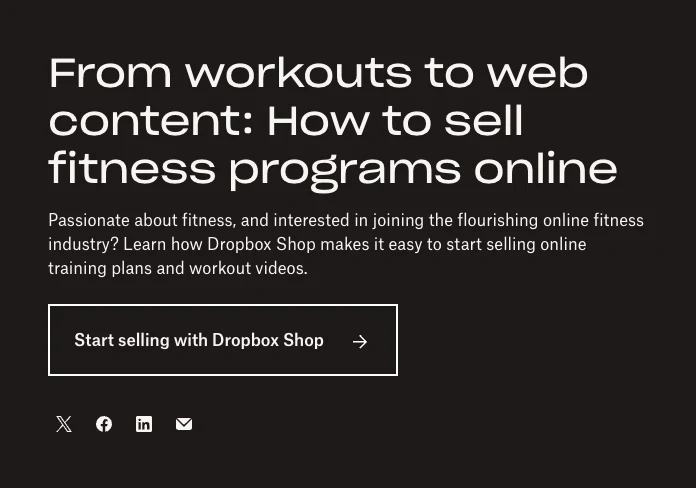
Dropbox’s guide for this search. Read the button: the shop it promotes closed in 2023.
Hevy Coach also ranks on page 1. Its pricing and features pages list program building, tracking and client chat, with nothing for charging a buyer. Its own guide sends you to WordPress, Shopify, Sellfy, Teachable or Gumroad for the store, so you would still need 1 of the tools below.
That leaves 19.
Cut 2: drop per-client apps if every buyer gets the same plan
ABC Trainerize, TrueCoach, Everfit, Trainerfu and TeamBuildr charge by how many people you train at once. That fits weekly coaching. It works against a one-time sale, because a buyer on a 12-week plan holds a seat for 12 weeks.
Say you sell 10 copies a month. By month 3 you have about 30 people in the app and $390 a month in sales.
At about 30 buyers at once, ABC Trainerize costs $81 a month ($71 for the seats plus $10 to take Stripe payments) and TrueCoach costs $136.99 on its 50-client tier, both billed yearly.
| App | Small plan | Bigger plan | Billing |
|---|---|---|---|
| ABC Trainerize | 2 seats, $9 a month, plus $10 for Stripe payments | 30 seats, $71 a month, plus the same $10 | Yearly |
| TrueCoach | 5 active clients, $26.34 a month | 50 active clients, $136.99 a month | Yearly |
| Everfit | 5 clients free, or $19 a month on Pro | 35 clients, $75 a month on Pro | Monthly, 16% less yearly |
| Trainerfu | 10 clients, $29 a month | 40 clients, $79 a month | As listed, 2 months free yearly |
| TeamBuildr | 50 profiles, $900 a year | 250 profiles, $1,500 a year | Yearly |
ABC Trainerize does offer free “basic client” seats. Its help docs say basic clients cannot receive training programs, so a plan buyer needs a paid seat.
These apps earn their price the moment you check in on people. 1 coach on r/personaltraining who reports roughly $5M in online personal training sales charges about $150 a month per client, and that is a price for weekly attention. If that is your business, pick an app here and skip the rest of the cuts. Everfit’s free plan lets you test the idea with 5 clients.
For a fixed plan, 5 apps go. That leaves 14.
Cut 3: drop anything you have to build first
Shopify, Squarespace and WordPress all ask you to set up and run a site before a plan can sell. The test here is simple: can you list a plan today with no site to build?
Shopify cannot deliver a digital file on its own, so it needs a delivery app on top of a plan that costs $19 a month billed yearly. The WordPress guide on page 1 takes 5 steps before the first plan goes on sale: set up the site, install a plugin, configure tiers, create the plans, then restrict access. That route also needs hosting and a domain.
A site gives you the most control, so keep yours if you already have it and add a checkout to your existing site. Building a new site for a single 12-week plan is a lot of setup before you know anyone wants it.
That leaves 11.
Cut 4: drop anything 1 sale cannot pay for
Kajabi, Podia, Teachable, Stan Store and Sellfy all bill you in months with no sales, so the test is whether 1 sale of a $39 plan can cover the tool for a whole year. Free plans pass automatically, so this cut really targets monthly bills. Kajabi, Podia and Teachable also host courses, which CartMango does not do yet, so this is a price test only.
Covering a year on the cheapest plan takes 23 sales on Kajabi, 15 on Podia, 11 on Teachable, 8 on Stan Store and 8 on Sellfy, against 1 on CartMango, all on yearly billing and counted after fees.
| Tool | Cheapest plan, billed yearly | Per year | $39 sales to cover it |
|---|---|---|---|
| Kajabi Kickstarter | $71 a month | $852 | 23 |
| Podia Mover | $42 a month, plus 5% per sale | $504 | 15 |
| Teachable Starter | $29 a month, plus 7.5% per sale | $348 | 11 |
| Stan Store Creator | $25 a month | $300 | 8 |
| Sellfy entry plan | $22 a month | $264 | 8 |
| CartMango Silver | Free right now, $10 a year once paid plans start in November | $10 | 1 |
I know this test suits CartMango, the tool I run. Free plans pass it too, and the flat-fee tools win it back at volume. Stan Store takes 0% per sale. Against the $1.95 Payhip’s free plan keeps on a $39 sale, Stan’s $300 a year pays off at 154 sales a year, or about 13 a month. Come back to this cut when you get there.
That leaves 6.
Cut 5: drop the tools that take 10% per sale
Gumroad and FitPros both take 10% + $0.50 per sale, which is $4.40 on a $39 plan and more than double the $1.95 Payhip’s free plan keeps. After card fees you keep $33.17 on either one and $35.62 on Payhip.
Etsy takes $4.16 a sale all-in, so you keep $34.84, which is $1.67 more than on Gumroad. It stays in because that fee also pays for search traffic you would not otherwise get. Gumroad’s Discover marketplace brings buyers too, but those sales cost 30%.
FitPros is the 1 exception worth a second look. It puts the plan in a mobile app with no per-client bill, which a PDF cannot do. If your buyers want to follow along on a phone, that extra $2.45 a sale is what you pay for it.
Check its income numbers before you plan around them. Its guide says you keep about 87%, while its own $50 example ($42.70) works out to 85.4%. At its $29 a month example, 500 subscribers bring in about $12,230 a month, where its table shows $12,615.
That leaves 4.
What is left, and how to pick between them
Etsy, Payhip, Whop and CartMango are the 4 options left, and the choice turns on who brings the buyer and how fast the money reaches you.
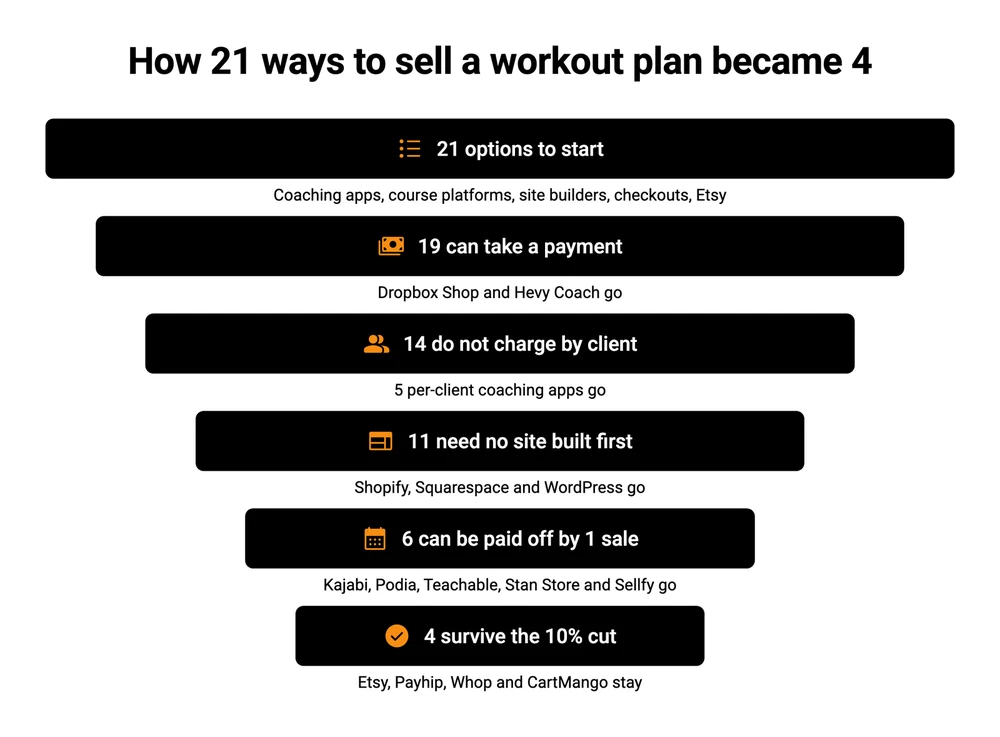
On a $39 plan you keep $37.65 on Whop, $37.57 on CartMango, $35.62 on Payhip’s free plan and $34.84 on Etsy, so the gap between all 4 is under $3 a sale.
| Option | You keep of $39 | Plan cost | Buyers come from | What it still does not do |
|---|---|---|---|---|
| Etsy | $34.84 | $0 | Etsy search | Let you own the buyer, and prices there run low |
| Payhip free plan | $35.62 | $0 | You | Run a one-click upsell. Its offer after checkout is a discount on a second product |
| Whop | $37.65 | $0 | You, plus Whop’s Discover | Pay in full up front: a reserve can hold 25% to 100% of a sale for 30 to 90 days |
| CartMango | $37.57 | Free right now, from $10 a year once paid plans start in November | You | Handle sales tax, or host video files. A course area is not live yet |
CartMango takes 0% per sale, but its plan still counts. At $10 a year, CartMango passes Payhip’s free plan on your 6th sale of a $39 plan. Whop beats it by 8 cents on a plain US card sale, before any reserve applies.
Those figures use Stripe’s standard 2.9% + $0.30 for Payhip and CartMango, and Etsy’s published fees plus its 3% + $0.25 payment fee in the US.
Here is how I would pick:
- No audience yet: Start on Etsy. Buyers already search there. You pay for that with low prices, which the next section shows.
- Some followers, and you want to start with no monthly fee: Payhip.
- Your buyers live in a Discord or a community: Whop.
- You want one-click upsells: CartMango. Order bumps are on every plan, upsells from the $20 plan.
Whichever you pick, the plan needs a page that sells it. This guide to a sales page covers the 7 blocks. You do not need a website for it: Payhip and Whop host a store page, and CartMango’s Mini Pages feature hosts a simple sales page.
2 formats change the answer. Video stays on YouTube or Vimeo if you use CartMango, and selling videos has its own costs. If you would rather charge $29 a month for a growing library, read how to sell subscriptions first. Some tools stop billing your members when you leave: Payhip does, even with your own Stripe or PayPal connected, and CartMango keeps them paying you.
What to charge: do not price to match Etsy
Cutting your price to match Etsy is the mistake, because workout plan PDFs there go for a median of $3.43 after discounts.
I read the first page of Etsy in US dollars for 2 searches. These are listed prices, not proof of sales:
- “Workout plan pdf”: 56 listings. The median was $3.43 after discounts and $7.05 before them. 39 sat under $5 and 45 were on sale. A smaller sample for our guide on how to sell PDFs landed at $3.96.
- “12 week workout plan”: 41 true 12-week plans. The median was $11.19, the middle range ran $7.73 to $20.49, and just 7 asked $25 or more.
At $3.43, Etsy’s fees take $0.78 and you keep $2.65. You would need 14 copies to match 1 $39 sale on Payhip.
Longer plans ask more. The most expensive plan in the 12-week search was a beginner home plan with videos at $45, and a kettlebell plan and a women’s glute program sat at $28 and $29.
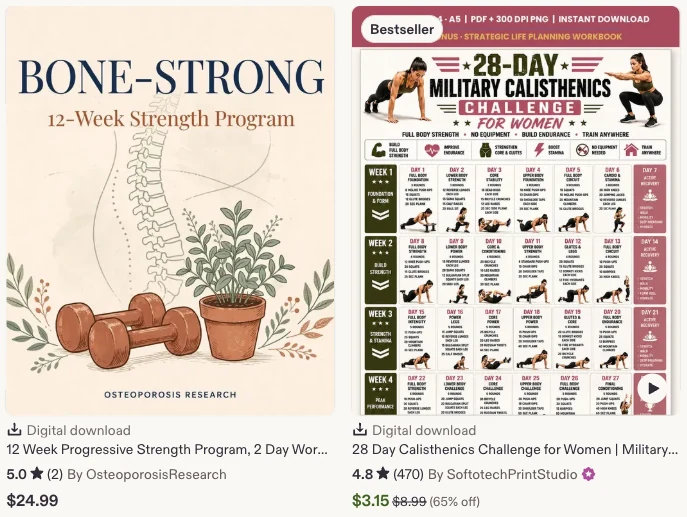
2 listings from the same Etsy search. The 12-week program asks $24.99 and shows 2 reviews. The 28-day challenge is listed at $3.15 after a 65% discount and shows 470.
The plan prices on page 1 are examples, not data: Hevy Coach uses $50 and $75, and FitPros uses $50. So $39 sits near the top of Etsy’s range and just under those.
With your own audience, I would start around there and raise it after real results come in. Etsy is still a fair place to begin. Use it to learn whether strangers buy, and keep the full plan at its real price on your own checkout.
Buyers pay for structure, so a bare PDF is a hard sell. “As a general rule, information is free, systems and support are paid for,” 1 trainer wrote in an r/personaltraining thread.
What to put in a plan people will pay for
I would pay for a workout plan that names 1 type of person, runs a set number of weeks, and says what to do on a bad day. I don’t write training programs, so take the coaching from your own experience. These 8 parts are what I would want as a buyer:
- 1 named person and 1 goal: “Strength for beginners over 40” beats “total body fitness”.
- A start-here page: Who the plan is for, what equipment it needs, and how many days a week it takes.
- A weekly schedule: The buyer should see the whole 12 weeks on 1 page.
- Every session spelled out: Exercises, sets, reps, rest and when to add weight.
- Swaps: A home version of each gym exercise, and an easier version for a sore knee or back.
- A demo for each exercise: A short clip on YouTube or Vimeo, linked from the digital download.
- A tracker: A sheet they can fill in. It also makes a good add-on at checkout.
- A short version of each session: For the days they don’t feel like it.
That last one comes from my own running, not from any coach. I usually run 5km while my son has basketball practice. On a tired day I wanted to skip it, so I told myself I would just do half. At 2.5km I pushed to 3.5km, then told myself it was only 1.5km more and finished. If I had told myself 5km at the start, I think I wouldn’t have started. That is why I would want a short version of every session: it gives a tired buyer a smaller first step.
Test it before you charge. “run a few people through it first. tweak what breaks,” 1 trainer told a newly certified coach in this thread, adding that “nobody’s gonna drop cash on a spreadsheet from someone with zero client results.” Give it free to about 5 people who match your named person. Then ask 3 things: where they got stuck, which sessions they skipped, and whether they finished.
If you work at a gym, ask before you sell anything to its members. That was the top answer when an employed trainer asked this on Reddit.
Certification, waivers and results claims
No US state requires a government-issued license to work as a personal trainer, according to NASM, but 5 other things still need sorting before you sell. None of the guides I read on page 1 mentions a waiver or insurance. I’m not a lawyer, so treat this as a list to check with one.
- Certification: Buyers read it as proof. The Bureau of Labor Statistics says most trainers hold one, and employers usually prefer it.
- Meal plans: ACE’s guidance lists “individualized meal planning/recommendations” among the things fitness professionals should not offer, and says nutrition rules vary by state. Keep food advice general unless you hold the right credential.
- Results claims: If you show someone who lost 20 pounds, the FTC’s endorsement guidance says you need proof that is typical, or you must state what people generally achieve. It also says “results not typical” does not fix it.
- Waiver and insurance: Put a health disclaimer on page 1 of the plan and on the sales page, and get a waiver accepted at checkout if your tool has a terms checkbox. NASM lists liability insurance as required for self-employed trainers. Ask your insurer whether it covers plans sold online.
- Sales tax: A seller in the top Reddit thread reported “quickly establishing sales tax nexus in many states”. Whop acts as merchant of record, and Payhip says it collects and remits sales tax across the US, Canada, the UK and the EU. On CartMango you stay the seller, so tax is yours to set up.
How to get your first buyers
Your first buyers for a workout plan will come from people who already know you, since a new store page starts with no visitors.
1 r/personaltraining post puts it bluntly: coaches go wrong “thinking that they can sell their workout programs to the masses with a small following/audience.” So start small:
- Clients and former clients: Offer the plan to them first. They are also your first honest testimonials.
- A free week for an email: Give away week 1 in exchange for an email address, then sell the other 11. The trainer quoted earlier, who wrote that “information is free”, used generic programs the same way, as lead magnets for paid coaching.
- Short clips: Post form fixes and single exercises, then send people to the plan. Instagram has no native checkout, so your bio link has to do that job. LinksMango, built by the CartMango team, has a free link-in-bio plan whose product cards link to your own checkout: 10 cards, or 20 if you keep a small LinksMango credit on the page.
- Other trainers: Pay a cut to a trainer or physio with a different audience. Payhip, Gumroad and CartMango’s $30 plan all have affiliate tools.
- Small ads, later: Hevy Coach’s guide suggests testing with $50 to $100. Wait until people who know you have bought.
- An add-on at checkout: Offer the tracker as an order bump. CartMango has these on every plan. Gumroad and Payhip offer them too.
Some buyers will forward the file. You can’t fully stop it, though protected downloads reduce it.
FAQ
How much money does an online fitness coach make?
I found no reliable figure for online coaches alone. The closest is the Bureau of Labor Statistics, which puts the median wage for all fitness trainers and instructors at $47,160 in May 2025. 1 coach on Reddit self-reports roughly $5M in total sales with profit margins around 25%. For scale, 10 sales a month of a $39 plan is $390 a month.
Is $300 a month a lot for a personal trainer?
It is about double the $150 a month that 1 coach on Reddit reports charging, and I found no solid pricing data beyond that. To compare it with selling plans, $300 a month equals about 8 sales of a $39 plan, while a coaching client also expects your time every week.
Do you need a certification to sell workout plans online?
No. No US state licenses personal trainers, and FitPros says it doesn’t require a certification, though it also says you are responsible for keeping your programs safe. A certification still helps buyers trust you, but as 1 Reddit trainer put it, “nobody’s gonna drop cash on a spreadsheet from someone with zero client results.”
Should you sell a PDF or use an app?
Sell a PDF or a download when every buyer gets the same plan, and link video demos from it. Use a coaching app when you check in with people. FitPros sits between the 2: an app with a fee per sale and no per-client bill.
Can you sell workout plans with no following?
Yes, on Etsy, where buyers already search, but expect Etsy prices. A plan at the $3.43 median leaves you $2.65 a sale, and a 12-week plan at the $11.19 median leaves you $9.68. Your own checkout pays more per sale but brings no visitors.
Put your 12-week plan on sale this week
That is how to sell workout plans online without paying for tools you don’t need yet. Pick 1 survivor today, then put your time into the plan and your first 5 buyers.
If your people are ready to buy, CartMango gives the plan a checkout and a Mini Pages sales page, and you keep $37.57 of a $39 sale before the plan price. CartMango is free right now, with paid plans from $10 a year starting in November.
About the Author

👋 I’m Welly, founder of CartMango (the site you’re on), a checkout platform for digital product sellers. We’ve previously processed $179M+. I also run BirdSend (email marketing tool, 3.1B+ emails sent). On the side I show other non-techie digital sellers how I use AI workflows to automate 50%+ of my operations. Find me on LinkedIn.
Related Reading
- How to Sell PDFs: what PDFs ask on Etsy and what each route leaves you
- How to Sell Subscriptions Online: for a monthly library instead of a fixed plan
- How to Sell Videos Online: for workouts filmed rather than written
- Etsy for Digital Products: the full fee math if you start there