

2 questions settle how to sell videos online: does the buyer stream the video or keep the file, and do they pay once or every month? Files sell through a digital-product store, streams through a video platform, monthly access through a membership tool, and stock clips through a licensing marketplace.
On a $25 video, Gumroad (10% + $0.50) leaves you $20.97 after card fees, Payhip’s free plan (5%) $22.72 and Vimeo OTT (10% + $0.50, fees included) $22.00. CartMango (0% per sale, free right now, from $10 a year once paid plans start in November) leaves $23.97, with the video hosted on Vimeo or YouTube. Vimeo On Demand stopped taking purchases on September 21, 2026.
Pick a platform before you think about your buyer, and 2 things can go wrong later. The store may not hold your video file, or it may keep your buyers’ emails when it closes.
Vimeo On Demand sellers are dealing with the second problem right now. Their storefronts go offline on November 20, 2026, buyers lose what they paid for, and Vimeo will only hand over the emails of buyers who opted in.
So this guide starts from the buyer. You’ll see which of 5 seller situations is yours, what each route leaves you on a $25 video or a $10 monthly member, and the mistakes that cost video sellers money after launch.
Key Takeaways
- 2 questions pick your route. Does the buyer stream the video or keep the file, and do they pay once or every month?
- Vimeo On Demand is closing. It stopped new purchases on September 21, 2026 and shuts down on November 20, so skip it.
- Hosting and checkout are 2 jobs. Gumroad and Payhip do both for video files. CartMango takes the payment, and the video stays on YouTube or Vimeo.
- Fees move a few dollars a sale. A $25 video leaves $20.97 on Gumroad, $22.72 on Payhip, $22.00 on Vimeo OTT and $23.97 on CartMango.
- Stock sites pay a royalty. Adobe Stock pays 35% of each video license, and the buyer stays the site’s customer.
How to sell videos online: what changes from seller to seller
What changes between video sellers is how the buyer watches and how often they pay. For example, a wedding videographer handing over a 4 GB file and a yoga teacher charging $10 a month for a class library both sell videos, and they need different tools.
Picking a tool before you know which kind of seller you are is one of those mistakes that only shows up after launch. If you’d rather spot the rest early, the Online Selling Mistakes Challenge covers 5 of them, 1 email a day.
The 2 questions give you 3 common kinds of sale, plus a 4th for clips that other creators license:
- Stream, pay once. A pay-per-view film rental, an event replay, a recorded workshop.
- Stream, pay monthly. A library of classes or episodes that keeps growing.
- Download, pay once. A file the buyer keeps, like event footage, a tutorial pack or a film.
- License to other creators. Stock clips that filmmakers and brands drop into their own projects.
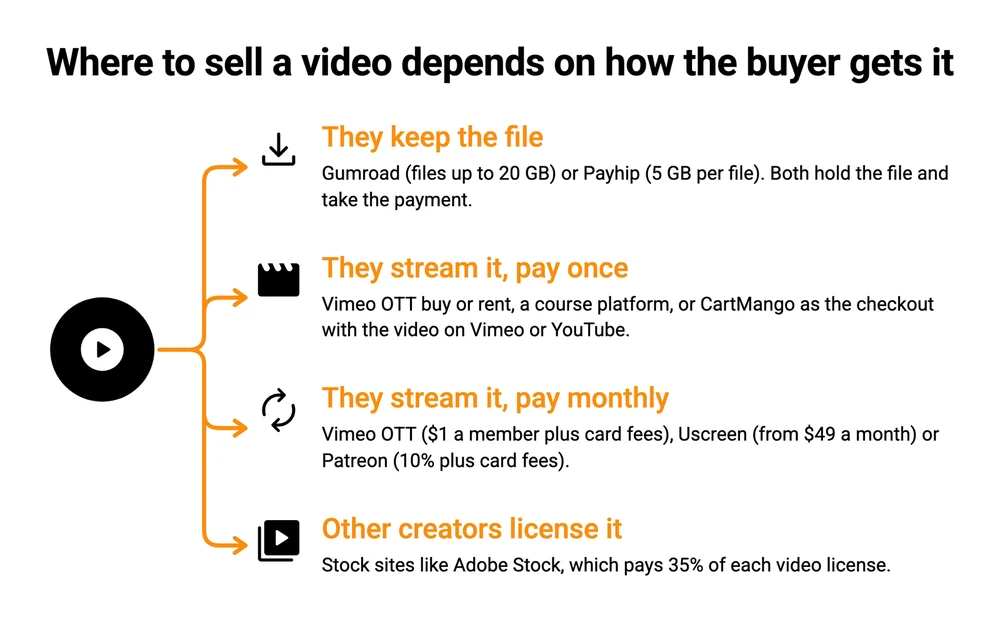
The first 3 each need 2 separate jobs done. Video hosting stores the file and plays it or delivers the download. A checkout takes the money, sends the receipt, handles refunds and, set up well, puts the buyer’s email on your list. A stock site does both jobs for you.
Gumroad and Payhip do both jobs for a video file. CartMango, the checkout I run, does the second. CartMango stores PDFs, audio and other downloads, but its own pricing table says video files need outside hosting, so on that route the video sits on YouTube, Vimeo or Loom.
If your videos are on Vimeo On Demand now
Vimeo On Demand sellers need a new home: Vimeo stopped new purchases and subscriptions on September 21, 2026, and the whole service shuts down on November 20, 2026. Uploads were blocked a month earlier, on August 22.
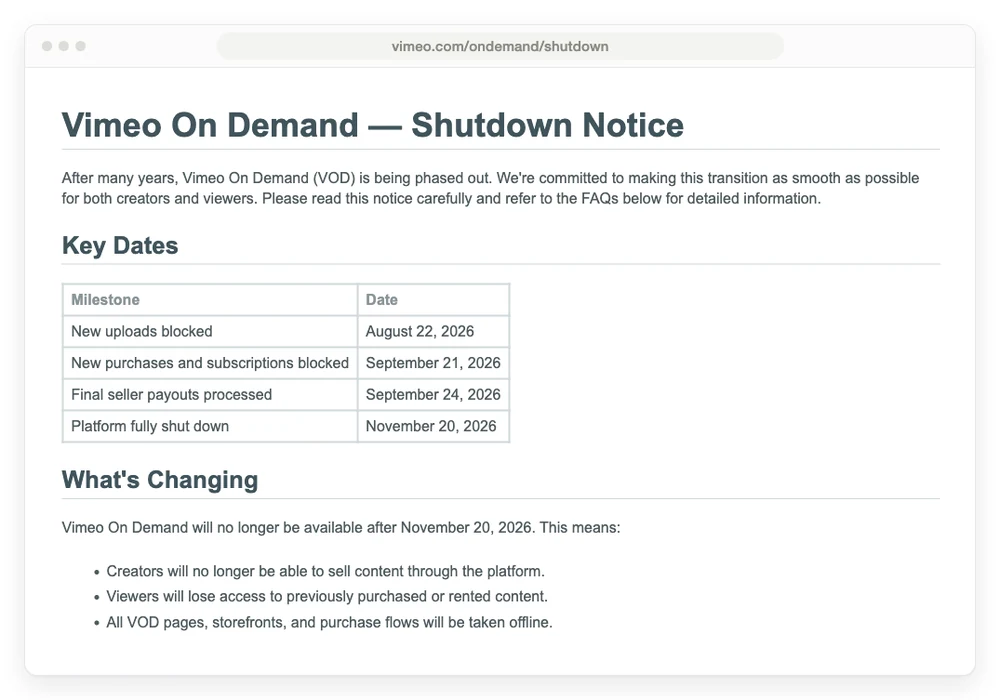
Vimeo’s shutdown notice for On Demand: new purchases and subscriptions blocked September 21, 2026.
The notice sits deep in Vimeo’s site. The top organic result for this search is still Vimeo’s On Demand sign-up page, which invites you to join and promises 90% of the revenue. And when you search the phrase, Google’s AI Overview names Vimeo On Demand as the first platform to use.
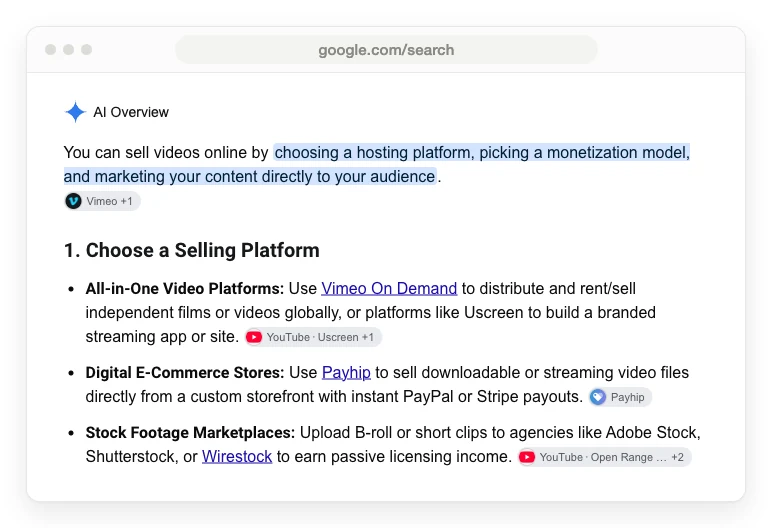
Google’s answer box for this search, with Vimeo On Demand listed first.
The rest is in Vimeo’s seller FAQ:
- Buyers keep watching until November 20, 2026. After that, purchased videos are gone unless the buyer downloaded a copy, which only works if you turned downloads on.
- Your Vimeo videos are not deleted. They stay in your Vimeo account under your plan’s storage terms.
- You get only opted-in emails. You can export a CSV of fans, but only viewers who opted in to updates. Vimeo says it cannot provide full buyer lists.
- Nothing moves across on its own. Vimeo calls a switch to Vimeo OTT a fresh start, though you can import videos from your Vimeo library without uploading them again. Once your OTT site is live, Vimeo Support will tell your buyers where you went.
If you are leaving, Vimeo OTT is the nearest swap. It keeps the buy and rent model at 10% + $0.50 a sale, card fees included, or charges $1 a subscriber a month plus 2.5% + $0.30. Videos you import from your Vimeo library don’t use up its paid upload hours.
Any of the routes below that fits how your buyers watch works too. When a platform owns the relationship with your buyers, a shutdown takes your list with it, so check that every buyer’s email reaches a list you control.
If buyers should keep the video file
For a video the buyer downloads and keeps, a digital-product store is a simple route. It holds the file, takes the payment and emails the download link, all in one place. Event videographers, tutorial sellers and filmmakers offering a copy to keep all fit here.
Gumroad and Payhip are the 2 stores this search keeps turning up, and file size decides between them. Gumroad accepts single files up to 20 GB on any product priced above $0.99, and caps free products at 250 MB in total. Payhip sets no limit on total storage but caps each file at 5 GB, so a long 4K film may need compressing first. By default Payhip lets each buyer download a file 3 times.
Pick Payhip when your files fit under 5 GB, because its free plan keeps more of each sale. Pick Gumroad when they don’t.
The table adds 2 pay-once routes that stream instead of handing over a file, so you can compare all of them on the same sale. On a single $25 video, you keep $23.97 on CartMango, $22.72 on Payhip’s free plan, $22.00 on Vimeo OTT, $20.97 on a direct Gumroad sale and $17.50 when the buyer finds you through Gumroad Discover.
| Route | Cut per sale | You keep of $25 | Hosts the video? | Plan fee |
|---|---|---|---|---|
| Gumroad, direct sale | 10% + $0.50, card fees on top | $20.97 | Yes, stream or download | None |
| Gumroad, Discover sale | 30%, card fees included | $17.50 | Yes, stream or download | None |
| Payhip free plan | 5%, card fees on top | $22.72 | Yes, download, 5 GB per file | None |
| Vimeo OTT, buy or rent | 10% + $0.50, card fees included | $22.00 | Yes, streaming | None. Uploads past 1 hour cost $99 to $199 unless imported from Vimeo |
| CartMango | 0%, card fees on top | $23.97 | No, the video stays on YouTube, Vimeo or Loom | Free right now, from $10 a year once paid plans start in November |
The card fee in these rows is Stripe’s standard US rate of 2.9% + $0.30, about $1.03 on a $25 sale. Vimeo OTT and Gumroad Discover fold it into their own cut.
CartMango’s row leaves out the plan price. Next to Payhip’s free plan, CartMango saves $1.25 a sale, so its $10 plan pays for itself after 8 sales a year if your host costs nothing. A CartMango buyer gets the video from wherever you keep it. For a plain video download, a store that holds the file is less work. CartMango makes more sense when a YouTube or Vimeo link is how you planned to deliver anyway.
Before building any download store, check that your buyers want files at all. A UK videographer on an r/videography thread tested downloads as a cheaper option next to physical copies. Their result: “download sales were in the low single figures, with USBs in the hundreds.” Even DVDs outsold the HD downloads, so ask your buyers how they want the video before you pick a tool.
If either store’s cut bothers you, these Gumroad alternatives and Payhip alternatives compare what rival stores take per sale.
If you teach in videos people watch in order
A course or lesson series needs streaming, a video player and a way to keep access limited to paying students. That comes from a course platform, or from a checkout paired with a private video host. A course platform does it all under a single bill, with lessons, progress tracking and a student login. On plans that put the course on your own domain, LearnWorlds starts at $29 a month billed monthly, plus $5 a sale. Teachable starts at $89 a month billed monthly, on Builder.
Courses on your own website compares 4 of those setups in full. For the selling side, how to sell online courses shows how 1 creator earned $2.8 million in 3 years. Payhip can also host course videos, for what its video page calls “a small extra charge”, without naming the figure.
The lighter route is a checkout plus a host you already use. An unlisted YouTube video costs $0, and Vimeo’s paid plans start at Starter, which adds password protection. CartMango takes the payment and adds each buyer to your email tool (Kit, ActiveCampaign, Beehiiv and BirdSend connect directly). A welcome email you set up there sends the private link.
With the course on unlisted YouTube, CartMango leaves $23.97 of a $25 course, before its plan. Any link works for whoever has it, though, so you cannot cut off 1 refunded buyer without changing it for everyone. CartMango’s own course area, with student dashboards, is planned for October 2026 on its $30 a year Platinum plan.
For me, the editing is where the time goes. In September 2025 I spent 8 hours making a 1-minute demo video for the CartMango homepage. My email to my list the next day summed it up: “Hit record, freeze, re-record, cut, trim, export, hate it, do it again.”
The moral I wrote at the end of that email was to absorb your customers’ pain so their side is easy. For a lesson, that means you do the cutting so the student gets the point in 1 minute instead of 20. If you’re unsure what to charge for that work, how to price digital products covers setting the price, and selling courses on YouTube covers moving viewers to a paid version.
If you want viewers paying every month
A monthly video library needs a platform that charges every renewal and locks out members who stop paying. The 4 common routes are Vimeo OTT, Uscreen, Patreon and YouTube channel memberships. Each charges in a different way:
- Vimeo OTT takes $1 per subscriber per month plus 2.5% + $0.30, with no upfront fee. The first hour of uploads is free. More costs $99 for 10 hours, $149 for 25 hours and $199 for 50 hours, according to Vimeo’s OTT pricing breakdown.
- Uscreen Starter is $49 a month, sold monthly only, with no per-subscriber fee and a cap of 100 subscribers. Growth is $199 a month, or $149 a month billed yearly, plus $1.99 per subscriber.
- Patreon takes 10% for creator pages published after August 4, 2025, plus payment processing of 2.9% + $0.30 per US card payment.
- YouTube channel memberships pay you 70% of net membership revenue, according to YouTube’s partner earnings page. Channels where many videos are made for kids or carry music claims are not eligible.
On a $10 monthly member, CartMango leaves you $9.34, Vimeo OTT $8.45, Uscreen Starter $8.43 at 50 members, Patreon $8.41 and YouTube at most $7.00.
| Route | Cost per $10 member | You keep | Player and member area | Plan fee |
|---|---|---|---|---|
| Vimeo OTT | $1 + 2.5% + $0.30 | $8.45 | Yes | None |
| Uscreen Starter | $49 a month shared across members, plus 2.9% + $0.30 | $8.43 at 50 members | Yes | $49 a month, monthly only, 100 members max |
| Patreon | 10% + 2.9% + $0.30 | $8.41 | Yes | None |
| YouTube memberships | 30% plus taxes | Under $7.00 | Yes, inside YouTube | None |
| CartMango | 2.9% + $0.30 + Stripe’s 0.7% | $9.34 | No player. A course area is planned for October 2026 | Free right now, from $10 a year once paid plans start in November |
Card fees use Stripe’s US rate, including on Uscreen, which runs payments through Stripe and PayPal. The CartMango row adds Stripe’s 0.7% subscription fee to stay on the safe side, and its plan price still counts. Counting the $10 plan, 1 member for a year leaves $102.08 on CartMango, against $101.40 on Vimeo OTT.
CartMango has no video library or member login today, which is what Vimeo OTT and Uscreen sell. If you leave CartMango, existing subscriptions keep paying you. The renewal side, failed cards and switching tools, is covered in how to sell subscriptions online.
If your clips are stock footage
Stock footage sells through licensing marketplaces, where the site finds the buyer and pays you a royalty on each license.
Adobe Stock pays contributors 35% of the net price of each video license, and 33% for photos and illustrations, according to Adobe’s contributor royalty page. Adobe sets that price through its own plans. Pond5 lets contributors set their own clip prices, and Wirestock’s footage page lists AI labs among its buyers.
The upside is reach, because buyers are already searching those libraries. The buyer stays the site’s customer, so you have no list to sell the next clip to. Nothing stops you doing both: license generic B-roll through a stock site and sell your own packs or tutorials direct.
Where selling videos goes wrong
5 mistakes catch video sellers after the platform is already chosen:
- Selling what you lack the rights to. Background music and the people in your shot both count. YouTube can refuse memberships to channels where many videos carry music claims, and in that same r/videography thread another commenter reminded the event videographer to get clearance from whoever ran the competition.
- Picking a store that cannot hold the file. Payhip stops at 5 GB per file and Gumroad at 20 GB. CartMango stores no video files at all.
- Letting the platform keep your buyers. Vimeo On Demand sellers can export only the fans who opted in, so check that any tool you pick gives you every buyer’s email.
- Selling streams with no exit. When a streaming store closes, buyers lose what they paid for. A file they downloaded stays theirs.
- Trusting a link to stay private. Unlisted links get forwarded. Payhip’s default of 3 downloads per file and unique buyer links make file sharing harder.
Which route fits your videos
Downloads point to Gumroad or Payhip, lessons to a course platform or a checkout with a private host, monthly libraries to Vimeo OTT, Uscreen or Patreon, and stock clips to Adobe Stock.
| Your situation | Pick | What a sale leaves you | The catch |
|---|---|---|---|
| Buyers keep the file | Gumroad or Payhip | $20.97 on Gumroad or $22.72 on Payhip, of $25 | Payhip caps files at 5 GB |
| You teach a series | A course platform, or CartMango with Vimeo or YouTube | $23.97 of $25 on CartMango, before its plan | Private links can be forwarded |
| A monthly library | Vimeo OTT, Uscreen or Patreon | $8.45 on Vimeo OTT, $8.43 on Uscreen at 50 members, $8.41 on Patreon, of $10 | Uscreen Starter stops at 100 members |
| Stock clips | Adobe Stock | 35% of each license | The buyer stays Adobe’s customer |
| Leaving Vimeo On Demand | Vimeo OTT or any route above | $22.00 of $25 on Vimeo OTT | Only opted-in emails come with you |
FAQ
What is the best website to sell videos on?
No single site wins, because the right site follows how your buyer watches. For downloads, Gumroad (10% + $0.50 a sale plus card fees) and Payhip (5% on its free plan) hold the file and take payment. For streams, Vimeo OTT charges 10% + $0.50 a sale or $1 per monthly subscriber. CartMango (free right now, from $10 a year once paid plans start in November, 0% per sale) works as the checkout when the video lives on YouTube or Vimeo. Stock clips go to Adobe Stock.
Can you sell videos on YouTube?
Not directly. The main paid options are channel memberships, which pay you 70% of net membership revenue, and ads, which pay 55% of net ad revenue on long-form videos, according to YouTube’s partner earnings page. Ads need the YouTube Partner Program, and memberships need YouTube’s fan-funding eligibility.
The usual workaround is free videos with a link to a paid one in the description. Earning from YouTube without AdSense lists more.
How many YouTube views do you need to make $1,000 or $10,000 a month?
YouTube publishes no fixed rate per view, so there is no fixed view count for either figure. It pays 55% of net ad revenue on long-form videos and 45% of the Shorts revenue it assigns to each creator, and what advertisers pay swings by topic and country. Selling direct gives you a number you control: 40 buyers of a $25 video is $1,000 before fees, and 400 buyers is $10,000.
Can buyers lose a video they paid for?
Yes, when the video only streams from a platform that closes. Vimeo On Demand buyers lose access on November 20, 2026, unless the seller allowed downloads and the buyer saved a copy. A downloaded file stays on the buyer’s device whatever happens to the store.
Does CartMango host video files?
No. CartMango’s own pricing table says its file storage covers images, PDFs, audio and downloadable files, and that video files need outside hosting such as YouTube, Vimeo, Loom or Zoom recordings. CartMango runs the checkout and adds each buyer to your email tool, and the video stays on your host.
Keeping the buyer list when the video lives elsewhere
The Vimeo shutdown leaves its sellers with 2 things: their files, and only the buyer emails people chose to share. Whatever you decide about how to sell videos online, set that list up on day 1. CartMango takes one-time or monthly payments at 0% per sale and sends each buyer to the email tool you connect, so that list grows with every sale. Your videos stay on YouTube, Vimeo or Loom. CartMango is free right now, with paid plans from $10 a year starting in November.
About the Author

👋 I’m Welly, founder of CartMango (the site you’re on), a checkout platform for digital product sellers. We’ve previously processed $179M+. I also run BirdSend (email marketing tool, 3.1B+ emails sent). On the side I show other non-techie digital sellers how I use AI workflows to automate 50%+ of my operations. Find me on LinkedIn.
Related Reading
- How to Sell Subscriptions Online: the renewal side of a monthly video library, with fees on a $10 subscriber
- How to Sell Online Courses From Your Own Website: 4 course setups and what each costs on your own domain
- Selling Courses on YouTube: moving YouTube viewers to a paid course
- Best Gumroad Alternative: 7 checkout options compared on fees, for when Gumroad’s cut adds up