
$89 a month is the cheapest Kajabi plan, though the pricing page no longer shows that tier and starts you at $179. Annual billing cuts every plan by 20%. On top of the plan you pay card processing of 2.9% + $0.30, and connecting your own Stripe adds another 0.5% to 5%.
I went looking for Kajabi pricing the way you probably did, and page 1 of Google could not agree with itself on what the cheapest plan costs.
2 results quote prices Kajabi replaced in January. 3 of them say Kajabi charges no transaction fees, which stopped being true for anyone using their own payment processor. And 3 of them tell you the cheapest way in costs $143 to $179 a month, when there is a live plan at $71.
So this post does the boring thing. Every number below was read this week from Kajabi’s own pricing page, its help centre fee schedule, and its signup flow. You will get the plan prices, the payment fees, the surcharges that stack on top, and what all of it adds up to on a real sale.
Key Takeaways
- Kajabi has 4 tiers: Kickstarter at $89 a month, Basic at $179, Growth at $249 and Pro at $499, all 20% cheaper billed annually.
- The Kickstarter plan is live and buyable at $89 a month, but Kajabi hides it from the public pricing table.
- Kajabi’s pricing page says “No hidden fees. No revenue sharing.” The same page charges 0.5% to 5% of every sale if you use your own Stripe.
- Card processing starts at 2.9% + $0.30 and climbs with surcharges for subscriptions, international cards and currency conversion.
- Prices rose 20% to 25% on 13 January 2026, the first change in 10 years. Kickstarter was the only tier left alone.
Kajabi pricing plans, and the one Kajabi stopped showing you
Kajabi runs 4 tiers. Here is what each costs and what you get, read live from the pricing page and the signup flow.
| Plan | Monthly | Annual | Per year | Products | Contacts |
|---|---|---|---|---|---|
| Kickstarter | $89 | $71/mo | $852 | 1 | 250 |
| Basic | $179 | $143/mo | $1,716 | 5 | 2,500 |
| Growth | $249 | $199/mo | $2,388 | 50 | 25,000 |
| Pro | $499 | $399/mo | $4,788 | Unlimited | 100,000 |
Annual billing saves you $216 on Kickstarter, $432 on Basic, $600 on Growth and $1,200 on Pro. Kajabi states those savings on the pricing page itself, and the arithmetic checks out against the monthly rates.
Before you commit to any platform fee: the free 5-day Online Selling Mistakes Challenge walks through the 5 mistakes that quietly cost solo sellers the most money. Paying for capacity you have not earned yet is one of them.
Now the part that took some digging.
Visit kajabi.com/pricing and you will see 3 plans, not 4. Kickstarter is missing. The page opens at Basic, $179 a month, and every “cheapest Kajabi plan” answer written off that page inherits the mistake.
Kickstarter is still there. It sits in the page’s own code with a hide instruction wrapped around it, so your browser loads the plan and then refuses to draw it.
The signup link works fine. Load it and Kajabi bills you $89 a month, or $852 a year for the annual version, with a stated saving of $216. Kajabi’s own December 2025 announcement of the price change lists the tier by name too, calling the 4 tiers “Kickstarter, Basic, Growth & Pro.”
So the plan is real, current and purchasable. It just is not advertised. I checked the page twice, in 2 separate browsers, and got 3 plans both times.
What you give up at $89 a month is genuine: 1 product, 250 contacts, no custom domain, no affiliate program, and Kajabi branding stays on your pages. For someone selling a single course to a small list, none of that is fatal.
The plan fee is only half the bill
Kajabi’s pricing page opens with this line:
All-in-one platform with transparent pricing. No hidden fees. No revenue sharing.
Scroll down the same page and you reach the payment section. There are 2 rows.
The first is Kajabi Payments, Kajabi’s own processor. US rates run 2.9% + $0.30 on Kickstarter and Basic, 2.8% + $0.30 on Growth, and 2.7% + $0.30 on Pro. That is ordinary card processing, priced about where Stripe and PayPal sit.
The second row is the one to read twice.
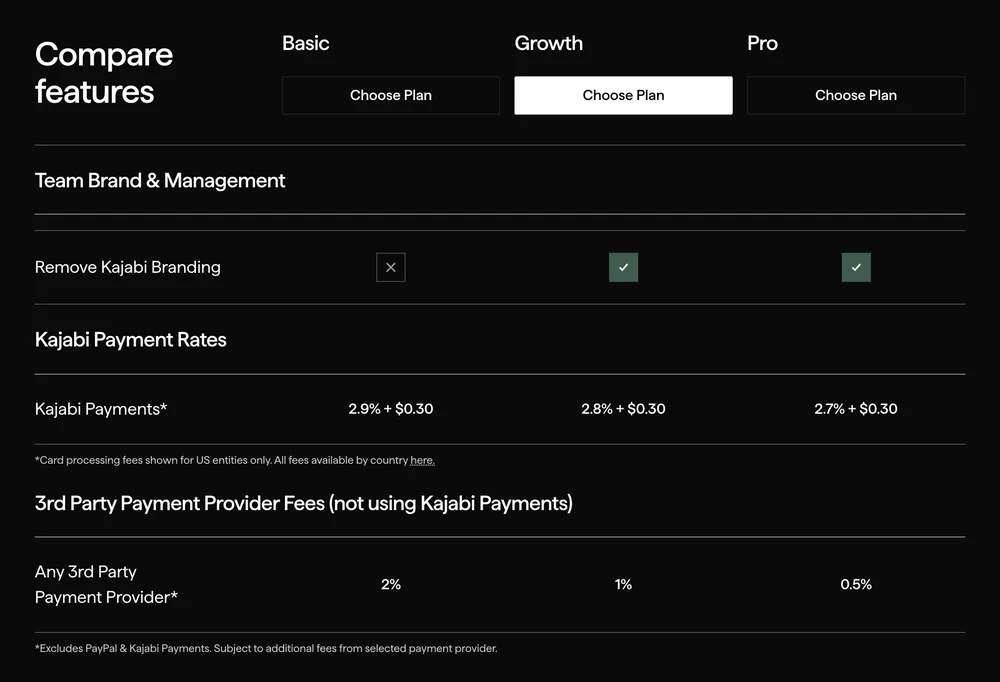
Kajabi’s own pricing page. The bottom row is the fee for using your own payment processor.
If you connect your own Stripe instead of using Kajabi Payments, Kajabi takes a cut of every sale: 5% on Kickstarter, 2% on Basic, 1% on Growth and 0.5% on Pro. That is on top of whatever Stripe charges you.
A percentage of every sale, paid to the platform, is revenue sharing. It sits on the same page as the sentence saying there is none. The fee arrived with the new plans in January 2026, which is why older guides do not mention it.
The signup page makes it sharper. Load the Kickstarter checkout, the plan carrying the 5% fee, and the bullet under the price reads “No platform fees: keep what you make.”
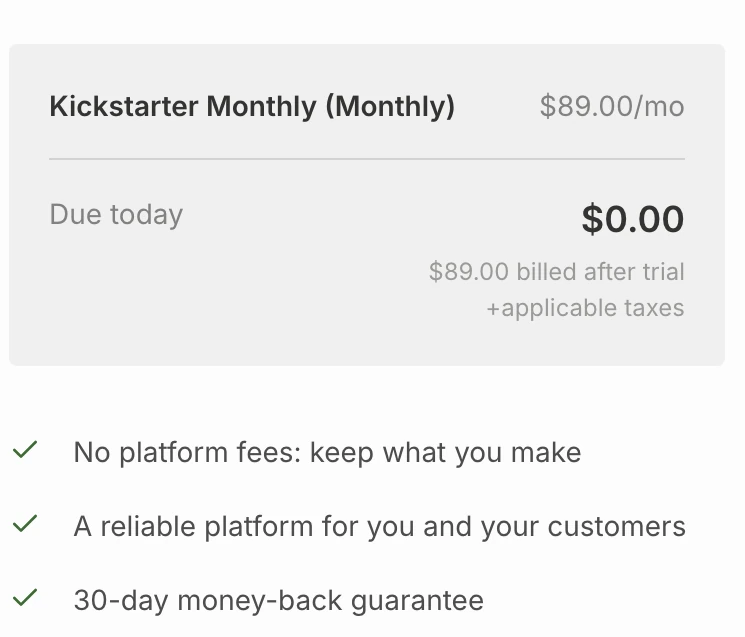
The Kickstarter signup page. This is the plan with the 5% third-party payment fee.
To be fair to Kajabi, there is a defensible reading here. If you use Kajabi Payments, Kajabi genuinely takes no cut beyond processing, and its help centre explains the third-party fee as covering “the cost of maintaining and supporting such 3rd party payment providers within Kajabi.” That is a real cost.
The problem is what happens to everyone else. A seller who reads “no revenue sharing” and plugs in the Stripe account they already have will not discover the 5% until it turns up in their payouts.
3 places the third-party fee does not apply, all confirmed in Kajabi’s own FAQ:
- PayPal transactions, in any region, on any plan.
- Legacy plans. Stay on your old plan and the fee never starts. You also forfeit the discounted Kajabi Payments rates and the new limits.
- Countries where Kajabi Payments does not operate. It currently runs in Australia, Canada, select European countries, the UAE, the UK and the US. Sell from outside those and Stripe costs you nothing extra.
No page ranking for this keyword mentions the country rule, and for a platform with sellers worldwide it decides whether the fee exists at all.
Every extra fee Kajabi can add
The 2.9% headline is a starting point. Kajabi’s US fee schedule lists a stack of surcharges, and no ranking page puts a number on any of them.
| Fee | Rate | When it hits |
|---|---|---|
| Card processing | 2.9% + $0.30 | Every card sale (2.8% Growth, 2.7% Pro) |
| Subscriptions and payment plans | + 0.7% | Every recurring charge, including the first |
| International cards | + 1.5% | Buyer’s card issued in another country |
| Currency conversion | + 1% | Offer priced in a different currency |
| Kajabi Sales Tax | $0.15 | Per transaction, where you enable it |
| Invoicing | + 0.4% | Payments taken through Kajabi Invoicing |
| Manual card entry | + 0.5% | First time you key a card in by hand |
| Dispute | $15.00 | Per chargeback, kept whether you win or lose |
| Instant payout | 1.5% | Optional, $0.50 minimum |
Klarna runs 5.99% + $0.30 and Afterpay 6% + $0.30, both well above the card rate. ACH is cheaper at 0.80% capped at $5, with $1.50 per bank verification attempt and $4 for a failed payment. Refunds cost nothing to issue, but Kajabi keeps the fees from the original charge.
Here is the fair reading, and it matters. Those surcharges are not a Kajabi invention. Stripe’s published rates are 2.9% + 30 cents, plus 1.5% for international cards and 1% when currency conversion is needed, and Stripe Billing charges 0.7% on recurring volume.
Kajabi Payments matches that schedule line for line. Run your own Stripe account outside Kajabi and you would be paying the same numbers.
So the surcharge stack is normal card processing, and you would meet it anywhere. The third-party fee from the previous section is the one charge with no equivalent outside Kajabi, and it exists purely because you picked a different processor.
Read the subscription line again anyway. Kajabi sells itself on courses, memberships and coaching, which are exactly the products people bill monthly. Every recurring charge carries an extra 0.7%, and for a membership business that is a permanent cost sitting on your main revenue line.
Here is how the layers stack on a $100 sale, paid by card through Kajabi Payments on Basic:
| What you are selling | Total fee | You keep |
|---|---|---|
| One-off product, domestic buyer | $3.20 | $96.80 |
| Monthly membership, domestic buyer | $3.90 | $96.10 |
| Monthly membership, overseas buyer | $5.40 | $94.60 |
| Monthly membership, overseas buyer, priced in their currency | $6.40 | $93.60 |
The currency conversion fee is worth one more sentence, because Kajabi is unusually plain about it: “This fee is included in the exchange rate so you will not see this as an explicit fee.” A charge you cannot see on your statement is a strange thing to find under a headline promising no hidden fees.
Which payment route is actually cheapest
You have 3 ways to take money on Kajabi, and the gap between them is bigger than the gap between 2 plans. Here is the same $100 sale on a Basic plan.
| Route | What you pay | Fee | You keep |
|---|---|---|---|
| Kajabi Payments | 2.9% + $0.30 | $3.20 | $96.80 |
| PayPal | 3.49% + $0.49, no Kajabi cut | $3.98 | $96.02 |
| Your own Stripe | 2.9% + $0.30, plus Kajabi’s 2% | $5.20 | $94.80 |
PayPal looks like the clever loophole, because Kajabi exempts it from the third-party fee entirely. It is not, quite. PayPal’s own US rate is 3.49% + $0.49 for commercial transactions, higher than Kajabi Payments, so dodging the 2% still leaves you worse off than just using Kajabi’s processor.
On the Kickstarter plan the spread gets wider. The 5% third-party fee pushes your own Stripe to $8.20 on that same $100 sale, against $3.20 through Kajabi Payments.
The practical upshot: on a new Kajabi plan, in a country where Kajabi Payments works, Kajabi Payments is the cheapest route and the other 2 cost you real money. Whether you want your payment processing tied to your course platform is a separate question, and a fair one.
What Kajabi actually costs at 3 income levels
Percentages are slippery. Here is the same question in dollars, using annual billing, Kajabi Payments and an average order of $100.
| Monthly sales | Plan | Plan cost | Processing | Total | Share of revenue |
|---|---|---|---|---|---|
| $2,000 | Kickstarter | $71 | $64 | $135 | 6.8% |
| $5,000 | Basic | $143 | $160 | $303 | 6.1% |
| $10,000 | Growth | $199 | $310 | $509 | 5.1% |
Over a year that is $1,620, $3,636 and $6,108. Sell subscriptions or ship to buyers abroad and every one of those numbers goes up.
The pattern is the useful bit: Kajabi gets proportionally cheaper as you grow, and it is most expensive per dollar when you are smallest. A seller doing $2,000 a month hands over a bigger share of revenue than one doing $10,000. Worth knowing if you are deciding whether to start on Kajabi or move to it once you have volume.
If you are still costing out the product itself, our breakdown of what it costs to create an online course covers the spend that happens before any platform fee.
Which Kajabi plan fits you
Price is the easy part. The caps are what actually push people up a tier.
- Kickstarter, $89. 1 product, 250 contacts. No custom domain, no affiliate program, Kajabi branding stays. Fine for 1 course and a small list.
- Basic, $179. 5 products, 2,500 contacts, custom domain. Still no affiliate program, still Kajabi branding, still no automations beyond the basics.
- Growth, $249. This is where the platform opens up. 50 products, 25,000 contacts, 11 admin users, and the tier that finally adds affiliate programs, removing Kajabi branding, advanced automations, webhooks and cohort courses.
- Pro, $499. Unlimited products, 100,000 contacts, 3 websites, plus the branded mobile app and API that Kajabi values at $199 and $25 a month.
2 caps catch people out. Contacts count everyone on your list, not just buyers, so a Basic plan with 2,500 contacts fills up faster than it sounds. Extra contacts are an add-on, and the price for another 5,000 went from $20 to $25 in the January change.
The other is the affiliate program sitting behind Growth. If your launch plan depends on affiliates, your real entry price is $199 a month, not $71.
I would add something that has nothing to do with the price sheet. Years ago I built an online training course, spent hundreds of hours on it, launched it, and fewer than 5 people bought. I nearly quit the whole thing over it.
What I do now is check that people want the thing before I build it, and the same logic applies to platforms. A $4,788 Pro plan does not fix a product nobody asked for. Prove somebody will pay first, on whatever is cheapest, then buy the tier your real volume needs.
What most Kajabi pricing guides get wrong
I read all 6 content pages ranking on page 1 for this keyword. Here is how their numbers compare with Kajabi’s live pricing page.
| Ranking page states | Reality |
|---|---|
| Basic $149, Growth $199, Pro $399 (2 pages) | Replaced on 13 January 2026 by $179 / $249 / $499 |
| Kickstarter costs $69 (2 pages) | Older still. Kickstarter was $89 before the change and is $89 now |
| Cheapest plan is $143 to $179 (3 pages) | Kickstarter is live at $71 to $89 |
| Kajabi charges 0% transaction fees (3 pages) | True on Kajabi Payments. False on your own Stripe, where it is 0.5% to 5% |
| Kickstarter was discontinued (1 page) | Kajabi’s own December 2025 announcement lists it as a current tier |
The 2 pages quoting $149, $199 and $399 are not inventing figures. Those were Kajabi’s real prices until 13 January 2026, and Kajabi’s own announcement page shows the old and new numbers side by side.
Their $69 Kickstarter figure is older than that again, so those pages were already behind before the January change landed. One of them carries a “2026 Updated” stamp and a heading that still reads “Kajabi Pricing 2024.”
That January change was Kajabi’s first in 10 years, in its own words. Basic went up $30 a month, Growth $50, Pro $100.
Kickstarter was the only tier that did not move. It stayed at $89 and it is the one no longer shown on the pricing page. Steering new signups toward the bigger plans is ordinary software pricing, not a scandal, and Kajabi has not commented either way. Worth knowing the cheap tier is still there, all the same.
One more wrinkle for existing customers, straight from that announcement. If you stay on your legacy plan you pay the new price anyway, and you keep the old limits.
Kajabi puts it plainly: pricing on legacy and new plans “will be the same,” and staying put means you “won’t have access to premium features or expanded limits included in the updated plans.” Staying where you are costs the same and gives you less.
Your free trial is 14 days or 30, depending on where you click
This one is small, and easy to miss.
Click any of the plan buttons on Kajabi’s pricing page and the signup screen offers a 14-day free trial. Click the separate “Start a 30-day free trial” link on that same page and you land on the same Basic plan at the same $179 a month, with a 30-day trial instead.
Same page, same plan, same price, double the runway. There is also a 30-day money-back guarantee on top, stated at checkout.
Affiliate sites promote other entry deals, including a widely advertised 3 months for $99. I could not verify that one on any Kajabi-owned page, so treat it as an affiliate offer rather than published pricing. What I can verify is the trial length changing with the link, so it is worth a look around before you sign up from the first button you see.
Is Kajabi worth the money?
For the right business, yes, and it is worth saying clearly.
Kajabi bundles courses, communities, coaching, email, landing pages, funnels, checkout and affiliates into a single login. Running that stack across 4 or 5 separate tools costs real money and real admin time. If you want all of it in one place, and you are turning over enough for a few hundred dollars a month to be a rounding error, Kajabi does the job and does it well.
The problem is the floor. $852 a year is the cheapest entry, and that is the tier with 1 product and no custom domain. The realistic starting point for most people is $1,716, and the plan with affiliates and branding removal is $2,388.
That floor is what pushes people out, and it is worth hearing from someone it happened to rather than from me. A Japanese seller who had used Kajabi for almost 4 years wrote on Trustpilot in May 2026 that Kajabi is “an excellent platform for selling and delivering online courses” and that they “would have liked to continue using” it, before listing the price rise as one of 2 reasons they cancelled: the cost “felt high” and “at that point I decided it was no longer practical for me to continue.”
Kajabi replied to that review in public, which is to its credit: “We know cost is a real consideration for creators at every stage.” 1 review proves nothing on its own. It does show how the decision tends to go: the product is good, the bill is the problem.
The nearest all-in-one rivals start lower. Podia opens at $42 a month, or $504 a year, with a 5% cut of sales and a 100-subscriber email cap. Teachable’s Starter plan is $39 a month, $29 billed annually, with a 7.5% transaction fee.
Both trade a lower monthly fee for a bigger slice of every sale, which is the better deal only while your volume is small.
And if you look at that list of features and realise you only want 1 of them, that is worth knowing before you spend $1,716.
Some people end up using Kajabi as an expensive checkout. The course lives somewhere simple, the email tool is one they already like, and what they actually needed was a payment page. If that describes you, a dedicated checkout costs a fraction of this.
I should be upfront that I run one, so start with what it cannot do. CartMango does not host your course, does not run a community, and does not manage affiliates.
Kajabi does all 3 today. If those are what you are buying, Kajabi is the honest answer and the $2,388 Growth plan is what it costs.
What CartMango does is the checkout half: order bumps, upsells, a hosted sales page, and buyers syncing into whatever email tool you already use. For a seller whose course lives elsewhere, that is the part of Kajabi they were actually paying for.
If you are weighing this against other platforms in the same bracket, the SamCart vs Kajabi comparison sets the 2 side by side, the SamCart pricing breakdown runs these same numbers on another course-friendly cart, and the Gumroad pricing breakdown covers the percentage-only end of the market. For the wider view, our guide to selling online courses covers the routes beyond the all-in-one platforms, and planning a course launch is where most of the real work sits once the platform question is settled.
FAQ
How much does Kajabi cost?
Kajabi costs $89 a month on Kickstarter, $179 on Basic, $249 on Growth and $499 on Pro. Annual billing drops those to $71, $143, $199 and $399 a month, or $852 to $4,788 a year. Card processing of 2.9% + $0.30 is charged on top of every plan.
Why is Kajabi so expensive?
Kajabi bundles what most sellers buy as 4 or 5 separate tools: course hosting, email, landing pages, funnels, checkout and communities. You pay for the whole bundle whether you use all of it or not. Prices also rose 20% to 25% on 13 January 2026, the first increase in a decade, which pushed Growth from $199 to $249 and Pro from $399 to $499.
Is Kajabi free to use?
No. There is no free plan. Kajabi offers a free trial of 14 or 30 days depending on which signup link you use, plus a 30-day money-back guarantee. After that the cheapest paid tier is $71 a month billed annually.
Does Kajabi take a percentage of your sales?
Only if you use your own payment processor. With Kajabi Payments you pay processing of 2.9% + $0.30 and no platform cut. Connect your own Stripe and Kajabi adds 5% on Kickstarter, 2% on Basic, 1% on Growth and 0.5% on Pro. PayPal transactions are exempt, and so is any seller in a country where Kajabi Payments is unavailable.
What is the cheapest Kajabi plan?
Kickstarter, at $89 a month or $852 a year. It is not shown on the public pricing page, which starts at Basic, but the plan is live and the signup flow bills at $89. It covers 1 product and 250 contacts, with no custom domain and no affiliate program.
Is Kajabi cheaper than Teachable or Podia?
Not at the entry level. Teachable starts at $29 a month billed annually and Podia at $42, against Kajabi’s $71. Both charge a percentage of sales at that tier, 7.5% for Teachable and 5% for Podia, so Kajabi becomes the cheaper option once your volume is high enough for those cuts to exceed the price gap.
Has Kajabi pricing changed recently?
Yes. On 13 January 2026 Kajabi pricing rose across the range, the first change in 10 years by Kajabi’s own account. Basic went from $149 to $179 a month, Growth from $199 to $249, Pro from $399 to $499, and Kickstarter held at $89. Existing customers on legacy plans pay the new rates too, and keep their old limits unless they migrate.
If the whole reason you were pricing up Kajabi is that you need a way to take payments, that part does not have to cost 4 figures a year. CartMango handles the checkout: order bumps, upsells, a hosted sales page, and every buyer dropped straight into your email tool. It is free while the beta runs, and priced per year rather than per month after that.
About the Author

👋 I’m Welly, founder of CartMango (the site you’re on), a checkout platform for digital product sellers. We’ve previously processed $179M+. I also run BirdSend (email marketing tool, 3.1B+ emails sent). On the side I show other non-techie digital sellers how I use AI workflows to automate 50%+ of my operations. Find me on LinkedIn.
Related Reading
- SamCart vs Kajabi: the 2 platforms set side by side on features and cost
- SamCart pricing breakdown: the same fee math run on another course-friendly cart
- Gumroad pricing breakdown: what the percentage-only end of the market really costs
- How to sell online courses: the routes that exist beyond the all-in-one platforms
- What it costs to create an online course: the spend that happens before any platform fee