
Ko-fi replaces Buy Me a Coffee for one-off tips, Patreon for tiered memberships, Gumroad for selling files, Ghost for a paywall on a site you own, and CartMango for tips and products through the same page. Each Buy Me a Coffee alternative differs mainly in the cut it keeps. Every fee below came from the platform’s own pricing or help page.
I went looking for what Buy Me a Coffee actually costs, expecting to confirm the 5% everybody quotes. The 5% is real. It is also about a third of the bill.
Buy Me a Coffee’s own help centre lists 4 more charges underneath it, and the setting that decides who pays them is switched to “you” the day you sign up. Then there is a rule published in June 2026, which I could not find on any page ranking for this search, that can unpublish your page and push your balance back to your supporters while you are not looking.
This guide prices the realistic alternatives, shows what each one keeps from a $5 tip, and covers the part the ranking guides skip: how to leave without losing the supporters you already have.
Key Takeaways
- Buy Me a Coffee’s 5% is the platform fee, not the total. Stripe’s cut, a payout fee, and 2 surcharges take a small international membership payment closer to 16%.
- By default you pay the card processing, not your supporter. It is a toggle in Settings that starts switched on for you.
- Go 18 months without logging in and your page is unpublished. Your balance is paid out or refunded to supporters, and Buy Me a Coffee calls the action irreversible.
- Ko-fi’s famous 0% on tips does not apply to a new account. Ko-fi turns Contributor status on for everyone who joins, which puts 5% on tips until you find the switch.
- Ghost’s advertised $15 plan cannot accept a tip or a donation at all. The cheapest Ghost plan that can is $29 a month billed yearly.
Before the platform comparison, something worth doing first: most creators lose more to a leaky offer than to any platform fee. If you want the short version of where that leak usually is, the free 5-day Online Selling Mistakes Challenge walks through the 5 mistakes solo sellers make most often.
What Buy Me a Coffee actually costs
Buy Me a Coffee’s public answer is short and it sounds generous. Its FAQ says the company charges “a 5% transaction fee, and creators keep 95% of the earnings.” There is no monthly fee, and that part is completely true.
The full list lives a click deeper, in a help centre article on calculating charges. Alongside the 5% platform fee, it names Stripe’s standard 2.9% plus $0.30 per transaction, then “a 0.5% fee for payout processing”, then 2 surcharges: “+1% for international (outside of the US) transaction” and “+0.5% for subscription payments.”
Stack those up and a $5 coffee from a supporter in the United States costs you 72 cents, which is 14.4% rather than 5%. Make it a $5 monthly membership from a supporter outside the US and both surcharges apply, so the cost is 79.5 cents, or 15.9%.
All of it sits in the help centre article on calculating charges. None of it sits on the FAQ page, which is where most people stop.
The setting that decides who pays
A setting in your dashboard decides whether you or your supporter absorbs the card fee, and it starts switched to you. Buy Me a Coffee’s help centre is direct about it: “Every time a supporter makes a payment, a small credit card processing fee is applied. By default, this fee is deducted from your earnings, so you receive slightly less than the amount your supporter pays.”
You can flip it. In Settings there is a “Cover credit card fee” option, and turning it off passes the processing cost to the supporter instead. Buy Me a Coffee’s own worked example says a supporter would be charged $26.03 for a $25 contribution once they cover it.
How much that 1 toggle matters depends on the size of the payment, because 30 cents of the processing fee is flat. On a $25 contribution, processing is about 4% of it. On a $5 tip, the same 30 cents pushes processing to nearly 9%. Small tips are the ones it punishes.
A creator who did the maths in public
A podcaster posted the whole thing to r/podcasting after a $10 test tip from their wife arrived as $7. They emailed support and got the itemised list back: platform 5%, processing 2.9% plus $0.30, international 1%, subscription 0.5%, payout 0.5%.
What makes the thread worth reading is the update they posted afterwards. They corrected their own headline: the missing amount was not a 30% fee, most of the rest was currency conversion, and the real admin cost was “10%, double what’s advertized, but not the 30% it appeared to be.”
That is the honest number for a creator outside the United States. Double the advertised rate, not 6 times it.
Buy Me a Coffee alternatives compared
On $500 a month in $5 tips, the platform cut alone is $100 on Gumroad, $50 on Patreon, $29 on Ghost, $27.50 on Buy Me a Coffee, $25 on a new Ko-fi account and nothing on CartMango. Gumroad is the outlier because its flat 50 cents per sale lands 100 times. Card processing applies to every row, so the column below is each platform’s own cut only.
| Platform | Platform cut | Monthly cost | Sells files | Memberships |
|---|---|---|---|---|
| Buy Me a Coffee | 5% plus 0.5% payout | None | Yes | Yes |
| Ko-fi | 0% on tips, 5% on everything else | None, or $12 for Gold | Yes | Yes |
| Patreon | 10% for new pages | None | Yes | Yes |
| Gumroad | 10% plus $0.50 a sale | None | Yes | Yes |
| Ghost | 0% | $29, billed yearly | No | Yes |
| Fourthwall | 0% on tips, 5% on files and memberships | None, or $15 for Pro | Yes | Yes |
| CartMango | 0% | Free until October 2026, then $10 a year | Yes | Yes |
I should be upfront about that last row: CartMango is my own platform. It earns its place here because pay what you want pricing is on all 3 of its plans, which is the feature that turns a checkout into a tip jar. It also gives you no audience and no fan feed, so nobody discovers you there.
A note on Ghost’s row. Ghost’s own comparison page for this exact search is titled “The advanced Buy Me a Coffee alternative with 0% fees” and leads with “From $15/mo”.
Open Ghost’s pricing page and read the Starter column: “Paid subscriptions: No” and “Tips/donations: No”. The cheapest Ghost plan that can take a single tip is Publisher at $29 a month billed yearly.
The 0% is genuine. The $15 is not the number to plan around, which is the same thing we found when we priced more Patreon alternatives.
The 3 rules that only bite later
Fees are the easy part, because you can read them before you sign up. These 3 are the ones that reach you after you have built something.
Go quiet for 18 months and the page comes down
Buy Me a Coffee published a dormancy policy in June 2026. An account counts as inactive after “no login activity for 18 consecutive months”, and login is the only thing that counts. Your balance, your payout history and your earnings make no difference.
Reminder emails start at the 12 month mark and arrive weekly for 6 months. Miss all of them and 2 things happen.
Your page is unpublished, so it stops working even for people with the direct link. Your remaining balance is either paid out to your connected payout method or, if you do not have one, refunded to your supporters’ original payment methods.
Buy Me a Coffee’s wording on the last part is worth quoting: “This action is irreversible.”
Read that next to who actually uses a tip jar. A podcaster on hiatus, a writer between projects, an illustrator who moved to a day job: 18 consecutive months without a single login is an ordinary amount of quiet for a side project. This is the clause I would want to know about before building an audience on it. I searched for it directly and found only Buy Me a Coffee’s own help article.
You have to reach $10, and ask
Payouts are not automatic. Buy Me a Coffee’s help centre puts the floor plainly: “You can request a payout once your outstanding balance reaches $10 or more.”
Your first request also enters a human review queue. The article says your account goes into moderation the first time you request a payout, that your first payout only happens after approval, and that the first typically takes 7 to 14 days. The review triggers on the first payout request rather than at signup, so an account opened a year ago gets reviewed the first time it tries to cash out.
Where you live decides which version you get
Buy Me a Coffee’s FAQ says payouts are “available to creators in 44 countries.” Its help centre lists more than that, split into 2 groups: 44 countries on Stripe Standard Connect and another 70 on Stripe Express, which is 114 in total.
The distinction matters because the 2 account types give you different amounts of control over your own payouts. Standard means you hold a full Stripe account. Express means Stripe holds it on the platform’s behalf. Worth checking which list your country is on before you commit.
The picks, one by one
Ko-fi
Ko-fi is the closest thing to a like for like swap, and it is what both Google’s AI summary and most roundups name first. The reason given is always the same, that Ko-fi charges 0% on tips.
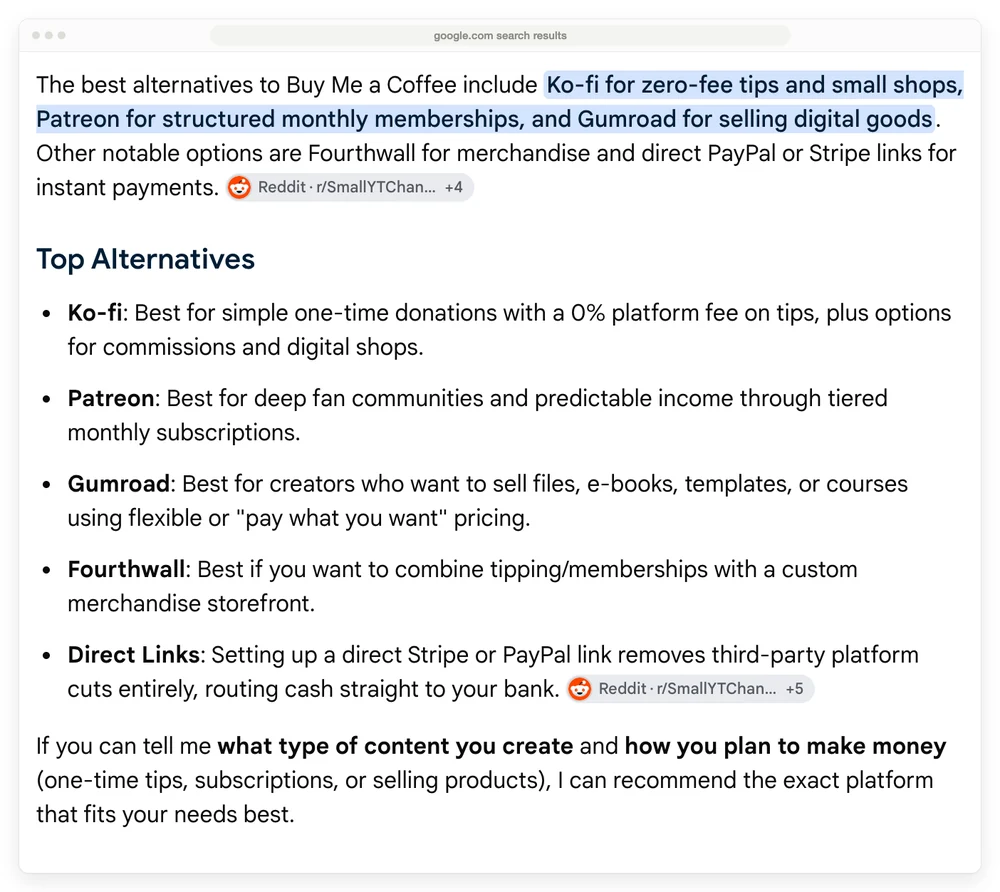
Google’s own summary of this search puts it plainly. Read the Ko-fi line.
That is true, and it is not true of a new account. Ko-fi’s help centre states it in a note on its Contributor status page: “Everyone who joins Ko-fi now starts with Contributor status.” Ko-fi adds that you can opt out at any time.
Contributor puts 5% on your tips. So a creator who signs up today and never opens Settings is paying the same 5% they left Buy Me a Coffee to escape.
Turn it off and tips really are 0%. Memberships, commissions, monthly tips and shop sales stay at 5% either way, and Ko-fi Gold removes that for $12 a month. We wrote up Ko-fi’s fees in full separately, including the trap where paying for Gold does not switch Contributor off for you.
Best for: one-off tips and small commissions, if you remember to change the setting.
Patreon
Patreon is built for tiered monthly memberships rather than tips, so it is a different kind of business rather than a cheaper version of the same one.
Every page published after 4 August 2025 is on the standard 10% plan. The 5%, 8% and 11% rates still quoted across the web are legacy plans that closed to new creators. Processing is on top: 2.9% plus $0.30 on cards, rising to 3.9% plus $0.30 for PayPal or Venmo outside the US. There is a detail in Patreon’s own fee article worth flagging if you are already on a legacy rate, which is that unpublishing your page “even briefly” moves you to the 10% plan.
At 10% plus processing, Patreon is the most expensive option here per payment. What you buy is the membership machinery and an audience that already understands the model. Patreon’s fees in full has the legacy rates and who still qualifies, and we put Patreon and Ko-fi side by side if those are your 2 finalists.
Best for: recurring memberships with tiers and perks.
Gumroad
Gumroad is a storefront that happens to accept pay what you want pricing, so people reach for it as a tip jar. Check the maths before you do.
Gumroad charges 10% plus $0.50 per transaction on direct sales, and its own help centre is explicit that this “does not include: Credit card processing (2.9% + $0.30)”. On a $5 tip the fixed 50 cents is 10% on its own, so you are at roughly 20% before Stripe takes anything. Gumroad has a volume discount that halves the percentage once your paid sales pass $20,000 in a calendar month, which is not a threshold a tip jar reaches.
Gumroad earns its place when you are selling a $29 template rather than collecting $5 coffees. Gumroad’s real pricing has the full breakdown.
Best for: selling files at real prices, not micro-payments.
Ghost
Ghost puts a paywall on a site you own, with your own domain and your own theme, and takes 0% of what your members pay. For a writer who wants a newsletter and a home on the web rather than a profile page, it is the strongest option on this list.
Start the maths at $29 a month billed yearly, not the $15 its own comparison page advertises. At $29 a month, Ghost costs less than Buy Me a Coffee’s platform side once you are past roughly $530 a month in tips.
Best for: writers and newsletters, above about $500 a month.
Fourthwall
Fourthwall bundles tips, memberships and print on demand merchandise in one place. Tips really are free: its pricing page lists “no fees” on donations for both its plans.
The 0% stops at tips. Fourthwall charges 5% on digital products and 5% on subscription memberships, and Pro at $15 a month billed yearly removes that 5% on digital products only. Memberships stay at 5% on both plans.
If part of your plan involves selling a mug or a shirt, Fourthwall removes a whole separate tool from your stack. If it does not, most of what you are paying for sits unused.
Best for: creators who want merchandise next to the tip button.
A direct Stripe or PayPal link
Google’s AI summary lists this and it deserves the mention. A payment link removes every platform cut and leaves you with the processor’s fee alone.
It also removes everything else: no page, no supporter list, no thank you messages, no memberships, no file delivery. It is the cheapest option and the most manual one. We covered where this fits among the other routes in selling online for free.
Best for: a handful of payments a month from people who already know you.
What each one leaves you on $500 a month
Numbers make this concrete. Take $500 a month arriving as 100 tips of $5, and compare only what each platform keeps, since card processing applies to all of them.
Buy Me a Coffee’s 5% plus the 0.5% payout fee comes to $27.50. Ko-fi on a fresh account with Contributor still on takes $25, and takes nothing at all once you switch it off.
Patreon would take $50, though a tip is not really what Patreon is for. Gumroad takes $100, because 100 transactions at 50 cents is $50 on top of its $50 percentage.
Ghost’s Publisher plan is $29 whatever you earn, so it costs slightly more than Buy Me a Coffee at this level and less at every level above it. CartMango charges nothing during its beta and $10 a year afterwards.
A percentage costs you more as you grow. A flat monthly fee costs you more when you are small. A per transaction charge like Gumroad’s 50 cents hurts most on small payments, which is exactly what a tip is.
Is the fee even your problem?
Often it is not. A platform cut only matters once there is enough money flowing through it for a percentage to be worth chasing.
A while back I got curious and Googled “how to become healthy”. It returned 961,000 results. Then I typed “how to go viral” and got 4 million. What I wrote to my list at the time still holds: “Pride can’t add dollars to our bank account.”
The point was that the thing creators chase is rarely the thing holding them back. Platform fees are the tip-jar version of that.
Moving from 5% to 0% on $80 a month saves you $4 a month. That is not the difference between a side project and an income. If your tip jar is quiet, the platform is not what is making it quiet, and a migration is a satisfying way to spend a weekend without changing the number at the end of the month.
Switch when the fee is genuinely large enough to notice, when you need something the current platform cannot do, or when a rule like the dormancy policy is a real risk for how you work. Those are good reasons. Saving 5% of not very much is not one.
How to move without losing your supporters
Moving off Buy Me a Coffee is mostly about sequence, and none of the guides ranking for this search walks through it. Here is the order that keeps the most.
Export your supporter list first. Buy Me a Coffee’s FAQ is unusually good on this point: “Yes, your supporters are strictly yours. We do not email them. You can export their list any time you like.”
Do that before you change anything else, because that list is the only asset you cannot rebuild.
Set up the new page before you take the old page down. You want somewhere to send people the moment you announce, and you want to have tested a real payment through it.
Deal with recurring members deliberately. One-off tips need no handling. Active memberships do, because on most platforms a subscription cannot be transferred, so members have to cancel on the old platform and subscribe on the new one. Some will not make the trip.
Tell them early, tell them once more at the switch, and make the new link a single click. This is the same question we worked through when comparing who keeps your members on a membership site platform.
Leave the old page up and pointing at the new one. A Buy Me a Coffee URL that has been shared for 3 years lives in podcast show notes, video descriptions and old posts you have forgotten. Update the page to say where you moved rather than deleting it.
Then log out and stay logged in. If you keep the old account open for its links, put a reminder in your calendar to sign in once a year. That is what stops the 18 month rule from reaching you.
FAQ
What is better than Buy Me a Coffee?
Nothing is better at everything. Ko-fi is better for tips once you switch Contributor status off, and Patreon is better for tiered memberships.
Gumroad is better for selling files at real prices, and Ghost is better if you want the paywall on a site you own, from $29 a month. On pure platform cost, a direct payment link beats all of them and gives you nothing else.
Which is better, Ko-fi or Buy Me a Coffee?
Ko-fi, on tips, provided you turn Contributor status off after signing up. Ko-fi then charges 0% on tips where Buy Me a Coffee charges 5% plus a 0.5% payout fee. Leave Contributor on, which is the default for new accounts, and both charge 5%, so the difference disappears entirely.
Does Buy Me a Coffee actually work?
It works. Payouts land in your bank, setup takes minutes, and the company says more than 2 million creators use it. Y Combinator’s directory lists it as an active Winter 2019 company in London with a team of about 30.
The complaints are about the gap between the advertised 5% and the real total, the $10 payout minimum, and the first payout review. None of those stop it working, they make it cost more than the headline suggests.
How do I move my supporters off Buy Me a Coffee?
Export your supporter list from your dashboard first, since Buy Me a Coffee lets you do that at any time. Build and test the new page before announcing. Ask recurring members to cancel and resubscribe, because subscriptions rarely transfer between platforms. Then leave the old page live with a note pointing at the new one.
What happens to my Buy Me a Coffee page if I stop using it?
Nothing for a year. Reminder emails start after 12 months without a login and repeat weekly for 6 months. At 18 consecutive months your page is unpublished and your remaining balance is either paid out to your connected method or refunded to your supporters. Logging in at any point resets the clock.
If tips are only half of what you sell
Plenty of people who look for a Buy Me a Coffee alternative have started selling something alongside the tips, a template, a guide, a preset pack. Then they notice their tip jar makes a poor shop.
CartMango was built for that middle case. Pay what you want pricing is on all 3 CartMango plans, so the same checkout takes a $3 tip and a $39 product, and CartMango charges no platform fee on either. It is free until October 2026 and $10 a year after that, and if you ever leave, your recurring payments keep coming to you rather than stopping.
CartMango will not grow your audience. There is no fan feed and no discovery. If a tip jar is genuinely all you need, Ko-fi with Contributor switched off costs nothing and does that job well.
About the Author

👋 I’m Welly, founder of CartMango (the site you’re on), a checkout platform for digital product sellers. We’ve previously processed $179M+. I also run BirdSend (email marketing tool, 3.1B+ emails sent). On the side I show other non-techie digital sellers how I use AI workflows to automate 50%+ of my operations. Find me on LinkedIn.
Related Reading
- Ko-fi fees in full: the 5% that is switched on by default for every new account
- Patreon vs Substack: for writers weighing a newsletter against a membership
- What community platforms really cost: if you want members talking to each other, not just paying
- An online store for digital products: for when the tips turn into a shop