

Patreon fees are 10% of your earnings plus payment processing of 2.9% and $0.30 per pledge, for any creator whose page was published after 4 August 2025. Older pages sit on legacy rates of 5%, 8% or 11%. Currency conversion, payout fees and Apple’s App Store cut can add more.
Patreon’s pricing page shows a single number. 10%. Underneath that sits a line saying there are also payment processing, currency conversion and payout fees, plus tax. It does not tell you what any of those cost.
So a creator trying to work out what a $5 pledge is actually worth has to go into the help centre and start opening collapsed panels. The real answer is spread across 5 separate fees and 8 different tables, and which ones apply to you depends on a date.
I went and read all of it. What came back was messier than I expected, including 2 numbers that most of the pages answering this question have wrong, and 1 that Patreon’s own pages disagree about.
Below is every fee, what each one costs, and what a real pledge leaves in your balance.
Key Takeaways
- Patreon takes 10% of your earnings if your page went live after 4 August 2025, plus payment processing on every single pledge.
- Legacy rates are 5%, 8% and 11%. Patreon’s own table names them Founders, Pro and Pro + Merch, with no plan at 12%.
- New creators do not get the cheap micropayment rate. A $3 pledge costs them $0.39 in processing, not the $0.25 most guides show.
- A $5 pledge leaves you $4.05. Across 100 patrons that is $405 of $500, so the real all-in cost is 19%.
- Unpublishing your page even once moves you to 10% permanently, and legacy billing disappears entirely on 1 November 2026.
Before we get into it: if you are trying to work out where your money leaks on any platform, not just this one, the free 5-day Online Selling Mistakes Challenge walks through the 5 that cost solo creators the most.
How much does Patreon take from creators?
Patreon takes 10% of your earnings if your creator page was published after 4 August 2025. That is the standard plan, and it is the only platform fee available to anyone starting today. Patreon’s own list of what the 10% includes runs to your hosted page, monthly and annual memberships, one-time digital sales, up to 100 hours a month of video hosting once you have paying fans, chats, polls, comments and audience insights.
Pages that were already published before that date kept whatever rate they were on. Patreon calls these legacy plans, and its own fee table lists exactly 3 of them.
A creator who published after 4 August 2025 pays 10%, while a page that has stayed published since before that date sits at 5%, 8% or 11% depending on which plan it was on.
| Plan | Platform fee | Who is on it |
|---|---|---|
| Standard | 10% | Any page published after 4 August 2025 |
| Founders | 5% | Joined before 7 May 2019, never changed plan or currency |
| Pro | 8% | Published on or before 4 August 2025 |
| Pro + Merch | 11% | Published on or before 4 August 2025, includes Merch fulfilment |
2 things about that table are worth pausing on, because a lot of the pages that answer this question say something different.
There is no plan called Lite and no plan called Premium on Patreon’s current table. Both are older plan names that no longer appear there. The plans that survive are Founders, Pro and Pro + Merch, and Patreon’s creator fees FAQ says the same thing in plain prose: “creators on the standard plan pay 10%, while legacy plan creators may pay 5%, 8% or 11%.”
There is also no 12%. You will see 12% quoted constantly, including in Wikipedia’s summary of Patreon, which says the company “charges a commission of 8 to 12 percent.”
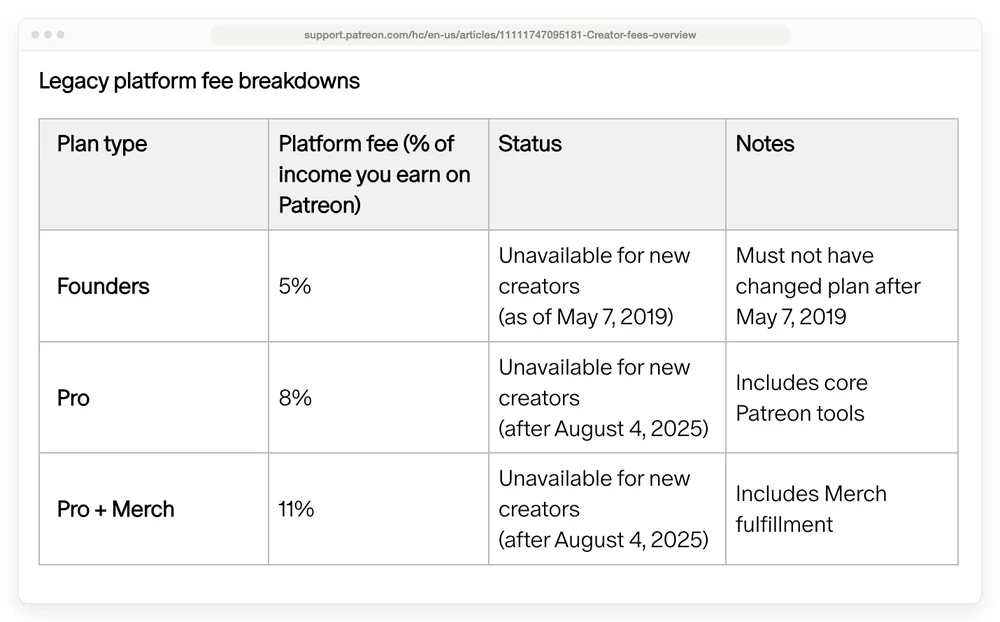
Patreon’s creator fees overview, inside the collapsed “Legacy Platform Plans” panel. Read the Platform fee column.
In fairness to everyone repeating it, the 12% figure comes from Patreon itself. 2 of its own help pages still describe the one-time purchase fee as “between 5% and 12% of successfully processed sales, depending on your platform plan”, a few paragraphs away from a table whose highest rate is 11%. Patreon has not cleaned up the old copy, so the old number keeps circulating.
What are Patreon’s payment processing fees?
Payment processing costs 2.9% plus $0.30 on a US credit card, on top of the platform fee, and Patreon charges it on every individual pledge rather than once a month. A patron paying with PayPal or Venmo from outside the US costs 3.9% plus $0.30. If you take payouts in a currency other than US dollars, you get a different rate again, starting at 3% plus A$0.30 for Australian dollars and running to 3.9% plus SGD 0.40 for Singapore dollars.
Legacy creators pay a reduced “micropayment” rate on pledges of $3 or less: 5% plus $0.10 on a card, or 6% plus $0.10 on non-US PayPal. It is a genuinely good deal on small tiers, and it is the part almost every guide gets wrong.
For anyone on the standard 10% plan, there is no micropayment rate. Patreon says so directly in its creator fees overview: “Unlike legacy plans, the standard 10% plan applies the same processing rates to all payments, regardless of amount.”
A US credit card costs 2.9% plus $0.30 on every plan, but only legacy creators get the cheaper $3-and-under rate.
| Payment method | Standard plan | Legacy Pro, over $3 | Legacy Pro, $3 or under |
|---|---|---|---|
| Card or Apple Pay | 2.9% + $0.30 | 2.9% + $0.30 | 5% + $0.10 |
| PayPal or Venmo, US | 2.9% + $0.30 | 2.9% + $0.30 | 5% + $0.10 |
| PayPal or Venmo, non-US | 3.9% + $0.30 | 3.9% + $0.30 | 6% + $0.10 |
That difference is small per pledge and large per year. On a $3 tier, a legacy creator pays $0.25 in processing and a new creator pays $0.39. With 100 patrons that gap is $14 a month, or $168 a year, on the same tier at the same price.
It is worth knowing because the wrong version is what a new creator is most likely to be told. Google’s AI summary for this exact search lists the micropayment rate as a general Patreon fee with no mention that it is legacy-only, and the fee calculator ranking on page 1 of the same search puts the line “Pledges of $3 or less use Patreon’s micropayment rate (5% + $0.10)” directly underneath a sentence about new creators.
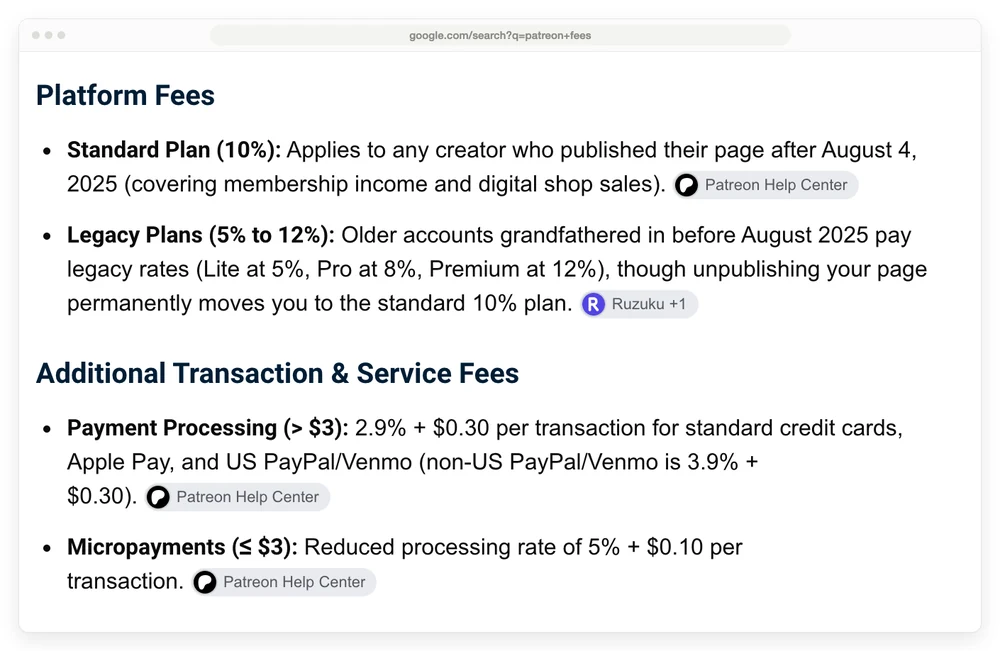
Google’s AI Overview for “patreon fees”. Read the Micropayments line, and note that the legacy-plan bullet above it cites a third-party blog rather than Patreon.
One more line item sits behind all of this. If a patron pays in a currency that is not your payout currency, Patreon adds a 2.5% currency conversion fee, calculated on the whole payment including any tax. For a creator with an international audience that is not a rounding error.
What does a $5 Patreon pledge actually pay out?
A $5 pledge leaves $4.05 in your Patreon balance on the standard plan, before you move the money anywhere. Here is the same maths across the tier prices creators actually use, calculated from Patreon’s published rates for a US card and a US dollar payout.
A $5 pledge leaves $4.05, a $10 pledge leaves $8.41, and a $3 pledge leaves $2.31, which is the worst rate on the whole list.
| Pledge | Platform fee | Processing | You keep | Share kept |
|---|---|---|---|---|
| $1 | $0.10 | $0.33 | $0.57 | 57.0% |
| $3 | $0.30 | $0.39 | $2.31 | 77.0% |
| $5 | $0.50 | $0.45 | $4.05 | 81.0% |
| $10 | $1.00 | $0.59 | $8.41 | 84.1% |
| $25 | $2.50 | $1.03 | $21.47 | 85.9% |
| $50 | $5.00 | $1.75 | $43.25 | 86.5% |
The 10% is flat, so it never changes your percentage. The $0.30 is fixed, so it eats a bigger share of a small pledge than a large one. That is why a $1 tier hands over 43% of the money and a $50 tier hands over 13.5%.
For a creator on the standard plan, the old $3 threshold now works against you. A $3 tier keeps 77%, against 81% on a $5 tier, so the tier that used to be the cheap one to run is now worse value than the one above it. Most fee guides show the opposite, because they apply the legacy micropayment rate and land on $2.45 instead of $2.31.
Run the $5 column out to 100 patrons and you get $405 from $500 of pledges. That is a 19% all-in cost, which lines up almost exactly with what creators report. In a thread on r/patreon, a creator wrote: “I am not happy that Patreon takes 8% (and 10% from August onwards), when you factor in payment processing fees, taxes, and other deductions, it comes to around 20%.”
What are Patreon’s payout fees?
Getting your balance out of Patreon costs between $0.25 and $20 a payout, depending on which method you use and where you live. Patreon does not show this fee in your earnings dashboard at all, so it is the one most creators never notice.
Direct deposit costs $0.25 a payout, PayPal costs 1% with a $20 ceiling, and Payoneer costs $1.00, but PayPal and Payoneer both hold your money until the balance clears a minimum.
| Payout method | Fee | Minimum balance | Who can use it |
|---|---|---|---|
| Direct deposit, via Stripe | $0.25 per payout | None stated | US creators, US dollars |
| PayPal | 1%, minimum $0.25, capped at $20 | $10 | US and non-US |
| Payoneer Wallet | $1.00 per payout | $25 | Non-US creators |
| Bank transfer, via Payoneer | $0.50, or $0.25 plus 1.55% converting to local currency | None stated | Non-US creators |
Those minimums matter more than the fees do. A creator earning $8 a month cannot pay out through PayPal at all until the balance clears $10, and a creator on Payoneer waits until $25.
The fee you see is also not always the fee you pay. Patreon says plainly that its own payout fees “do not include any additional costs that may be charged by third-party payment processors”, and that PayPal and Payoneer may add their own currency conversion or withdrawal charges. A creator in that Reddit thread put numbers on it from outside the US: “PayPal takes 1% for withdrawals then another 3-4% in fees hidden within their conversions.”
Does Patreon charge fees on one-time sales?
Patreon charges the same platform fee on one-time digital purchases as it does on memberships. So a creator on the standard plan pays 10% plus payment processing when someone buys a single file from their shop. Listing the work costs nothing.
There is a grandfather clause. Creators who started selling digital products before late May 2025 may still be on a flat 5% one-time purchase fee. If you are wondering why I wrote “late May” rather than a date, it is because Patreon’s own pages give 2: the creator fees overview says 22 May 2025 and the creator fees FAQ says 26 May 2025. The 4-day gap does not change anyone’s maths, but it is a fair signal of how carefully these pages are maintained.
Worth putting next to a comparison. A dedicated download platform like Gumroad charges 10% plus $0.50 with card processing stacking on top, which is more than Patreon’s 10% plus 2.9% and $0.30 on a small file. Patreon’s shop is genuinely competitive on price for one-time sales. What it is not is a storefront people browse, which is the trade you are actually making.
Why is my Patreon price different on an iPhone?
Your Patreon price is different on an iPhone because Apple takes 30% of anything bought through its in-app purchase system. Patreon’s default response is to raise the price the fan sees rather than cut what you earn. Apple’s own developer documentation confirms the rate: “During a subscriber’s first year of service, you receive 70% of the subscription price at each billing cycle.”
Patreon shows its working on the adjustment. Your list price “is increased by roughly 43%”, because a price has to be divided by 0.7 to survive a 30% cut intact, which works out as a rise of 42.86%. A $10 tier on the web appears as $14.29 in the iOS app.
You can switch that off in your billing settings and absorb Apple’s fee yourself. If you do, a $10 iOS membership pays you $6.00: Apple takes $3.00 and Patreon takes its $1.00 platform fee. Patreon does not add its own processing fee on iOS, because Apple’s cut replaces it, but the platform fee still applies.
3 things soften this over time.
Apple drops from 30% to 15% once a member completes a year of continuous billing, and Patreon passes that saving through to you. In China the rates changed in March 2026 to 25% in year 1 and 12% after. And fans in the US can complete the purchase through Patreon’s mobile web checkout instead, which skips Apple’s fee entirely, a direct result of the Epic v. Apple ruling.
What are Patreon’s legacy plans, and how do you lose one?
Legacy plans are the older platform rates that Patreon stopped offering to new creators, and you keep yours only while your page stays continuously published. Unpublish it for a day, or have Patreon unpublish it for any reason, and you move to the standard 10% when you republish. There is no route back.
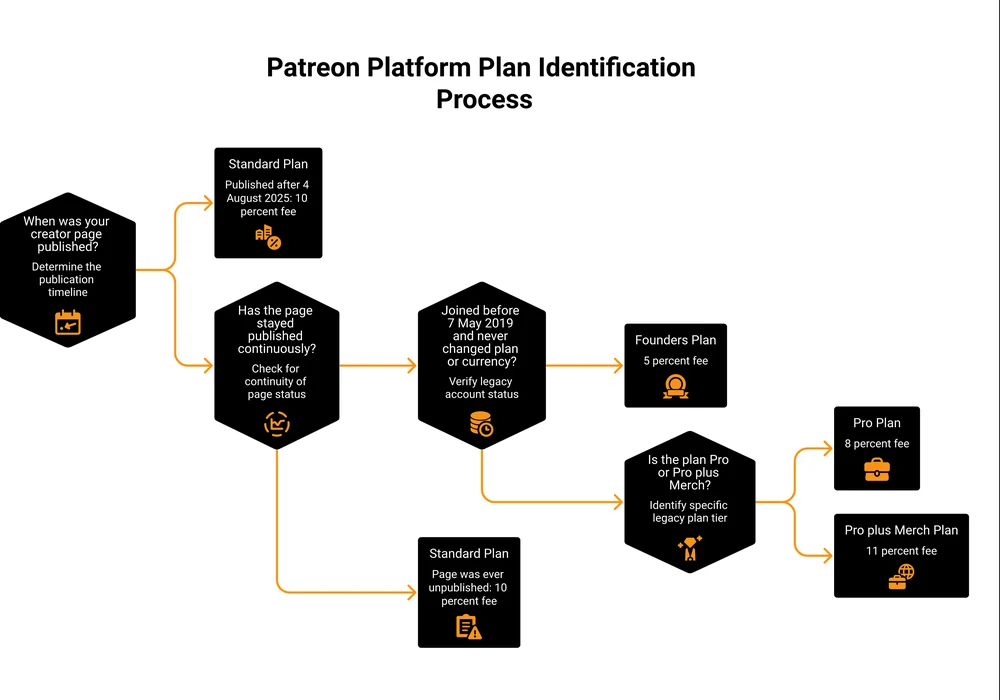
Which plan you are on comes down to 2 questions: when the page went live, and whether it has ever been unpublished.
The Founders plan is the one worth protecting. Beyond its 5% platform fee, it carries its own cheaper processing rates: 1.6% plus $0.30 on a card, against 2.9% plus $0.30 on every other plan. Change your payout currency and you keep the 5% but lose those rates.
Patreon also tells legacy creators to use the pause tool instead of unpublishing, which is the practical advice buried in a collapsed panel.
A date is coming that legacy creators cannot avoid. Patreon says that “all creators still using legacy billing will be required to switch to subscription billing by November 1, 2026”, and that anyone wanting one-to-one help with the move has to contact support through their settings by 30 September 2026.
Patreon has form here, and the last big change went badly. In December 2017 the company tried to move payment processing costs onto patrons, which would have taken a $1 pledge to $1.38 and a $5 pledge to $5.50, rises of 38% and 10%. The backlash was bad enough that Patreon cancelled the rollout and apologised.
I have watched this pattern from the other side of the table. Back in July 2022 I wrote to my email list about ConvertKit changing its affiliate terms. ConvertKit is the email tool for creators that goes by Kit these days, so if you only know the newer name, it is the same company.
Affiliates had been promised lifetime recurring commissions. ConvertKit capped those commissions at 24 months and applied the cap to people who had signed up years earlier, so, as I put it at the time, affiliates who had referred customers more than 24 months ago “practically got their entire commissions wiped out overnight.”
My view then is my view now. I wrote: “This is their affiliate program and they can impose whatever terms they want. No problem about that.”
Setting your own prices is your business. Changing the deal for people who already did the work under the old one is a different thing.
Patreon has not done that, and it deserves credit for it. Legacy creators genuinely kept their rate. What did change is that the rate now depends on a condition nobody agreed to when they signed up in 2018, which is that your page must never go dark. If you run a seasonal project, or you take a break, that is a real risk sitting on a fee you have had for 7 years.
Is Patreon worth the fees?
Patreon is worth the fees when what you need is a membership people already trust enough to hand over a card, and expensive when what you need is a checkout. That is the split, and the creators arguing about it in public are usually arguing from different sides of it.
The complaint is legitimate. 19% all-in on a $5 tier is real money, and it is roughly double the headline number Patreon advertises.
The defence in that same Reddit thread is also legitimate, and it came from a commenter the site flags as a top 1% contributor: the fees pay for hosting, for site maintenance, and for the support staff everyone complains about. Patreon adds to that list itself, saying its payment infrastructure covers fraud monitoring and chasing down declined payments, and it handles tax collection and remittance in most places. That is genuine work a creator would otherwise do.
Discovery and trust decide it. Fans know what a Patreon link is, and they will click one from a stranger. That is a real asset, and it is exactly what the 10% buys.
If you are weighing this against other ways to charge for access, the numbers sit next to platforms in the same category rather than checkout tools. Our breakdowns of what community platforms really cost and what membership site platforms charge run the same maths across Skool, Circle, Mighty Networks and others. If you are choosing between Patreon and a newsletter, Patreon vs Substack covers that head to head.
How can you reduce your Patreon fees?
You can reduce Patreon fees in 4 ways, and only 1 of them involves leaving. None of them changes the 10%, because that number is fixed.
Price your lowest tier above $3. On the standard plan the $3 threshold no longer buys you a cheaper processing rate, so a $3 tier keeps 77% while a $5 tier keeps 81%. Below that the fixed $0.30 does the damage, and it gets worse the lower you go.
Keep your page published. If you are on a legacy rate, pausing is safe and unpublishing is not. For a Founders page that habit is worth 5 percentage points of everything you earn, and for a Pro page 2 points. Pro + Merch sits at 11%, so that one plan would pay slightly less on the standard rate, but it would lose Merch fulfilment to get there.
Pick your payout method on purpose. Direct deposit at $0.25 beats PayPal at 1% the moment a payout clears $25, and PayPal’s own conversion charges sit on top of what Patreon lists.
Consider annual billing. Processing is charged per transaction with a fixed $0.30 attached, so collecting $60 once costs less in fixed fees than collecting $5 in 12 separate charges. Patreon does not present this as a saving anywhere, and it publishes no special annual rate, so treat it as arithmetic on their published numbers rather than official advice.
The 4th route, leaving, is the one that changes the most and the one worth doing arithmetic on before you commit. We priced 11 Patreon alternatives against this same 10% and worked out the monthly revenue where each one starts costing you less than Patreon does.
One bigger question sits behind all 4 of those tips: whether a membership is what you are selling at all.
When what you sell is not really a membership
Plenty of people on Patreon are selling files rather than running a membership. A pack of presets, a set of templates, a course, a PDF, delivered once and paid for once, with the Patreon shop working as the till.
That is a different job from what Patreon is built for, so price it as one. What each one costs varies a lot in that category, so check them one at a time rather than assuming. Gumroad charges 10% plus $0.50 per sale, Payhip charges 5% on its free plan, and CartMango takes 0% of your sales and is free until October 2026, then from $10 a year. In every case you still pay Stripe or PayPal directly, at the same 2.9% plus $0.30 you were paying anyway.
I should say plainly that I run CartMango, so I am not a neutral party on that last one. The honest limitation is the one this whole section is about: none of those tools gives you what Patreon’s 10% is really buying, which is an audience that already knows the platform and trusts it enough to enter a card. If your income depends on discovery, that is not a trade worth making.
FAQ
Why are Patreon fees so high?
Patreon’s fees look high because the advertised 10% is only the platform’s own cut. Payment processing, currency conversion, payout fees and any App Store fee sit on top, which takes a typical $5 pledge to about 19% all-in. Payment processing is charged per pledge rather than per month, so a page built on many small tiers pays a much higher effective rate than one built on fewer large ones.
Is it worth paying for Patreon?
Patreon is worth it if fan discovery and trust are doing real work for you, and poor value if you are mostly selling one-time files to an audience you already own. A creator with 100 patrons at $5 keeps $405 of $500 a month. The question is whether the missing $95 is buying you patrons you would not otherwise have.
What is the minimum Patreon tier price?
Patreon does not publish a general minimum tier price. Its tier setup guide prefills the first tier at $5 and names no floor. The $1 minimum you will see quoted comes from Patreon’s custom pledges article, where $1 is described as the minimum so the pledge still covers processing fees, which is a different mechanic from a tier. Merch tiers are the one place Patreon does show a minimum tier price, set by the merch item you attach, so treat the general floor as an open question and check inside your own account.
Who is the biggest earner on Patreon?
There is no verifiable answer to this. Patreon does not publish creator earnings, and the ranking sites that claim to know are working from estimates they do not source. Rather than repeat a number nobody can check, this guide leaves it out.
Why is Patreon declining?
No reliable public data shows Patreon shrinking, so the premise is worth holding loosely. What is documented is a run of changes creators have pushed back on: the standard 10% plan for anyone publishing after August 2025, Apple’s 30% cut arriving inside the iOS app, and a requirement from 6 July that every creator merge their separate creator and fan profiles into a single identity, with access to Patreon restricted until they do. Whether that adds up to decline is something the public numbers cannot answer.
Does Patreon take a cut of one-time digital sales?
Yes. One-time purchases carry the same platform fee as memberships, so a standard-plan creator pays 10% plus payment processing. Creators who began selling digital products before late May 2025 may still be on a flat 5% rate. Either way, Patreon fees land the same on a file sale as they do on a pledge of the same size.
What the 19% is buying you
Patreon’s 19% all-in cost buys 2 things. It buys the payment plumbing, and it buys an audience that already trusts the platform enough to enter a card. If you are still building an audience, that second half is worth real money and Patreon is a reasonable place to pay for it.
If you already have the audience, and most of the people paying you found you somewhere else first, the sums look different. You are paying a discovery fee on discovery you did yourself, every month, on every pledge.
CartMango is a checkout built for that second case. It takes 0% of your sales, it handles one-off products and recurring subscriptions on every plan, and your funds go straight to your own Stripe or PayPal. If you ever leave, your existing subscriptions carry on billing and the money keeps coming to you, which is not true of every platform that hosts a membership.
About the Author

👋 I’m Welly, founder of CartMango (the site you’re on), a checkout platform for digital product sellers. We’ve previously processed $179M+. I also run BirdSend (email marketing tool, 3.1B+ emails sent). On the side I show other non-techie digital sellers how I use AI workflows to automate 50%+ of my operations. Find me on LinkedIn.
Related Reading
- Patreon vs Substack: who holds the payment relationship, and how Patreon fees compare against a paid newsletter
- What community platforms really cost: Skool, Circle, Mighty Networks and Patreon priced side by side
- Membership site platform costs: 8 platforms priced at 100 members, and the first-year renewal trap
- Gumroad pricing: why the 10% plus $0.50 is not the whole fee
- Patreon alternatives priced at your revenue: 11 platforms, and the break-even where each one beats Patreon’s 10%