

Substack fits writers who need help getting found, Patreon fits multimedia creators who arrive with an audience, and a checkout like CartMango or ThriveCart fits anyone who wants no platform cut. Patreon vs Substack is close to a tie, since both charge about 10% before processing, so the choice turns on who holds the payment relationship. Prices come from each platform’s own fee documentation.
Most people choose between these 2 by asking which one suits their content. That instinct is roughly right, and it is also the only thing almost every guide covers.
Then the money arrives and it does not match anyone’s mental model.
The 10% headline rate is the part everyone quotes, and it is only the first of 3 charges. Substack stacks 2 more on top, and one of them is a fee Substack itself admits does not show up where you would look for it in Stripe. Patreon adds its own, plus a currency fee most creators never think about until an overseas fan subscribes.
So this post does the arithmetic. You will see what each platform leaves you on a $10 subscription, the fee layer hidden from your Stripe dashboard, what Apple takes when someone subscribes inside an app, and which subscribers can follow you out.
Key Takeaways
- The headline rates are nearly identical. Substack costs 13.6% plus 30 cents on a card subscription. Patreon’s standard plan costs 12.9% plus 30 cents.
- Annual billing quietly beats monthly. The flat 30 cents lands once a year instead of 12 times, worth about $330 a year across 100 subscribers.
- Substack has a third fee layer. A 0.7% Stripe Billing charge hits recurring payments, and Substack says it does not show in your Stripe processing line.
- Apple rewrites the maths. In-app subscribers cost 15% to 30% extra, and your money is held up to 45 days on Substack or 75 days on Patreon.
- Emails move. Billing usually does not. Both platforms export subscriber emails, but only a Substack web subscription sits in a Stripe account you own.
- Unpublishing a Patreon page is costly. Legacy 5% and 8% creators jump to the standard 10% permanently, and iOS memberships get cancelled.
Patreon vs Substack fees: what you actually keep
Substack charges 10% of each transaction and Patreon’s standard plan charges 10% of what you earn, so the 2 platform fees are the same number. The difference lives underneath, in the processing charges each one stacks on top.
New here and not sure where your money is leaking? The free 5-day Online Selling Mistakes Challenge walks through the 5 that cost solo creators the most.
Substack’s own pricing help page lists 3 separate charges on a paid subscription:
- Substack: 10% of each transaction
- Stripe card fee: 2.9% plus 30 cents
- Stripe Billing fee: 0.7% on recurring payments, per Substack’s own figure
Add them and a card-paid web subscription costs 13.6% plus 30 cents.
Patreon’s creator fees overview publishes a flat 10% platform fee for anyone who started after early August 2025, plus payment processing of 2.9% plus 30 cents on a credit card with a US payout currency. That comes to 12.9% plus 30 cents.
If your fan pays in a currency different from your payout currency, Patreon adds a 2.5% conversion fee calculated on the full payment including tax. International audiences should assume that one applies.
On a $10 a month subscription paid by card on the web, Substack leaves you $8.34, Patreon leaves you $8.41, and a checkout running on your own Stripe leaves you $9.41.
| Platform | Platform fee | Processing | Fee on $10 | You keep |
|---|---|---|---|---|
| Substack | 10% | 2.9% + 30c card, plus 0.7% Stripe Billing | $1.66 | $8.34 |
| Patreon (standard) | 10% | 2.9% + 30c card | $1.59 | $8.41 |
| Patreon (legacy Pro) | 8% | 2.9% + 30c card | $1.39 | $8.61 |
| CartMango | 0% per sale, $10 a year flat | 2.9% + 30c paid straight to Stripe | $0.59 | $9.41 |
I should be upfront that CartMango is my platform, so read that last row with that in mind. CartMango is a checkout, free until October 2026 and then from $10 a year, and it publishes nothing and brings you no readers. The section on what each platform is built for explains where that matters.
The fee layer that does not show up in Stripe
Substack’s 0.7% Stripe Billing charge is real money that most creators never see itemised. Substack says so directly on its pricing help page, noting that the Billing fee is not included in the “Stripe processing fee” amount you see against a transaction.
To find it you have to open Stripe, go to the Balances tab, select Payouts, click a payout and read the Summary line labelled “Stripe fee”. On $50,000 of subscription revenue that layer alone is $350.
Stripe’s own Billing pricing page confirms the rate at 0.7% of billing volume on the pay-as-you-go plan.
Why the flat 30 cents matters more than the percentage
The fixed 30 cents per transaction hurts small subscriptions far more than the percentage does. On a $3 a month tier, Substack’s total cost works out at 23.6% of the payment. On a $25 tier the same fee structure costs 14.8%.
That is also the strongest argument for annual billing. Charge $100 once a year and the 30 cents lands once. Charge $10 12 times and it lands 12 times.
Hold the revenue identical at $120 a year and the saving is the 11 fixed fees you no longer pay: $3.30 per subscriber, or $330 a year across 100 of them. Charging $100 annually instead of $120 monthly saves more again, but part of that is you discounting your own price.
Worth knowing before you decide: Patreon does not support annual memberships in its iOS app, though it does on web and Android.
What the ranking pages and Google’s AI summary say
Google’s AI Overview for this search states that Substack’s 10% “includes payment processing through Stripe”. That claim contradicts Substack’s own help page, which lists Stripe’s card fee and Billing fee as separate charges.
The same summary describes Patreon as using “tiered plan structures (ranging from 5% to 12% depending on the chosen feature plan)”. Those tiers are closed.
Patreon’s Founders plan at 5% shut to new creators in 2019, and the Pro plan at 8% and Pro plus Merch at 11% shut in August 2025. Anyone starting today pays the standard 10%.
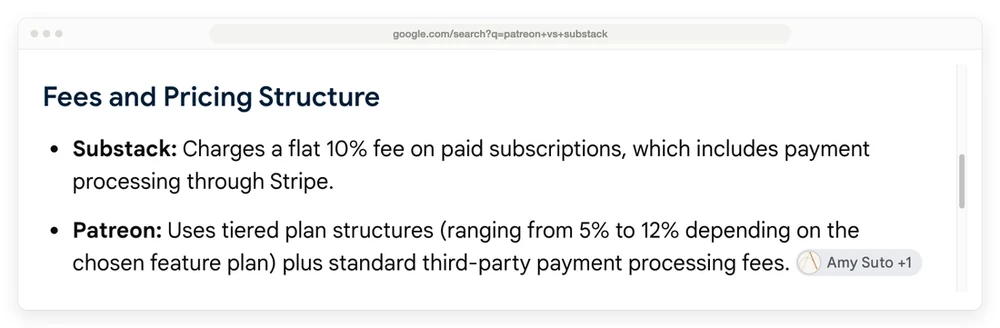
Google’s AI Overview for this search. Read the 2 lines under “Fees and Pricing Structure”. Both are contradicted by the platforms’ own help pages.
The blog results are not much better. Of the 4 articles ranking on page 1, 3 quote no creator-side fee numbers whatsoever, and none of the 4 includes a comparison table. The exception is writer Amy Suto, who reports her own Substack revenue publicly and gets the current structure right, putting Substack at 10% plus roughly 3% and Patreon’s real cost at 13% to 16% of gross.
The Apple tax nobody puts in the table
An in-app subscription costs far more than a web one, on Patreon and Substack alike. Apple takes its App Store cut on top of the platform fee, and it holds your money for weeks.
Substack tells creators that Apple charges an extra 15% to 30% on purchases made through the app, and that the Apple fee is deducted alongside Substack’s own. Substack’s default setting raises your in-app price to compensate, which your readers do see.
Patreon states that in-app purchases are subject to Apple’s 30% App Store fee. In the United States, Patreon and Substack can both route iOS readers to a web checkout, which avoids the Apple fee. Outside the United States, Apple does not allow that link.
Then there is the wait. Substack says Apple pays it for a month of subscriptions at a time, up to 45 days after that month ends, so a January subscription can reach your Stripe account in mid-March. Patreon is blunter still, describing a 75-day pending period while Apple settles, and saying plainly that it cannot speed Apple up.
For a creator living on subscription income, having 75 days of revenue sit in limbo is a real cash-flow problem.
Who owns the payment relationship
Patreon is the merchant on every transaction, and Substack is not. This one structural difference explains the fees, the tax admin and the exit terms all at once.
Patreon’s own documentation is explicit about it. Its payment-processing explainer includes the line “Patreon = Merchant”, and adds that creators create the goods while Patreon manages the actual exchange. The acquiring bank in that chain is described as Patreon’s bank.
Patreon also says it takes care of most applicable tax collection and remittance on your behalf.
Substack works the other way. You create your own Stripe account, connect it, and Substack recommends keeping it separate from your other businesses. When a payout goes wrong you contact Stripe support, not Substack.
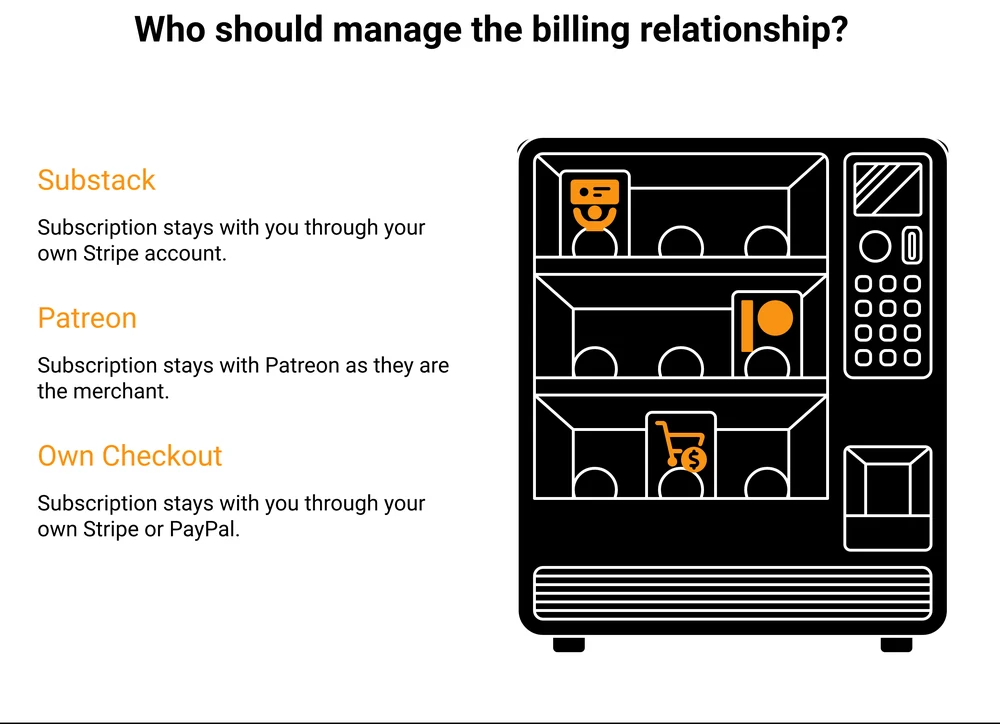
The same $10 goes through 3 different arrangements. Only the middle one puts another company’s name on the charge.
That has a real consequence people discover late. In a thread on r/patreon about moving between the 2, a creator explained why they went to Patreon rather than away from it:
“I migrated from Substack to Patreon with all my paid subscribers. Substack does not educate creators (publishers) on the fact they are responsible for VAT taxes, etc and they don’t handle it for you – Patreon does, as a Merchant of Record, so Creators on Patreon save on time and accounting fees, which can be expensive if you have an international following.”
That is a genuine advantage for Patreon and it grows with how international your audience is. Handling VAT yourself is tedious and easy to get wrong.
The trade is control. Being the merchant is what lets Patreon handle your tax, and it is also what puts Patreon between you and your subscribers’ payment methods. You cannot have the first without the second.
So creators who want the tax work done choose Patreon. Creators who want the billing relationship in their own name run their own Stripe, through Substack or through a checkout such as CartMango, and accept the paperwork that comes with it.
Can you take your paying subscribers with you?
Your subscriber emails move with you from either platform. Your active subscriptions are a separate question, and the 2 get run together constantly in this debate.
Both platforms export email addresses. Patreon lists exportable email lists as a standard feature, and Substack’s whole ownership pitch is built on your master email list.
On the r/Substack thread comparing the 2, a creator made the ownership argument plainly, saying that if they were unhappy with Substack they would have full power to take what they had built and go elsewhere. Another corrected the record for Patreon, pointing out that paid members appear in the creator’s audience list with their email addresses, ready to export or push into a CRM.
A third reader replied “Huh. Is this new? It’s definitely not common knowledge.”
They were both right, and both incomplete. An exported email address lets you contact someone and ask them to pay again. Whether the billing itself survives the move is where the 2 platforms actually diverge.
On Substack, a web subscriber’s card sits in the Stripe account you own, so the subscription itself is yours. On Patreon, Patreon is the merchant, so the subscription is Patreon’s to end. And Substack’s own answer for anyone who leaves after selling through the iOS app is stark: Apple does not transfer billing relationships between platforms, so you keep the email address and have to ask the person to subscribe again.
In practice, asking a thousand people to re-enter their card details loses you a large share of them for good.
That difference is worth pricing before you build. Our breakdown of who keeps your members if you leave runs the same test across 8 membership platforms, and the real cost of community platforms covers Patreon alongside Skool, Circle and Discord.
The Patreon trap worth knowing about
Unpublishing your Patreon page, even briefly, costs legacy creators their pricing permanently. Patreon says that if you unpublish after August 2025, or Patreon unpublishes you, or you republish, you move onto the standard 10% plan. A creator sitting on the old 5% Founders rate pays double the platform fee from then on.
The same action carries a second penalty. Patreon’s iOS documentation says that unpublishing your page cancels iOS in-app memberships, with no automatic refunds. Patreon’s advice in both places is to use the pause tool instead.
Those are 2 separate penalties, written up in 2 separate help articles, both triggered by the same button. If you run a legacy Patreon and you are thinking of taking a break, pause it.
What each platform is actually built for
Substack is built around publishing and Patreon is built around membership. That framing is the one thing every guide gets right, so it is worth stating quickly and then moving on.
Substack writes and sends the email, hosts the archive, and pushes your work through Notes and cross-recommendations from other writers. That discovery engine is real, and it is the strongest thing Substack has that money cannot buy elsewhere.
It is still worth being clear about what a rented audience is worth to you. It took me 16 months to get my first 1,000 Twitter followers, and when I finally got there I wrote that I would rather have 100 email subscribers.
The reason was ownership. A social account can be closed at any time and the followers go with it, and as I put it then, “I truly own my subscribers, and no one can take it away from me.”
Notes sits on the follower side of that same trade. Readers who convert into paying subscribers are yours, through your own Stripe. The audience discovering you on Notes belongs to Substack.
Patreon assumes you arrive with an audience from YouTube, TikTok or a podcast, and gives you tiers, chats, DMs, native video and livestreaming to serve them. It does very little to find you new fans by itself.
Patreon vs Substack for writers
Substack suits writers better, and the reason is distribution rather than editing. Your post lands in an inbox, sits in a searchable archive, and can be recommended by other publications to their readers. Patreon posts largely reach people who already decided to pay you.
If your product is the writing itself, and you want new readers to find it without you running ads, Substack is the stronger starting point. Our guide to starting a paid newsletter covers the conversion rates to expect before you count on the income.
Patreon vs Substack for artists, podcasters and musicians
Patreon suits multimedia creators better, mostly on delivery and tiers. It hosts native video and livestreams, imports and syncs podcasts, distributes episodes by RSS, and lets you set different tiers with different perks, including physical rewards.
Substack does support podcasts and video embeds, and plenty of podcasters run there happily. The gap shows up when your offer is layered, where tier 1 gets the files, tier 2 gets the process videos and tier 3 gets a monthly call. That layered setup is what Patreon was built around.
Where each one is genuinely better
The reliability complaints run in both directions, which is worth knowing before you commit. Picking on vibes alone tends to mean picking on whichever platform a louder creator complained about most recently.
A frequent commenter who has used both platforms said they would pick Substack every time, citing repeated problems delivering content to Patreon customers. Asked what went wrong, they went further in a second r/Substack thread: uploading media was a fight, and their patrons had a hard time watching and downloading things.
The counterweight is just as direct. Writing on her Substack, which is titled Mrs. Doe, the artist and writer Krissy Teegerstrom compared more than 6 years on Patreon with 6 months on Substack.
She called Patreon’s method of paying creators far more elegant and transparent than Substack’s, which she described as a mess.
One more limitation rarely makes these lists. In the r/patreon migration thread, a commenter noted that Substack has no API, which makes it awkward to feed subscribers into a membership site or automate anything around them. If your stack has other moving parts, check that before you commit.
How to decide between Patreon and Substack
Choose Substack if writing is the product and you need the platform to help you get found. Choose Patreon if you arrive with an audience, sell layered perks, or serve an international crowd you would rather not do VAT paperwork for.
| If this is you | Pick | The one reason |
|---|---|---|
| Writer, no audience yet, needs discovery | Substack | Notes and recommendations bring readers you did not have |
| Video, art, podcast, audience already elsewhere | Patreon | Native hosting and layered tiers, built for perks |
| International fans, no appetite for VAT admin | Patreon | Patreon handles most tax collection and remittance |
| Selling courses, downloads or one-off products | Neither | Both are built for recurring fan support, not product catalogues |
| Wants the subscription in their own name | Own checkout | The billing relationship stays with you when you move |
The table above sorts by fit. Plenty of creators would be well served by either platform, and the fee gap between them is too small to break a tie on its own.
About that last row. A standalone checkout such as CartMango takes 0% of each sale and runs on your own Stripe or PayPal, which is why the fee column earlier looks the way it does.
It also gives you no readers, no discovery, no community and no publishing tool, and CartMango’s learning management and community features are planned for October 2026 rather than available now. If getting found is your problem, that row does not solve it.
FAQ
Why are people leaving Substack for Patreon?
Some are, and others are going the other way, so treat any claim of a mass migration carefully. In the r/patreon migration thread the 2 reasons creators actually give for choosing Patreon are tax handling and an audience that already has Patreon accounts.
A creator in the same thread described starting on Substack, moving to Patreon, then moving back. There is no verified figure showing a one-way trend.
Does anyone use Patreon anymore?
Yes, particularly among podcasters, artists, video creators and game developers, which is where its tier and hosting features fit best. Patreon is still shipping meaningful pricing and product changes, including a new standard plan in August 2025. No reliable public figure for current active creator numbers turned up while researching this post, so treat any specific count you see elsewhere with suspicion.
Is there anything better than Substack?
For paid newsletters, beehiiv, Ghost and Kit are the usual alternatives, and each trades Substack’s built-in discovery for lower fees or more control. Ghost and a self-hosted setup let you keep the subscription entirely, at the cost of doing your own growth. Which one is better depends on whether you value discovery or margin more.
Is there anything better than Patreon?
Ko-fi is the closest comparison for one-off tips and light memberships. Its free plan takes no service fee on simple tips, though card processing still applies, and memberships and product sales carry a 5% service fee unless you pay for Ko-fi Gold.
For layered tiers with video hosting, Patreon is still hard to beat on features. If your goal is selling products rather than funding ongoing work, a checkout tool fits the job better than either.
Can you run Patreon and Substack at the same time?
You can, and some creators deliberately do. Krissy Teegerstrom, quoted earlier, decided to keep both because in her words the platforms function in different ways: Substack helps her get discovered, while she values Patreon for being founded by artists. The cost is that 2 paywalls means 2 decisions for the same fan, so unless each side offers something genuinely different, you are usually better picking the one that matches your main format and using the other as a free channel.
Which is cheaper, Patreon or Substack?
Patreon is marginally cheaper on a card-paid web subscription, at 12.9% plus 30 cents against Substack’s 13.6% plus 30 cents. On 100 subscribers paying $10 a month that difference is about $84 a year, which is small enough that it should not decide anything. Currency conversion on Patreon and in-app purchases on either platform move the number far more than the headline rate does.
If you would rather hold the subscription yourself
When a fan’s card is charged every month, somebody’s name is on that arrangement. On Patreon it is Patreon’s. On Substack it is yours through Stripe, unless the fan subscribed inside the iOS app, in which case it is Apple’s and it does not travel.
If your answer is that it should be yours, and you want the sales page and the checkout without a cut coming out of every payment, that is the job CartMango does. CartMango charges 0% commission on your sales, pays out directly to your own Stripe or PayPal, and if you ever leave, your recurring payments keep running instead of being cancelled. CartMango is free until October 2026, then from $10 a year.
Patreon vs Substack has a third answer worth weighing. Pick whichever of the 2 fits how you publish and how people find you, then keep the billing in your own name.
About the Author

👋 I’m Welly, founder of CartMango (the site you’re on), a checkout platform for digital product sellers. We’ve previously processed $179M+. I also run BirdSend (email marketing tool, 3.1B+ emails sent). On the side I show other non-techie digital sellers how I use AI workflows to automate 50%+ of my operations. Find me on LinkedIn.
Related Reading
- Starting a paid newsletter: the honest conversion rates and economics before you count on the income
- How to make money from a newsletter: 6 methods sorted by list size, with real income numbers
- What membership platforms really cost: 8 platforms priced at 100 members, and who keeps your subscribers if you leave
- What community platforms really cost: Skool, Circle, Mighty Networks, Heartbeat, Patreon and Discord compared
- Content creator business models: 6 examples of how creators actually structure their income