

Ko-fi fits one-off tips, commissions and digital files, at 0% to 5%. Patreon fits tiered monthly memberships, at a flat 10% for anyone who published a page after August 2025. Patreon vs Ko-fi is really a question about what each fee buys you, and every figure below was read at both platforms’ own help pages.
Both platforms publish their fees. Both have help pages spelling out every rate. So this comparison should take 5 minutes.
The problem is that almost nothing you will read about them is current. Patreon rebuilt its pricing in August 2025 and closed its old plans. Ko-fi renamed its default setting and doubled the price of its paid tier.
Most of the guides ranking for this comparison were written before either change, and the ones written afterwards copied the older ones.
So I went and read both platforms’ own help pages instead. What follows is what each one charges today, what each one gives you that the other cannot, and the 2 questions that decide this more than the fees do: who finds your supporters, and what happens to them the day you leave.
Key Takeaways
- Patreon is a flat 10% for anyone who joined after August 2025. The 5%, 8% and 11% rates still quoted everywhere are legacy plans, closed to new creators.
- Ko-fi’s 0% only covers one-off tips and crowdfunding goals. Memberships, monthly tips, commissions and shop sales are 5%.
- New Ko-fi accounts start with the 5% switched on for tips too. It is a toggle you have to find and turn off.
- Ko-fi Gold now costs $12 a month for new users, not the $6 much of the web still quotes. It pays for itself above $240 a month of fee-bearing income.
- Neither platform sends you supporters. Both let you export member emails, but neither lets you take the billing with you.
Before we get into it: if you are weighing up how you sell rather than just where, the free 5-day Online Selling Mistakes Challenge walks through the 5 mistakes that quietly cost solo creators the most money.
What Patreon and Ko-fi actually charge
Patreon charges a flat 10% platform fee on every payment, plus payment processing. Ko-fi charges nothing on one-off tips, 5% on everything else, and offers a $12 a month plan that removes the 5%.
That is the whole picture, and it is not what page 1 of Google will tell you.
Patreon’s own Creator fees FAQ lists every rate it charges in a single sentence: “creators on the standard plan pay 10%, while legacy plan creators may pay 5%, 8% or 11%”. Its Creator fees overview marks all 3 legacy plans, Founders at 5%, Pro at 8% and Pro plus Merch at 11%, as “Unavailable for new creators”. Publish a Patreon page today and you are on 10%. There is no plan to pick and no cheaper rate to qualify for.
Now look at what the search results say.
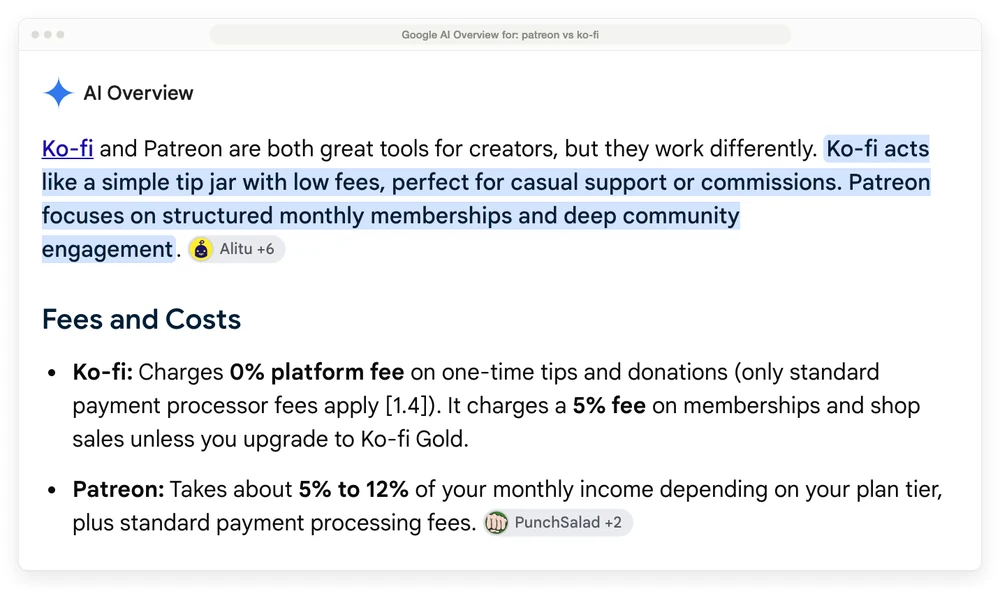
Google’s AI Overview for this comparison. The Ko-fi line is right. Read the Patreon line underneath it.
“About 5% to 12% of your monthly income depending on your plan tier” describes a choice no new creator has. It is also not the only place that range turns up on this page of results.
Ko-fi’s own comparison page lists Patreon at “5-12%” and adds “Minimum $300 p/m for some plans”. The beehiiv blog post ranking on this keyword says Patreon’s “costs range from 8% – 12%”. A forum thread near the top says “Patreon seems to take 8-12%”.
Only 1 of the 5 gets it right. Alitu, a podcast production tool whose comparison post also ranks on this page, says plainly that “Patreon charges a 10% fee on creators’ earnings”.
The 12% is a ghost. It was real once, when Patreon ran Lite, Pro and Premium tiers at 5%, 8% and 12%. Those tiers are gone, and Patreon lists no 12% plan anywhere.
The figure survives because Patreon’s own fee pages still carry a sentence about one-time purchases costing “Between 5% and 12%”, which sits oddly next to a plan table that stops at 11%. Every guide that copies that line inherits the problem.
The “$300 per month minimum” has no source I could find on Patreon at all. Patreon’s Pricing FAQ says the opposite: it is free to get started and you “only start paying once you begin earning”.
Ko-fi’s headline is loose in the other direction. Ko-fi advertises “0-5% service fees”, and its Patreon comparison page leads with “0% fees with Ko-fi Free”. Both are true. Both are also easy to misread, and the misreading costs Ko-fi creators money.
What each platform takes on a real payment
On a $10 payment, Patreon takes $1.59 all in, Ko-fi Free takes $1.09 on a membership and $0.59 on a tip, and Ko-fi Gold takes $0.59 plus its $12 monthly fee.
| Payment | Patreon | Ko-fi Free | Ko-fi Gold |
|---|---|---|---|
| $5 membership | $4.05 (81.0%) | $4.30 (86.0%) | $4.55 (91.0%) |
| $10 tip | $8.41 (84.1%) | $9.41 (94.1%) | $9.41 (94.1%) |
| $10 membership | $8.41 (84.1%) | $8.91 (89.1%) | $9.41 (94.1%) |
| $25 product | $21.47 (85.9%) | $22.72 (90.9%) | $23.97 (95.9%) |
| $50 product | $43.25 (86.5%) | $45.75 (91.5%) | $48.25 (96.5%) |
Figures are what you keep, on a card payment at 2.9% plus $0.30, paying out in US dollars. That is Patreon’s own published card rate and Stripe’s standard US rate, so both columns sit on the same basis. Ko-fi Gold’s $12 a month is not included in the per-payment numbers.
The table leaves out 2 things. Patreon adds a 2.5% currency conversion fee whenever a member pays in a currency other than your payout currency. And if your supporter pays by PayPal rather than card, Ko-fi’s cut stays the same but PayPal’s own rate is higher than Stripe’s, so your take-home drops.
Our full Patreon fees breakdown and Ko-fi fees breakdown work through every layer on each side.
Ko-fi’s 0% covers tips, and the 5% is switched on by default
Ko-fi’s 0% does not cover the thing most people are comparing against Patreon. A monthly membership tier is one of the 4 payment types Ko-fi charges 5% on.
Ko-fi charges 0% on one-off tips and crowdfunding goals, 5% on monthly tips, membership tiers, commissions and shop sales, and 0% on all 6 once you pay $12 a month for Gold.
| Payment type | Ko-fi Free | Standard on | Ko-fi Gold |
|---|---|---|---|
| One-off tips | 0% | 5% | 0% |
| Crowdfunding goals | 0% | 5% | 0% |
| Monthly tips | 5% | 5% | 0% |
| Membership tiers | 5% | 5% | 0% |
| Commission sales | 5% | 5% | 0% |
| Shop sales | 5% | 5% | 0% |
The middle column is the part worth slowing down on. Ko-fi has a setting that applies the 5% to everything including tips, and new accounts have it on. Ko-fi says so plainly on its own help page: “Everyone who joins Ko-fi now starts with Contributor status”, and you can opt out any time.
You get real things for it. Supporter-only content, scheduled posts, a shorter page name, custom page colours, Google Analytics, Discord role access, direct audio uploads and more shop storage. If you never touch those, you are paying 5% on tips for perks you do not use.
Worth knowing if you go looking for the switch: Ko-fi is mid-rename. Its “Does Ko-fi take a fee?” page now calls this “Standard” mode, while its own Contributor page still calls it Contributor. Same toggle, 2 names, both under Settings then Payment.
Which one is cheaper at your income level
Ko-fi’s platform cut is lower than Patreon’s at every income level, because 5% is always less than 10%. The only real decision is whether to add Ko-fi Gold on top.
| Monthly membership income | Patreon 10% | Ko-fi Free 5% | Ko-fi Gold |
|---|---|---|---|
| $100 | $10 | $5 | $12 |
| $240 | $24 | $12 | $12 |
| $500 | $50 | $25 | $12 |
| $1,000 | $100 | $50 | $12 |
| $2,000 | $200 | $100 | $12 |
Ko-fi Gold costs $12 a month for new users. Much of the web still quotes $6, which was the old price. Ko-fi’s own explanation of the change notes that some creators were earning thousands a month “but only paying $8”, and new subscribers are now monthly only, with annual plans withdrawn.
The break-even is $240 a month of fee-bearing income. Below that, the free plan’s 5% costs you less than the subscription. Above it, Gold wins and keeps winning.
The pull to just pay the $12 anyway is real, and I know it well. I once bought 54 software lifetime deals through AppSumo and still had not used 90% of them years later. The rule that fixed it is the one I would use here: buy it when you need it now or within the next 6 months, not because $12 sounds small.
There is a catch that costs money if you miss it. Paying for Ko-fi Gold does not switch the 5% off by itself. If Contributor was on when you subscribed, Ko-fi says you have to opt out of it separately, so you can pay $12 a month and still hand over 5%.
Who holds your money, and when you actually get it
Ko-fi never holds your money, and Patreon does, paying out once a month by default and charging a fee to release it.
On Ko-fi, supporters pay straight into your own connected PayPal or Stripe account. Ko-fi’s help centre puts it as “No minimum balance, no waiting around”, and the money is there the moment someone pays.
Patreon works the other way. Payments land in a Patreon balance, and automatic payouts run on the 5th of each month. Patreon notes that if you turn them on “on or after the 5th, you won’t be paid out automatically until the following 5th”.
Once a transfer starts it takes 3 to 5 business days to arrive, and you can only pay out once every 24 hours.
Patreon charges $0.25 to release a payout through Stripe, 1% through PayPal capped at $20, and $1.00 through a Payoneer Wallet that also needs a $25 balance.
| Payout method | Patreon fee | Minimum balance |
|---|---|---|
| Direct deposit via Stripe | $0.25 per payout | none stated |
| PayPal | 1%, minimum $0.25, capped at $20 | $10 |
| Payoneer Wallet | $1.00 per payout | $25 |
| Bank transfer via Payoneer | $0.50, or $0.25 plus 1.55% with currency conversion | none stated |
Ko-fi charges none of these, because there is nothing to release. Over a year the gap in money is small. For a creator living on what supporters send, waiting until the 5th is still worth knowing about before you pick.
Does either platform actually bring you supporters?
Neither platform will find your supporters for you. Ko-fi has no discovery feed at all, and Patreon’s own CEO has just said its recommendation system worked against smaller creators.
In August 2026 Patreon published a roadmap of more than 30 changes, and the headline item is a rebuilt discovery algorithm. The Verge reported that the new system “will shift away from recommending creators based on who fans already follow, a system that favored suggesting larger creators”, and will compare posts to other posts instead. The same report notes several of the announced updates are still in development and may not fully roll out.
Put that together from a creator’s side. Patreon at least has a discovery surface, it is being rebuilt because it was not serving small creators, and the rebuild has not landed yet. Ko-fi does not have one to rebuild.
A creator answering this exact question on r/artbusiness put it more briefly than I can. Asked whether any site would push viewers toward them, the reply was “Sorry, no, both need you to drive your own audience to them”.
Where Patreon does help is recognition. The same commenter pointed out that fans who already have Patreon accounts support you with far less friction than someone who has to make a Ko-fi account first, adding that “even people who don’t have an account instantly know it’s paywalled content”. That is worth something real. It works on people who have already heard of you, which is a different job from finding you new ones.
What each platform does that the other cannot
Patreon is built for tiered monthly memberships with gated content and a native mobile app. Ko-fi runs membership tiers too, and adds one-off tips, commissions and a shop that Patreon has no equal for.
| Patreon | Ko-fi | |
|---|---|---|
| One-off tips | no | yes, 0% on the free plan |
| Tiered memberships | yes | yes |
| Native mobile app | yes | no |
| Commissions and requests | no | yes |
| Digital and physical shop | yes, one-time purchases | yes |
| Monthly cost to you | none | none, or $12 for Gold |
| Supporter needs an account | yes | no, for one-off tips |
Patreon’s 10% buys a hosted page, monthly and annual memberships, digital product sales, video hosting up to 100 hours a month once you have paying fans, plus chats, polls, comments and audience insights. The video hosting matters if you post video, because Ko-fi has no equivalent.
Ko-fi’s spread is wider at the shallow end. Commissions, crowdfunding goals, Twitch and YouTube stream alerts, and a shop that takes both digital and physical items. A supporter can tip you without making an account, which removes the single biggest reason a casual fan gives up halfway.
If what you actually want is a members-only space with discussion rather than a payment page, neither of these is really the tool. Our guide to community platforms for creators prices the ones built for that job.
What happens to your members if you leave
Both platforms let you export your supporters’ email addresses. Neither lets you take the billing with you, which is the part that pays you.
Ko-fi gives you a CSV from the Members tab with usernames, email addresses, membership status, total given and whether each person pays by PayPal or Stripe. Patreon has its own audience email export. So the “you can never leave” framing you will read on competitor blogs is not accurate on either platform.
An export gives you a list of email addresses. Moving an active member still means asking that person to enter their card again somewhere else, and a share of them will not.
Ko-fi is unusually clear about what deletion does. Its help page states that deleting a creator account removes everything permanently and that “All active subscriptions to your page will be automatically canceled”. There is a quieter line on the same page worth reading twice: if you disconnect your PayPal or Stripe instead of deleting, “any active subscriptions will still renew”, because they sit with your payment provider rather than with Ko-fi.
Patreon has a trap of its own for older accounts. Unpublishing a legacy page, even briefly, moves you onto the standard 10% permanently.
Patreon’s fees overview lists the triggers plainly: unpublish your page, have Patreon unpublish it, or republish after 4 August 2025. A 5% Founders rate you have held since 2019 does not come back.
This is the same question we worked through in Patreon vs Substack and in our membership site platform costs comparison, and the answer is consistent across all of them. Where the recurring charge lives decides how free you are to move.
Do creators run both at once?
Plenty of creators run both, on purpose. The 2 platforms collect different kinds of money, so running both is closer to having a shop and a subscription than to hedging.
Illustrator Kelci D Crawford, whose post ranks on this very search, wrote the whole thing up: Patreon funds her art, Ko-fi funds her writing, because the supporters for each showed up differently. On the same r/artbusiness thread, a creator described starting on Ko-fi and moving to Patreon only when their monthly clubs grew too big to manage, adding that Ko-fi “served me well for like 3/4 years” first.
Running both costs you attention. You are asking the same audience to choose between 2 links, and split attention usually costs more than 5%.
Patreon vs Ko-fi: which should you pick
Pick Ko-fi if most of your support is one-off, or if you sell files and take commissions. Pick Patreon if your income is tiered monthly memberships and you want an app, video hosting and the recognition that comes with the name.
| Your situation | Best fit | Why |
|---|---|---|
| Casual tips from an existing following | Ko-fi Free | 0% on tips, no account needed to give |
| Commissions and digital files | Ko-fi Free | Commission tools and a shop, 5% |
| Tiered memberships, over $240 a month | Ko-fi Gold | 0% cut, $12 a month beats the 5% |
| Tiered memberships with gated video | Patreon | Video hosting and app, at a flat 10% |
| You want to be found by new fans | Patreon, with caution | Only platform with discovery, currently being rebuilt |
| You already bring your own traffic and just need billing | CartMango | Subscriptions and pay-what-you-want on the $10 a year plan, 0% platform cut, paid direct to your Stripe or PayPal |
I should say plainly that I run CartMango, so read that last row with that in mind. It is also the narrowest row in the table. CartMango handles the billing and a simple hosted sales page, and that is all it handles here: there is no fan feed, no supporter comments, no discovery and no members-only video.
If what you want is a place fans browse and hang out, Patreon or Ko-fi is the honest answer, and a dedicated community platform is a better one. Course hosting and community are in development at CartMango and are planned for October 2026, so they are not a reason to pick it today.
FAQ
Is there a better option than Patreon?
Yes, depending on what you sell. Ko-fi costs less on every payment type and adds commissions and a shop. Buy Me a Coffee sits close to Ko-fi, and Substack suits writers who want the newsletter and the payments in one place. We priced 11 of them, with the break-even for each, in our Patreon alternatives breakdown.
Does anyone use Patreon anymore?
Yes. Patreon is still the default name in creator memberships, and in August 2026 it announced a roadmap of more than 30 new and rebuilt features, which is not the behaviour of a platform winding down. It also laid off 20% of its staff, 93 people, in July 2026, so it is under pressure and busy at the same time.
Why would anyone pay for Patreon?
For the things the 10% buys: tiered gated content, a native mobile app, video hosting up to 100 hours a month, and a name your fans already recognise and already have an account for. Ko-fi is cheaper. If the extra step of creating an account loses you supporters, that saving never reaches your bank account.
How much does Patreon cost a month?
Patreon has no monthly fee. It takes 10% of what you earn, plus payment processing of 2.9% and $0.30 on a US card, plus a payout fee when you withdraw. On $500 a month of memberships that is $50 in platform fees before processing.
Which is cheaper, Patreon or Ko-fi?
Ko-fi, at every level. Its platform cut is 5% against Patreon’s 10%, it is 0% on one-off tips, and Ko-fi Gold removes the cut entirely for $12 a month once you clear $240 a month of fee-bearing income.
Can you use Patreon and Ko-fi at the same time?
Yes, and many creators do. The usual split is Patreon for the recurring membership and Ko-fi for tips, commissions and one-off files. Neither platform restricts it.
When you already brought the audience
Strip Patreon vs Ko-fi back and both of them take a cut of money sent to you by people you found yourself. Patreon takes 10% of it. Ko-fi takes 5%, or nothing at all on one-off tips once you have gone and turned Contributor off.
That cut buys you real things on both platforms. A page your supporters recognise, a checkout you did not have to build, and on Patreon an app, a feed and the only discovery surface either platform has.
The question worth asking is how much of it you use. A creator who posts every week inside Patreon and talks to members in the comments is getting that 10% back. A creator whose supporters all arrive from a link in a YouTube description, and who never posts on the platform at all, is paying a percentage on an introduction they made themselves.
If that is closer to your situation, CartMango does the billing half without the percentage: subscriptions and one-time sales on every plan, a simple hosted page, and payouts straight into your own Stripe or PayPal. CartMango is free while the beta runs, and if you ever leave, your recurring payments keep coming to you.
About the Author

👋 I’m Welly, founder of CartMango (the site you’re on), a checkout platform for digital product sellers. We’ve previously processed $179M+. I also run BirdSend (email marketing tool, 3.1B+ emails sent). On the side I show other non-techie digital sellers how I use AI workflows to automate 50%+ of my operations. Find me on LinkedIn.
Related Reading
- Patreon fees explained: every layer behind the 10%, and the rates most pages get wrong
- Ko-fi fees explained: the 5% that is on by default and what Ko-fi Gold really costs
- Patreon alternatives: 11 platforms priced at $1,000 a month with the break-even for each, if Patreon vs Ko-fi is not the pair you needed
- How to make money as a podcaster: where memberships fit among 9 income streams
- Content creator business models: 6 real examples of how creators put the pieces together