
Kajabi earns its price for a creator who already sells courses and wants the website, courses, email, community and checkout on 1 bill. For a first product, this Kajabi review comes out the other way: the cheapest plan on Kajabi’s pricing page costs $179 a month, or $143 a month billed yearly.
Recent reviews are harsher than the headline score. Kajabi has 2,347 Trustpilot ratings, 75% of them 5-star, yet 43 of the 94 reviews posted from October 2025 to October 2026 give 1 star. Most complaints are about billing, a hard-to-use editor and support. Kajabi also adds 2% per sale on Basic when you take payments through your own Stripe account.
Kajabi’s own pricing FAQ admits it is expensive if all you want is a course platform. The real question is whether it is worth $1,716 a year before you have sold much.
The reviews ranking for it do not settle that. 4 of the 5 written ones on Google’s first page say Kajabi charges no transaction fees, which Kajabi’s own fee table contradicts.
This review is built from Kajabi’s own pages and public reviews: its pricing page and help center, its 94 most recent Trustpilot reviews sorted by complaint, and a Reddit thread from an email marketer.
You will see what each plan costs, what Kajabi does well, where reviewers say it breaks, and what happens to your students if you ever leave.
Key Takeaways
- Kajabi’s price: its pricing page lists 3 plans at $179, $249 and $499 a month, or $143, $199 and $399 a month billed yearly.
- The fee most reviews miss: Kajabi adds 2%, 1% or 0.5% of each sale when you use your own processor instead of Kajabi Payments. PayPal is exempt.
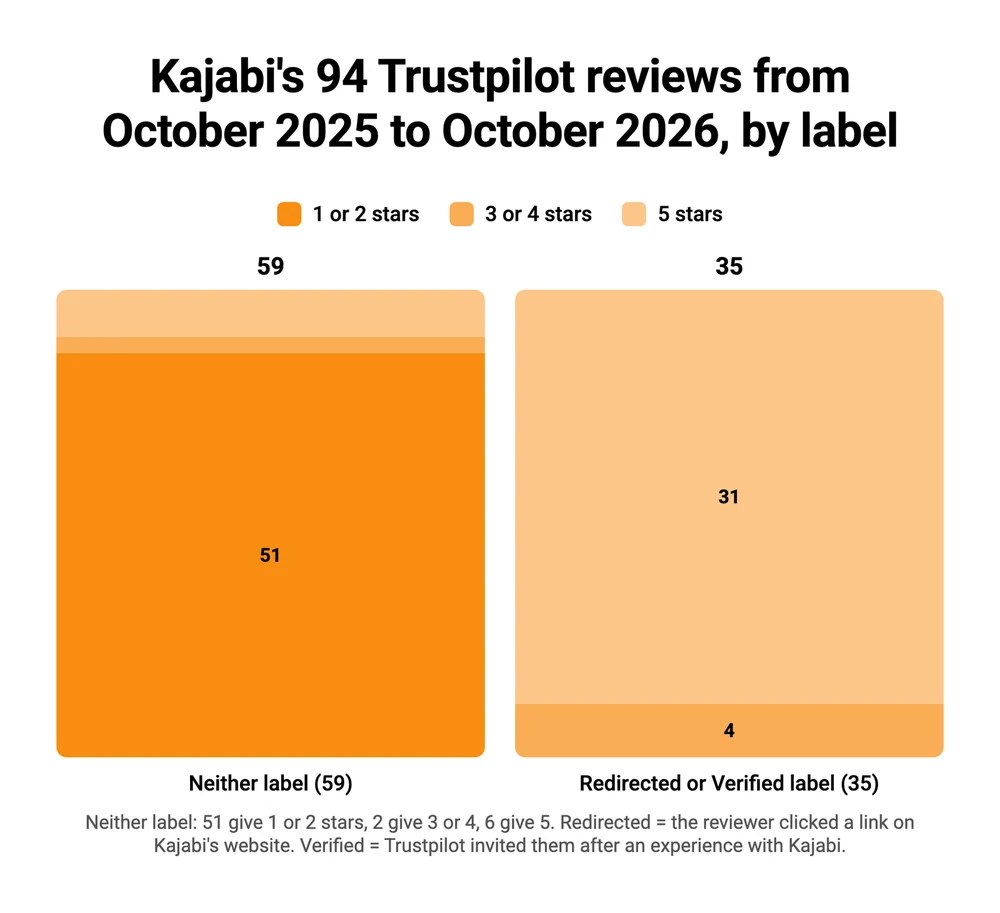
- Recent reviews skew negative: 51 of the 59 Trustpilot reviews since October 2025 without a Redirected or Verified label give 1 or 2 stars.
- Email changed: on your own email domain, Kajabi now sends from a required kjbm sub-address, and 3 users report open rates falling after the switch.
- Leaving has a cost: cancel Kajabi and students lose access to what they bought, while their subscriptions keep charging until you cancel each one.
Kajabi’s pricing page lists 3 plans from $179 a month
Kajabi’s pricing page lists 3 plans: Basic at $179 a month, Growth at $249 and Pro at $499, or $143, $199 and $399 a month if you pay for a year up front. Kajabi is an all-in-one platform for course creators and coaches. A single subscription covers the course area, a website, landing pages, funnels, email, a community and the checkout.
If you are still deciding what to sell before you commit to any platform, the Online Selling Mistakes Challenge walks through 5 common mistakes new sellers make, over 5 days by email.
Billed yearly, Basic costs $1,716 and caps you at 5 products and 2,500 contacts, while Pro costs $4,788 for unlimited products and 100,000 contacts.
| Plan | Monthly | Billed yearly | Products | Contacts | Own-processor fee |
|---|---|---|---|---|---|
| Basic | $179 | $143 a month ($1,716) | 5 | 2,500 | 2% |
| Growth | $249 | $199 a month ($2,388) | 50 | 25,000 | 1% |
| Pro | $499 | $399 a month ($4,788) | Unlimited | 100,000 | 0.5% |
Every Kajabi plan includes unlimited marketing emails, landing pages and funnels. Basic keeps Kajabi’s branding on your pages and allows 2 admin users. Growth removes the branding and adds your own affiliate program. Pro adds a branded app in the App Store, 3 websites and 3 communities. Past the contact cap, Kajabi sells extra contacts in blocks of 25,000 for $125 a month.
Kajabi advertises a 14-day free trial and a 30-day money-back guarantee. Our Kajabi coupon code guide covers the trial offers and the few real discounts.
Kajabi also sells a Kickstarter plan, at $89 a month for 1 product and 250 contacts, through a direct signup link rather than the pricing page. Our Kajabi pricing breakdown covers it along with the full fee schedule. The ranking reviews are further behind: 3 of the 5 written reviews on Google’s first page still print entry prices of $69 for Kickstarter, or $119 and $149 for Basic, and 1 lists Basic with 10,000 contacts, 4 times today’s 2,500.
What this Kajabi review found in 94 recent Trustpilot reviews
Kajabi’s recent Trustpilot reviews are mostly negative, while 75% of its 2,347 ratings over the years are 5-star. Kajabi’s Trustpilot page shows a TrustScore of 3.4 out of 5, from 1,766 ratings at 5 stars, 209 at 4, 98 at 3, 62 at 2 and 212 at 1.
A plain average of those stars would come out near 4.4, so the 3.4 is Trustpilot’s own calculation, not a simple mean. The newest reviews average 2.8 stars. For this review, every Kajabi review posted from October 2025 to October 2026 was read and sorted, 94 in all, by star rating and by the label Trustpilot shows beside each one.
2 labels matter. Redirected means the reviewer reached Trustpilot by clicking a link on Kajabi’s website, and Verified means Trustpilot invited the reviewer automatically after an experience with Kajabi. The labels say nothing about whether a review is genuine, only how the reviewer reached Trustpilot.
Of the 59 reviews with neither label, 51 give 1 or 2 stars. Of the 37 5-star reviews, 31 carry the Redirected or Verified label, and 6 came in without one. Reviewers who came on their own leaned negative and reviewers who arrived through Kajabi’s side leaned positive, so this sample cannot tell you how the average Kajabi customer feels.
Invited reviews include complaints too. Of the 100 Verified invitations Kajabi collected in September 2025 alone, 65 gave 5 stars and 27 gave 1 star.
Billing is the biggest complaint: 15 of the 51 reviews at 1 or 2 stars describe charges after cancelling or at the start of a free trial, plans that would not cancel, or students’ payments failing or continuing.
| Complaint | Reviews | What reviewers describe |
|---|---|---|
| Billing and cancelling | 15 | Charged when a free trial started, a cancel button that did not work, students still billed after the creator cancelled |
| Hard to use or buggy | 12 | A fragmented dashboard, a clunky page editor, a student app that logs people out |
| Support | 10 | AI-first chat, wrong answers from agents, weeks of back and forth on a single issue |
| Price rises and removed features | 7 | A rise of about 20%, manual subtitles removed, a legacy Pro customer paying more than new ones |
| Site, account or data lost | 3 | A deleted site, a terminated account, a fee to get customer data back |
| Email deliverability | 2 | Open rates falling after Kajabi changed the sending address |
| Not a Kajabi customer | 2 | People on a creator’s mailing list or course, not creators |
Trustpilot does not check what reviewers claim, so treat these as what reviewers say happened.
The 37 reviews at 5 stars praise different things. Counting what each one mentions:
- Support: 20 mention support or customer service.
- New features: 15 mention updates, new features or the platform improving.
- Everything in 1 place: 13 praise having everything under a single login.
- Ease of use: 11 call Kajabi easy, simple or intuitive.
Among the price complaints, a long-time customer on a legacy Pro plan pays $4,788 a year plus $89 a month for the branded mobile app, $5,856 in total. Kajabi’s current Pro plan costs the same $4,788 and includes the app.
Hosting the course: the job happy reviewers praise
Hosting is part of what Kajabi’s happy reviewers praise when they mention having everything under a single login, and even some who left say it works. You upload course videos straight to Kajabi, build the sales page, landing pages and funnels in the same dashboard, and run coaching, memberships and a private community without stitching tools together. A user from Japan who left after almost 4 years still called the course features easy to use and the video upload a major advantage.
The limits sit in the plan table. Basic gives you 5 products, 1 website and 1 community. A course, a coaching offer and a small membership already use 3 of those 5 slots. The 12 “hard to use” reviews cluster around building, not studying. A seller spent about an hour getting a custom domain connected and still needed a real person to finish it. Others describe the page editor as counter-intuitive and the dashboard as pages within pages. 2 more describe the mobile app logging them out mid-session or crashing before they could verify an email.
Kajabi also retires features. Its help center says Creator Studio, the AI tool that turned videos into clips, posts and emails, is being shut down, and anything not exported before it goes will be permanently deleted.
If course hosting is your main job, the head-to-head posts go deeper on it: Kajabi vs Teachable and Kajabi vs Podia compare the course side, and Kajabi vs Circle compares the community side.
Taking the money: Kajabi’s fee depends on your processor
Kajabi takes no share of your sales when you use Kajabi Payments, its own processor. Use another processor, such as your own Stripe account, and Kajabi adds 2%, 1% or 0.5% per sale. Kajabi Payments itself charges US sellers 2.9%, 2.8% or 2.7% plus $0.30 per sale, depending on the plan.
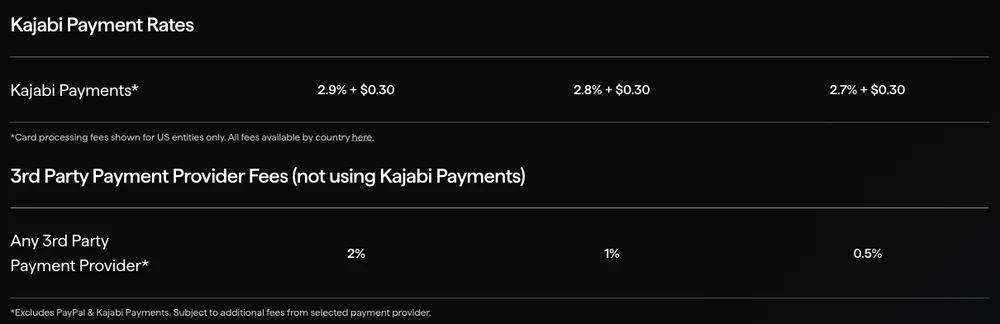
Kajabi’s footnote excludes PayPal, so PayPal sales carry no extra Kajabi fee. In countries where Kajabi Payments does not operate, its FAQ says there is no extra fee either. The catch lands on sellers in countries where Kajabi Payments runs, the US among them, who connect a Stripe account they already have.
A Basic seller doing $10,000 a year through their own Stripe account pays Kajabi $200 a year in that fee. That is on top of the $1,716 plan and Stripe’s own card fee of 2.9% + 30¢ per charge. Moving to Kajabi Payments removes the $200, and on Basic its 2.9% + $0.30 card rate matches Stripe’s.
4 of the 5 written reviews on Google’s first page tell readers Kajabi charges no transaction fees at all. The newer version of its pricing page, which some visitors are sent to, opens with “0% revenue share”, leaves out the fee table, and its FAQ mentions only an “additional processing fee” for outside processors, with no percentage.
The 15 billing reviews often start at signup. 3 reviewers say they were charged as a “free” trial began, and 1 of the 3 says the charge was refunded straight away. Others describe a cancel button that did nothing, or students still being charged after the creator cancelled their subscriptions.
If the checkout is the only part of Kajabi you would use, a checkout-only tool covers that job on its own. CartMango, the checkout I run, is one: it takes 0% of each sale on your own Stripe or PayPal, with card fees paid to the processor as usual. CartMango does not host courses yet.
Emailing your list from a sending address Kajabi picks
Kajabi’s email tool sends unlimited marketing emails on every plan, and if you connect your own email domain, it sends them from a kjbm sub-address of it, such as kjbm.yourdomain.com. Kajabi’s email domain rules say that sub-address is required and “can’t be removed, renamed, or hidden.” Remove your custom domain and your email goes out from Kajabi’s shared domain instead.
Kajabi gives 3 reasons for it:
- It protects your normal email. Kajabi’s records sit on the sub-address, away from the inbox you already run on your domain.
- It isolates your reputation. If a campaign draws spam complaints, the damage stays on the kjbm sub-address.
- It meets stricter sender rules. Kajabi says Gmail, Yahoo and Microsoft now require stricter checks on bulk mail, and the sub-address lets it pass them.
Some senders saw their numbers fall after the switch:
- An email marketer on Reddit, posting in October 2025 about a client’s list, wrote in a r/kajabi thread that open rates “went from 48% to 28% in two weeks” after Kajabi moved the client’s sending address to a kjbm subdomain, with emails landing in the Promotions tab.
- A seller with a 17,000-person list told Trustpilot in August 2026 that years of 30% open rates dropped to 7-10% after Kajabi changed the sender domain.
- Another long-time customer reported in September 2026 that open rates fell about 10 percentage points after a switch to the kjbm subdomain in late July and never recovered.
3 reports do not prove a cause. Open rates move for other reasons, and Kajabi’s own case for the change is about protecting deliverability. They are still worth weighing if your email list is the business.
The other email limit is the contact cap: 2,500 on Basic, 25,000 on Growth and 100,000 on Pro. Our ClickFunnels vs Kajabi comparison sets those caps against ClickFunnels’ plan by plan.
Leaving Kajabi without stranding your students
Cancelling Kajabi takes your site offline at the end of the billing period, and your students lose access to the products they bought, according to Kajabi’s cancellation guide. Only 1 of the 5 written reviews on Google’s first page says anything about leaving, in a single FAQ answer, and none mentions what happens to students.
3 more things happen when you leave, all from Kajabi’s help center:
- Subscriptions keep charging. Your customers’ subscriptions and payment plans do not stop when you cancel. They keep billing until you cancel each one by hand, through a limited login Kajabi leaves you.
- Customer data can be deleted. Kajabi says customer data may be deleted 90 days after your account ends.
- Legacy prices are gone. A special offer or legacy plan will not be available if you come back.
Kajabi’s backup guide lists what you can take with you: product templates, landing page templates, your contact list, and your videos, which you download separately. Blog posts cannot be exported, so Kajabi tells you to copy them into a document by hand.
The Trustpilot reviews show what goes wrong at this stage. 2 creators say students were still being charged after they cancelled. A third reviewer says Kajabi wanted $179 extra to release their customer data after they had parked the plan. Another says a site built over 6 years was deleted.
Before you cancel Kajabi:
- Export your contact list and every product and landing page template.
- Download your course videos.
- Copy your blog posts into documents.
- Cancel or move every active student subscription and payment plan.
- Tell students where the course will live next, before the site goes offline.
If you are already planning the move, our Kajabi alternatives guide prices 8 options once you count what each takes per sale.
Who should pay for Kajabi: the 4 jobs side by side
Kajabi handles hosting, payments and email on a single $1,716-a-year bill, while CartMango handles only the checkout and a hosted sales page today, for $10 to $30 a year once paid plans start in November.
| What you need | Kajabi Basic | What Kajabi reviewers report | CartMango |
|---|---|---|---|
| Host the course | 5 products, 1 website, 1 community | 12 reviews on a hard-to-use editor and bugs | Not yet, planned for October 2026 |
| Take the money | No Kajabi cut on Kajabi Payments, 2% on top of Stripe’s fee on your own Stripe | 15 reviews on billing and cancelling | 0% per sale on your own Stripe or PayPal, card fees apart |
| Email your list | Unlimited sends, 2,500 contacts | 3 reports of opens falling after the kjbm switch | Sends no email. Syncs buyers to Kit, ActiveCampaign, beehiiv or BirdSend |
| Leave | Site and student access end, subscriptions keep billing | Students still billed, a fee to get data back, a deleted site | Subscriptions keep paying you if you leave |
| Cost | $1,716 a year ($143 a month billed yearly) | 1 review on a price rise of about 20% | Free now, then $10 to $30 a year (about $0.83 to $2.50 a month billed yearly) |
CartMango’s course hosting and community are planned for October 2026 on its $30 a year plan. Until then CartMango sells courses as protected files, with the videos kept on a host like Vimeo or YouTube. BirdSend, 1 of the email tools in that row, is my other company.
Kajabi’s pricing page says 1 subscription replaces 5 tools: a website, email, a checkout, a community and courses. That is the fair way to judge it, against the bills it would replace rather than against zero. We switched our home from bought drinking water to a filter subscription because it cost about what we already spent on water each month, which made it a no-brainer. Run the same sum for Kajabi with what you pay today for those 5 tools.
Kajabi suits you if you already sell, your list runs to thousands of contacts, and you would otherwise pay for 4 or 5 separate tools. If that total is above $1,716 a year, Kajabi can be the cheaper, simpler choice.
Skip it, or wait, if you are selling a first product to a few hundred people, you want your own Stripe account without a 2% fee on Basic, or your email list is the business and the kjbm reports worry you. Kajabi’s own FAQ says Basic is the right plan if you have not sold anything yet. The reviews above are a reason to test your idea somewhere cheaper first.
FAQ
Is Kajabi worth the money?
Kajabi is worth it for a creator who already has buyers, a list in the thousands and several offers, because it replaces a website, an email tool, a checkout, a community and a course host. For a first product it means $179 a month, or $1,716 for a year paid up front, before any sales, and recent Trustpilot reviews are mostly complaints about billing, bugs and support.
What are the downsides of Kajabi?
Kajabi’s main downsides are price, a 2,500-contact cap on Basic, a 2% fee on your own Stripe account on Basic and, on a custom email domain, a kjbm sending address you cannot remove. Recent reviewers also report billing problems, a hard-to-use editor and slow, AI-first support. Leaving takes planning, because students lose access when you cancel.
Is there anything better than Kajabi?
The answer changes with the job. For courses alone, Teachable, Thinkific and Podia all have cheaper entry plans than Kajabi, and our Kajabi vs Thinkific comparison shows where the totals cross. For selling files, or a course delivered as files with the videos on another host, CartMango, a checkout-only tool, does the job without course hosting.
How much does Kajabi cost a month?
Kajabi’s pricing page lists $179 a month for Basic, $249 for Growth and $499 for Pro on monthly billing. Paying yearly drops those to $143, $199 and $399 a month, or $1,716, $2,388 and $4,788 a year. A Kickstarter plan at $89 a month is sold through a direct signup link instead. Card processing and, on your own processor, a Kajabi fee come on top.
Does Kajabi have a free trial?
Kajabi advertises a 14-day free trial and a 30-day money-back guarantee. Several Trustpilot reviewers say they were charged when the trial started, so check your card statement in the first days and set a reminder before day 14.
When Kajabi’s checkout is the only part you would use
If you came to this Kajabi review hoping to sell a first course or download, Kajabi’s course area, community and email may be more than you need yet. At $179 a month, or $1,716 for a year paid up front, paying for 5 tools before your first sale is the expensive way to find that out.
CartMango was built for that seller. Your buyers pay through your own Stripe or PayPal, CartMango takes 0% of each sale, and order bumps come on every plan. It is free right now, and paid plans run from $10 to $30 a year once they start in November, with course hosting on the way for the $30 plan.
About the Author

👋 I’m Welly, founder of CartMango (the site you’re on), a checkout platform for digital product sellers. We’ve previously processed $179M+. I also run BirdSend (email marketing tool, 3.1B+ emails sent). On the side I show other non-techie digital sellers how I use AI workflows to automate 50%+ of my operations. Find me on LinkedIn.
Related Reading
- Kajabi Pricing: every plan, the fee for using your own processor, and what Kajabi costs at 3 income levels
- Kajabi Alternatives: 8 options priced on what they cost once you sell
- Podia Alternatives: course platforms priced on their current tiers
- SendOwl Review: the same Trustpilot sort as this Kajabi review, run on SendOwl after its price change