

Pick Thinkific if the monthly bill matters most, since Basic runs $54 against Kajabi Basic at $179. Pick Kajabi if you would rather have email marketing, funnels and a community included than buy them separately. Payment processing decides the real total. Prices here came from both pricing pages and both help centres.
Thinkific raised its prices on 13 August 2026, by roughly 10% across Basic, Start and Grow. Most of the Kajabi vs Thinkific comparisons you can find still quote the old numbers.
Every one of those guides was accurate on the day it was written. Zapier still lists Thinkific at $49, $99 and $199.
Ship 30 for 30 puts Kajabi Basic at $119 and calls a Thinkific free plan “one of the big advantages Thinkific has over Kajabi”. Course Platforms Review, which stamps its own page as updated in August 2026, quotes $39 and $119.
Kajabi has a quieter version of the same problem. Its pricing page draws 3 plans and its page code carries 4, and the one it does not draw costs half what the cheapest visible plan does.
This post reads every number off the source instead. You will get both plan ladders at today’s prices, the fee neither pricing page puts in its headline, and the exact sales figure where the cost order flips.
Key Takeaways
- Thinkific increased Basic from $49 to $54 a month, Start from $99 to $109 and Grow from $199 to $219, effective 13 August 2026.
- Kajabi Basic costs $179 a month, and Kajabi runs a 4th plan called Starter at $89 that its pricing page does not display.
- Both platforms charge 0% on their own payment processor and a percentage on yours: Thinkific 5% on Basic, Kajabi 2% on Basic.
- Run your own Stripe and the cost order flips at about $3,433 a month in sales, above which Kajabi Basic works out cheaper.
- Thinkific has no free plan any more, only a 30-day trial, which several widely read guides still get wrong.
Worth doing before you pick either one: the fee that decides your bill on both these platforms is not on either pricing page, and that pattern repeats all over a solo selling setup. The free 5-day Online Selling Mistakes Challenge covers the 5 leaks that cost solo sellers the most, 1 email a day.
Kajabi vs Thinkific pricing: every plan side by side
Thinkific Basic costs $54 a month and Kajabi Basic costs $179, and the plan that undercuts both is Kajabi Starter at $89, which the Kajabi pricing page does not draw.
| Plan | Monthly | Annual, per month | Fee on your own Stripe |
|---|---|---|---|
| Thinkific Basic | $54 | $40 | 5% |
| Thinkific Start | $109 | $82 | 2% |
| Thinkific Grow | $219 | $164 | 1% |
| Kajabi Starter | $89 | $71 | 5% |
| Kajabi Basic | $179 | $143 | 2% |
| Kajabi Growth | $249 | $199 | 1% |
| Kajabi Pro | $499 | $399 | 0.5% |
Annual billing is a bigger lever than most guides admit. Thinkific gives 25% off for paying yearly, which puts Basic at $475 a year, Start at $978 and Grow at $1,968. Kajabi’s discount is 20%, worth $432 a year on Basic and $1,200 on Pro.
2 columns in that table deserve more than a glance. The Kajabi Starter row, and the last column, which is the number that decides your real bill and appears on neither platform’s headline pricing.
A caution on plan names. Thinkific sells Basic, Start and Grow publicly, and its help centre names 3 more: Expand at $499 a month, Plus, and a Free tier that no longer appears anywhere on the pricing page. A guide quoting a Thinkific plan called Pro, Essentials or Business is quoting a legacy name.
What changed in the Thinkific price increase
Thinkific put its prices up by about 10% on 13 August 2026, and its own announcement calls this “our first subscription price increase since 2022”.
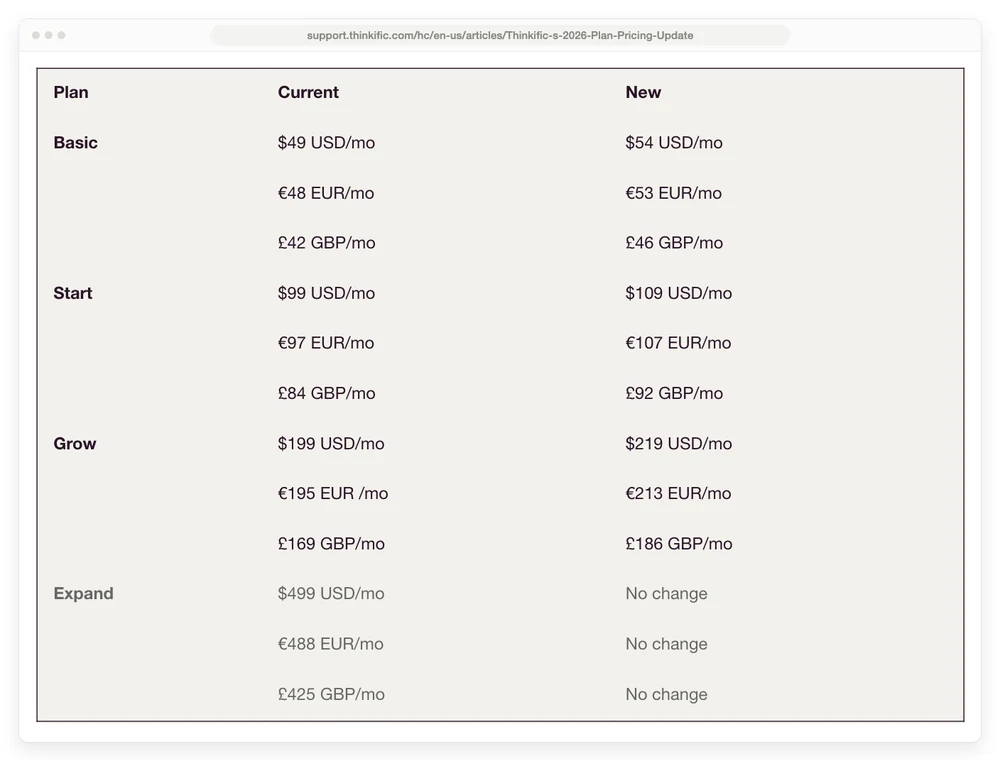
Thinkific’s own price-change table. Read the Basic row: $49 becomes $54 a month.
Monthly went from $49 to $54 on Basic, $99 to $109 on Start and $199 to $219 on Grow. Annual went from $432 to $475 on Basic, $888 to $978 on Start and $1,788 to $1,968 on Grow. Expand held at $499 a month.
3 details matter if you already pay Thinkific. Existing non-profit accounts and accounts carrying an active discount are exempt. Annual customers keep the old price until their next renewal, so plenty of sellers are still paying $432 a year for Basic.
Thinkific also warned that its own invoice page would not show the new pricing until the change landed, which is an unusual thing for a company to have to say.
The window to lock in the old rate has closed. Thinkific offered it to anyone switching from monthly to annual before the change took effect.
The Kajabi plan that is not on the pricing page
Kajabi’s public pricing page draws 3 plans and its own page code carries 4. The one it does not draw is called Starter, at $89 a month or $71 billed annually, and it gives you 1 product and 250 contacts with 2 admin users.
Almost every comparison treats $179 as the floor. Zapier’s comparison says Kajabi “now starts with a much more expensive price tag: $179/month”. For someone selling a single course, the real floor is half that.
Our own Kajabi pricing deep-dive found this tier hidden behind a CSS rule, then under the name Kickstarter, and documented its 5% third-party cut. It is still there and still $89. So a guide telling you the tier was retired is describing a plan that is live and buyable today.
Worth being straight about the catch. 1 product and 250 contacts is a small allowance, and a 250-contact ceiling on a platform whose main pitch is built-in email marketing is a real limit rather than a technicality.
Thinkific Basic gives you unlimited courses at $54. Kajabi Starter gives you 1 product at $89.
Read the plan grid and you would never know the tier exists. That is the part worth knowing before you compare headline prices.
What each platform charges when you bring your own Stripe
Both platforms advertise no transaction fees, and both mean it only if you use their in-house payment processor. Route sales through your own Stripe account and each one takes a percentage on top of your subscription.
Kajabi publishes the schedule on its pricing page, in a row headed 3rd Party Payment Provider Fees. It is 2% on Basic, 1% on Growth and 0.5% on Pro, and the footnote excludes PayPal and Kajabi Payments.
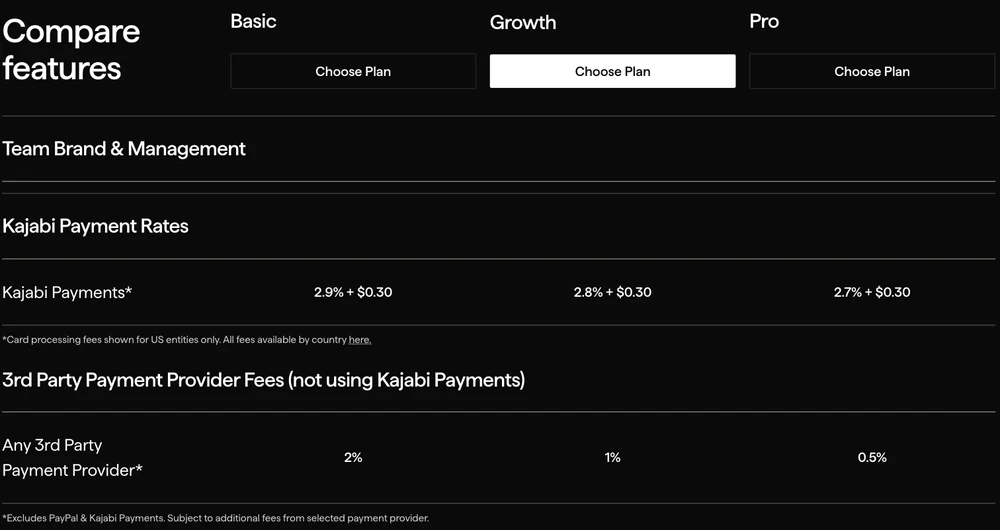
Kajabi’s pricing page. The bottom row is the cut Kajabi takes when you use your own payment provider.
A few screens above that row, the same page carries the headline “No hidden fees. No revenue sharing.”
Thinkific puts its version in the help centre rather than on the pricing page, and its rates are higher at the bottom of the ladder.
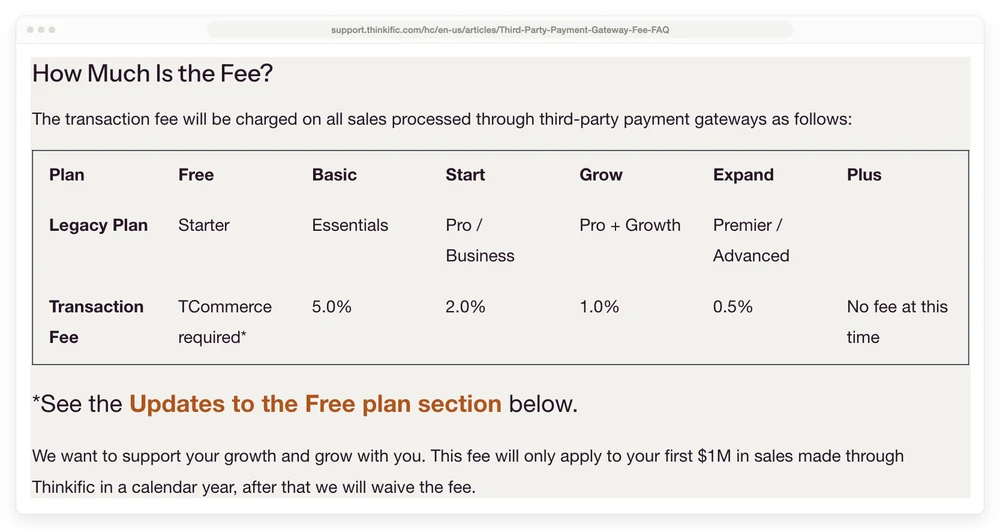
Thinkific’s help centre. The Basic column charges 5% of every sale processed outside Thinkific Payments.
Thinkific charges 5% on Basic, 2% on Start, 1% on Grow and 0.5% on Expand, with no fee on Plus. Its own wording is that the fee “will only apply to your first $1M in sales made through Thinkific in a calendar year, after that we will waive the fee.” That cap is real and rarely mentioned, though it only starts mattering at a scale most course sellers never reach.
A harder rule sits underneath it. Thinkific accounts on the old Free plan cannot use Stripe or PayPal at all, because access was revoked and the in-house processor became mandatory on that tier.
For what the processors themselves cost, Stripe publishes its rates and so does PayPal. Thinkific describes its in-house processor as priced “in line with other processors like Stripe and Paypal at 2.9%”, and Kajabi lists Kajabi Payments at 2.9% plus $0.30 on Basic, falling to 2.7% plus $0.30 on Pro. The surcharge above is charged on top of that, not instead of it.
Of the comparison guides competing for this search, almost none publish either schedule. Group.app is the exception and covers the surcharge for both.
The crossover point, where the cheaper platform stops being cheaper
Kajabi Basic becomes cheaper than Thinkific Basic at about $3,433 a month in sales, if you run your own Stripe. Kajabi costs $103 a month more in subscription while charging 3 percentage points less per sale.
| Monthly sales | Thinkific Basic | Kajabi Basic | Cheaper |
|---|---|---|---|
| $500 | $65 | $153 | Thinkific |
| $1,000 | $90 | $163 | Thinkific |
| $2,000 | $140 | $183 | Thinkific |
| $3,433 | $212 | $212 | level |
| $5,000 | $290 | $243 | Kajabi |
| $10,000 | $540 | $343 | Kajabi |
Those totals are the annual-billing subscription plus the third-party surcharge, and they exclude the card processing every platform passes through.
All of that only applies if you run your own Stripe. Use each platform’s own processor and the surcharge is 0% on both, so the crossover disappears and Thinkific Basic stays $103 a month cheaper at every revenue level.
The fee schedule only ever bites a seller who insists on their own Stripe account. If you are happy on Thinkific Payments or Kajabi Payments, ignore the last column of the first table and compare the subscriptions.
There is still a reason to care which processor you sit on. Moving off a platform’s in-house processor later means your existing subscribers have to re-enter card details, and a share of them will not. We ran the same maths across 7 platforms in our guide to picking an LMS for online courses.
Course building and student assessment
Thinkific is the stronger course builder of the 2, and assessment is where the gap is widest. It carries quizzes, exams, surveys and assignments plus a randomised question bank that serves a different set each attempt, where Kajabi offers simpler quizzing.
Thinkific Basic includes unlimited courses, video lessons, student discussions and 1 community, along with up to 5 digital products such as ebooks or workbooks. Checkout, order bumps, gifting, coupon codes and abandoned-cart emails sit on that entry plan too.
SCORM is the one to check before committing. If you author in a tool like Articulate and need to import SCORM packages, Thinkific supports it only on the Plus plan, which is quote-only and sits above the 3 published tiers.
Kajabi’s course builder is good and less deep. Where it pulls ahead is live delivery, since it bundles live rooms and native community, while Thinkific leans on outside tools for live sessions.
Marketing, email and funnels
Kajabi beats Thinkific on marketing outright, and marketing is what the extra $103 a month buys. Unlimited marketing emails, unlimited landing pages and unlimited funnels sit on every Kajabi plan including Basic, and Thinkific expects you to connect an outside email tool.
The contact ceiling is the thing to watch. Kajabi counts contacts at 2,500 on Basic, 25,000 on Growth and 100,000 on Pro, and a list that outgrows the tier forces an upgrade whether or not you need anything else on it.
Affiliate programs, removing Kajabi branding and advanced automations all sit on Growth at $249 a month rather than Basic. The API, the custom code editor and 3 websites are Pro only.
Both platforms sell the same branded mobile app at the same price, which is a neat coincidence worth knowing. Kajabi includes it on Pro and prices it at a stated $199 a month of value. Thinkific sells it as an add-on at $199 a month, included only on select Plus contracts.
Website builder and integrations
Kajabi gives you a website rather than a page, and Thinkific gives you a course site plus an app store to bolt the rest on. Kajabi Basic and Growth include 1 website, Pro includes 3, and landing pages are unlimited on every tier. Thinkific puts your school on your own custom domain from Basic upward.
That difference explains the connected-apps story better than any count would. Kajabi bundles the email, the funnels and the pages, so it needs fewer outside connections: Stripe, PayPal, analytics, webhooks, an API on Pro, and Zapier for the rest.
Thinkific leaves marketing to you, so it runs a dedicated app store instead, with named connections like HubSpot and QuickBooks Sync grouped by job, plus Zapier as the catch-all. Neither company publishes a total, so treat any guide quoting you a precise app count as an estimate rather than a fact.
If you want fewer moving parts, Kajabi already contains most of them. If you already run tools you like, Thinkific plugs into them and you avoid paying twice for email.
What are the downsides of Kajabi?
Kajabi’s main downside is that the entry price buys a small allowance. Basic is $179 a month for 5 products and 2,500 contacts, and the next step up is $249.
The second is the product cap itself. Counting products rather than courses means a lead magnet, a mini course and a coaching offer can eat 3 of your 5 Basic slots without you launching anything new.
The third is the gap between the pricing page and the real ladder. A 4th plan at $89 exists and is not drawn, and a third-party surcharge of up to 2% sits several screens below a headline promising no hidden fees.
If the price is the sticking point rather than the platform, we priced the field in our roundup of Kajabi alternatives.
What are the disadvantages of Thinkific?
Thinkific’s biggest disadvantage is the 5% third-party payment gateway fee on Basic, more than double Kajabi’s 2% on the equivalent tier, and documented in the help centre rather than on the pricing page.
The second is that marketing is not included. There is no built-in email marketing to speak of on the lower plans, so budget for an outside email tool and count that against the cheaper subscription.
The third is feature gating that is easy to miss. SCORM needs Plus, the branded mobile app is $199 a month on top, and the free plan people still recommend does not exist.
That last one catches guides too. Thinkific’s own pricing FAQ answers “Does Thinkific have a free plan?” with “No, instead, you can explore the whole platform with a 30-day free trial.”
We ran the same live-price check across the wider market in our Thinkific alternatives roundup.
Is there anything better than Kajabi or Thinkific?
Kajabi and Thinkific are both genuinely strong at course hosting, so a better option means one that beats them on the half of the job you care about. Teachable is the obvious third name to weigh, and we have put it head to head against both: Kajabi vs Teachable and Teachable vs Thinkific, with the full ladder in our Teachable pricing breakdown.
If your objection is the monthly cost rather than the feature set, the honest answer is that any platform hosting your video, running your checkout and storing your students charges a monthly fee. The cheaper end of that market trades away the marketing tools rather than the hosting.
If you are not really selling a course, and what you need is a checkout for a digital download or a template pack, an all-in-one course platform is the wrong tool for the job and you will pay for plenty you never open.
How to choose between Kajabi and Thinkific
Choose on which job you are actually buying, since the $103 a month gap on Basic is close to the price of the marketing stack Kajabi bundles and Thinkific does not.
Thinkific is the better buy if you already have an email tool you like, you want the lowest running cost, or your courses need serious assessment. Kajabi is the better buy if you want 1 login for the course, the emails, the funnels and the community, or you are far enough along that consolidating tools saves more than it costs.
Then check 3 things before paying. Which payment processor you intend to use, since that decides whether the surcharge applies at all. How many products you sell, because Kajabi counts them and Thinkific does not.
The third is your email list size, because Kajabi’s contact ceiling forces most upgrades.
A last word from someone who was asking the same question. Posting on r/elearning, a seller asked for an honest comparison site and put the problem plainly: “All I can find are ‘comparisons’ on the sites of the individual hosts, where magically their own product always comes out on top.” Further down the same thread, a seller who had left Kajabi wrote that “once the business grew they were taking a big chunk of my income, so I switched to self hosted alternatives.”
Read every comparison, this one included, with a tab open on the actual pricing page.
FAQ
How much does Thinkific cost a month?
Thinkific costs $54 a month on Basic, $109 on Start and $219 on Grow when you pay monthly. Paying yearly drops those to $40, $82 and $164 a month, or $475, $978 and $1,968 a year. Thinkific has no free plan, only a 30-day trial, and a third-party payment gateway fee of 5%, 2% or 1% applies by plan if you use your own Stripe or PayPal.
Does Kajabi really start at $179 a month?
Not quite. The visible pricing grid starts at $179 a month for Basic, or $143 billed annually, and Kajabi’s page code carries a Starter plan at $89 a month for 1 product and 250 contacts. Most comparison guides quote $179 as the floor because the cheaper tier is not drawn on the page.
Do Kajabi and Thinkific really charge 0% transaction fees?
Only on their own payment processors. Kajabi Payments and Thinkific Payments both carry no platform surcharge, and using an outside processor triggers 2% down to 0.5% on Kajabi by plan and 5% down to 0.5% on Thinkific by plan. Card processing is charged separately by the processor either way.
Which is cheaper overall, Kajabi or Thinkific?
Thinkific, in almost every realistic case. On each platform’s own processor Thinkific Basic stays $103 a month cheaper than Kajabi Basic at any sales volume. The only case where Kajabi Basic wins on cost is a seller using their own Stripe who is past roughly $3,433 a month in sales, where Kajabi’s lower surcharge outweighs its higher subscription.
Can I move from Thinkific to Kajabi later?
Yes, and the content is the easy half. The part that costs you is subscribers: recurring payments taken through a platform’s in-house processor do not transfer, so those customers have to re-enter card details on the new platform, and a share of them lapse rather than do it.
What to check before you pay either one
Both of the expensive numbers in this Kajabi vs Thinkific comparison are percentages, and neither sits on a pricing page headline. Kajabi’s is several screens below “No hidden fees”. Thinkific’s is in the help centre.
So check 2 numbers before you pay, whichever platform you pick: the subscription, and the cut per sale on the processor you plan to use.
If it turns out you do not need the course hosting at all, and what you want is a checkout that takes 0% of your sales, that is what CartMango does. CartMango is my own platform, so treat that as the disclosure it is.
CartMango is free until October 2026 and starts at $10 a year after that, with order bumps and protected file delivery on the CartMango entry plan. CartMango course hosting and community are not live yet and arrive on the $30 a year plan at the same point, so if you need the courses hosted today, one of the 2 platforms above is your answer.
About the Author

👋 I’m Welly, founder of CartMango (the site you’re on), a checkout platform for digital product sellers. We’ve previously processed $179M+. I also run BirdSend (email marketing tool, 3.1B+ emails sent). On the side I show other non-techie digital sellers how I use AI workflows to automate 50%+ of my operations. Find me on LinkedIn.
Related Reading
More on the platforms in this Kajabi vs Thinkific comparison, and on what the rest of the market charges:
- Kajabi pricing: the full plan ladder: every tier including the one the pricing page does not draw
- Teachable vs Thinkific: the other half of this comparison, priced live
- Thinkific alternatives: 6 platforms priced after the price rise
- LMS for online courses: real fees for 7 platforms and the crossover point on each entry plan
- How much it costs to create an online course: the spend before you pick a platform