

Circle is worth its $89 a month when the paid product is the community itself. Kajabi asks $143 and earns it when you also need the course, the email and the funnel on 1 bill. Both take 2% of member payments at that tier, only Kajabi lets you switch its 2% off, and every price here comes from their own pages.
I sat down to price Kajabi vs Circle properly and found something odd on the first page of Google. 2 of the 8 results that rank for this comparison sell you a Kajabi plan that a new customer cannot buy, and 1 of them was last updated in July 2026.
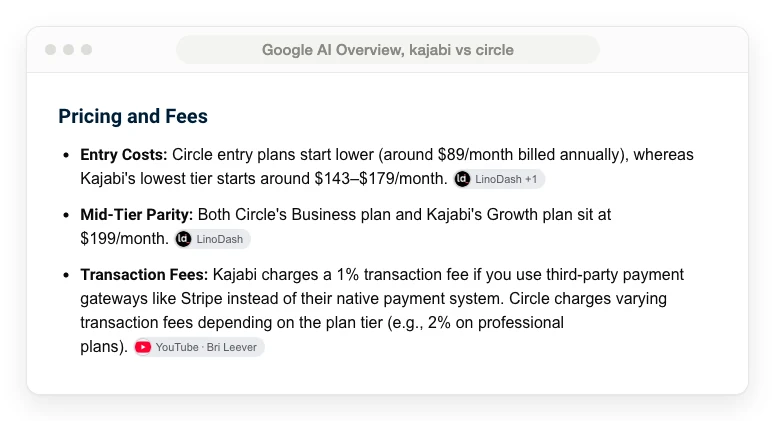
Every guide I read, including Google’s own AI summary, also prints a single transaction fee for each platform. Both of them actually run a 3-step ladder that changes with your plan. So this post prices both from their own current pages, works out what each takes from a real $100 charge, and finds the exact member count where Kajabi Basic becomes the cheaper plan.
Key Takeaways
- Kajabi’s entry price is $143 a month billed annually, not $89. The old $89 Kickstarter tier is now a legacy plan, and Kajabi’s own page code says so.
- Both platforms charge the identical ladder: 2%, then 1%, then 0.5%. The difference is that you can switch Kajabi’s off and you cannot switch Circle’s off.
- Circle Business and Kajabi Growth cost exactly the same, $199 a month billed annually. At that tier the fee is the only thing separating them.
- Both add 0.7% on recurring charges that neither pricing page shows you. That is Stripe Billing, and it applies to every payment in the series.
- At 27 members paying $100 a month, the 2 entry plans cost the same for the year. Below that Circle wins, above it Kajabi does, if you use Kajabi Payments.
Most people picking between these 2 are about to sign a year of billing based on a number they read in a roundup. If you want the short version of where solo sellers lose money on decisions like this, grab the free 5-day Online Selling Mistakes Challenge.
What Kajabi and Circle cost right now
Kajabi starts at $143 a month and Circle starts at $89, both billed annually. Kajabi sells 3 plans, Circle sells 2 plus a sales-priced tier. Both companies put the annual rate on the plan card, so every number in this section is the annual rate unless it says otherwise.
Circle is the stricter of the 2 here. Its pricing page publishes an annual figure only, with a footnote reading “Prices displayed in USD, based on annual billing,” and there is no monthly toggle anywhere on the page. Kajabi shows both, with the month to month price in smaller type underneath.
Circle Professional is the cheapest way in at $89 a month, which is $1,068 for the year, against $143 a month and $1,716 for Kajabi Basic. Both of those entry plans then take 2% of every member payment, and Kajabi is the only 1 of the 2 that lets you switch its 2% off.
| Plan | Per month, billed yearly | Cost for the year | Members or contacts | Its cut of each payment |
|---|---|---|---|---|
| Circle Professional | $89 | $1,068 | Unlimited members | 2% |
| Circle Business | $199 | $2,388 | Unlimited members | 1% |
| Circle Plus | Talk to sales | Not published | Unlimited members | 0.5% |
| Kajabi Basic | $143 | $1,716 | 2,500 contacts | 2% on an outside processor, 0% on Kajabi Payments |
| Kajabi Growth | $199 | $2,388 | 25,000 contacts | 1% on an outside processor, 0% on Kajabi Payments |
| Kajabi Pro | $399 | $4,788 | 100,000 contacts | 0.5% on an outside processor, 0% on Kajabi Payments |
2 rows in that table deserve a second look.
The first is the middle row on each side. Circle Business and Kajabi Growth are both $199 a month, which is $2,388 a year, to the dollar. At that level the fee is the whole conversation.
The second is how the 2 companies count. Circle sells unlimited members on every plan and charges you for admins, moderators and spaces instead. Kajabi caps contacts, at 2,500 on Basic and 25,000 on Growth, and a contact is anyone on your list rather than anyone who paid you. A free lead magnet on Kajabi eats the same allowance as a paying member.
Kajabi’s yearly totals are its own arithmetic, not a rounded monthly figure multiplied by 12. Its page prints “SAVE $432/YEAR” against Basic, and $179 a month for 12 months minus $432 lands on $1,716 exactly. Growth and Pro reconcile the same way. Circle publishes no yearly total at all, so the $1,068 and $2,388 above are 12 times its published monthly rate.
The Kajabi plan every comparison quotes that you cannot buy
Kajabi’s cheapest plan for a new customer is Basic at $143 a month billed annually. It is not the $89 Kickstarter tier, and that matters because 2 of the 8 pages ranking for this comparison still price Kajabi as if you can sign up for Kickstarter today. Both quote it at $69 a month, which was not even the last published price.
Kajabi’s own pricing page settles it 4 ways at once. The plan cards show Basic, Growth and Pro only. The page’s plan picker holds a list of exactly 3 plans in its code, and every signup link points at basic, growth or pro, monthly or yearly, with no kickstarter link among them.
The fourth way is the clearest. The page source carries a note from whoever built it, in plain words: “Starter/Kickstarter is retired and intentionally not offered here, Basic is the floor plan.”
Kajabi’s own update page fills in the history. It announced a price rise across every plan taking effect on 13 January 2026, which it describes as the first change in 10 years. It lists Kickstarter alongside Basic, Growth and Pro as tier names that apply to legacy accounts. Existing customers keep what they have, and new ones start at Basic.
There is a wrinkle here that explains why so many guides got it wrong. The tier did not vanish cleanly.
Archived copies of Kajabi’s pricing page tell the story. The plan was fully visible through November 2025, disappeared from the page entirely in the January 2026 restructure, then reappeared in the page’s underlying code from April 2026 onward without ever being drawn on screen. The last archived copy carrying that hidden version is dated 4 August 2026.
Anyone who read the page code in that window found a real $89 tier sitting there, which is the likeliest source of the stale figure still on Google today. That version is gone, replaced by the retirement note quoted above. So if you have read somewhere that Kajabi hides a cheap plan, that was true and it is not any more. Budget from $143.
What each one takes out of every member payment
On a $100 monthly membership charge, Circle Professional takes $5.90 and Kajabi Basic takes $3.90 if you run payments through Kajabi Payments. That is a $2 gap on every charge, which is $24 a year for every member you have. Neither pricing page gives you those totals, because each one shows its own slice and stops there.
| Setup | Platform’s own cut | Card and recurring fees | Taken from $100 | You keep |
|---|---|---|---|---|
| Circle Professional | 2% | 2.9% + $0.30 + 0.7% | $5.90 | $94.10 |
| Circle Business | 1% | 2.9% + $0.30 + 0.7% | $4.90 | $95.10 |
| Kajabi Basic, Kajabi Payments | 0% | 2.9% + $0.30 + 0.7% | $3.90 | $96.10 |
| Kajabi Growth, Kajabi Payments | 0% | 2.8% + $0.30 + 0.7% | $3.80 | $96.20 |
| Kajabi Pro, Kajabi Payments | 0% | 2.7% + $0.30 + 0.7% | $3.70 | $96.30 |
3 separate charges stack on a recurring payment, and you have to go into the help docs to find the third.
The 0.7% is Stripe Billing, which charges 0.7% of billing volume on its pay as you go plan. Circle’s own help documentation spells the stack out and gives a worked example for a Business plan subscription: 1% to Circle, 2.9% plus 30 cents to Stripe Payments, and 0.7% to Stripe Billing. Kajabi’s fee schedule lists the same 0.7% for subscriptions and payment plans, and adds that it applies to every transaction in the series including the first one.
None of the 8 pages ranking for this comparison mentions that 0.7% at all. Neither does Circle’s own comparison page.
Circle’s 2% is unavoidable, because Circle connects to Stripe and nothing else. Kajabi’s 2% is a surcharge for using an outside processor, and it disappears in 4 situations: you use Kajabi Payments, you take the payment through PayPal, you are on a legacy plan, or Kajabi Payments is not offered in your country.
That last route has a catch. PayPal’s published US rate for PayPal Checkout is 3.49% plus 49 cents, which is higher than the 2.9% plus 30 cents you pay on Kajabi Payments. Dodging the 2% through PayPal works, and it costs you a little more than not needing to dodge it.
Google’s AI summary for this comparison gets it half right. It states that Kajabi charges a 1% transaction fee on third party gateways, full stop. 1% is the Growth rate. On Basic it is 2%, on Pro it is 0.5%, and on Kajabi Payments it is nothing.
For someone on the entry plan that gap is worth real money. Budget 1% while you are actually paying 2% and you are out by double on every sale.
The 27-member line where Kajabi Basic gets cheaper
At 27 members paying $100 a month, Circle Professional and Kajabi Basic cost you exactly the same for the year, $2,979.60 each, as long as you take payments through Kajabi Payments. Below 27 members Circle is cheaper. Above it, Kajabi is.
The maths is simple enough to check. Circle Professional costs $1,068 for the year and takes $5.90 from each $100 charge, so 27 members paying 12 times over gives $1,911.60 in fees, and $1,068 plus $1,911.60 is $2,979.60. Kajabi Basic costs $1,716 for the year and takes $3.90 a charge, so the same 27 members cost $1,263.60 in fees, and $1,716 plus $1,263.60 is $2,979.60.
Kajabi Basic starts $648 a year more expensive on the plan alone. It claws that back at $24 a year per member. Divide 1 by the other and you get 27.
2 caveats decide whether that line applies to you at all.
The first is Kajabi Payments. The whole crossover exists because Kajabi’s 2% goes away when you use its own processor. Connect an outside Stripe instead and Kajabi Basic takes 2% on top of whatever Stripe charges you, which puts it level with Circle Professional per charge. The $648 gap on the plan then never closes, and Circle stays cheaper at every member count.
The second is where you live. Kajabi Payments is offered in the United States, Canada, Australia, the United Arab Emirates, the United Kingdom and selected European countries. Outside those, Kajabi’s own documentation says the outside processor fee is not charged at all, which is good news, but you also cannot get the discounted card rate. Check your country before you build a budget on this.
At the $199 tier there is no crossover to find. Circle Business and Kajabi Growth cost the same, and Kajabi Growth on Kajabi Payments takes $3.80 from a $100 charge against Circle Business at $4.90. Same plan price, $1.10 a charge apart.
If fee maths is the sort of thing you would rather have someone else catch for you, the Online Selling Mistakes Challenge runs through the 5 places solo sellers most often leak money.
Where Kajabi is the stronger side
Kajabi sells you a whole business stack on 1 bill, and that is the honest reason it costs more. Email marketing, landing pages, funnels and checkout are included on every plan with no separate charge and no volume tier. Its course builder is the more structured of the 2, with assessments built in.
Pro adds cohort courses, video transcriptions and translations, a branded mobile app and API access. An affiliate program comes with Growth, not Basic. If recruiting affiliates is part of how you plan to launch, your real entry price is $199 a month rather than $143, and that single feature moves your yearly bill by $672.
Kajabi also gives you more admin seats as you climb, going from 2 on Basic to 11 on Growth and 26 on Pro. Circle starts you at 3 admins and 10 moderators on Professional, then charges $10 a month for each extra admin and $20 a month per 10 extra moderators.
The trade is bloat, and the people running these platforms say so out loud.
A creator on the r/onlinecourses subreddit started from the usual complaint about Kajabi’s price, then landed somewhere more interesting: “I’ve been seeing a lot of complaints about Kajabi pricing but when you switch, you still end up stitching together courses + funnels + emails… just across different tools. So now it’s cheaper… but more complex.” (the r/onlinecourses thread on Kajabi bloat)
Where Circle is the stronger side
Circle runs the bigger community, and Kajabi runs a smaller one rather than none at all. Most comparisons overstate this gap in Circle’s favour, so here are the actual limits. Kajabi includes 1 community on Basic and Growth and 3 on Pro, with unlimited access groups inside them. Circle gives you 20 spaces on Professional and 30 on Business.
The real gap is who you can let in. Every Circle plan carries unlimited members, while Kajabi counts contacts and caps them at 2,500 on Basic. A big free list costs you money on Kajabi and costs you nothing on Circle.
Circle’s cheaper plan also carries live streams, live rooms, gamification, a searchable member directory, courses and a website builder. Business adds workflows, an admin API, a headless member API, activity scores, automated transcriptions and the ability to remove Circle branding.
Both Circle plans include 2,500 Circle AI credits a month, with extras at $10 per 1,000. Kajabi gives you 0 AI credits on Basic, 500 on Growth and 1,000 on Pro, with top ups at $15 for 500. On AI allowance the cheaper Circle plan beats the more expensive Kajabi one outright.
Circle also runs the better migration story. It offers payment migration on Professional and a fuller standard migration on Business, covering courses, content and members. Kajabi offers no free migration on any plan.
The add-ons that move the bill
If you want email, Circle’s plan price is only part of your bill, and this is the biggest hidden number in the comparison after the fee ladder. Circle’s Email Hub is an add-on charged on top of your plan, at $99 a month for 10,000 contacts. Kajabi includes unlimited marketing emails on every plan.
Add that 1 item and the picture flips. Circle Professional plus Email Hub is $188 a month, which is $2,256 a year, against Kajabi Basic at $1,716. The platform that looked $648 a year cheaper is now $540 a year more expensive, and you still have Circle’s 2% to pay on top.
A few smaller ones can still surprise you. On Circle Professional, branded email notifications cost $40 a month and customizable profile fields cost $49 a month, and both are included on Business. Extra spaces are $20 a month per 10. On Kajabi, an extra 5,000 contacts went from $20 to $25 in the January 2026 change.
Both companies publish all of it. The plan card is still only a starting point, and your real bill depends on which add-ons you switch on.
Which one fits what you are actually selling
The right answer here depends less on the 2 feature lists than on what you are selling and to whom, and I learned that the expensive way.
My first business was an event organizing company running motivational seminars, which I ran with 2 partners. We started with public seminars alongside well known speakers, then branched into supplying those same speakers to companies for a training fee.
We would go to their offices and pitch, and nobody signed. Not 1. The speakers were genuinely well known, our pitch was fine, and the answer turned out to be embarrassingly simple: those companies did not have the budget we were asking for. Once we filtered for companies that did, sales started arriving.
My takeaway from it has stuck. The who comes first, then the offer, then the traffic, and the copy is the cherry on top. The same order applies here, so before you compare feature lists, decide which of these you are.
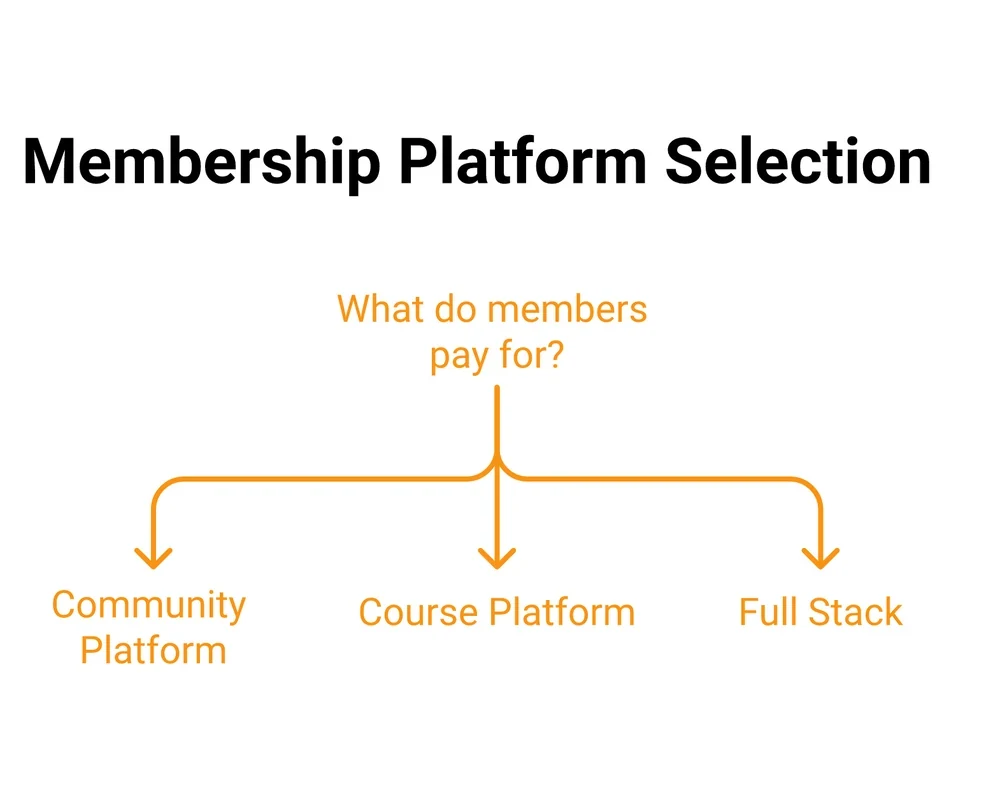
If the thing people pay for is the room, the conversation and the other members, Circle is built around that and Kajabi treats it as 1 feature among many. Unlimited members on every Circle plan is what matters most, and you will not fight the platform to get discussions, spaces and live events working.
If the thing people pay for is a structured course and a funnel that sells it, Kajabi is built for that. You get email, landing pages and funnels included rather than bolted on, and above 27 paying members at $100 you are also paying less per sale.
If you genuinely need both halves, price the whole stack rather than the plan. That means Circle plus Email Hub against Kajabi’s included email, and it usually lands in Kajabi’s favour once your list is real. Some sellers skip the choice and run both, keeping courses on Kajabi and the community on Circle, which works fine and costs you both bills.
1 more frame, from a course seller in that same Reddit thread, and it is the most useful sentence I read while researching this. They called Kajabi a platform “you upgrade to,” and said you probably should not start there with nothing in your pocket. That is a fair reading of the numbers above.
Kajabi vs Circle FAQ
How much does Circle cost a month?
Circle Professional is $89 a month and Circle Business is $199 a month, both quoted on annual billing, which is the only basis Circle’s pricing page publishes. There is no monthly toggle on the page. A third tier, Circle Plus, is sales priced. On top of the plan, Circle takes 2% of member payments on Professional and 1% on Business.
Is the Kajabi Kickstarter plan still available?
Not to new customers. Kajabi’s public pricing page shows Basic, Growth and Pro only, its plan picker holds those 3, and the page code says Starter and Kickstarter are retired with Basic as the floor plan. Kajabi’s own update page lists Kickstarter as a legacy tier following its 13 January 2026 price change. Existing Kickstarter customers keep the plan.
What are the downsides of Kajabi?
Price is the obvious 1, at $143 a month billed annually before you sell anything. Beyond that, Kajabi caps contacts rather than members, so a large free list costs you money. It charges 2% on Basic if you connect your own processor, offers no free migration on any plan, and puts the affiliate program behind the $199 Growth plan.
Who is Circle’s biggest competitor?
For a paid community, Skool and Mighty Networks are the closest direct rivals, and Kajabi competes from the other direction as a course platform that includes a community. Which one is closest depends on whether courses or conversation is the paid product. Our Skool vs Circle comparison and our roundup of Circle competitors both price these head to head.
Is there anything better than Kajabi?
Better depends entirely on what you need it to do. If you want the community to be the product, Circle does that job for less. If you want courses without the funnel and email stack, lighter course platforms exist, and our best course platform roundup prices 6 of them live. If you want the whole business on 1 bill and you sell enough to cover it, Kajabi is hard to replace.
Do Kajabi and Circle both charge transaction fees?
Yes, and the published ladders are identical: 2%, then 1%, then 0.5% as you move up the plans. The difference is escapability. Circle’s applies to every paywall payment because Circle only connects to Stripe. Kajabi’s applies only when you connect an outside processor, and it does not apply on Kajabi Payments, on PayPal, on legacy plans, or in countries where Kajabi Payments is unavailable.
If charging people is the only part you need today
Everything above assumes you need a platform to host the thing you are selling. Plenty of people reading a comparison like this do not. If you already have a place for your course or your community, and the only missing piece is a way to take money and follow up with buyers, you are shopping in a different category, and it is a much cheaper one.
That is what CartMango is, a checkout platform for solo digital product sellers. CartMango is free until October 2026, then runs at $10, $20 or $30 a year, and CartMango takes 0% commission on your sales at every tier.
CartMango puts order bumps and Mini Pages, its hosted sales page editor, on the $10 plan, and post-purchase upsells and downsells on the $20 one. CartMango also syncs buyers back into your email tool automatically so you can follow up. Being straight with you, CartMango is my platform.
CartMango does not host courses or run a community yet. Both are planned for October 2026, alongside affiliate management in September 2026. So if you want the course and the community together in 1 place, Kajabi and Circle really are your 2 options, and the numbers above are the honest version of Kajabi vs Circle.
About the Author

👋 I’m Welly, founder of CartMango (the site you’re on), a checkout platform for digital product sellers. We’ve previously processed $179M+. I also run BirdSend (email marketing tool, 3.1B+ emails sent). On the side I show other non-techie digital sellers how I use AI workflows to automate 50%+ of my operations. Find me on LinkedIn.
Related Reading
- Skool vs Circle: the other Circle head to head, with the 2% hidden behind a compare panel
- Circle competitors: 8 alternatives sorted by which buyer each one serves
- Community platform for creators: what Skool, Circle, Mighty Networks, Heartbeat, Patreon and Discord really cost
- Best course platform: 6 platforms priced live by the cut each one takes
- Mighty Networks pricing: the 2 plans with no pricing card, and the 5% Explore fee