

Podia is the cheaper pick for a big catalogue and modest sales, at $49 a month plus 5% of every sale. Kajabi wins on a single flagship offer sold to a large list, from a tier it keeps off its pricing page. The 2 platforms cap different things: products against email contacts. Both prices came off the live pricing pages.
I went looking for a straight Kajabi vs Podia price comparison and could not find one that was current.
Page 1 of Google has 7 guides on it. Only 2 of them state what either platform charges today, and 4 quote prices that were replaced. The top result contradicts itself, listing 2 different sets of numbers for the same plans on the same page.
Google’s own AI Overview sits above all of them and repeats the wrong ones.
That matters more than it sounds. The gap between “$39 a month with a free plan” and “$49 a month plus 5%” is the whole decision for someone starting out. So this post does the slow version. Every figure below came off Kajabi’s and Podia’s own pricing pages this week, including the plan Kajabi does not show you.
Key Takeaways
- Podia costs $49, $99 or $179 a month, or $42, $84 and $150 when you pay for the year. Only the cheapest plan takes a cut, at 5%.
- Kajabi shows Basic at $179, Growth at $249 and Pro at $499, but a 4th plan sits at $89 a month, undrawn and buried in its own page code.
- Kajabi’s unlisted Starter plan buys you 1 product and 250 contacts. Those limits rule it out for most sellers long before the price does.
- Google’s AI Overview for this search gets 3 of its 4 comparison rows wrong, including a Podia free plan that no longer exists.
- The 2 platforms cap you on different things: Kajabi limits how many products you sell, Podia limits how many people you can email.
- At $143 and $150 a month, Kajabi Basic and Podia Earthquaker cost almost the same and give you wildly different room to grow.
Free download: if you are weighing platforms because sales are slower than you hoped, the platform is rarely the cause. The free 5-day Online Selling Mistakes Challenge walks through the 5 leaks that cost solo sellers the most, before you pay anyone a monthly fee.
Kajabi vs Podia: what the plans actually cost
Podia starts at $49 a month and takes 5% of every sale on that plan. Kajabi’s cheapest visible plan is $179 a month and takes nothing, though a hidden $89 tier exists below it, and connecting an outside payment processor adds a surcharge of 0.5% to 5% depending on which Kajabi plan you are on.
Podia’s cheapest plan costs $130 a month less than Kajabi’s cheapest visible plan, gives you 50 products against Kajabi’s 5, and takes 5% of sales where Kajabi takes nothing.
| Plan | Monthly | Yearly, per month | Cut of sales | Products | Email contacts |
|---|---|---|---|---|---|
| Podia Mover | $49 | $42 | 5% | 50 | 100 |
| Podia Shaker | $99 | $84 | 0% | 150 | 500 |
| Podia Earthquaker | $179 | $150 | 0% | Unlimited | 1,000 |
| Kajabi Starter | $89 | $71 | 0%, or 5% on an outside processor | 1 | 250 |
| Kajabi Basic | $179 | $143 | 0%, or 2% on an outside processor | 5 | 2,500 |
| Kajabi Growth | $249 | $199 | 0%, or 1% on an outside processor | 50 | 25,000 |
| Kajabi Pro | $499 | $399 | 0%, or 0.5% on an outside processor | Unlimited | 100,000 |
The yearly column is the per-month price when you pay for 12 months up front, which is how both companies display their prices by default. 3 things in that table are worth slowing down on.
The “cut of sales” column means something different on each side. Podia’s 5% is a flat platform fee on the Mover plan, charged whatever processor you use. Kajabi’s percentage only appears if you connect your own Stripe account instead of using Kajabi Payments, and Kajabi’s footnote says it excludes PayPal.
Card processing sits on top of all of it, on both platforms. Stripe charges 2.9% plus $0.30 per successful transaction for domestic cards on its standard plan. PayPal Checkout is 3.49% plus a fixed fee for US commercial transactions. Neither platform absorbs that.
And the email contacts column decides the bill more often than the headline price does. More on that further down, because it decides the real bill more often than the headline price does.
If you want the full tier-by-tier breakdown of either one on its own, I have written both up separately: Kajabi pricing and Podia pricing.
The Kajabi plan its pricing page does not draw
Kajabi has a 4th plan at $89 a month, and its public pricing table does not show it. The plan is live, buyable, and sitting in the page’s own HTML, in columns marked with a CSS class that hides them.
The plan data reads like this, straight from kajabi.com/pricing:
key: 'starter', name: 'Starter',
priceAnnual: '$71/mo', priceMonthly: '$89/mo',
specs: [['Products','1'], ['Contacts','250'], ['Admin users','2'],
        ['Included','1 website, 1 community, unlimited emails and funnels']]
The signup link attached to it still uses the plan’s older internal name, kickstarter. The “Need help choosing a plan?” quiz on the same page ranks its options as Starter, Basic, Growth, Pro, so Kajabi’s own tool knows the plan is there. The hidden column in the fee table gives it a 5% surcharge on an outside payment processor, 2.5 times what Basic pays.
That makes the honest entry-level comparison $49 against $89, a gap of $40 rather than the $130 you get by comparing Podia to the cheapest Kajabi plan on display.
Then you read the limits and the picture changes again. Kajabi Starter gives you 1 product and 250 contacts. Podia Mover gives you 50 products and 100 email contacts, with unlimited customers. If you plan to sell anything beyond a single product, Starter is out before price enters the conversation.
Of the 7 guides on page 1 for this search, exactly 1 mentions a Kajabi tier below Basic. That page lists it twice, at $55 in one place and $69 in another, and neither figure is right.
What Google’s AI Overview gets wrong about Kajabi vs Podia
Google’s AI Overview for this search gets 3 of its 4 comparison rows wrong, on both platforms. It is the first thing on the page, above every result, and a reader who trusts it walks away with 2 retired prices and a free plan that was retired too.
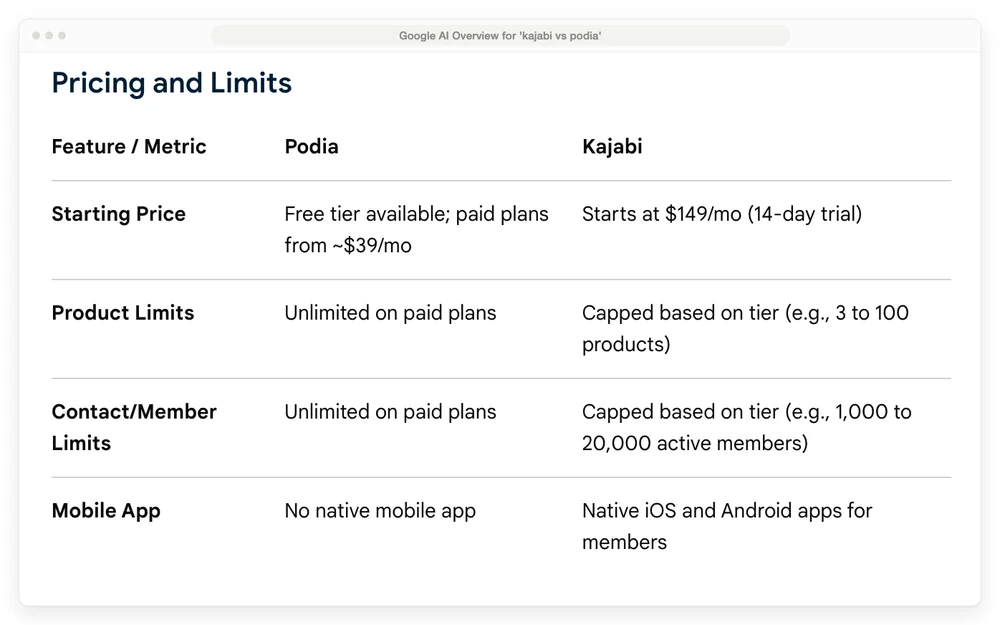
Google’s AI Overview for this search. Read the Starting Price row, then compare it to what both companies charge.
Here is each claim against the live pricing pages.
Podia has no free plan and no $39 tier, Kajabi has no $149 plan, and the product and contact caps are wrong for both. Only the mobile app row survives.
| Claim | Google’s AI Overview | Live pricing pages |
|---|---|---|
| Podia entry price | Paid plans from around $39/mo | $49/mo, or $42/mo billed yearly |
| Podia free plan | Free tier available | No free plan. A 30-day trial |
| Podia product limit | Unlimited on paid plans | 50 on Mover, 150 on Shaker, unlimited on Earthquaker |
| Kajabi entry price | Starts at $149/mo | $89/mo on the undrawn Starter tier, $179 on Basic |
| Kajabi product limit | 3 to 100 products | 1, 5, 50, then unlimited |
| Kajabi contact limit | 1,000 to 20,000 active members | 250, 2,500, 25,000, then 100,000 |
Those numbers trace straight back to a single source. Every figure in that table matches the page ranked 1st for this search, which Google also lists among its sources. That page carries 2 different price lists for the same plans.
Its summary says Podia “offers a free plan” with a “Mover plan is $33/mo”. Its detailed table, a few hundred words later, says Podia has a $0 free plan and a Mover plan at $39. The Kajabi rows disagree with themselves the same way, $55 in one place and $69 in the other.
The AI Overview picked the second set. Its “3 to 100 products” and “1,000 to 20,000 active members” are that page’s Basic and Pro rows, copied across.
2 results below the AI Overview, Podia’s own comparison page states the correct figures in the search snippet itself: Podia plans start at $49 a month, Kajabi plans start at $179. Google had the right answer on the same screen and used the wrong one.
The stale $39 and $149 pair shows up in 2 more page-1 results. One is a personal blog post from 2022, kept online deliberately as a historical record, whose author has since left Podia. It says Podia costs “39$/month” and refers to “my 149$ Kajabi bill”. The other, a 5,700-word review, calls Podia a 2-tier product at $39 and $79, never mentions the Earthquaker plan, and says Kajabi’s “lowest tier is their Basic Plan which costs $149/month”.
A 4th page quotes retired figures for a different reason. It tells you affiliate tools need “the Growth plan (starting at $139/month)” on Kajabi against “the Shaker plan on (at just $79/month)” for Podia. The feature point is right on both sides. The prices attached to it are out of date: Growth is $249 today and Shaker is $99.
That makes 4 of the 7 guides on page 1 wrong on price and 2 correct. The 7th quotes no price at all, though its own title promises pricing.
None of this is anyone behaving badly. Prices move and posts do not. The top of this particular search is years behind on the only number most readers came for.
The sales figure where Podia’s 5% overtakes the price gap
Podia’s 5% Mover fee overtakes the price gap at $800 a month in sales on monthly billing, and at $580 a month on yearly billing. Below that, Mover is the cheapest way onto either platform. Above it, Kajabi’s hidden $89 Starter plan costs less.
The arithmetic is simple enough to do on your phone. Mover is $49 plus 5% of whatever you sell. Kajabi Starter is $89 flat if you take payments through Kajabi Payments. They meet where 5% of your sales equals the $40 gap, which is $800 a month.
Pay yearly and the gap shrinks to $29, so they meet at $580 a month.
There is a second crossover inside Podia itself, and it catches more people. Mover at $49 plus 5% costs the same as Shaker at $99 once you are selling $1,000 a month. On yearly billing that lands at $840 a month. Past those points you are paying Podia for the privilege of being on its cheaper plan.
What that means in practice: Mover is a genuinely cheap place to start and a bad place to stay. If you are already selling more than about $1,000 a month, price the Shaker plan before you price the Mover plan, because the fee has already eaten the difference.
A commenter in an r/SaaS thread on which platform to start with put the wider version of this well: most of these platforms “are fine once you’re earning consistently but they’ll charge you $69-$400/month whether you have 0 students or 1,000.” They disclosed working on a competing tool, so weigh it with that in mind. The observation holds for both platforms here. Neither charges less because you sold nothing this month.
Kajabi caps your products, Podia caps who you can email
Kajabi runs out of product slots first, and Podia runs out of email subscribers first. Both platforms make you upgrade to get past the limit, and which wall you meet depends on whether you sell many small things or email a large list.
Podia gives you 50 products on its cheapest plan and 100 free email contacts. Kajabi gives you 1 product on its cheapest plan and 250 contacts, or 5 products and 2,500 contacts on Basic.
| What gets capped | Kajabi | Podia |
|---|---|---|
| Products, cheapest plan | 1 on Starter, 5 on Basic | 50 on Mover |
| Email contacts, cheapest plan | 250 on Starter, 2,500 on Basic | 100 on Mover |
| Buying past the cap | No. You move up a whole tier | Contacts only. Products need a tier |
| Cost of more contacts | Starter to Basic is $72 a month more | 500 contacts is $8 a month more, yearly |
| Communities | 1 until Pro, which gives 3 | 25 spaces on Mover, unlimited on Earthquaker |
| Video | Not capped by count | 500 on Mover, 1,000 on Shaker |
That 3rd row is where the 2 platforms differ most. Podia sells extra email contacts as an add-on, so going from 100 to 500 costs $8 a month on yearly billing and you stay on Mover. Kajabi has no equivalent. Run past 250 contacts on Starter and the only move is Basic, which is $72 a month more.
So Podia’s cap is a bill that rises in small steps. Kajabi’s is a step change. If you are building an email list faster than you are building products, that difference is worth more than the sticker price.
Podia’s ladder keeps climbing after that. 1,000 contacts is $14 a month extra, 2,500 is $22, 5,000 is $36 and 10,000 is $56, all on yearly billing and all on top of your plan.
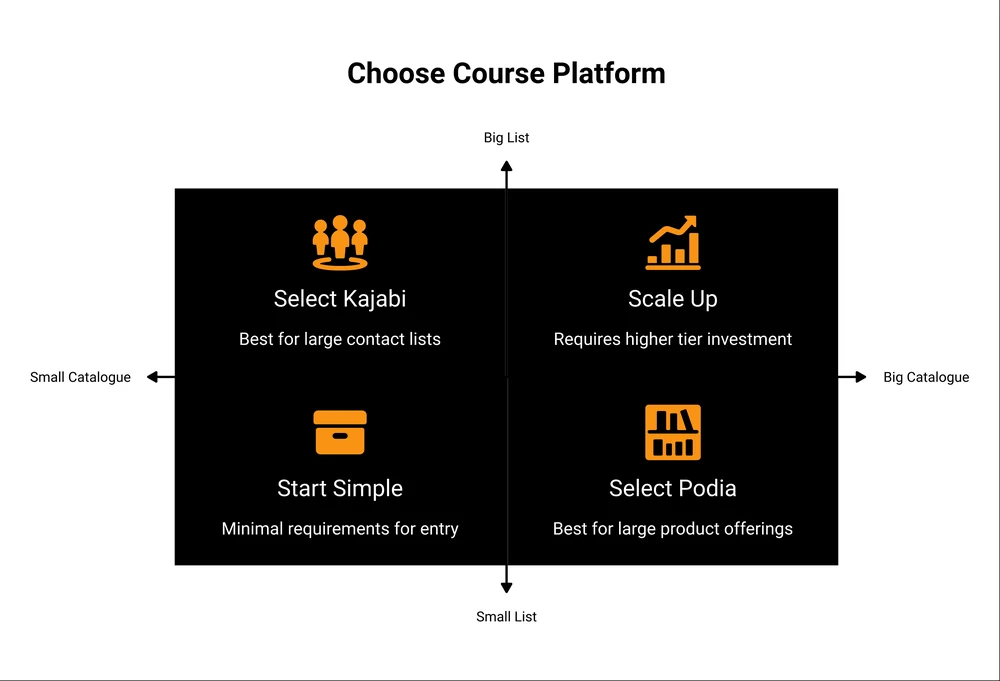
Which platform runs out of room first depends on your catalogue and your list, not on the headline price.
The near-tie: $143 a month against $150 a month
Kajabi Basic at $143 a month and Podia Earthquaker at $150 a month cost within $7 of each other, and buy completely different businesses. Basic gives you 5 products and 2,500 contacts. Earthquaker gives you unlimited products, unlimited community spaces and unlimited video, with 1,000 contacts.
Both figures are the yearly-billing price. Over 12 months that is $1,716 for Kajabi Basic and $1,800 for Podia Earthquaker, a difference of $84 a year.
Matching Earthquaker’s unlimited products on Kajabi means Pro, at $399 a month or $4,788 a year. That is $2,988 a year more than Podia charges for the same outcome.
Going the other way, matching Kajabi Basic’s 2,500 contacts on Podia Earthquaker costs $22 a month extra, taking it to $172 a month or $2,064 a year. You would be paying $348 a year more than Kajabi Basic, and getting unlimited products instead of 5.
That is the clearest way to see what each company charges for. Kajabi prices your audience. Podia prices your catalogue.
What each one genuinely does better
Kajabi wins on marketing depth and Podia wins on room to grow at the bottom. Both statements survive a look at the actual feature lists, which is more than can be said for either company’s comparison page.
Kajabi is stronger on funnels, automation and email. It has a visual funnel builder, behaviour-based automation tied to purchases and course progress, checkout upsells and order bumps, and contact allowances that run to 100,000. Podia has none of the funnel machinery, offers upsells only on Shaker and above, and has no order bumps at all.
Kajabi is stronger on the buyer’s experience. Its feature table lists cohort courses, video transcriptions and translations, and a Kajabi customer app, with a branded mobile app on the Pro plan. Podia’s help centre answers the same question plainly: it does not currently offer a mobile app. If you are selling a structured programme rather than a single file, that gap is real.
Podia is stronger on breadth per dollar. Every Podia plan includes courses, community, coaching, events, a website, a blog, landing pages and email. Community and coaching both sit on the $49 Mover plan, with no upgrade needed. Kajabi’s cheapest plan carries 1 product, which rules out most catalogues before you compare anything else.
Podia is stronger on getting off the ground. A 30-day trial against Kajabi’s 14, free migration of up to 50 products on Mover and 150 on the higher plans, and a flat price that does not punish you for connecting your own Stripe.
Podia is weaker on payments than the price suggests. PayPal is not available on the Mover plan. Neither are upsells, affiliate marketing or Zapier. If you were choosing Mover because it looked complete at $49, it is worth reading that list twice.
For the wider view of how both sit against the rest of the category, I compared the same fee structures across 7 course platforms in what an LMS really takes from each sale, and there are head-to-heads for Kajabi against Teachable and Teachable against Podia.
What Kajabi and Podia say about each other
Both companies rank on page 1 for this search with their own comparison page, and both pages leave something out. Kajabi’s page makes 3 claims about Podia that Podia’s own pricing page contradicts. Podia’s page is accurate on price and quietly starts the Kajabi comparison a tier too high.
Kajabi’s page says Podia has “no native coaching product”. Podia’s pricing page lists Coaching under the features every plan includes.
Kajabi’s page says Podia’s community is “available as a paid add-on, not part of the core product”. Podia’s pricing page lists Community under the same everyone-gets-this heading, with 25 spaces on the cheapest plan.
Kajabi’s page says Podia offers “basic checkout only, no upsells or order bumps”. Half of that is right. Podia has no order bumps. It does list Upsells on both the Shaker and Earthquaker plans.
Kajabi’s page also puts the word Pricing in its own title and contains no prices anywhere on it.
Podia’s page is the more careful of the 2. Every price on it matches what Kajabi and Podia charge today, and it runs a worked example at $500 a month in sales that checks out to the cent. Its omission is the important one: it says “Podia plans start at $49/month, while Kajabi plans start at $179/month”, which turns a 1.8x price gap into a 3.7x one by leaving out the $89 plan.
To be fair to Podia, that plan is hidden on Kajabi’s own site, so the omission is Kajabi’s doing more than Podia’s.
So which one should you pick
Pick Podia if you sell several products, or you are under about $800 a month in sales, or you want community and coaching without paying up for them. Pick Kajabi if you sell a single flagship offer to a large list, or you need funnels and behaviour-based automation, or your monthly email list is bigger than your catalogue.
The clean way to decide is to answer 2 questions before you look at a single price.
How many things will you sell in the next 12 months? Not eventually. In the next 12 months. If the honest answer is 1, Kajabi Starter at $89 is on the table and almost nobody will tell you it exists. If it is 5 or more, Kajabi’s cheapest plan is gone and you are comparing Podia Mover at $49 against Kajabi Basic at $179.
How many people will you be emailing? If your list is heading past a few hundred, Podia’s contact ladder starts adding up and Kajabi’s larger allowances start looking cheap. If your list is small and your catalogue is big, Podia wins on cost and it is not close.
I run my own business just in time now, and it took me a long while to get there. Preparing for a long list of negative what-ifs is mostly playing mental chess with problems that are not real yet. Platform choice is where that habit shows up as money. The upgrade you might need in 18 months is a poor reason to pay for it in month 1, on either platform, since both let you move up the day you actually need to.
If neither fits, the Kajabi alternatives and Podia alternatives roundups price the rest of the field the same way.
FAQ
How much does Podia cost per month?
Podia costs $49, $99 or $179 a month for its Mover, Shaker and Earthquaker plans. Paying for a full year drops those to $42, $84 and $150 a month, billed as $504, $1,008 and $1,800. Only Mover charges a Podia transaction fee, at 5% of each sale. Card processing from Stripe or PayPal is charged separately on every plan.
Does Podia still have a free plan?
No. Podia has a 30-day free trial and no free tier. Its pricing page offers the trial with no credit card required, then moves you onto a paid plan. Several guides ranking for this comparison still describe a free Podia plan, and so does Google’s AI Overview for this search, but it is not on Podia’s pricing page.
What are the downsides of Kajabi?
Price and product caps. The cheapest plan Kajabi advertises is $179 a month for 5 products, and the $89 plan it does not advertise allows only 1. Connecting your own Stripe instead of using Kajabi Payments adds 0.5% to 5% on top, depending on tier. Affiliate programmes and removing Kajabi branding need the $249 Growth plan.
Is there anything better than Kajabi?
Better depends on which part of Kajabi you actually use. For course delivery plus community at a lower price, Podia, Teachable and Thinkific all undercut it. For funnels and paid traffic, ClickFunnels covers similar ground. For a seller who needs a checkout and not the course hosting, a dedicated checkout tool such as CartMango costs a fraction of any of them.
What is better than Podia?
Podia gets beaten on different axes by different tools. Kajabi and ClickFunnels both run sales funnels and behaviour-based automation, which Podia does not offer at all. Thinkific and Teachable are built around course delivery first, so the teaching side goes deeper.
Skool and Circle sell community as the main product rather than as a side feature. Where Podia is hard to beat is breadth per dollar, which is why it holds up for a seller with a wide catalogue and a small list.
Can I move from Kajabi to Podia?
Yes, and Podia does the work. Its migration team moves up to 50 products on the Mover plan and up to 150 on Shaker and Earthquaker, including course content, digital downloads and customer email addresses. The service is not available during the 30-day trial. Kajabi offers no equivalent free migration.
Which is cheaper, Kajabi or Podia?
Podia, until you are selling around $800 a month. Podia Mover at $49 beats Kajabi’s undrawn $89 Starter plan below that figure, and beats the $179 Basic plan until roughly $2,600 a month. Above those points Podia’s 5% fee overtakes the difference. On yearly billing the first crossover falls to $580 a month.
If the course player stays empty
Kajabi and Podia both sell the same bundle: courses, community, email, a website and a checkout, charged as a single subscription. That is the right purchase when you genuinely use most of it, and both companies are good at what they do.
It is a poor purchase when what you needed was a checkout. Plenty of sellers pay $49 or $179 a month to take payments for a handful of digital files, with the course player empty and the community quiet.
CartMango is the checkout on its own. CartMango is free until October 2026, then starts at $10 a year rather than a month, with order bumps on every plan and no cut of your sales. Course hosting and community are not live yet and arrive on the $30 a year plan in October 2026, so if you need either of those today, one of the platforms above is the honest answer. I built CartMango, so treat that as the disclosure it is.
About the Author

👋 I’m Welly, founder of CartMango (the site you’re on), a checkout platform for digital product sellers. We’ve previously processed $179M+. I also run BirdSend (email marketing tool, 3.1B+ emails sent). On the side I show other non-techie digital sellers how I use AI workflows to automate 50%+ of my operations. Find me on LinkedIn.
Related Reading
- Kajabi pricing: all 4 tiers, the surcharge schedule, and what a real sale costs
- Podia pricing: the 3 plans, the 5% on Mover, and the email ladder behind a dropdown
- Kajabi vs Thinkific: the same comparison against a cheaper course platform
- Teachable vs Podia: where Podia sits against the other big name in courses
- LMS for online courses: real fees for 7 platforms, the wider field behind Kajabi vs Podia