
ClickFunnels starts at $97 a month and suits sellers pushing paid traffic into funnels. Kajabi starts at $179 a month and suits people selling courses and coaching. Both put a ceiling on something: ClickFunnels caps courses and contacts on every plan, Kajabi caps products and adds a percentage when you take payments through your own processor.
I went to compare ClickFunnels vs Kajabi the normal way, by reading what already ranks. That turned into a different job. 4 of the 7 guides on page 1 quote a Kajabi price card Kajabi has stopped showing, and 1 of them is ClickFunnels’ own blog.
So every price below comes from each vendor’s live pricing page instead, read at source. You get the current tier list for both, the limits sitting inside each plan, and the payment fee that only 1 page on the whole first page even admits exists. If you are choosing between these 2 right now, the numbers you have probably already read are the wrong ones.
Key Takeaways
- ClickFunnels runs 4 plans costing $970 to $5,997 a year, and every plan caps courses at 3, 6, 10 or 20.
- Kajabi runs 3 visible plans costing $1,716 to $4,788 a year, capping products at 5, 50 or unlimited.
- Kajabi takes 0% only through Kajabi Payments. Use your own processor and it adds 2%, 1% or 0.5% by plan.
- ClickFunnels charges no cut of your sales on any plan, in its own words on its pricing FAQ.
- 4 of the 7 guides ranking for this comparison quote a Kajabi price card that no longer exists.
ClickFunnels vs Kajabi at a glance
ClickFunnels asks $97 a month and gives you 10,000 contacts with 3 courses, while Kajabi asks $179 a month and gives you 2,500 contacts with 5 products, and only Kajabi takes a further cut when you use an outside payment processor.
| Comparison | ClickFunnels | Kajabi |
|---|---|---|
| Entry plan, monthly | $97 | $179 |
| Entry plan, yearly | $970 | $1,716 |
| Top plan, yearly | $5,997 | $4,788 |
| Contacts on entry plan | 10,000 | 2,500 |
| Courses or products on entry plan | 3 courses | 5 products |
| Cut of your sales | 0% on every plan | 0% via Kajabi Payments, 2% to 0.5% via your own processor |
| Websites on entry plan | 5 custom domains | 1 website |
| Suits | paid traffic and funnels | courses, coaching and community |
Read that fee row twice. Every other number here is a subscription you can see coming, and that one scales with how much you sell.
The 2 yearly rows are worth reading together, because they point in opposite directions. At the entry level Kajabi costs $746 more a year. At the top of each range Kajabi costs $1,209 less. The platform that looks expensive when you start is the cheaper one by the time you are running a full catalog.
Every yearly figure above is the price for paying a year up front, which is how both platforms sell their cheapest rate. ClickFunnels Dominate has no monthly option at all.
Before you go further, if you are still working out where the money leaks in a digital business, the free 5-day Online Selling Mistakes Challenge walks through the 5 most common ones. No platform pitch, just the leaks.
Why most guides for this comparison quote prices that changed
4 of the 7 non-forum results on page 1 describe a Kajabi price card Kajabi no longer publishes, 5 never mention that ClickFunnels has a 4th plan, and not 1 states the percentage Kajabi charges when you bring an outside processor. I checked each page against both vendors’ own pricing pages.
| The claim | Pages making it | The vendor’s own page |
|---|---|---|
| Kajabi costs $69, $149, $199, $399 a month | 3 of 7 | no plan below $179 a month is shown |
| Kajabi costs $119, $159, $319 a month | 1 of 7 | $179, $249 and $499 a month |
| ClickFunnels sells Startup and Pro plans | 3 of 7 | plans are Launch, Scale, Optimize and Dominate |
| ClickFunnels has only 2 or 3 plans | 5 of 7 | 4 plans, the top one at $5,997 a year |
| Kajabi’s rate on an outside processor | 0 of 7 give a number | 2% on Basic, 1% on Growth, 0.5% on Pro |
The page ranked 1st for this search was published in December 2023 and last updated in October 2024. It lists Kajabi at $69, $149, $199 and $399 a month. Kajabi’s cheapest visible plan is now $179.
There is a reason so many pages agree with each other and still get it wrong. Kajabi raised prices in January 2026, its first change in 10 years, taking Basic up $30 a month, Growth up $50 and Pro up $100. Guides written before that change read perfectly well and are simply describing a price card that no longer exists.
Watch what happened to 2 of those numbers, because this one has teeth. Kajabi’s Growth plan now costs $249 a month and its Pro plan $499, while the $199 and $399 that guide quotes are Kajabi’s current annual rates.
So a reader who cross-checks against Kajabi’s pricing page sees $199 and $399 sitting right there and concludes the guide is fine. The monthly prices are $50 and $100 higher.
The stamps on these pages do not help either. The result at position 5 carries “2025 Updated” in its title and a byline reading “Last updated on August 6th, 2024”. That one is published by ClickFunnels.
Google’s own summary inherits the problem. Its AI Overview for this search cites a rival vendor’s blog for both pricing claims rather than either platform’s pricing page.
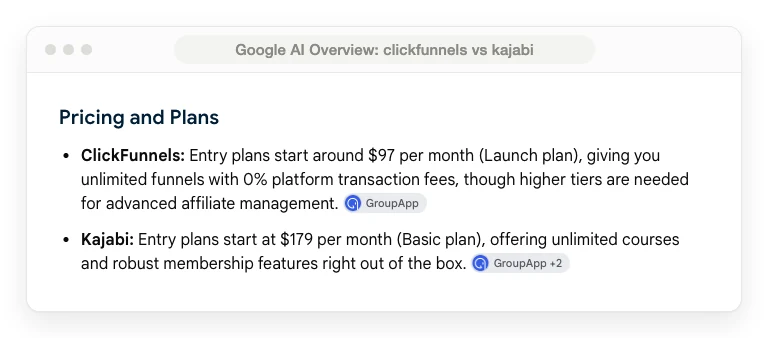
Google’s AI Overview for this search. Both the “$179 per month” and the “unlimited courses” wording come from here, and the small source chip under each bullet names the blog it took them from.
ClickFunnels pricing, plan by plan
ClickFunnels runs 4 plans. Paying month by month they cost $97, $197 and $297, and Dominate is not sold that way at all. Paying a year up front they cost $970, $1,970, $2,970 and $5,997.
| Plan | Cost a month | Cost a year | Contacts | Emails per month | Courses |
|---|---|---|---|---|---|
| Launch | $97 | $970 | 10,000 | 50,000 | 3 |
| Scale | $197 | $1,970 | 75,000 | 300,000 | 6 |
| Optimize | $297 | $2,970 | 150,000 | 750,000 | 10 |
| Dominate | not sold monthly | $5,997 | 400,000 | 1,200,000 | 20 |
Those yearly figures come from ClickFunnels’ own saving lines of $194, $394 and $594, subtracted from 12 months at the monthly rate. Do not reach them by multiplying the per-month price the card advertises for annual billing: that $81 is $80.83 rounded up, so 12 of them overshoots the real total by $2.
2 things on that table catch people out.
The first is courses. A lot of older guides say ClickFunnels gives you unlimited everything, and course count is capped on every plan.
The entry plan stops at 3 courses. Selling a 4th means moving to Scale at $197 a month.
The second is contacts. 10,000 on Launch is generous next to Kajabi’s 2,500, and it is still a ceiling. Run cold traffic into a lead magnet and you will find it.
Every plan card also reads “Unlimited Funnels Limited Time”. Unlimited funnels is a promotion, by ClickFunnels’ own wording, not a permanent term of the plan.
On fees, ClickFunnels is direct. Its pricing FAQ asks “Does ClickFunnels take a percentage of my sales?” and answers “No. You’ll keep every penny you make.”
You still pay your payment processor. Stripe charges 2.9% plus $0.30 on a standard US card, and PayPal publishes its own rates, but nothing goes to ClickFunnels on top.
Kajabi pricing, plan by plan
Kajabi shows 3 plans. Paying month by month they cost $179, $249 and $499. Paying a year up front they cost $1,716, $2,388 and $4,788, which Kajabi’s own saving lines of $432, $600 and $1,200 confirm.
| Plan | Cost a month | Cost a year | Products | Contacts | Admin users |
|---|---|---|---|---|---|
| Basic | $179 | $1,716 | 5 | 2,500 | 2 |
| Growth | $249 | $2,388 | 50 | 25,000 | 11 |
| Pro | $499 | $4,788 | Unlimited | 100,000 | 26 |
Kajabi’s comparison chart has no separate row counting courses. It counts products, and Basic allows 5 of them.
Communities get their own row at 1 on Basic, 1 on Growth and 3 on Pro. Websites run 1, 1 and 3.
That matters against the way Kajabi gets described elsewhere. Google’s AI Overview says Kajabi’s entry plan offers “unlimited courses”. Kajabi’s own chart puts the number at 5.
There is a 4th plan the pricing page does not draw. Kajabi’s own page code still defines a Starter tier at $89 a month, capped at 1 product and 250 contacts and carrying the highest outside-processor fee of the lot at 5%. Its column sits in the comparison chart with a hide instruction wrapped around it, so your browser loads the plan and then declines to show it.
$179 is what the pricing page will sell you. Our full breakdown of Kajabi pricing covers where the hidden tier sits and what you give up on it.
The fee Kajabi does not put in its headline
Kajabi charges 0% on your sales only when you take payments through Kajabi Payments. Route payments through your own processor and Kajabi adds 2% on Basic, 1% on Growth and 0.5% on Pro, on top of what your processor already takes.
That sits on Kajabi’s pricing page under a heading reading “3rd Party Payment Provider Fees (not using Kajabi Payments)”, a few inches below a line that says “No hidden fees. No revenue sharing.” Both statements are on the same page.
On $5,000 a month in sales through Kajabi Basic, Kajabi Payments costs you about $145 and your own Stripe costs about $245, because Kajabi’s 2% adds $100 on top of the same card rate.
| Where payments run | Kajabi’s cut | Card processing | Total on $5,000 |
|---|---|---|---|
| Kajabi Payments | $0 | 2.9% plus $0.30 per sale | about $145 plus 30c a sale |
| Your own Stripe | 2%, so $100 | 2.9% plus $0.30 per sale | about $245 plus 30c a sale |
$100 a month is $1,200 a year, which is most of another Kajabi subscription. And it is charged for the privilege of using the payment processor you already have.
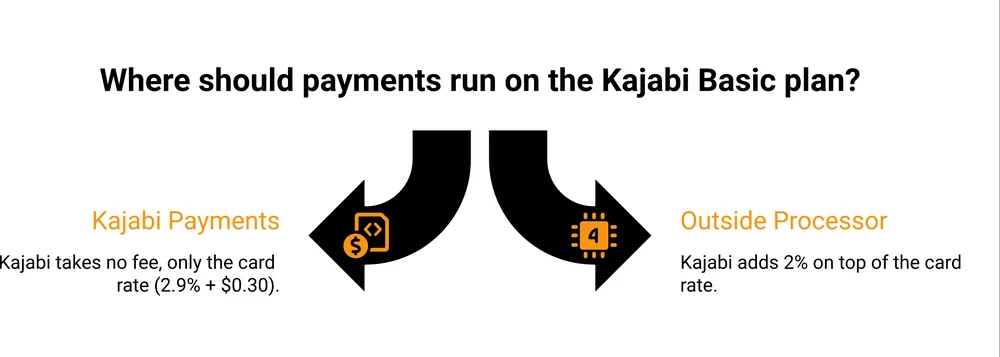
The same card rate applies either way. The 2% is what changes.
Not 1 of the 7 guides ranking for this comparison gives you those percentages. 1 page acknowledges the fee exists without stating a rate, writing that “there’s an additional fee if you use a third-party payment processor”. Another gives a 0.7% figure that describes a different charge and does not match Kajabi’s published rates, so I have left it out rather than repeat a number I could not match to source.
Why would anyone use their own processor and pay this? Existing Stripe history, a country Kajabi Payments does not serve, or an accounting setup already wired to a specific account. Those are ordinary reasons, and they cost 2% here.
Sales funnels and conversion: where ClickFunnels leads
ClickFunnels was built as a funnel tool and it still wins on funnel depth. Split testing, one-click post-purchase upsells, order bumps, countdown funnels and a page editor tuned for conversion all come standard, on the $97 plan.
Kajabi has funnels too, built from templates, and they are fine for warm traffic. Someone running cold paid traffic and testing 6 variants of a page will feel the difference quickly.
If funnels are new to you, the mechanics are worth learning before you pay for either tool. Our guides on order bumps and upsell pages cover what these actually do to average order value.
Courses, community and membership: where Kajabi leads
Kajabi builds its whole platform around course delivery. Quizzes, assessments, drip scheduling, a polished student player and a customer app come as standard, and community spaces are built in rather than bolted on.
ClickFunnels ships courses and a community app on every plan, and the 3-course cap on the entry plan tells you where it sits in their priorities. It is a funnel tool that also hosts courses.
For a wider read on what course delivery costs across the market, we priced 7 platforms for online courses and 8 membership platforms at 100 members.
Why are people leaving ClickFunnels?
Cost is the complaint that surfaces publicly, and Google ranks a forum thread about it on page 1 of this very search. It is titled “Been a ClickFunnels user for some time, but now it’s costing me more than I had planned for”, and the replies are people pricing up a page builder and a checkout separately.
The reason you can check for yourself is the caps. ClickFunnels prices every plan against contacts, emails and courses, and the entry plan stops at 10,000 contacts, 50,000 emails a month and 3 courses. Anyone who signed up expecting unlimited anything now sits inside real ceilings, and clearing a cap costs $100 a month.
The rest is my own read, not a finding. A business built on community and membership instead of cold traffic never needed a funnel-first tool, so some of the churn is people discovering they bought the wrong category.
Is there anything better than ClickFunnels or Kajabi?
Yes for some jobs, no for others, and the warning that matters first is about who is answering. 4 of the 7 guides ranking for this comparison are published by companies selling a rival platform, including ClickFunnels itself. Every one of them concludes in a direction that suits its own product.
Here is the same disclosure applied to me. I run CartMango, a checkout platform, so treat what follows as a scoped comparison rather than a recommendation.
If you need what these 2 actually sell, a full platform with course hosting, email, community and funnels in 1 subscription, then Kajabi and ClickFunnels are genuinely the products for that, and so is a shorter list of rivals. We have priced the field in Kajabi alternatives and ClickFunnels alternatives, and there are head-to-heads on Kajabi vs Teachable and Kajabi vs Thinkific if a course platform is what you are really shopping for.
There is 1 group this comparison catches by accident. Some people land on this search paying $97 or $179 a month while using the checkout, an order bump and not much else, because the platform came bundled. That is a different problem from choosing between these 2.
A commenter in the r/kajabi thread on Kajabi’s price increases put the arithmetic plainly: “I migrated a client from Kajabi and drop her bill from $250/mo to ~$40/mo. I can’t jusfity Kajabi’s prices.” They named the replacement as a checkout tool plus Stripe. Another commenter in the same thread made the case for staying, writing that avoiding “having to duct-tape a bunch of separate tools together is why I went with Kajabi about 2 years ago”, before adding “damn it sure is expensive”.
Both are right, for different businesses. If courses and community are your business, an all-in-one earns its price. If you are paying all-in-one money to take payments, you are buying a lot of software you do not open.
CartMango sits in that second case only, handling checkout, order bumps, protected delivery and hosted sales pages at $10 a year, with upsells and downsells on the $20 a year plan.
CartMango does not host courses, run a community or manage affiliates today. Affiliate management arrives in September 2026, and course hosting and community in October 2026, both on the $30 a year plan.
So on the thing this comparison is actually about, running a full course and community business in 1 place, Kajabi and ClickFunnels win today and it is not close.
How to choose between ClickFunnels and Kajabi
A funnel-led seller with 1 or 2 offers clears every cap on ClickFunnels Launch at $97, while a course seller with a small catalog needs Kajabi Basic at $179, and running your own Stripe on that Kajabi plan adds $100 a month at $5,000 in sales.
| Your situation | The plan to price | Cost a year |
|---|---|---|
| Cold paid traffic, 1 or 2 offers | ClickFunnels Launch | $970 |
| More than 3 courses, funnel-led | ClickFunnels Scale | $1,970 |
| Courses and community, small catalog | Kajabi Basic | $1,716 |
| More than 5 products or a team | Kajabi Growth | $2,388 |
| Using your own Stripe on Kajabi | add 2% of sales on Basic | $1,200 at $5,000 a month in sales |
3 checks before you pay either one.
Count your courses and your contacts against the entry plan’s actual limits. Both platforms cap both, and the caps are where the upgrade pressure comes from.
Decide where payments will run. On Kajabi that choice has a price, and 2% of everything is a bigger number than the gap between 2 subscription tiers.
Price the annual plan properly. Multiply the vendor’s published annual total, not the rounded monthly figure on the card, or you will be out by a few dollars a year in your own spreadsheet.
FAQ
How much does ClickFunnels cost per month?
Paying month by month, ClickFunnels costs $97 on Launch, $197 on Scale and $297 on Optimize. Paying a year up front, the same 3 plans cost $970, $1,970 and $2,970 for the year. A 4th plan, Dominate, is sold only by the year at $5,997.
Why is Kajabi so expensive?
Kajabi’s cheapest visible plan is $179 a month because it bundles course hosting, email marketing, a website builder, community and funnels into 1 subscription. It also removed its cheaper entry plan, so there is no longer a sub-$179 option on the pricing page. On top of the subscription, using your own payment processor adds 2% of sales on Basic.
Does ClickFunnels take a percentage of my sales?
No. ClickFunnels’ own pricing FAQ answers this directly: “No. You’ll keep every penny you make.” You still pay your payment processor’s normal rate, currently 2.9% plus $0.30 for a standard US card on Stripe, but ClickFunnels adds nothing on top of it.
Does Kajabi charge a transaction fee?
Kajabi charges nothing extra when payments run through Kajabi Payments, which itself costs 2.9% plus $0.30 per sale on Basic. Using an outside processor instead adds a Kajabi fee of 2% on Basic, 1% on Growth or 0.5% on Pro, charged on top of whatever that processor takes.
Can I use ClickFunnels and Kajabi together?
You can, and most people should not. Running both means paying $276 a month at entry level for 2 tools that each cover most of what the other does. The setup makes sense only when you want Kajabi course delivery alongside the ClickFunnels funnel builder, and you have the revenue to justify $3,312 a year before you sell anything.
Which is cheaper overall, ClickFunnels or Kajabi?
ClickFunnels is cheaper on subscription at every comparable tier, starting $82 a month below Kajabi. The gap widens if you use your own payment processor, since Kajabi adds a percentage there and ClickFunnels does not. Kajabi closes some of it back if you would otherwise buy course-hosting software separately.
The part you can stop paying for
ClickFunnels vs Kajabi is worth working out carefully, because both answers are a real monthly commitment and most guides ranking for it quote numbers from a pricing page that has since changed. Count the caps, decide where payments run, and price the plan that clears your ceiling.
And if you recognised yourself in the group paying all-in-one money mainly to take payments, the checkout half of ClickFunnels vs Kajabi is separable. CartMango does checkout, order bumps and protected delivery from $10 a year, free until October 2026.
About the Author

👋 I’m Welly, founder of CartMango (the site you’re on), a checkout platform for digital product sellers. We’ve previously processed $179M+. I also run BirdSend (email marketing tool, 3.1B+ emails sent). On the side I show other non-techie digital sellers how I use AI workflows to automate 50%+ of my operations. Find me on LinkedIn.
Related Reading
- Kajabi Pricing: every tier plus the surcharge schedule, in one place
- ClickFunnels Alternatives: 8 options priced at the same 10,000 contacts
- Kajabi vs Thinkific: for readers shopping course platforms rather than funnels
- LMS for Online Courses: what 7 course platforms really take per sale