

Teachable is the cheaper way in at $39 a month against Kajabi’s $179, but its entry plan takes 7.5% of every sale. Kajabi bundles email, funnels and a community into the price, then charges 0.5% to 2% per sale if you connect your own Stripe. The right pick turns on which fee layer you can avoid.
I went looking for a straight answer on Kajabi vs Teachable and kept finding the same sentence, repeated across page 1 of Google and inside Google’s own AI Overview: Kajabi charges no transaction fees.
Kajabi’s pricing page charges a fee on every sale. It is printed on the same page as the words “No hidden fees. No revenue sharing.” Only 1 of the 7 pages ranking for this comparison mentions it.
That matters because the fee is the part that scales with you. A plan price is a number you can see coming. A percentage scales with every sale you make, so it costs you most when things go well.
Below you get both platforms’ live prices, the fee schedules each one folds away behind a dropdown, what a real $100 sale nets on each, and the 2 revenue points where the cheaper option flips.
Key Takeaways
- Teachable starts at $39 a month plus a 7.5% cut of sales. Kajabi starts at $179 a month with no cut on Kajabi Payments.
- Kajabi charges 2% on Basic, 1% on Growth and 0.5% on Pro when you use your own Stripe instead of Kajabi Payments.
- Past roughly $667 a month in sales, Teachable’s $89 Builder plan costs less than the $39 Starter plan with its 7.5% fee.
- Past roughly $1,867 a month, Kajabi Basic costs less than Teachable Starter, before you count what each one includes.
- Both platforms repriced recently: Teachable in June 2025, Kajabi on 13 January 2026. Teachable tightened what counts as a product, Kajabi raised prices and loosened product limits.
Kajabi vs Teachable pricing in 2026
Teachable’s cheapest plan is $39 a month and Kajabi’s cheapest advertised plan is $179 a month, so Kajabi asks for 4.6 times more before you sell anything. Both discount an annual commitment, and both put a ceiling on how many products you can publish, except on Kajabi’s top tier.
Before you commit to any platform fee: the free 5-day Online Selling Mistakes Challenge walks through the 5 mistakes that quietly cost solo sellers the most money. Paying for capacity you have not earned yet is one of them.
Teachable Starter costs $39 a month and takes 7.5% of sales, Teachable Builder costs $89 with no cut, and Kajabi Basic costs $179 with no cut on its own processor. Here is the full picture on both.
| Platform | Plan | Monthly | Annual | Products | Cut of sales |
|---|---|---|---|---|---|
| Teachable | Starter | $39 | $29/mo | 5 | 7.5% |
| Teachable | Builder | $89 | $69/mo | 10 | 0% |
| Teachable | Growth | $189 | $139/mo | 50 | 0% |
| Kajabi | Basic | $179 | $143/mo | 5 | 0% |
| Kajabi | Growth | $249 | $199/mo | 50 | 0% |
| Kajabi | Pro | $499 | $399/mo | Unlimited | 0% |
The 0% cells carry a condition, and it is the whole subject of the next section.
Teachable’s annual billing saves $120 a year on Starter, $240 on Builder and $600 on Growth. Kajabi’s saves $432 on Basic, $600 on Growth and $1,200 on Pro. Teachable’s top tier is now called Custom and is quoted by sales rather than listed.
Student limits split the 2 platforms. Teachable caps active students at 100 on Starter, 1,000 on Builder and 5,000 on Growth, then removes those caps once your school passes $10,000 a year in sales through the platform. Kajabi caps marketing contacts instead, at 2,500 on Basic, 25,000 on Growth and 100,000 on Pro, and does not limit enrolments.
Kajabi also keeps a 4th tier off that table. A plan called Kickstarter sits at $89 a month with 1 product and 250 contacts, and the pricing page carries a working signup link for it in the page’s own code without ever drawing the card.
Kajabi’s December 2025 pricing announcement still lists the tiers as “Kickstarter, Basic, Growth & Pro”. Our full Kajabi pricing breakdown has the signup screenshot and the tier’s own 5% payment fee.
Teachable does something similar in reverse. Its Custom plan card opens with the line “EVERYTHING IN ADVANCED, PLUS:” while no Advanced plan appears anywhere on the page.
Does Kajabi charge transaction fees?
Kajabi charges 2% of every sale on Basic, 1% on Growth and 0.5% on Pro when you take payment through a provider other than Kajabi Payments or PayPal.
Kajabi’s own pricing page lists it under the heading “3rd Party Payment Provider Fee”. That sits directly beneath a headline reading “All-in-one platform with transparent pricing. No hidden fees. No revenue sharing.”
Almost nothing that ranks for this comparison tells you that.
Google’s AI Overview for “kajabi vs teachable” puts it plainly, and gets the Kajabi half backwards. Under its own “Pricing and Fees” heading it says Kajabi “costs more per month, but charges zero transaction fees on any plan.”
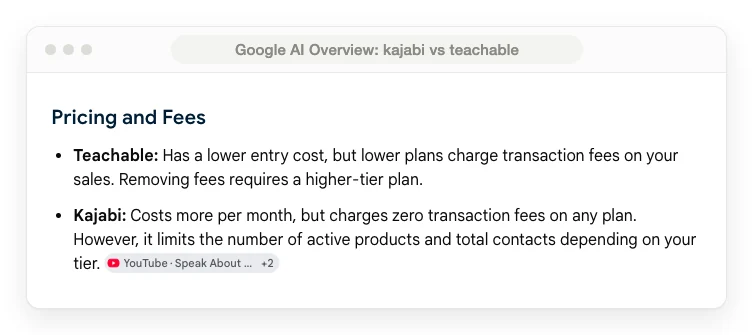
Google’s AI Overview for this comparison. Read the Kajabi line.
Zapier’s guide, the top organic result, says Kajabi’s plans “have zero transaction fees”. Sam Vander Wielen’s review says all 3 Kajabi plans come with “a 0% transaction fee”.
Steph Taylor’s Kajabi review lists Kajabi’s transaction fees as “0%” in its comparison table. FreshLearn’s roundup says Kajabi comes “with 0% transaction fees”.
Kajabi’s own blog comparison says “No transaction fees on any paid plan” and, a line later, that Kajabi “does not charge transaction fees”.
Exactly 1 page on the whole first page of results names the fee. LinoDash reports the 2%, 1% and 0.5% surcharges correctly.
So of the 7 pages ranking for this comparison, 5 tell you Kajabi takes no cut of your sales. Just 1 reports the real numbers. The last never raises the subject at all.
The fee has real edges, and they are worth knowing before you panic:
- It never applies to PayPal, on any plan, in any region.
- It never applies if you use Kajabi Payments.
- It never applies in regions where Kajabi Payments is not offered.
- It never applies to customers who stayed on a legacy plan through the January 2026 change.
Read that list again and you can see why so many guides get it wrong. For a US seller using Kajabi Payments the fee genuinely is zero, and that is the seller most reviewers are. The fee lands on the seller who wants to keep their own Stripe account, which is the seller most likely to be reading a comparison post in the first place.
What a $100 sale pays out on each
A $100 sale nets $89.30 on Teachable Starter, $96.80 on Teachable Builder, $96.80 on Kajabi Basic through Kajabi Payments, and $94.80 on Kajabi Basic through your own Stripe. Every figure below uses a US card and each platform’s published rates.
| Route | Platform cut | Processing | Total fees | You keep |
|---|---|---|---|---|
| Teachable Starter | $7.50 | $3.20 | $10.70 | $89.30 |
| Teachable Builder or Growth | $0 | $3.20 | $3.20 | $96.80 |
| Kajabi Basic, Kajabi Payments | $0 | $3.20 | $3.20 | $96.80 |
| Kajabi Basic, own Stripe | $2.00 | $3.20 | $5.20 | $94.80 |
| Kajabi Growth, own Stripe | $1.00 | $3.20 | $4.20 | $95.80 |
| Kajabi Pro, own Stripe | $0.50 | $3.20 | $3.70 | $96.30 |
Teachable’s US card rate of 2.9% + 30 cents is exactly what Stripe charges directly for a domestic card, so Teachable adds nothing on top of processing once you are past the Starter plan. Kajabi Payments matches it on Basic and beats it slightly higher up, at 2.8% + 30 cents on Growth and 2.7% + 30 cents on Pro.
The line to notice is the second-last one. On Kajabi Basic with your own Stripe you keep $94.80, which is $2 less than the same sale on Teachable Builder, on a plan costing $90 a month more.
Teachable buries its own fee schedule too. The rates sit behind a collapsed dropdown on the pricing page:
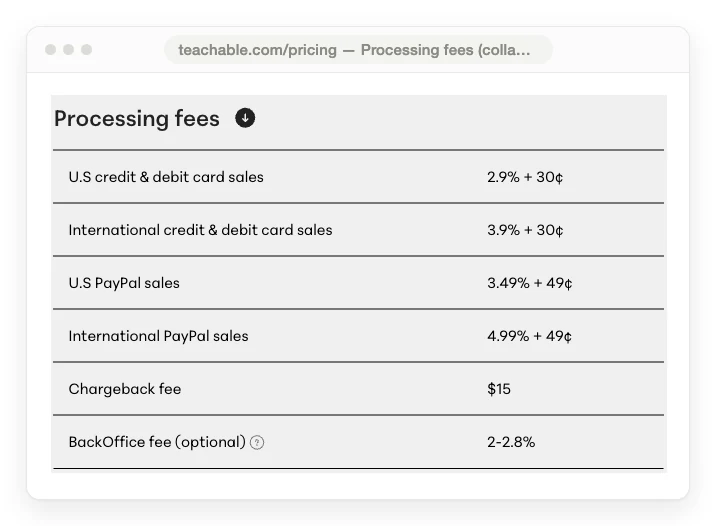
Teachable’s pricing page. The Processing fees row is closed by default.
Teachable’s international card rate of 3.9% + 30 cents is the one to plan around if you sell outside the US. That rate sits under Stripe’s own standard international pricing, which runs 2.9% plus a 1.5% international surcharge, so Teachable is not marking it up. Teachable’s US PayPal rate of 3.49% + 49 cents is PayPal’s own published rate passed straight through.
When does Kajabi cost less than Teachable?
Kajabi Basic costs less than Teachable Starter once you pass roughly $1,867 a month in sales, because Teachable’s 7.5% cut has to grow by $140 to cover the $140 gap in plan price. On annual billing the crossover drops to about $1,520 a month.
There is an earlier crossover that matters more, and it sits inside Teachable.
| Monthly sales | Teachable Starter | Teachable Builder | Kajabi Basic |
|---|---|---|---|
| $500 | $76.50 | $89 | $179 |
| $1,000 | $114 | $89 | $179 |
| $2,000 | $189 | $89 | $179 |
| $5,000 | $414 | $89 | $179 |
| $10,000 | $789 | $89 | $179 |
Card processing is left out of that table because it is the same on all 3 routes when you use each platform’s own processor.
Past about $667 a month, Teachable’s $89 Builder plan costs you less than the $39 Starter plan does. At $5,000 a month the Starter plan costs $414 while Builder costs $89, so the cheap plan is charging you $325 a month for the privilege of looking cheap.
If Teachable Starter is where you are starting, put a note in your calendar at $667 a month. Above that line, Builder is simply the cheaper plan.
What the extra money buys on Kajabi
Kajabi Basic includes email marketing, funnels, landing pages, a website and 1 community for $179 a month, none of which Teachable includes at any tier. That bundle is the entire argument for the price gap.
Teachable does courses, coaching, digital downloads, checkout and a discussion area. For email sequences, segmentation and behavioural triggers you add a separate tool. For funnels and landing pages you add another.
Kajabi’s own comparison puts the replaced stack at $158 to $374 a month. That is Kajabi’s number about Kajabi, so treat it as the high end of the argument rather than a finding. Even at the low end it exceeds the $74 a month that separates Kajabi Basic from Teachable Builder on annual billing.
Kajabi Pro throws in a branded mobile app that Kajabi prices at $199 a month as a standalone, plus API access it prices at $25 a month. Kajabi also now meters AI: 0 credits on Basic, 500 on Growth, 1,000 on Pro, with top-ups at $15 a month for 500 more.
The only sane way to read Kajabi’s price is against what you already spend. Comparing $179 against Teachable’s $39 makes Kajabi look absurd. Comparing $179 against $39 plus your email tool plus your page builder plus your community tool is a different sum, and it is the sum you are actually doing.
Work out what you already pay every month before you decide which number is big.
If you have not built that stack yet, Kajabi is asking you to buy 6 things to use 2. Our guide to what it costs to create an online course has the honest version of that budget.
Where Teachable wins
Teachable handles sales tax and VAT for you through teachable:pay, which removes a real compliance job. Kajabi hands that job back to you on any plan where you are not using Kajabi Payments. For a seller with students in the EU or the UK, that alone can decide it.
3 more places Teachable comes out ahead:
- Payouts arrive daily on teachable:pay. The Monthly Payment Gateway, the other option, pays monthly, so pick deliberately.
- The entry price is real. $39 a month, or $29 billed annually, with 5 products and 100 active students, is a genuine way to test whether anyone wants your course before you spend $179 a month finding out.
- Student caps lift themselves. Once your school passes $10,000 a year in sales on the platform, the active and imported student limits come off, so growth is not punished with a forced upgrade.
Teachable also gives you BackOffice as an option, at 2% to 2.8% per transaction, which handles affiliate and author payouts and the tax forms that come with them. It is a real cost, and it is optional, which is more than can be said for most fee layers.
What are the downsides of Kajabi?
Kajabi’s biggest downside is that its cheapest advertised plan costs $179 a month and caps you at 5 products and 2,500 contacts, which is a lot of money for a first course. 4 more worth weighing:
- The third-party payment fee. 2% on Basic is not small, and it applies to exactly the seller who wants to own their payment relationship.
- Contacts, not students, are the meter. Every lead you collect counts. A free lead magnet that converts at 2% still fills your contact allowance with the 98%.
- The extra contacts price went up. An additional 5,000 contacts moved from $20 to $25 in the January 2026 change.
- The good plan is 2 tiers up. Affiliate management, cohort courses and webhooks start at Growth, which is $249 a month.
For sellers who look at that list and want the checkout without the rest of the building, our Kajabi alternatives breakdown prices 8 options all-in.
Both platforms changed the deal recently
Teachable restructured its plans in June 2025 and Kajabi raised prices on 13 January 2026, so the numbers in most comparison guides predate at least one of those changes. The 2 changes did not move in the same direction, which is worth understanding before you pick.
Teachable’s change raised the fee on the entry plan and cut it everywhere else. The old $39 Basic plan charged 5%. The new $39 Starter plan charges 7.5%, while Builder and Growth dropped to 0%.
Teachable also dropped its free plan and changed what counts as a product, so bundles that used to ride along free now consume the limit. The r/elearning thread discussing the announcement is worth reading before you migrate anything.
A long-time user, posting as 30X40, laid out their own numbers: 7 years on Teachable, a Legacy Pro 2 annual plan at $1,428 a year, moving to $3,708 a year because legacy bundles are now counted as “separate courses”. They stayed, because 30,000 students make moving an operational nightmare rather than an inconvenience.
Another, FranDreschersLaugh, wrote that theirs “went from $179/mo –> $399/mo” with 30 days notice, and decided to leave: “I’m probably going to work with my VA to migrate everything.”
A third summed up the entry tier change: “Wait… from $39 to $69? That’s a pretty big jump. I do like that they got rid of the 5% transaction fee.”
Kajabi’s January change was the first in 10 years and ran 20% to 25% across the tiers. Product limits went the other way: Kajabi’s own announcement describes the new plans as having “more generous product limits”, and Pro moved to unlimited products.
What went up alongside the plan prices was the add-on. An extra 5,000 contacts moved from $20 to $25. Customers who stayed on legacy plans kept their old feature set and, usefully, are not charged the third-party payment fee at all.
Switching costs are what turn a price rise into a trap. A course platform holds your students, your funnels and your billing, so a repricing email arrives with very little you can do about it. Weigh how hard each one would be to leave alongside what each one charges today.
Selling outside the US changes the answer
Teachable charges non-US sellers more, and Kajabi’s surcharge often stops applying to them entirely. Teachable’s international card rate is 3.9% + 30 cents against 2.9% + 30 cents domestic, and international PayPal runs 4.99% + 49 cents.
Kajabi’s third-party payment fee works in your favour here. It only applies in regions where Kajabi Payments is offered, so a seller outside those regions can connect their own Stripe and pay Kajabi nothing extra. Kajabi publishes the current region list on its own site, and it is worth checking before you assume either way.
Kajabi also leaves tax handling to you on any plan where you are not using Kajabi Payments. Teachable’s teachable:pay remits US sales tax, EU and UK VAT and several other digital content taxes automatically. For a solo seller with buyers in 20 countries, that is the difference between a compliance task and no compliance task.
Kajabi vs Teachable: who should pick which
Pick Teachable if courses are the product and you want the lowest possible cost to find out whether anyone buys. Pick Kajabi if you are already paying for an email tool, a page builder and a community, and you would rather pay for all of it in a single subscription.
The specifics:
- Starting from zero, no audience. Teachable Starter at $39. Accept the 7.5% and move to Builder the month you cross $667 in sales.
- Selling $1,000 to $5,000 a month, courses only. Teachable Builder at $89. Nothing in Kajabi’s bundle beats $90 a month of savings if you are not going to use it.
- Already running an email list, funnels and a paid community. Kajabi Basic at $179, or Growth at $249 if you want affiliates. Total up your current tools first.
- Selling outside the US with buyers everywhere. Teachable, for the tax handling. Skip that reason if you already have a tax setup you trust.
- You want to keep your own Stripe account. Kajabi Growth or Pro, where the surcharge drops to 1% and 0.5%, or Teachable Builder, where the question does not arise.
There is a 5th case worth naming, because I sell into it. Some readers land on this comparison and do not need a course platform at all. They deliver the course through a tool they already have, or by email, and what they are really shopping for is a checkout that does upsells and does not take a percentage.
That is what I build. CartMango is a checkout platform for solo digital sellers: order bumps, upsells and downsells, buyers syncing straight into your email tool, no cut of your sales, free until October 2026 and $10 to $30 a year after that.
CartMango does not host courses today. Course hosting and a community feature are in development for October 2026, and affiliate management arrives in September 2026.
So if you need somewhere to host lessons, track student progress and issue certificates this month, use Teachable or Kajabi. That is a real requirement and I am not going to talk you out of it. Our guide to choosing an LMS for online courses prices 7 platforms that do the job today.
FAQ
Which is better, Kajabi or Teachable?
Teachable is better for course sellers who want the lowest entry cost and automatic tax handling. Kajabi is better for sellers already paying for email marketing, funnels and a community, because it replaces those bills. On fees alone they are close once you are past Teachable’s Starter plan: both charge 2.9% + 30 cents on a US card at their entry tier, and Kajabi Payments drops to 2.8% and 2.7% higher up.
Is there anything better than Kajabi?
For all-in-one course selling, Teachable, Thinkific and Podia cover the same job at lower prices, with smaller feature sets. For sellers who only need checkout and upsells, a dedicated cart costs a small fraction of $179 a month. CartMango is one, and I run it. Before you decide, list the parts of Kajabi you would switch on in the first 90 days.
Can you really make money on Teachable?
Yes. At $1,000 a month in sales spread over 10 sales, Teachable Builder takes $89 plus about $32 in card processing, so roughly 88% of the revenue reaches you. Your bigger problem is finding people who want the course, and no platform solves that one for you. Our guide to selling online courses covers it.
Does Teachable still have a free plan?
No. Teachable removed its free plan in the June 2025 restructure. What remains is a 7-day free trial and a 30-day money-back guarantee, so you can test the platform at no cost but cannot run a school on it indefinitely.
Can I move from Teachable to Kajabi?
Yes, and both offer migration help, though neither includes it free on entry plans. Moving the content is the easy half. The funnels, automations and payment records tied to the old platform are what turn a migration into a project, which is why some long-time users in the r/elearning thread above chose to absorb a price rise instead.
Check the fee before you sign up
Whichever way the Kajabi vs Teachable decision lands for you, run the numbers against what you already pay every month, not against zero.
Every course platform takes something. Find out what, and whether you can see it before you sign up.
If the checkout is the only part you need, that is the piece CartMango does. CartMango runs order bumps, upsells and downsells so each buyer is worth more without more traffic, and syncs every buyer straight into your email tool for the next offer. CartMango is free until October 2026, then $10 to $30 a year.
About the Author

👋 I’m Welly, founder of CartMango (the site you’re on), a checkout platform for digital product sellers. We’ve previously processed $179M+. I also run BirdSend (email marketing tool, 3.1B+ emails sent). On the side I show other non-techie digital sellers how I use AI workflows to automate 50%+ of my operations. Find me on LinkedIn.
Related Reading
- Kajabi pricing, broken down tier by tier: the hidden $89 plan and the full surcharge schedule behind the Kajabi vs Teachable numbers above
- SamCart vs Kajabi: for readers weighing Kajabi against a checkout-first platform
- What community platforms really cost: real prices for Skool, Circle, Mighty Networks and the rest
- How to launch a course without the stress: the 30-day plan for after you have picked a platform