

Podia alternatives split cleanly by job: Thinkific and Teachable for courses, Skool and Circle for community, Systeme.io for the whole bundle starting free, and CartMango, Gumroad or Payhip for the checkout alone. Podia itself now costs $42 a month for Mover, $84 for Shaker and $150 for Earthquaker, billed annually.
Something odd happens when you search for a Podia replacement. The guides that come back are confident, detailed, and quoting a price Podia stopped charging.
I went through the whole first page of Google, then opened Podia’s own pricing page next to it. 7 of the 10 results state what Podia costs. 6 of those 7 are wrong, and they are wrong in the same direction: too cheap, by about $10 a month.
You pick a replacement by comparing it to what you pay now. Get the starting number wrong and every comparison built on it is wrong too.
So this post starts with what Podia actually charges today, then sorts the alternatives by which part of Podia you are actually using.
Key Takeaways
- Podia has 3 paid plans: Mover at $42 a month, Shaker at $84 and Earthquaker at $150, all billed annually.
- Mover takes 5% of every sale, so past $840 a month in sales the pricier Shaker plan costs you less.
- Mover also blocks PayPal, upsells, affiliate marketing and Zapier. All 4 are Shaker features and up.
- Podia retired its free plan in 2024. What is left is a 30-day trial with no card required.
- Pick your replacement by the part you use: courses, community, email, or just the checkout.
Before you switch anything, it is worth knowing where the money already leaks. The free 5-day Online Selling Mistakes Challenge walks through the 5 mistakes that quietly cost solo sellers the most.
What Podia costs right now
Podia sells 3 plans, and the price you see depends on whether you pay monthly or yearly. Mover is $49 a month billed monthly, or $42 a month billed annually, which works out at $504 for the year.
Shaker is $99 monthly or $84 annually, so $1,008 for the year. Earthquaker is $179 monthly or $150 annually, which comes to $1,800.
The gap between Mover and everything above it is wider than the price suggests. Mover charges a 5% Podia fee on every sale, where Shaker and Earthquaker charge nothing. Mover also leaves out PayPal, post-purchase upsells, affiliate marketing and Zapier, all of which start at Shaker.
Podia’s entry plan costs $504 a year and takes 5% of sales, while the fee-free plan starts at $1,008 a year.
| Plan | Billed monthly | Billed yearly | Podia fee | Products | Email subscribers |
|---|---|---|---|---|---|
| Mover | $49/mo | $42/mo ($504/yr) | 5% | 50 | 100 |
| Shaker | $99/mo | $84/mo ($1,008/yr) | 0% | 150 | 500 |
| Earthquaker | $179/mo | $150/mo ($1,800/yr) | 0% | unlimited | 1,000 |
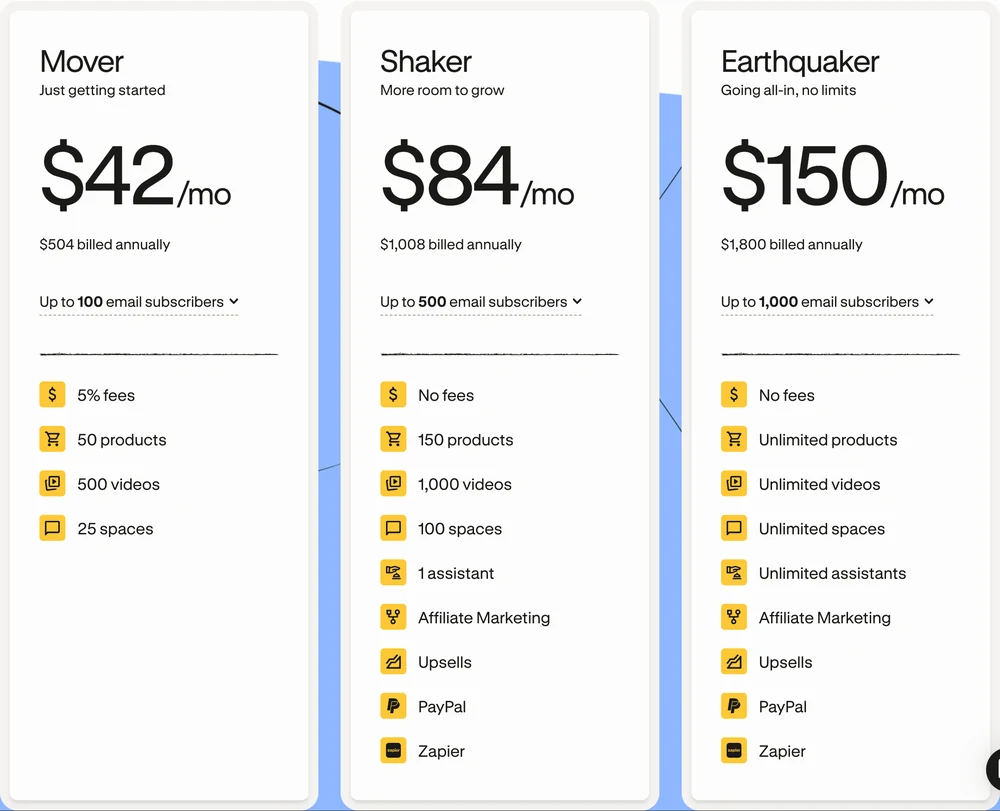
Podia’s own pricing page. Note the 5% fee on Mover, and that PayPal, upsells and affiliate marketing only appear from Shaker.
On top of any Podia fee, your payment processor takes its own cut. Podia’s pricing FAQ puts it at 2.9% plus 30 cents, which matches Stripe’s published US rate. That applies on every plan, including the ones with no Podia fee.
Worth knowing if you were planning to take PayPal: that 2.9% is Stripe’s number, and PayPal publishes several different rates depending on which product you use. Mover cannot take PayPal at all, so this only becomes your problem from Shaker upwards.
Page 1 of Google is quoting a Podia price that expired
Most guides ranking for this search quote $39 a month as Podia’s starting price. Podia’s own pricing page says $49 monthly, or $42 if you pay for the year. The $39 figure is a retired price, and it has been copied across the results until it reads like the truth.
A single stale number would be a slip. Reading all 10 results against Podia’s live pages turned up 7 separate wrong claims, and 3 of the pages never state a price at all.
Of the 7 page-1 results that quote a Podia price, only Podia’s own page has it right.
| Claim you will find on page 1 | What Podia’s own pages say |
|---|---|
| “Plans start at $39 a month” | Mover is $49 monthly, $42 billed yearly |
| “Podia has 2 paid plans” | 3 plans: Mover, Shaker, Earthquaker |
| “A 14-day free trial” | 30 days, no credit card needed |
| “The Starter plan” | The entry plan is called Mover |
| “Podia Pro, $79 a month” | No plan by that name exists |
| “Podia has a free plan” | Retired in 2024, trial only |
| “3% fee on the entry plan” | 5% on Mover |
Google’s own AI Overview is built on 2 of those pages. It names Kajabi, Thinkific, Teachable, Skool and Systeme.io, and 4 of those 5 are paid monthly bundles, with Systeme.io the only one offering a free tier. No checkout-only option appears anywhere in it, which is what a lot of people leaving Podia actually want.

Google’s AI Overview for this search. Of the 5 platforms it names, only Systeme.io has a free tier.
The free plan question comes up a lot, and the answer is genuinely a bit sad. Podia used to have one. It went away in 2024, and creators noticed: a r/edtech thread from October 2024 is titled “Podia has removed it’s free plan, what are you switching to?”, and the poster goes on to ask for alternatives “for a good price or free”.
Which part of Podia are you actually paying for?
Podia bundles course hosting, a community, coaching, events, email marketing, a website builder and a checkout into 1 subscription. You pay for all of it whether or not you open any of it. So the useful question before you shop is which parts you actually touched in the last 6 months.
Run the fee math too, because Mover’s 5% is the part people miss. On Mover you pay $42 a month plus 5% of sales. On Shaker you pay $84 and nothing per sale.
Those 2 lines cross at $840 a month in sales. Under $840, Mover is cheaper. Over it, you are paying Podia extra for the privilege of being on the cheaper plan.
At $2,000 a month in sales, Mover costs $142 against Shaker’s $84. That is $58 a month handed over for being on the cheaper plan, which is the exact opposite of what the price tag suggests.
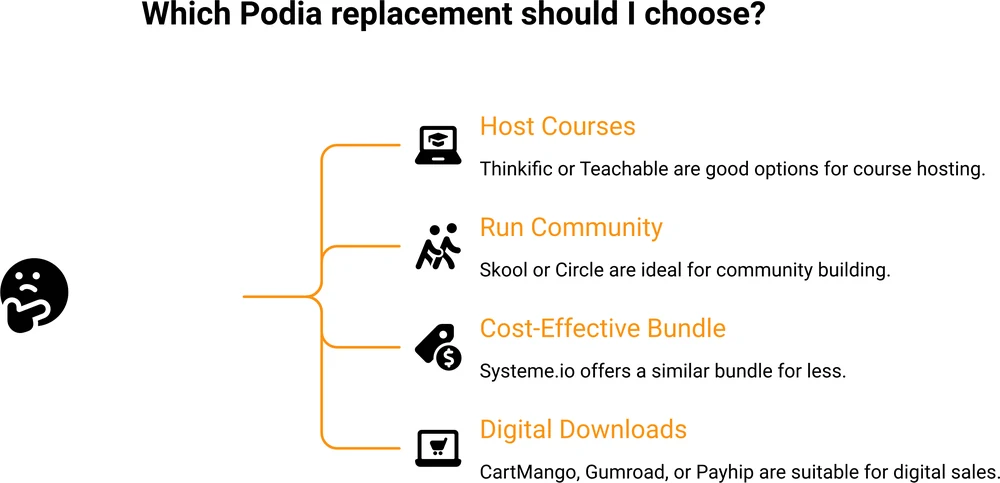
Which Podia replacement fits depends on the part of Podia you actually use.
Podia alternatives if you need courses or a community
Thinkific and Teachable replace Podia’s course hosting, Skool and Circle replace the community, and Systeme.io covers the whole bundle for less than Podia charges. Podia’s rivals here are genuinely good at these jobs. On courses and community, every platform below beats what CartMango can do today.
Systeme.io is the cheapest full replacement, with a free plan that covers 1 course, 3 funnels and 2,000 contacts before you pay anything. Thinkific and Teachable are the specialists if courses are the main event.
Skool and Circle are community-first. Kajabi is the expensive one, and it is expensive because it does the most.
Systeme.io starts free, Skool costs $9 a month and Kajabi’s entry plan is $143 a month, across 6 platforms that all claim to replace the same tool.
| Platform | Entry price | Platform fee | What it covers |
|---|---|---|---|
| Systeme.io | Free, then $17/mo | 0% | the whole bundle, with caps |
| Skool | $9/mo | 10% on Hobby, 2.9% on Pro | community and courses |
| Teachable | $29/mo yearly | 7.5% on Starter, 0% above | courses |
| Thinkific | $40/mo yearly | 0% on Thinkific Payments | courses |
| Circle | $89/mo yearly | 2% | community |
| Kajabi | $143/mo yearly | 2% on a third-party processor, 0% on Kajabi Payments | the whole bundle, richer |
A few things the price column hides. Systeme.io’s free plan caps you at 1 course, so treat it as a starting point rather than a permanent home. Teachable’s $29 Starter takes 7.5% of every sale, which is worse than Podia’s 5%.
Thinkific’s cheapest plan limits you to 5 digital products. Skool’s $9 Hobby plan takes 10%.
Worth reading next: our Kajabi pricing breakdown and Skool pricing breakdown both go into the fees these pricing pages leave off. If courses are the whole reason you are shopping, our LMS options for online courses breakdown works out the point where each platform’s cheapest plan costs more than the tier above it.
Podia alternatives if you only need the checkout
CartMango, Gumroad and Payhip all sell digital downloads without a course platform wrapped around them, which is what plenty of people on Podia actually need. Those sellers move a handful of files, never opened the community, and keep their email list somewhere else. If that is you, Podia’s Mover plan is charging you $504 a year and 5% of sales for a checkout.
A checkout on its own costs a lot less. Gumroad charges no monthly fee but takes 10% plus 50 cents on a direct sale, and its own fees page is clear that this “does not include: Credit card processing (2.9% + $0.30)”. So the real cost of a direct Gumroad sale is closer to 12.9% plus 80 cents, which we walk through in our Gumroad pricing breakdown.
Payhip has a free plan at 5% and paid plans that cut the fee. CartMango is free until October 2026 and starts at $10 a year after that, with no CartMango commission on sales.
On a $50 sale, Gumroad takes $7.25 and Podia’s Mover plan takes $4.25 on top of its monthly fee, while CartMango takes only what Stripe charges.
| Where you sell | Ongoing cost | Cut of a $50 sale | You keep |
|---|---|---|---|
| Podia Mover | $42/mo | $4.25 | $45.75 |
| Gumroad | none | $7.25 | $42.75 |
| Payhip Free | none | $4.25 | $45.75 |
| Payhip Plus | $29/mo | $2.75 | $47.25 |
| CartMango | free until October 2026, then from $10/year | $1.75 | $48.25 |
Every row includes the Stripe cut of 2.9% plus 30 cents, so the differences you see are the platform’s own take.
I should be upfront that CartMango is mine, so read that row with the usual pinch of salt and check the numbers yourself. CartMango also does the least of any option in that table, which is the trade you are making for the price.
CartMango does checkout, order bumps, upsells, downsells, subscriptions and a simple hosted sales page called Mini Pages. CartMango does not host courses or run a community today, and it has no affiliate management yet. All 3 are in development: affiliate management is due September 2026, with the course system and community following in October 2026.
We have also broken down Payhip’s pricing tiers in detail, and there is a direct Podia vs Gumroad comparison if those 2 are your shortlist.
The 0% transaction fee catch
Thinkific, Teachable and Kajabi all advertise 0% transaction fees, and all 3 attach the same condition: you have to use their own payment processor to get it.
Thinkific charges no gateway fee when you use Thinkific Payments, and its pricing page states that a third-party gateway fee applies when you plug in Stripe or PayPal directly, varying by plan. Teachable’s 0% applies when you use teachable:pay.
Kajabi is the clearest example, because the headline and the detail sit on the same page. The top of its pricing page reads “No hidden fees. No revenue sharing.” Further down, a row labelled “3rd Party Payment Provider Fees (not using Kajabi Payments)” charges 5%, 2%, 1% and 0.5% by tier, so the Basic plan takes 2% of every sale unless you let Kajabi process the money.
The pattern is worth knowing before you switch: several platforms waive their cut only if you also let them handle the money. Podia’s 5% on Mover at least applies the same way whichever processor you connect.
Those platforms are still good value at those prices. Just treat the headline number as the start of your own math, and check which processor the 0% depends on before you commit.
What you give up by leaving Podia
Leaving Podia costs you 2 things that are easy to miss: the email marketing bundled into your plan, and the free migration help.
The first is your email list. Podia includes email marketing, capped at 100 subscribers on Mover, 500 on Shaker and 1,000 on Earthquaker.
If you move to a checkout-only tool, your list needs a home. That is a separate bill, and it is worth pricing before you commit rather than after.
The second is migration help. Podia will move up to 50 products for you on Mover, and up to 150 on Shaker and Earthquaker. Not every platform offers this, and it is the kind of thing you only notice when you are 40 products into a manual re-upload.
Podia’s 30-day trial is genuinely useful here, and it does not ask for a card. If you are unsure, you can rebuild your setup on a rival and run both side by side before you cancel anything. Selling without your own site is easier than it used to be too, which our guide on selling digital products without a website walks through.
FAQ
What is better than Podia?
Nothing is better at everything, because Podia bundles courses, community, coaching, events, email and a checkout, and no single rival matches the whole set. Systeme.io beats it on price with a free plan, Thinkific and Teachable beat it on course features, and Skool and Circle beat it on community. For selling digital downloads without the bundle, CartMango, Gumroad and Payhip are all cheaper per month than Podia’s $42 Mover plan.
Which platform is better, Podia or Thinkific?
Thinkific is the better course platform, and Podia is the broader tool. Thinkific’s Basic plan is $40 a month billed yearly with quizzes and student tracking, though it caps digital products at 5. Podia’s Mover is $42 a month billed yearly and adds a community, a website builder and email, while taking 5% of every sale. Pick Thinkific if teaching is the product.
Does Podia have a free version?
No. Podia retired its free plan in 2024 and now offers a 30-day free trial instead, with no credit card required. Several guides still describe a Podia free plan, and at least 1 describes a 14-day trial, so both claims are out of date. The cheapest ongoing Podia plan is Mover at $42 a month billed annually.
What are the key differences between Kajabi and Podia?
Price and depth. Kajabi’s entry plan is $143 a month billed yearly against Podia’s $42, and Kajabi gives you more marketing tooling, funnels and higher limits for it. Podia is the simpler and cheaper option with a 5% fee on its entry plan. Kajabi suits established businesses with revenue to justify the bill.
Is Podia’s 5% fee actually a big deal?
Your sales volume decides it, and there is a clean crossover point. At $840 a month in sales, Podia’s Mover plan and its fee-free Shaker plan cost exactly the same. Below that Mover wins, and above it every extra sale hands Podia 5% you could avoid by paying more upfront. Run that number before you shortlist any Podia alternatives, because it tells you whether you need a cheaper plan or a different platform.
About the Author

👋 I’m Welly, founder of CartMango (the site you’re on), a checkout platform for digital product sellers. We’ve previously processed $179M+. I also run BirdSend (email marketing tool, 3.1B+ emails sent). On the side I show other non-techie digital sellers how I use AI workflows to automate 50%+ of my operations. Find me on LinkedIn.
Related Reading
- Kajabi alternatives: the same exercise run on the other big all-in-one platform
- Payhip vs Podia: a direct head-to-head if those 2 are your shortlist
- How to sell online courses: what actually moves the needle once your platform is sorted
- LMS for online courses: real fees for 7 course platforms