
The strongest ClickFunnels alternatives are Systeme.io for solo sellers who want the same bundle cheaper, GoHighLevel for agencies running client accounts, and a checkout tool like ThriveCart or CartMango if the order form is all you use. They split on how each one charges for stored contacts. Every price below came from the vendor’s own pricing page.
Almost every list of ClickFunnels alternatives compares starting prices. $97 against $59. $97 against free. Then you sign up, import your list, and the number on your card looks nothing like the number in the article.
That happens because this whole category charges by how many contacts you store, and the entry plans hold wildly different amounts. ClickFunnels’ cheapest plan holds 10,000 contacts. Kartra’s cheapest holds 500.
Comparing those 2 prices tells you almost nothing about what you will pay.
So I priced every option at the same list size instead. Same 10,000 contacts, every platform, read live off each vendor’s own pricing page. Below you will see what each one costs at a list that size, and the tool most roundups call the budget pick lands above ClickFunnels once you do that.
Key Takeaways
- ClickFunnels sells 4 plans, not 3. The 4th, Dominate, costs $5,997 a year, and none of the roundups ranking on page 1 mention it.
- The cheapest ClickFunnels plan holds 10,000 contacts and 3 courses. No page on the first results page states either cap.
- Priced at 10,000 contacts, Kartra jumps from $59 a month to $229, and Kajabi from $179 to $249. Both cost more than ClickFunnels at that list size.
- Systeme.io is the only all-in-one that is genuinely cheaper, at $47 a month for the same 10,000 contacts.
- ClickFunnels takes 0% of your sales, so leaving is a decision about the subscription, not about a cut of revenue.
- If the checkout is the only part you use, that half costs $47 a month or less on a dedicated cart tool.
What ClickFunnels charges
ClickFunnels starts at $97 a month and runs to $5,997 a year, across 4 plans rather than the 3 that most comparison pages list.
Launch costs $97 a month, Scale $197, Optimize $297, and the annual-only Dominate plan $5,997 a year, and the cheapest of the 4 holds 10,000 contacts and 3 courses.
| Plan | Paid monthly | Paid yearly | Contacts | Courses |
|---|---|---|---|---|
| Launch | $97/mo | $81/mo | 10,000 | 3 |
| Scale | $197/mo | $164/mo | 75,000 | 6 |
| Optimize | $297/mo | $248/mo | 150,000 | 10 |
| Dominate | Not sold monthly | $5,997/yr | 400,000 | 20 |
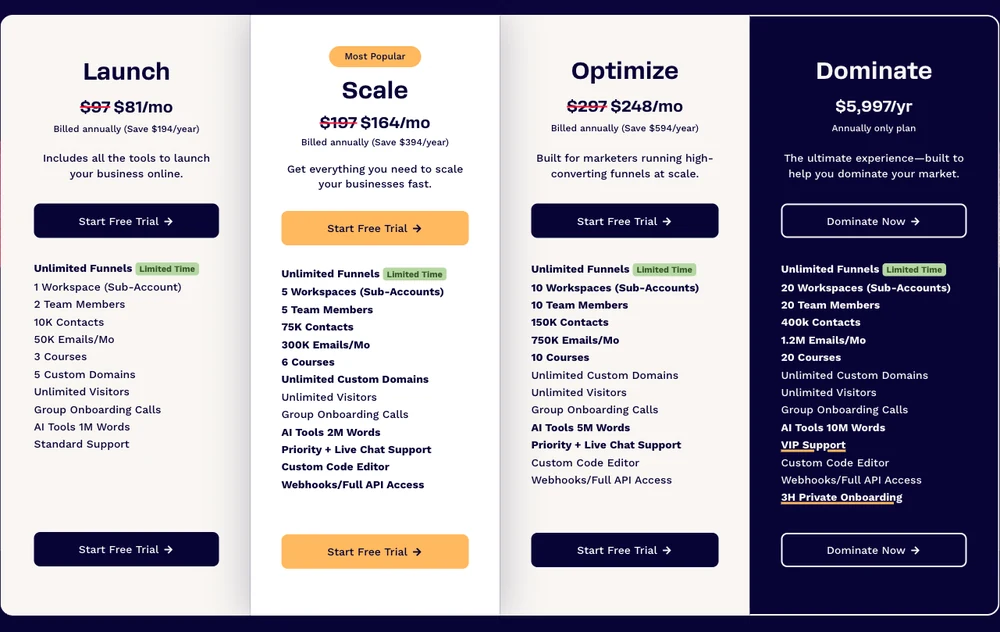
ClickFunnels’ own pricing page. Launch at $97 a month holds 10,000 contacts and 3 courses. Dominate, on the right, is the 4th plan at $5,997 a year.
Paying month to month, the entry plan works out at $1,164 a year. Paying up front drops it to $970, because the yearly price is 10 months of the monthly one.
2 things ClickFunnels gets right, and both are worth saying before the rest of this post picks it apart.
It takes nothing from your sales. Its own pricing FAQ answers the question “Does ClickFunnels take a percentage of my sales?” with 5 words: “No. You’ll keep every penny you make.”
Hosting and a free subdomain are included, so no second bill is hiding behind the first.
And you get 44 days to change your mind: a 14-day free trial, then a 30-day money back guarantee once the trial ends.
Before you go further, most of the money a funnel loses is lost after the traffic arrives, not before. The free 5-day Online Selling Mistakes Challenge walks through the 5 leaks that cost solo sellers the most.
The number that moves your bill
Your contact count sets the price on every all-in-one platform in this category, ahead of how many funnels, pages or products you build.
ClickFunnels holds 10,000 contacts on Launch, 75,000 on Scale and 150,000 on Optimize. Systeme.io holds 2,000 on the free plan, 5,000 on Startup and 10,000 on Webinar. Kartra holds 500 on its cheapest plan, and Kajabi holds 2,500.
A headline price only means something once you say how many contacts it buys. Almost nobody does.
I read all 6 comparison pages ranking on the first page of Google for this search. Not one of them states ClickFunnels’ 10,000-contact cap, and not one mentions the 3-course cap.
Not one mentions the Dominate plan either, so a reader could finish any of those articles believing ClickFunnels tops out at $297 a month when there is a $5,997 tier above it.
Email Tool Tester, one of those 6 pages, goes further and gets it backwards. It tells readers: “ClickFunnels’ Starter plan comes with unlimited contacts so at least you don’t need to worry about your monthly bill rising as your business gets bigger.”
ClickFunnels has no plan called Starter. The plans are Launch, Scale, Optimize and Dominate. The cheapest one caps at 10,000 contacts, which is the exact number that decides whether your bill doubles to $197.
The same page lists Systeme.io’s plans as $32.40, $56.40 and an “Enterprise” tier at $116.40 for 15,000 contacts. Systeme.io has no Enterprise plan and no 15,000-contact tier. Its top plan is called Unlimited, costs $97, and holds unlimited contacts.
Open the ClickFunnels pricing page yourself before you switch anything, then do the same on whichever tool you land on.
The all-in-one ClickFunnels alternatives, priced at 10,000 contacts
At 10,000 contacts, the list size ClickFunnels’ cheapest plan holds, Systeme.io costs $47 a month, GoHighLevel costs $97, Kartra costs $229 and Kajabi costs $249, against ClickFunnels at $97.
| Platform | Advertised entry price | Contacts at that price | Cost at 10,000 contacts |
|---|---|---|---|
| ClickFunnels | $97/mo (Launch) | 10,000 | $97/mo |
| Systeme.io | $0 (Free) | 2,000 | $47/mo |
| GoHighLevel | $97/mo (Starter) | Unlimited | $97/mo |
| Kartra | $59/mo (Essentials) | 500 | $229/mo |
| Kajabi | $179/mo (Basic) | 2,500 | $249/mo |
Every figure is the monthly billing rate, so the rows compare on the same basis. All 5 platforms discount an annual payment.
Systeme.io: the real saving
Systeme.io is the one that survives the like-for-like test. Its Webinar plan costs $47 a month and holds 10,000 contacts, which is $50 a month less than ClickFunnels charges for the same list.
It charges 0% on sales too, on every plan including the free one. That free plan holds 2,000 contacts with 3 sales funnels, 1 course, 1 community and an affiliate program, which is more than most free tiers in this category give away.
What you give up is polish and depth. The page editor is simpler than the ClickFunnels one, the analytics are thinner, and there are fewer native integrations.
A solopreneur in the r/EntrepreneurConnect thread on this exact question put the trade plainly: “For solopreneurs, Systeme io is hard to beat. It’s basically Clickfunnels lite but way cheaper. funnels, email, checkout, upsells, all there. If you don’t need crazy customization, it’s a solid alternative.”
GoHighLevel: same price, no contact ceiling
GoHighLevel’s Starter plan is $97 a month, the identical headline to ClickFunnels Launch. What it buys is different: 3 sub-accounts, unlimited users, and unlimited contacts. Your bill does not move when your list grows.
The catch is that the plan fee is not the whole bill. Conversation AI, Voice AI, Reviews AI, email, SMS and calling are all billed by usage on top. A quiet month and a busy month cost different amounts, which is the opposite of how ClickFunnels bills you. We priced those metered charges in detail in our GoHighLevel alternatives breakdown.
GoHighLevel is built for agencies managing client accounts. For 1 person selling 1 product, most of it sits unused.
Kartra: the one that flips
Kartra advertises $59 a month, which is why it shows up on nearly every list as the cheap pick. That plan holds 500 contacts and charges 5% transaction fees on your sales.
Kartra is the only platform in this table that takes a cut of your sales. Sell $5,000 in a month on the Essentials plan and Kartra takes $250 on top of the $59.
The 5% disappears on Starter at $119 a month, which holds 2,500 contacts. To reach 10,000 you need Growth at $229 a month, which holds 12,500. So the tool that looks $38 cheaper than ClickFunnels costs $132 a month more at the same list size.
Kajabi: priced for course businesses
Kajabi Basic is $179 a month and holds 2,500 contacts and 5 products. Growth is $249 for 25,000 contacts and 50 products. Pro is $499 for 100,000 contacts.
There is a cut on top if you bring your own payment processor: 2% on Basic, 1% on Growth, 0.5% on Pro. Use Kajabi Payments instead and you pay card rates of 2.9% + $0.30, dropping to 2.7% on Pro.
Kajabi earns its price when courses and community are the actual product rather than a side feature. If that is you, our full Kajabi pricing breakdown goes deeper on the surcharges.
The landing page tools are on a third meter
Unbounce and Leadpages each turn up on 3 of the 6 pages ranking for this search, and both charge on a completely different axis from every platform above.
Unbounce meters traffic, not contacts. Its Starter plan is $29 a month, or $22 if you pay yearly, and it carries a cap of 500 visitors a month. Unlimited pages start on the Build plan at $99 a month with a 20,000-visitor cap, then $149 and $249 above that.
Leadpages splits into 2 product lines now. Its HTML Pub line starts at $10 a month for 5 pages, $29 for 25 pages and $49 for 50. The Leadpages product proper starts at $99 a month with A/B testing and unlimited pages.
Both of them build pages. Neither sends email, holds contacts, hosts a course, or runs a checkout with upsells. Calling them ClickFunnels alternatives only works if pages were the only thing you used, and if you already pay for an email tool separately. Our breakdown of what a lead capture page really costs prices that stack end to end.
If you only use the checkout half
The checkout is the only part of ClickFunnels a lot of solo sellers touch, and a dedicated cart tool does that half from $47 a month down to $10 a year.
ClickFunnels ships roughly 16 apps: landing pages, courses, community, email, CRM, appointments, an affiliate center, a store, analytics, countdown timers, surveys and more.
How many of them did you open last month?
For most solo sellers the honest answer is 2 or 3. That matters more than it sounds. Across 50 separate studies, Baymard Institute puts the average documented cart abandonment rate at 70.22%. Most of what a funnel loses, it loses on the order form.
To get 1-click upsells, downsells and order bumps, ClickFunnels costs $1,164 a year, SamCart’s Pro plan costs $2,388, ThriveCart’s Standard plan costs $564 and CartMango costs $20 a year once its free beta ends in October 2026.
| Tool | Cheapest plan with upsells + bumps | Per year | Cut of each sale |
|---|---|---|---|
| ClickFunnels | Launch, $97/mo | $1,164 | 0% |
| SamCart | Pro, $199/mo | $2,388 | 0% |
| ThriveCart | Standard, $47/mo | $564 | 0% |
| CartMango | Free until October 2026, then $20/yr | $20 | 0% |
I should be upfront: CartMango is my platform, built for sellers who only ever needed the checkout half.
2 numbers in that table moved recently, and the published comparisons have not caught up with either.
SamCart’s $79 Core plan no longer includes upsells or order bumps. Those sit on the Pro plan at $199 a month, so the figure a ClickFunnels switcher needs is $199, not the $79 on the ads. Our SamCart vs ClickFunnels comparison covers the rest of that gap.
ThriveCart no longer leads with its $495 one-time licence. Its published plans are Standard at $47 a month and Pro+ at $87, with a lifetime option offered but no price shown on the page.
Be clear about what a checkout tool will not do. It will not host a course, run a community, or send your broadcasts. If you need those, buy them separately and read what community platforms really cost and what affiliate software costs before assuming the bundle is cheaper.
For CartMango, courses and community are due in October 2026 and affiliate management in September 2026. Today it does the checkout, the order bump, the 1-click upsell page and a simple hosted sales page, and nothing beyond that.
What ClickFunnels still does better
ClickFunnels beats every alternative in this post on 3 things: its training, the depth of its page editor, and taking 0% of your sales.
The training and the community are the strongest in this category, and nobody in the alternatives crowd has replaced them. A commenter in that same Reddit thread said it better than any review: “Clickfunnels education and community are still top tier. No alternative really matches that. If you’re new to click funnels, that matters more than features sometimes.”
That is fair. If you have never built a funnel, buying the tool that comes with the teaching is a defensible call at $97 a month.
The page editor is deeper than Systeme.io’s. If you run paid traffic into heavily designed pages, that gap shows up in your conversion rate.
And it takes 0% of your sales, which puts it ahead of Kartra’s entry plan and level with everything else in the tables above.
What has to move when you switch
The part nobody prices is the migration, and it is where most switches stall. 4 things move at different speeds.
Pages rebuild, they do not transfer. No funnel builder imports another one’s pages. Budget a weekend per funnel, screenshot everything first, and rebuild your best performer only. The rest were probably not earning anyway.
Contacts export fine. Every platform here exports a CSV and imports one. Tags and automation rules do not survive the trip, so write your sequences down before you cancel.
Subscriptions are the dangerous one. ClickFunnels lets your recurring payments carry on after you leave. Several cheaper carts do not, and the ones that break it break it quietly. If you sell memberships, confirm that line in writing before you move a single product.
Domains need DNS. Point them at the new host before you cancel the old account, not after, or your live pages go dark in the gap.
Run the new tool alongside ClickFunnels for 1 billing cycle. Paying twice for a month is cheaper than a broken checkout during a launch.
How to pick without buying another tool you never open
I have a bad history here, so take this as a warning rather than advice.
Over the years I bought 54 software lifetime deals on AppSumo. Social media tools, AI tools, bots, customer support, landing pages, SEO, ads, all of it.
I would buy them thinking I would probably need them later. Later never came. I still have not used 90% of the apps I bought.
Changing 1 rule stopped it: I only buy a tool if it is relevant to me now or in the next 6 months. If not, I pass.
Run your ClickFunnels replacement through the same 3 questions.
1. Which apps did you open last month? Write them down before you look at a single pricing page. If the list is checkout and email, you are shopping in a much cheaper aisle than the roundups suggest.
2. How many contacts do you have today, and how many in 6 months? That number sets your bill on every platform in this post. Price the tier that holds your real list, and add the next one up so you know what growth costs.
3. What happens to your recurring revenue if you leave? ClickFunnels lets you keep your subscriptions running. Several cheaper carts do not. If you sell memberships, check that before you check price.
Then pick the smallest tool that answers all 3. Funnels make money when someone shows up and does the work, and no subscription does that part for you.
FAQ
Why are people leaving ClickFunnels?
Price is the reason named on every comparison page ranking for this search. The entry plan is $97 a month, or $1,164 a year, and it caps at 10,000 contacts and 3 courses. Sellers who use 2 or 3 of the bundled apps end up paying for 16. The second reason is the editor, which some users find slower and more restrictive than newer builders.
Is there a free version of ClickFunnels?
No. ClickFunnels has no free plan. It offers a 14-day free trial plus a 30-day money back guarantee after the trial ends, which gives you 44 days to test it and still get your money back. For a genuinely free tier, Systeme.io’s free plan holds 2,000 contacts, 3 funnels, 1 course and 1 community at $0.
Who is the best funnel builder?
For a solo seller on a budget, Systeme.io at $47 a month for 10,000 contacts is the best value in this list. For an agency running client sub-accounts, GoHighLevel at $97 a month with unlimited contacts fits better. For someone who only needs a high-converting order form with upsells, a dedicated cart like ThriveCart or CartMango costs a fraction of either.
Is GoHighLevel better than ClickFunnels?
They cost the same at the entry tier, $97 a month each, and they are built for different buyers. GoHighLevel gives you unlimited contacts, a CRM and client sub-accounts, then bills AI, email, SMS and calling by usage on top. ClickFunnels charges 1 flat fee with a 10,000-contact ceiling.
Agencies usually prefer GoHighLevel. Solo sellers usually find most of it unused.
What happens to my funnels if I cancel ClickFunnels?
Your pages come down with the account, so export or rebuild anything you want to keep before the billing date. Subscriptions are the part people miss. ClickFunnels lets your recurring payments carry on after you leave, and several cheaper carts do not. Check that specific line on any platform you move to, because it is the one mistake you cannot undo.
The short version
Price the ClickFunnels alternatives against your own list size before you compare anything. Do that and Systeme.io lands at $47 a month, GoHighLevel matches ClickFunnels on price while removing the contact ceiling, and Kartra, the one every list calls the budget option, ends up at $229 with Kajabi at $249. Then subtract the apps you never open. If the checkout was the only part doing any work, that half costs under $50 a month, or $10 a year.
CartMango is the checkout half on its own. Order bumps come on every CartMango plan, and 1-click upsells and downsells from the $20 tier up, so each buyer is worth more without you finding a single extra visitor. CartMango is free until October 2026, then $10 to $30 a year.
About the Author

👋 I’m Welly, founder of CartMango (the site you’re on), a checkout platform for digital product sellers. We’ve previously processed $179M+. I also run BirdSend (email marketing tool, 3.1B+ emails sent). On the side I show other non-techie digital sellers how I use AI workflows to automate 50%+ of my operations. Find me on LinkedIn.
Related Reading
- Kajabi alternatives: 8 all-in-one options priced with the surcharges included
- ThriveCart vs ClickFunnels: the head-to-head, if ThriveCart is your pick from these ClickFunnels alternatives
- How to create a sales page: the 7-block structure, plus a fill-in template
- Low funnel marketing: what to do with the traffic already close to buying