

Skool is a good fit for a paid community where members talk every day. Pro costs $99 a month plus 2.9% and 30 cents per charge. Hobby costs $9 a month plus 10% and 30 cents. Sellers of structured courses should pick a course platform with quizzes.
Skool’s 1.6 on Trustpilot sits on an unclaimed page, and 27 of its 55 reviews come from people who joined or bought inside someone’s group, against 9 from hosts. Skool leaves most refunds to the group owner. This Skool review draws on all 55 reviews, Skool’s help docs and terms, and its live prices.
Look at who writes the Skool reviews on Google. Samuel Earp’s page asks you to use his referral link, 17 links in all.
Himanshu Bisht says openly that he has been a Skool affiliate for more than 2 years. LinoDash links out with a referral code, and Ruzuku sells a rival platform.
Skool pays referrers 40% of the plan price, which its help doc puts at $39 a month per Pro signup. I sell a checkout tool myself, and I will mark where that matters.
The reviewers with no referral link are mostly on Trustpilot, and most of them are angry. So I sorted all 55 to find out who they are and what went wrong.
By the end you will know which plan fits, what Skool will and will not do when a refund goes bad, and how to check a paid group before you join.
Key Takeaways
- Best fit: a paid community where members talk daily, on Pro at $99 a month plus 2.9% and 30 cents per charge.
- The cheap plan: on monthly billing, Hobby costs less until you take about $1,268 a month, then Pro is the better buy.
- Who is angry: 27 of the 55 Trustpilot reviews come from group members, 9 come from hosts and 19 do not say.
- Main complaints: 28 of the 48 low reviews concern charges, cancelling, refunds or a group that did not deliver.
- Refunds: Skool leaves them to the group owner, so get a group’s refund terms in writing before you pay.
- Course gaps: Skool’s help center returns nothing for quizzes, and drip runs only by days after a member joins.
What Skool does and costs in 2026: 2 plans, 3 fee rates
Skool is a community platform that puts a feed, courses, a calendar for live calls, a member list and a points leaderboard on 1 screen, with apps for iPhone and Android. Sam Ovens and Daniel Kang founded it in 2019, and its about page says Alex Hormozi partnered with Skool in 2024 to create The Skool Games.
Is Skool your first paid offer? Before you launch, the Online Selling Mistakes Challenge walks you through 5 mistakes solo sellers make, in 5 emails, at no cost.
Skool has 2 plans, Hobby at $9 a month and Pro at $99, and each group you run needs its own plan. Pro’s cut is 2.9% or 3.9% plus 30 cents per charge, and Hobby’s is 10% plus 30 cents.
| What you get | Hobby | Pro |
|---|---|---|
| Paid monthly | $9 | $99 |
| Paid yearly | $7.50 a month | $82 a month |
| Cut of each charge | 10% + 30c | 2.9% + 30c, or 3.9% + 30c above $900 |
| Members, courses, videos, live calls | Unlimited | Unlimited |
| Custom URL, member affiliates | No | Yes |
| Zapier, AutoDM, webinars | No | Yes |
Both plans start with a 14-day free trial. Skool calls itself the merchant of record for sales tax, so it collects and files VAT and sales tax for you. You also cannot connect your own Stripe account, because every charge runs on Skool’s merchant account. Payouts land every Wednesday in your local currency, and the first can take up to 14 days.
“0% fee up to $899 in sales then 1% plus standard processing” is how Google’s AI summary describes Pro. That reads as though your first $899 in sales carries no fee at all.
Skool’s payments FAQ says 2.9% plus 30 cents on every charge up to $899, then 3.9% plus 30 cents above $900. So the $899 is the size of 1 charge. You can reach Google’s version by calling the 2.9% “processing” and only the extra point Skool’s fee, but you pay the 2.9% either way.
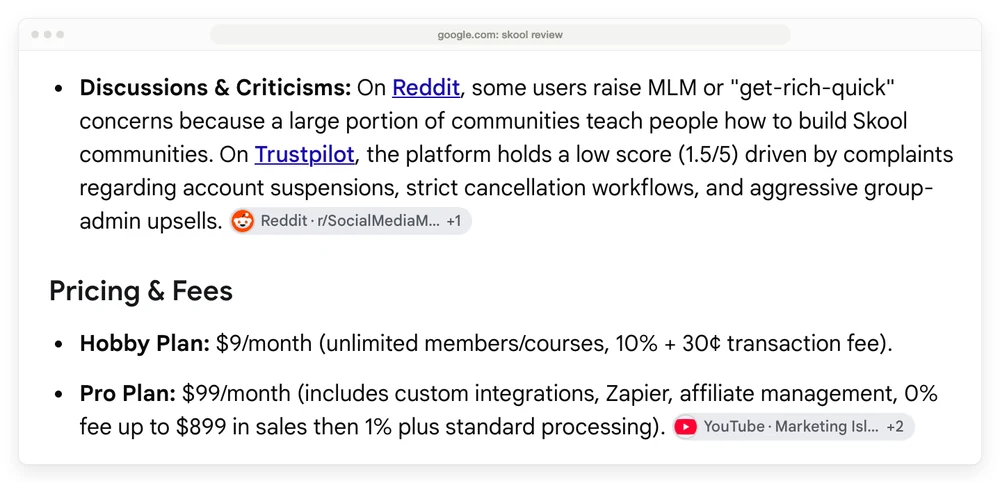
Google’s AI summary for this search. Read the Pro Plan line against Skool’s fee table above.
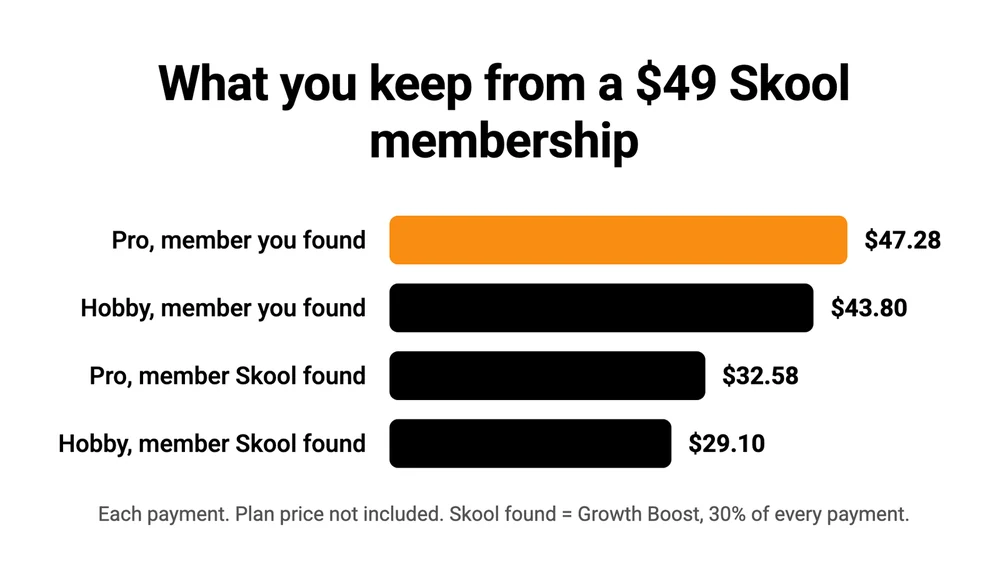
A $49 membership leaves you $47.28 on Pro and $43.80 on Hobby when you brought the member yourself.
Growth Boost changes that sum. It puts your group in Skool’s search results and off-site ads, then takes 30% of every payment from each member it brings, for as long as they stay. On a member Skool found, that same $49 leaves $32.58 on Pro and $29.10 on Hobby.
The payments FAQ says Growth Boost is on by default and goes off under Settings, then Discovery. Another Skool doc talks about toggling it on, so check the switch yourself. The month-by-month math lives in our Skool pricing breakdown.
An ebook or a template pack needs no community at all. A seller like that can use CartMango, which I run (free right now, from $10 a year once paid plans start in November, 0% per sale), Gumroad (10% + $0.50 per sale) or Payhip (free plan, 5% per sale). CartMango has no community features, so it only fits a seller who never needed a group.
Skool reviews: who wrote those 55 Trustpilot ratings
Skool scores 1.6 on Trustpilot from 55 reviews, 3.9 on the App Store from 793 ratings and 4.3 on Google Play from about 6,900 reviews. Those sites are judging different things.
| Site | Score | Ratings | What it judges |
|---|---|---|---|
| Google Play | 4.3 | About 6,900 | The Android app |
| App Store | 3.9 | 793 | The iPhone app |
| Trustpilot | 1.6 | 55 | The company, and the groups people bought through it |
That Trustpilot page is still called “Skool Safe Search for Kids – Home”. It sits in Trustpilot’s education category with an “Unclaimed profile” tag, and none of the 55 reviews has a reply from Skool.
A 2024 reviewer wrote that the site “has shifted from ‘Safe Search for Kids’ to a Kajabi online course competitor”, so the name looks like a leftover from an older use of the domain. Another review, at 2 stars, just asks to join “your football team”.
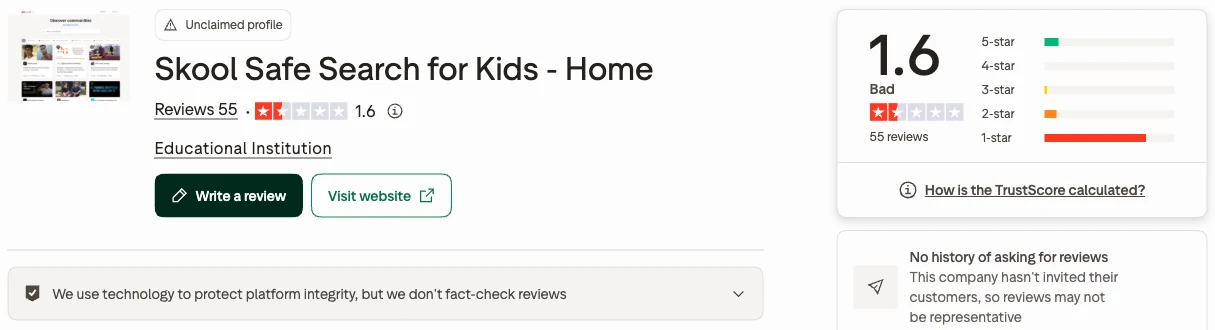
The page Google quotes. The 1.6 is its TrustScore, and the 55 reviews average 1.56.
Trustpilot says Skool has no history of asking for reviews, and it warns that “reviews may not be representative”.
Who actually wrote them
I read all 55 and sorted them by who was writing: 27 joined or bought something inside someone else’s group, 9 host a group or tried to, and 19 do not say.
| Who wrote it | Reviews | 1-2 stars | 3 stars | 5 stars |
|---|---|---|---|---|
| Joined or bought in a group | 27 | 25 | 1 | 1 |
| Host, or trialling a group of their own | 9 | 6 | 0 | 3 |
| Does not say | 19 | 17 | 0 | 2 |
Among reviewers who say who they are, members outnumber hosts 3 to 1. So the 1.6 leans heavily toward what it feels like to join a stranger’s group through Skool. Hosts also wrote 3 of the 6 reviews with 5 stars.
Hosts have complaints too. 6 of the 9 gave 1 star, and 3 of those 6 say they were charged around a free trial they had cancelled or tried to cancel.
What the 48 low reviews complain about
Charges and cancelling lead the 48 low reviews with 15, and refunds or a group that did not deliver follow with 13.
| Main complaint | Low reviews |
|---|---|
| Charged after cancelling, or could not cancel | 15 |
| Refund refused, or the group did not deliver | 13 |
| Banned, suspended or removed | 4 |
| Group quality: hype, spam, upsells | 4 |
| Support went quiet | 1 |
| Other, or no clear complaint | 11 |
Each review went in 1 row by its main complaint, and that call was mine. 10 of the 48 also say support never answered them, whatever the main problem was. These are complaints, and I cannot check any single one of them.
Skool’s transaction terms explain the refund row. They say “Skool’s policy is to not provide refunds” and leave refunds to each creator. They add that in most cases Skool will not refund on behalf of creators, and that Skool “is under no obligation to become involved” if a host and a member fall out.
If members pay to be in the room
Pick Skool Pro if people pay you for access to each other: a mastermind, a coaching circle, a hobby club with weekly calls. This is the job Skool was built for. Posts, comments, live calls and courses sit in 1 place. The points system rewards members for taking part, since each like on a post or comment earns 1 point.
What it costs. 100 members at $49 a month pay $4,900. On Pro that costs $99 plus $172 in charges, so $271 a month, or 5.5% of what you take. Hobby would cost $529 for the same group.
What you give up. Your own look. LinoDash notes that every group “will still live under skool.com, and will look like every other Skool community”. Members also pay in USD only.
The iPhone app is a weak spot if your members live on their phones, at 3.9 against 4.8 for Mighty Networks. If branding or separate spaces matter more than the leaderboard, read our Skool vs Circle comparison before you commit.
If nobody has paid you yet
Hobby is the right start for a group with no paying members yet. Pro costs $90 a month more and saves you 7.1% of each payment. So on monthly billing, Hobby stays cheaper until you take about $1,268 a month, or about 26 members at $49. On yearly billing that point is near $1,049.
What it costs. 10 members at $49 pay $490. Hobby costs $9 plus $52 in charges, so $61 a month, or 12.4% of what you take. Pro would cost $116 for the same group.
What you give up. Custom URL, member affiliates, Zapier, AutoDM, webinars, and the onboarding and cancellation videos all start at Pro. A UK host who paid the £9 price wrote in March 2026 that “unless you upgrade for 99£/$ per month you cannot set on any affiliates”. Skool’s pricing page does mark custom URL and affiliates with a cross on Hobby, so that limit is in plain sight.
Where the trial bites. The reviews above name free trials more than any other host problem, so put a reminder in your calendar on day 12. Find the Billing tab on day 1 as well: Skool’s cancel doc tells owners who cannot see it to zoom the browser out with Command and minus. When you cancel, the group goes read-only at the end of the billing period.
A cheaper test needs no group at all. Sell 1 small paid thing, such as a template or a short guide, through a Mini Page and a checkout on CartMango at 0% per sale. 10 buyers would show people will pay you for something, though a monthly group is a bigger ask. CartMango has no community yet, so the group itself would still need a home like Skool.
If students need quizzes or a certificate
Pick a course platform if students need to finish something and prove it. Skool’s Classroom holds pages, folders, video, files and transcripts, up to 200 pages per course. You can lock a course until a member reaches a set level, or sell it as a one-time Buy Now inside the group.
Classroom does have drip, which Google’s summary says it lacks: Skool has a help doc called “How to drip the content?”. The catch is that drip only counts days after a member joins, so a cohort cannot share a calendar start date that way.
Quizzes and certificates are harder to find. A search of Skool’s help center for “quiz” returns nothing, and “certificate” finds 1 doc about card disputes. A 2024 Trustpilot reviewer put it plainly: “For a truly educational setting, it is missing advanced quizzes.”
What it costs. Thinkific Start costs $82 a month billed yearly, the same display price as Skool Pro, and its pricing page lists quizzes, assignments and certificates on that plan. It keeps 2% of each sale if you use your own Stripe account.
What you give up. The feed and the leaderboard that a Skool group is built around. Thinkific Start includes 1 community, and Grow, at $164 a month billed yearly, includes 3. Our Thinkific review, Teachable review, LearnWorlds review and Kajabi review cover the course side in full.
If someone invited you into a paid group
Check the owner before you pay. Skool takes the payment and leaves the refund decision to the person who runs the group. That person also sets the price, which reaches $249 a month on the Discovery front page. As 1 commenter on a 556-comment r/SocialMediaMarketing thread put it: “You need to research who’s giving the course.”
4 things to check first:
- Ask what sits behind levels. A course can stay locked until you earn enough points. Level 5 takes 155 points, and 1 point is 1 like from another member. On r/kettlebell, a paying member complained in August 2025 of being “forced to like and comment on posts” to reach more of the material. A $97 buyer on Trustpilot found the same locks only after paying.
- Get the refund terms in writing from the owner. Skool says the owner decides. If you leave a group, no refund follows on its own.
- Read the star rating with care. Only recurring, paying members can rate a group, and the prompt arrives after 30 days, so a person who quit in week 2 never sees it. 22 of the top 30 groups on Skool’s Discovery page show 5.0.
- Learn the way out first. On the web it is profile picture, Settings, Communities, Settings, Manage membership, and Skool says to do it at least 24 hours before the next charge. Skool Support will also cancel if you message “cancel” plus the group name.
Be most careful with groups that promise income. When I read Skool’s Discovery page, 20 of the top 30 groups sold a way to earn money, win clients, run ads or grow a business. That count is mine, taken from each group’s own description.
I fell for that kind of promise myself, years ago and nowhere near Skool. Once I had saved a little money, I paid for courses that promised “How to go from 0 to 10k in a month, even if you’re a complete beginner”. I told my email list in 2023 that I had been naive to fall for it. With no skills and no audience, you are unlikely to make $1k in a month, let alone $10k, whichever platform hosts the course.
If you came to Skool to make money from it
You can make money on Skool 2 ways, and neither is automatic. You can run a group that people pay for, starting on Hobby, and Skool sends you what they paid minus its cut every Wednesday. Or you can refer new hosts. Skool’s affiliate doc pays 40% of the plan price for as long as that host stays, and it puts that at $39 a month for Pro and $3.60 for Hobby.
What the numbers say. Skool’s signup page claims “200k communities earning $1 billion per year”. Taken at face value, that averages $5,000 a year per community, and an average like that hides who earns it. The same page shows a calligraphy group earning $6,237 a month, which is the example it picked. Skool publishes no figure for how many groups earn nothing, at least none I could find.
The pyramid worry. The top comment on that Reddit thread reads “Skool Games feels super MLM pyramid scheme”. Skool’s rules describe The Skool Games as a contest. The top 5 earners in each category win a trip to Los Angeles and an event with Hormozi, and entry is limited to residents of the US and Canada aged 21 or over, with Quebec left out.
The referral doc pays on the host you refer, with nothing on the hosts they refer, so that is 1 level, as another commenter pointed out. In Skool’s own documents I see a contest and a 1-level referral program. What I cannot tell you is what any single group will sell you once you are inside.
Groups that teach people to run groups do exist. Search Discovery for “skool community” and you get names such as Your Skool Growth and Digital Boss Skool Hub. On the Discovery front page they are a small shelf, though: of the top 90, only SkoolKit at 73 is built for Skool owners.
What refunds, disputes and leaving cost a host
Skool leaves refunds to you, so the 13 refund reviews above are a warning for hosts as much as for buyers. Skool’s refund doc says you “may not refund more than your available account balance”. If a member on a $2,000 seat wants money back in a slow week, Skool suggests you wait or use PayPal, Venmo or similar. Transaction fees are non-refundable.
A card dispute costs more. Skool’s dispute doc takes the disputed amount plus a $15 fee from your balance, charges $15 more to counter it (refundable if you win), and says the bank review takes 6 weeks. It also says “Skool doesn’t participate in the decision-making process”.
You can head off many of these cheaply: write your refund rule on your About page and answer refund requests fast. “Bad customer support” is on Skool’s own list of Discovery ranking penalties.
Leaving takes planning too. Every charge runs on Skool’s merchant account, and I found no doc that moves live subscriptions to another tool, so plan on your members subscribing again wherever you go. I read that as the price of having Skool run the charges and handle tax. Our membership platform breakdown compares who keeps your subscribers, and Skool alternatives sorts the options if you are already on your way out.
Skool review verdict, situation by situation
Pro is the pick for a paid community, at $82 a month billed yearly. Every price below is on yearly billing, and Skool’s rates already include card fees.
| If this is you | Pick | Cost | The catch |
|---|---|---|---|
| Members pay to be in the room | Skool Pro | $82 a month, plus 2.9% + 30c | Your refunds cannot exceed your balance |
| Nobody has paid you yet | Skool Hobby | $7.50 a month, plus 10% + 30c | No affiliates, Zapier or custom URL |
| Students need quizzes or a certificate | Thinkific Start | $82 a month plus card fees, and 2% more if you use your own Stripe | 1 community until Grow |
| You were invited to a paid group | Check the owner first | The group’s price | Skool leaves refunds to the owner |
| You came to make money from a group | Skool Hobby | $7.50 a month, plus 10% + 30c | No public data on typical earnings |
| You sell files, not a community | CartMango | Free right now, then from about $0.83 a month, 0% per sale, plus Stripe or PayPal fees | Not yet: no community or course hosting |
CartMango is mine, and it is the 1 row here that is neither a Skool plan nor a course platform.
FAQ
Can you actually make money on Skool?
Yes, if people will pay for your group or you refer new hosts. Skool’s signup page claims $1 billion a year across 200,000 communities, which averages $5,000 each. It publishes no figure for how many earn nothing. Build an audience first, because Discovery ranks groups by member growth, engagement and retention.
What are the cons of Skool?
The main cons are a 10% cut on Hobby, no sign of quizzes or certificates in its help docs, no way to use your own Stripe account, and a shared look for every group. Hosts also carry refunds and card disputes themselves. On the plus side, everything sits in 1 place and Skool handles sales tax. 28 of the 48 low Trustpilot reviews concern charges, cancelling, refunds or a group that did not deliver.
Is Skool worth joining?
Skool is worth joining for a free group or a paid group whose owner you already trust. Skool itself costs a member nothing. The risk sits with the paid group: its owner sets the refund terms, parts of it may be locked behind points, and Skool says that in most cases it will not refund on the owner’s behalf.
Does Skool pay you?
Skool pays out what your members paid, minus its cut, every Wednesday into your bank account in your local currency. The first payout can take up to 14 days. Skool also pays referrers 40% of the plan price each month, so $39 for a Pro host, after a 14-day hold on each commission.
Is Skool legit or a scam?
Skool is a real company with published fees, founded in 2019 and based in Los Angeles. 28 of its 48 low Trustpilot reviews concern charges, cancelling, refunds or a group that did not deliver. A group on Skool can be poor while the platform is real, so judge the owner, and watch your card statement after any free trial.
Is Skool free?
Joining a free group costs nothing. Running your own group costs $9 or $99 a month after a 14-day free trial, or $7.50 or $82 a month billed yearly. There is no free plan for hosts.
Who owns Skool?
Skool’s about page says Sam Ovens (CEO) and Daniel Kang (CTO) founded it in 2019, and that it has 30 employees in Los Angeles. Alex Hormozi partnered with Skool in 2024 to create The Skool Games. The page calls him a partner and gives no ownership split.
When members ask for a file, not a feed
Sooner or later a group gets asked for the workbook, the template or the recording on its own. Skool can sell that as a Buy Now course, but the buyer has to be inside the group, and your plan’s cut applies.
CartMango handles that side of the business. CartMango takes no cut of a sale on any plan, so you pay your Stripe or PayPal fees plus the plan price, and Mini Pages hosts the sales page. CartMango is free right now, and paid plans start in November from $10 a year.
CartMango has no community or course hosting yet: neither is live, and both are planned for the $30 a year plan, so today it sits beside a community platform. If this Skool review left you with something to sell and no need for a group yet, CartMango is a cheap place to start.
About the Author

👋 I’m Welly, founder of CartMango (the site you’re on), a checkout platform for digital product sellers. We’ve previously processed $179M+. I also run BirdSend (email marketing tool, 3.1B+ emails sent). On the side I show other non-techie digital sellers how I use AI workflows to automate 50%+ of my operations. Find me on LinkedIn.
Related Reading
- Skool pricing: both plans, the 3.9% rate and Growth Boost
- Skool alternatives: 5 platforms priced on real monthly rates
- Skool vs Mighty Networks: all 7 plans priced against each other
- Skool vs Circle: where the cheaper plan costs more
- Community platform for creators: the real cost of 6 community tools