

Thinkific’s course tools cover quizzes, certificates and live cohorts from its cheapest plan in 2026, but that plan now costs $109 a month, or $82 a month billed yearly, after the $54 Basic plan left the pricing page in October 2026. There is no free plan, only a 30-day trial.
On your own Stripe account, Thinkific also keeps 2% of each sale on Start, 1% on Grow and 0.5% on Expand. The verdict of this Thinkific review: a fit for video courses sold through Thinkific Payments, costly for anyone selling files or a single small course. Most of its recent Trustpilot reviews give 1 star.
Thinkific’s own pricing page shows a G2 badge: 4.4 stars from 426+ reviews. Trustpilot gives the same company a TrustScore of 1.8 from 868 ratings.
Trustpilot’s reviews split hard by date. Most of the glowing ones are years old, and so is much of the pricing quoted around the web. A review on Google’s first page still says paid plans start at $39 a month.
So everything below comes from what Thinkific publishes now and what its customers wrote: the pricing page, the help center, the cancel guide, and all 868 Trustpilot ratings sorted by date.
You will see what each plan costs, what Thinkific keeps from each sale, what recent reviewers keep complaining about, and what cancelling does to your courses.
If you are picking a platform to sell a course, the rest of your setup deserves the same check. The Online Selling Mistakes Challenge walks through 5 mistakes that cost solo creators sales, with a short email each day.
Key Takeaways
- Thinkific has no free plan and no Basic plan any more. Start costs $109 a month, or $978 a year on yearly billing.
- Your own Stripe account costs extra. Thinkific adds 2% per sale on Start, 1% on Grow and 0.5% on Expand.
- Order bumps and abandoned cart emails need Thinkific Payments. Sellers on their own Stripe pay the extra fee and lose those tools.
- Trustpilot reviews split by date. 720 of the 763 posted before June 2023 give 4 or 5 stars, while 90 of the 105 since then give 1 or 2.
- Billing tops recent complaints. 12 of the 30 Trustpilot reviews from the past 12 months are about charges or cancelling, mostly after a free trial.
- Cancelling locks you out of your admin. Thinkific’s cancel guide says you lose access to your dashboard, courses and order tables until you upgrade again.
Thinkific pricing in 2026: 3 plans, and Basic is gone
Thinkific sells 3 self-serve plans in 2026: Start at $109 a month, Grow at $219 and Expand at $499, or $82, $164 and $374 a month billed yearly. A 4th plan, Plus, is priced by its sales team. The $82 on the Start card is rounded, and the real yearly bill is $978.
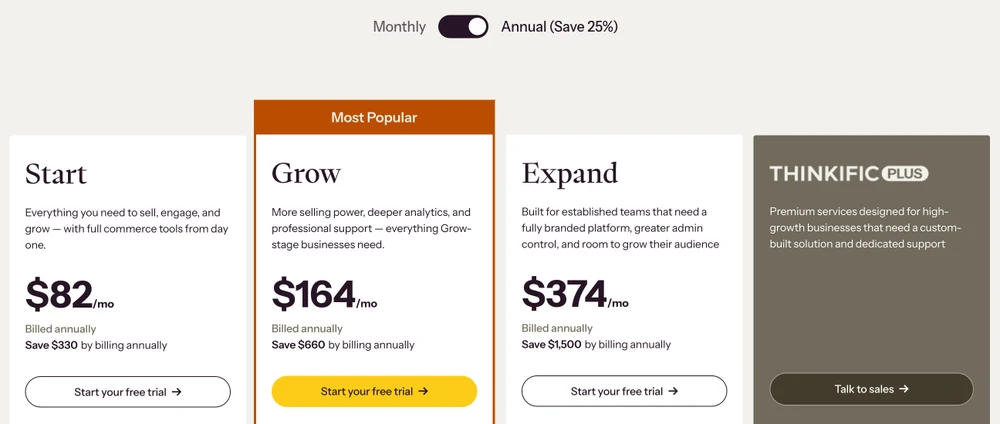
Thinkific’s pricing page on its default yearly setting. Read the small line under each price: all 3 figures are billed annually.
Start costs $978 a year and takes 2% of each sale made through your own Stripe account, Grow costs $1,968 a year and takes 1%, and Expand costs $4,488 a year and takes 0.5%. None of them adds a fee on Thinkific Payments.
| Plan | Monthly | Billed yearly | Own Stripe fee | PayPal | Communities |
|---|---|---|---|---|---|
| Start | $109 | $82/mo ($978/yr) | 2% | No | 1, with 10 spaces |
| Grow | $219 | $164/mo ($1,968/yr) | 1% | Yes | 3, with 20 spaces |
| Expand | $499 | $374/mo ($4,488/yr) | 0.5% | Yes | 10, with 200 spaces |
| Plus | Ask sales | Ask sales | None | Yes | Unlimited |
The yearly totals are 12 months of the monthly price minus the saving Thinkific prints on each card: $330 on Start, $660 on Grow and $1,500 on Expand. Until October 2026 the page also sold Basic, at $54 a month or $40 a month billed yearly. Archived copies of the pricing page show Basic on October 5 and gone by October 22, and the live Thinkific pricing page has no Basic card. Start’s price did not move in that window, so the entry price simply jumped from $40 to $82 a month on yearly billing.
On paper, Start is generous for a course seller. Unlimited courses, digital downloads and coaching products, video lessons, quizzes, assignments, completion certificates, live cohorts with unlimited Zoom sessions, bundles, payment plans, memberships and a custom domain are all on it.
What Start leaves out:
- No PayPal checkout. That starts on Grow.
- No bulk email to your students.
- Thinkific branding stays on your site and products.
- No Thinkific Analytics revenue reporting, no API and webhooks, and no Zapier actions.
Every self-serve plan caps current students, meaning anyone with unexpired access to a course, at 10,000.
Thinkific can sell files and coaching too, but if that is all you sell, $978 a year buys a lot of course player you will not use. A checkout like CartMango, which I run, sells downloads and subscriptions with no per-sale cut for $10 to $30 a year once paid plans start in November 2026, and it is free right now. CartMango does not host courses yet.
What 868 Trustpilot reviews say about Thinkific
Recent Trustpilot reviews of Thinkific are mostly 1-star, and billing and cancelling is the most common complaint. That is the picture behind a TrustScore of 1.8 out of 5 from 868 ratings, while 603 of those ratings are 5 stars. The dates explain the gap: nearly all of the 5-star reviews were posted before mid-2023.
Before June 2023, 720 of 763 Thinkific reviews gave 4 or 5 stars, while 90 of the 105 reviews posted since then gave 1 or 2 stars, and 27 of the 30 from the past 12 months did.
| Period | Reviews | 1-2 stars | 3 stars | 4-5 stars |
|---|---|---|---|---|
| Before June 2023 | 763 | 23 | 20 | 720 |
| June 2023 to October 2025 | 75 | 63 | 5 | 7 |
| Past 12 months | 30 | 27 | 0 | 3 |
How the reviews arrived changed too. 189 of the 200 newest 5-star reviews came through Trustpilot’s invitation system, the link a company sends its own customers to ask for a review. Of the 105 reviews written since June 2023, 103 came from people who went to the page on their own.
Those recent, unprompted reviews are the better guide to what customers say now. Sorting all 30 reviews from the past 12 months by their main complaint gives the table below. They came from 29 people, because 1 reviewer posted twice.
Billing tops the list: 12 of the 30 are about charges or cancelling, while no other topic reaches more than 3.
| What the review is about | Reviews | Example |
|---|---|---|
| Billing and cancelling problems | 12 | A yearly charge of over £900 after a free month |
| Lost access to their own courses after they stopped paying | 3 | A creator who could not reach their own course files |
| Lessons or checkout stopped working | 3 | A checkout that spun and never took the payment |
| Support | 3 | 2 complaints, 1 praising a refund |
| Students or email recipients, not sellers | 3 | A student whose lessons would not play |
| Payouts held, or Thinkific Payments switched off after an ID check | 2 | Funds held for almost a month |
| Platform limits | 2 | Limits that stayed after upgrading the plan |
| Locked out of the account | 2 | A password reset that led to the student site |
8 of the 12 billing reviews involve a free trial. Several reviewers believed they had cancelled during the trial, one of them by email, and were then charged for a full plan, in 2 cases a yearly one. The single 5-star review in that group describes an $888 yearly charge after cancelling by email, which Thinkific then refunded in full.
Thinkific replied publicly to 28 of the 30, and every review is on Thinkific’s Trustpilot page.
Testing Thinkific without paying for a year by mistake
Thinkific has no free plan to sign up for, so its 30-day free trial is how you test it, and Thinkific’s pricing FAQ says you can cancel at any time, including during the trial. The recent Trustpilot reviews show where that goes wrong. Thinkific’s cancel guide gives an in-admin path: Account, then Account Management, then Manage Subscription, then Cancel Plan, then the confirmation popups. A reviewer who cancelled by email was still charged, then refunded.
3 habits keep a trial from turning into a bill:
- Choose monthly billing if you are undecided. A yearly plan charges the whole year at once, which is how 2 reviewers ended up with yearly charges of $888 and over £900.
- Put the trial end date in your calendar a few days early.
- After cancelling, take a screenshot of the confirmation screen.
That sounds fussy. It is cheaper than a $978 charge for a platform you stopped using in week 2.
What Start gives you to build and teach a course
Every Thinkific plan, Start included, builds unlimited courses with video lessons, quizzes, assignments, completion certificates and live cohorts run over Zoom. Start allows 200 GB a month of students watching your videos. Grow doubles that, and Expand gives 1,000 GB.
A 2026 change catches people out. On sites created on or after January 28, 2026, Thinkific’s new course builder runs lesson discussions through a linked community space, so a comment under a lesson also appears in your community. The classic builder keeps discussions inside the lesson.
A course creator in an r/elearning thread hit this in September 2026. They had planned to move their courses to Thinkific, wanted students to post under each reflection activity, and worried that on the plan they meant to buy “I would only have three communities.” Thinkific links 1 community space per course, and Start includes 10 spaces inside its 1 community, while Grow includes 20 across 3.
If you run cohort-style courses, live cohorts are included on Start at $82 a month billed yearly. Our Maven alternatives guide prices that against the cohort marketplaces.
Getting paid, and what Thinkific keeps from each sale
Thinkific takes no extra percentage when you sell through Thinkific Payments, and it takes 2%, 1% or 0.5% of each sale on Start, Grow or Expand when you use your own Stripe account. Thinkific calls it a third-party payment gateway fee, a transaction fee on every sale that skips its processor.
The fee applies to sellers in the US, Canada, the UK and the EU, on the first $1 million of sales made through Thinkific in a calendar year, and Thinkific Plus pays none. Thinkific’s gateway fee FAQ sets it out plan by plan and says PayPal will be added to it in future.
Thinkific’s help center says its selling tools need Thinkific Payments, including order bumps, and it calls abandoned cart emails “exclusively on TCommerce”, its name for the Thinkific Payments setup. So a seller on their own Stripe pays the extra percentage and loses those tools too, while the pricing grid lists them on every plan.
Thinkific Payments is Thinkific’s own processor, run with Stripe and available in 36 countries, including the US, Canada, the UK, the EU, Australia and Singapore. Its fees are not zero. For a US seller, a card sale costs 2.9% plus $0.30, and Thinkific’s fee table lists these extras:
- 0.7% on subscriptions and payment plans
- 1.5% on international cards
- 1% when a currency conversion is needed
- 0.5% on each sale where Thinkific’s sales tax and VAT tool assesses tax, even at a 0% rate
- 6.5% plus $0.30 instead of the card rate on each buy now, pay later sale
In a month with $5,000 of sales through your own Stripe, Start adds $100, which is $1,200 a year on top of the $978 plan. Grow adds $50 a month, or $600 a year, on top of $1,968.
Grow costs $990 more a year than Start and saves 1% of sales, so upgrading only pays for itself past $99,000 a year in sales. At $2,000 a month in sales, a year on Start costs $1,458 against $2,208 on Grow. At $10,000 a month, Start costs $3,378 and Grow $3,168.
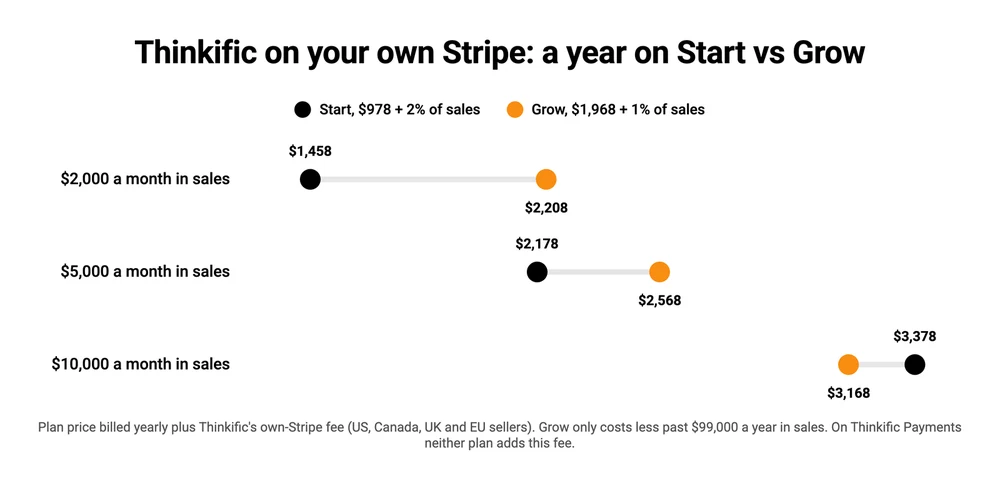
Plan price billed yearly plus Thinkific’s own-Stripe fee. Look at the bottom row: only there does Grow cost less.
Below $99,000 a year, Start plus its fee costs less, unless you need PayPal, which waits for Grow. If many of your buyers pay with PayPal, that alone can decide it.
On the Thinkific Payments side, 2 Trustpilot reviewers describe a different risk: funds held for almost a month after an identity check, and Thinkific Payments switched off after launch.
For comparison, CartMango charges no per-sale fee on any plan, and its order bumps work with your own Stripe or PayPal account. CartMango does not host courses yet, which is where Thinkific wins today.
Bringing buyers in with Thinkific’s selling tools
Thinkific gives you selling tools on every plan, including order bumps, upsells after purchase, abandoned cart emails, coupons, bundles, free trials and affiliate reporting, but order bumps and abandoned cart emails only run on Thinkific Payments. None of the tools brings you traffic. That still comes from your email list, your content and your ads.
2 limits on Start affect that work directly. Start includes email automation with ready-made sequences, but it cannot email your students in bulk, so a one-off launch email or new-course announcement goes through a separate email tool unless you pay for Grow. Start can send Zapier triggers but not Zapier actions, which narrows what other tools can do inside Thinkific.
Landing pages, the site builder, a members-only section and connecting your existing website are on every plan. If your main site already lives elsewhere, Thinkific can sit behind it as the course part, which is the route our guide to selling a course from your own website covers.
Leaving Thinkific without losing your work
Cancelling a Thinkific plan locks you out of the admin side at the end of the billing cycle. Thinkific’s cancel guide says you “will no longer be able to access, edit, or interact with any areas of Thinkific”, and lists your admin dashboard, your learning products, your landing pages and product pages, and your order, transaction and user tables. Custom domains, bundles and memberships stop working. You can upgrade again to get access back.
The guide says students keep access to what they bought, but its own checklist warns that students on active subscriptions keep being charged and lose access at their next billing cycle. 4 points from Thinkific’s help center are easy to miss:
- Only the site owner can cancel. Other admins cannot.
- Remove your custom domain as the primary domain first. If it is still primary when the plan ends, Thinkific says you cannot reach your admin through either web address until Support restores it.
- Cancel students’ recurring payments by hand before you cancel your own plan.
- On Stripe, students cannot cancel from their dashboard once you downgrade. Thinkific’s help center says those subscriptions must be deleted in Stripe by the site owner.
This is where 3 of the recent Trustpilot reviews come from. 2 creators stopped paying because their courses were not selling, then found they could not get back to their own material, and 1 of them describes a course still marked as published but “completely grayed out” in the account.
Of the reviews on Google’s first page, only the one written by a rival course platform walks through this. Before you cancel, download every video and file you uploaded, and save your student list and order history while the admin still opens.
Thinkific review: which plan does each job, and where CartMango fits
Thinkific Start covers the course itself for $978 a year, Grow adds PayPal and bulk student email for $1,968, and CartMango covers only the checkout for $10 to $30 a year.
| Job | Thinkific Start | Thinkific Grow | CartMango |
|---|---|---|---|
| Price, billed yearly | $82/mo ($978/yr) | $164/mo ($1,968/yr) | About $0.83 to $2.50/mo ($10 to $30/yr), free right now |
| Host courses and a community | Yes | Yes | Not yet, planned for October 2026 |
| Extra cut on your own Stripe | 2% | 1% | 0% |
| PayPal at checkout | No | Yes | Yes, every plan |
| Order bumps and upsells | Both, bumps on Thinkific Payments only | Both, bumps on Thinkific Payments only | Order bumps from $10, upsells from $20 |
| Email your buyers | Sequences, no bulk email | Sequences and bulk email | Syncs buyers to Kit, ActiveCampaign, beehiiv or BirdSend |
| After you cancel | Admin locked until you upgrade | Admin locked until you upgrade | Your recurring payments keep running |
CartMango is the checkout I run, so weigh its column with that in mind. CartMango fits a seller whose product is files, templates or coaching, not someone who needs a course player with quizzes today.
Course hosting and a community feature are planned for October 2026 on CartMango’s $30 a year plan. CartMango does not store video files, so any video you sell through it stays on a host like the ones in our video hosting guide.
FAQ
Is Thinkific legit?
Yes, Thinkific is a real course platform, with 868 Trustpilot ratings and a G2 badge of 4.4 stars from 426+ reviews on its pricing page. Its recent Trustpilot reviews show a billing and cancelling problem: 12 of the 30 from the past 12 months are about charges or cancelling. Thinkific replied publicly to 28 of those 30.
How much does Thinkific cost a month?
Thinkific costs $109 a month for Start, $219 for Grow and $499 for Expand on monthly billing. Billed yearly, the same plans cost $82, $164 and $374 a month. There is no free plan, and the $54 Basic plan left the pricing page in October 2026.
What percentage does Thinkific take?
Thinkific takes 0% extra on Thinkific Payments, where processing costs 2.9% plus $0.30 per US card sale. On your own Stripe account it takes 2% on Start, 1% on Grow and 0.5% on Expand, on your first $1 million of sales a year, and order bumps and abandoned cart emails stop working.
Which is better, Teachable or Thinkific?
Teachable vs Thinkific comes down to course count: Teachable is cheaper for a few courses, while Thinkific suits more courses or certificates on its cheapest plan. Teachable Starter costs $29 a month billed yearly with a 7.5% cut and a 5-product cap, and Builder costs $69 with 10 products and 0% on Teachable Payments. Thinkific Start costs $82 and includes unlimited courses and completion certificates. Teachable caps products at 5 or 10 on those 2 plans and adds course certificates only on Growth, at $139. Our Teachable review covers its 2026 fee changes.
What is better than Thinkific?
For a cheaper course host with a product cap, look at Teachable. For courses, email and a website on a single bill, see our Kajabi review and Podia review. For selling files, templates or coaching with no course player, a checkout such as CartMango costs $10 to $30 a year once paid plans start, and nothing right now.
Does Thinkific have a free plan?
No. Thinkific’s pricing FAQ offers a 30-day free trial instead. If you cancel a paid plan later, your account is downgraded and you lose access to the admin side. Students keep what they bought, and Thinkific’s cancel guide tells you to cancel students’ subscriptions by hand first.
The files and coaching that do not need a course player
This Thinkific review lands on a well-equipped course platform at a price that now starts at $978 a year. Plenty of course creators also sell things that need none of the course machinery, like workbooks, templates, recordings or a coaching package. Thinkific can sell those too, at that same price.
For those, CartMango is a checkout with no per-sale fee, order bumps on every plan and every buyer synced to your email tool. CartMango is free right now, and paid plans start in November 2026 from $10 a year.
About the Author

👋 I’m Welly, founder of CartMango (the site you’re on), a checkout platform for digital product sellers. We’ve previously processed $179M+. I also run BirdSend (email marketing tool, 3.1B+ emails sent). On the side I show other non-techie digital sellers how I use AI workflows to automate 50%+ of my operations. Find me on LinkedIn.
Related Reading
- Teachable review: the per-student fee on free courses and the 2026 payment bundles
- Kajabi review: what 94 recent Trustpilot reviews say and the own-processor fee
- Podia review: Mover’s 5% and what a failed plan payment does to members
- Sell online courses from your own website: 4 ways to host a course on your own domain
- Maven alternatives: cohort course platforms priced on yearly billing