

To make money from a newsletter, you monetize your subscribers through paid subscriptions, sponsorships and ads, affiliate links, or by selling your own products, services, or consulting. Selling your own offers is often the most profitable route, even on a small list. Most newsletters need a few thousand engaged readers before the income turns into real money.
Search “make money from a newsletter” and every guide hands you the same list. Sponsorships, subscriptions, affiliates, your own products. All true. All close to useless on their own.
Because none of them answer the 2 questions you actually have. How much will you make? And how big does your list need to be before any of it works?
I run an email tool and a checkout platform for creators, so I see both sides: the sending and the selling. The pattern almost never changes. People blame the method when the problem is the match between the method, the list size, and how much readers trust them. A small, tight list can out-earn a huge, cold one.
This guide skips the hype. You get what each method actually pays, the subscriber count it needs, and how to pick the one that fits the list you have today, not the one you wish you had.
Key Takeaways
- There are 6 main ways to monetize a newsletter: paid subscriptions, sponsorships, selling your own products, affiliate marketing, services or consulting, and selling the newsletter itself.
- List size decides the method. Sponsorships need a few thousand readers. Selling your own product or service can pay off with a few hundred.
- Most small newsletters earn little at first. Real free-to-paid conversion usually runs closer to 2 to 3 percent, well under the 5 to 10 percent platforms advertise.
- Selling your own products or services is usually the most profitable route on a small list, because you keep the full price instead of handing over a slice.
- The biggest newsletters make money on ads and acquisitions, not subscriptions. Morning Brew and The Hustle both sold for millions on the free-plus-ads model.
- A list you do not own is a liability. Grow subscribers on a platform you control, then monetize on your own terms.
How newsletters actually make money (the honest version)
A newsletter makes money for a single reason: enough people trust you to open, read, and act. That trust is the asset. Every method below is just a different way to turn it into revenue. Miss that, and no tactic saves you.
Email is a strong place to build that asset. Litmus has measured email marketing returning around 36 dollars for every dollar spent, one of the highest returns of any channel. But that number is an average across established senders. It is not a promise for a 300-person list in month one.
The uncomfortable truth: most small newsletters make very little at the start. When creators launch a paid tier too early, the results sting.
One creator posted on Indie Hackers after opening paid subscriptions on a list of more than 1,000 people and earning exactly nothing, “made 0 dollars” as the title put it. The comments diagnosed the real issue fast: a list is not a reason to pay. People pay for a specific, valuable thing they cannot get free.
Conversion math tells the same story. Substack’s own guidance tells creators to expect 5 to 10 percent of free readers to upgrade to paid. But independent estimates of real publications put the typical rate closer to 2 to 3 percent.
On a 1,000-person list at 3 percent and 8 dollars a month, that is 30 paying readers and about 240 dollars a month. A fine start, though not life-changing yet.
So the goal early on is not to squeeze the list. It is to grow it, keep it engaged, and pick a method that pays even when the numbers are small. That is where most people get it backwards.
Want the fastest wins first? My team put together a free 5-day challenge that walks you through the most common online selling mistakes solo creators make, including the ones that quietly cap newsletter income. It is a good gut-check before you pick a money method.
The 6 ways to make money from a newsletter
Almost every newsletter income story comes down to 6 methods. The table gives you an honest look at each: how it works, the list size where it starts to pay, a rough income read, and how much work it takes. The income column is illustrative math from the benchmarks cited in this post, not a guarantee. The hard, sourced numbers live in the next section.
| Method | How it works | List size to start | Rough income read | Effort |
|---|---|---|---|---|
| Sell your own products | Sell ebooks, templates, or courses to your readers | A few hundred | High per sale, scales with your offer | Medium |
| Services or consulting | Turn readers into coaching or freelance clients | A few hundred | Highest per client, hard to scale | Medium |
| Paid subscriptions | Gate premium content behind a monthly fee | 1,000+ engaged | Low early, compounds slowly | High |
| Affiliate marketing | Earn commission recommending tools you use | Any size | Low to medium, niche-dependent | Low |
| Sponsorships and ads | Brands pay to reach your readers | 2,000 to 5,000+ | Scales with subscribers | Medium |
| Sell the newsletter | Sell the whole audience as an asset | 50,000+ | One-time, large | Very high |
A quick note before the breakdowns: you do not pick one forever. Most creators stack 2 or 3 methods as the list grows. But you do pick one to start, and the right first move depends almost entirely on your numbers.
Selling your own products
For most small lists, this is the most profitable route, and it matches what I see. When you sell your own ebook, template pack, or course, you keep the full price instead of a commission. A 500-person list that trusts you can produce several hundred to a few thousand dollars from a single product launch, depending on the offer. You do not need scale, you need an offer your readers already want.
The mechanics are simple. You mention the product in your emails, link to a checkout, and the buyer pays. Where you host that checkout matters more than people think, because per-sale fees eat into a one-time product fast.
Options range from marketplaces to dedicated checkout tools like Gumroad, Payhip, or CartMango, the platform I run. If you are weighing them, this roundup of the best Gumroad alternatives breaks down the fee differences. One easy win most sellers miss: add an order bump at checkout, a small related add-on, to lift the average order value without extra traffic.
No product yet? Start with the audience you have and the expertise you already have. A short guide or template your readers keep asking for is usually the fastest first offer.
Services and consulting
The most under-rated newsletter income method, and the best fit for a brand-new list. If your newsletter shows expertise, some readers will want to hire you. A single consulting client at 1,500 dollars can out-earn a year of ads on a small list.
You share case studies and insight in the emails, then offer coaching, done-for-you work, or a paid audit. It does not scale like a product, since your time is the ceiling, but it turns a 400-person list into money faster than anything else.
Paid subscriptions
The subscription model. Readers pay a monthly or annual fee for your best, most exclusive content. It works beautifully at scale and painfully slow below it.
Remember the 2 to 3 percent conversion range: you need either a large free list or an unusually devoted niche audience for this to carry you. It fits deep, specialized content people rely on, like financial analysis or industry research, far better than a general-interest newsletter.
Where you run a paid newsletter changes what you keep. The fee picture:
| Platform | Cut of paid subs | Free tier can charge? | Best for |
|---|---|---|---|
| Substack | 10% + card fees | Yes, free to start | Writers who want zero setup |
| beehiiv | 0% + card fees | No, needs a paid plan | Growth-focused newsletters |
| Ghost | 0% + card fees | No, needs a paid plan | Owning your whole stack |
| Kit | ~0.6% + card fees | Yes, on the free plan | Creators with product funnels |
The trade-off comes down to this. Substack is free to start but takes 10 percent forever. beehiiv and Ghost take 0 percent but charge a monthly plan fee (beehiiv’s paid subscriptions need its Scale plan, which starts around 43 to 49 dollars a month and rises as your list grows).
Kit’s platform cut is tiny, roughly 3.5 percent all-in once you add card processing. For a deeper look at the economics, read our full guide to running a paid newsletter.
Affiliate marketing
The lowest-effort method, and it works at any size. You recommend tools or products you genuinely use, drop in a tracked affiliate link, and earn a commission on each sale. It pays little on a small list and adds up on a large, trusting one.
The rule that keeps it honest: only recommend things you would recommend for free. One burned recommendation costs more trust than the commission is worth.
Sponsorships and ads
Brands pay to put a message in front of your readers. This is the method with a hard subscriber floor. Most sponsors and ad networks want 3,000 to 5,000 active subscribers before they pay meaningful rates. Newsletter ad pricing runs on CPM, the cost per 1,000 opens, and industry benchmarks put it around 10 to 75 dollars depending on niche and audience quality.
Here is roughly what that pays per placement by size. Under 5,000 subscribers, expect 50 to 250 dollars. From 5,000 to 50,000, expect 500 to 3,000 dollars. Above that, it climbs into the thousands and beyond.
Cross-promotions with other creators are the free version, and often the fastest way to reach the subscriber count sponsors want. Our guide to email marketing partnerships covers how to set those up.
Selling the newsletter itself
The endgame most people never reach, worth knowing anyway. A large, engaged newsletter is a business someone will buy. It only applies at real scale, tens of thousands of engaged readers with steady revenue, but it is why the ad model quietly wins at the top (more on those numbers next).
How much can you make, and how big does your list need to be?
At the top, newsletters are serious businesses. Morning Brew, a free daily built entirely on ads and sponsorships, sold a majority stake to Business Insider’s parent company in a deal that valued it at around 75 million dollars in 2020. The Hustle, another free ad-supported daily, was acquired by HubSpot in 2021 with 1.5 million subscribers. Notice the pattern: the giants monetize with ads and exits, not subscriptions.
Paid subscriptions can still build a strong income with a fraction of that reach. Lenny Rachitsky, now one of the top business newsletters on Substack, said back in 2020 when he was starting out that around 500 paying subscribers were earning him “about 65,000 dollars a year before fees,” on roughly 15,000 free readers. His list is far bigger now, with third parties estimating seven-figure annual revenue, though he has stopped sharing exact numbers.
More recently, Forbes reported the food-and-business newsletter Feed Me is projected to reach seven figures across subscriptions and merch, on a base of 150,000-plus readers.
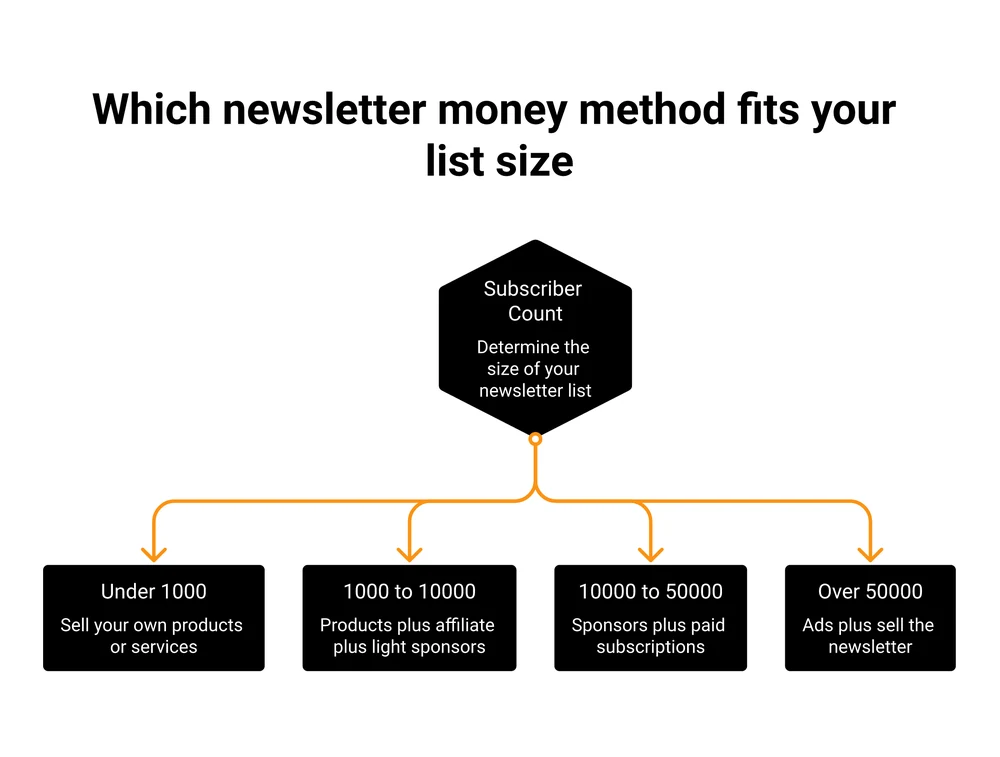
Now bring it back to your list. Here is the realistic read by size:
- Under 1,000 subscribers: sell your own product or service. Sponsorships and paid subs will not carry you yet. A small, tight list here can still produce a few hundred to a few thousand dollars from a single strong offer.
- 1,000 to 10,000: stack a product with affiliate income, and start light sponsorships near the top of that range. Paid subscriptions become viable if your niche is deep.
- 10,000 to 50,000: sponsorships become real money, paid subscriptions compound, and your own products scale. This is where full-time income is common.
- 50,000+: ads and acquisitions enter the picture, and the newsletter itself becomes a sellable asset.
The lesson underneath all of it: chasing subscriber count without a monetization plan is how you end up with a big list and a small bank balance.
How to start monetizing your newsletter
You do not need all 6 methods. You need one that fits your list today, plus the setup to run it. Use this order.
1. Grow and own your list first. Before any of this pays, you need engaged subscribers on a platform you control. If you are still early, start with the fundamentals in our guide to starting a newsletter, then use a simple lead magnet email sequence to convert new signups into readers who actually open.
2. Pick the method that matches your size. Use the list-size read above. Under 1,000 subscribers, that almost always means selling your own product or service, not launching a paid tier that no one buys.
3. Set up the money side. For selling products, price the offer so the math works on a small list, then connect a checkout to your emails so buyers can pay in a couple of clicks, and every buyer flows back into your email tool for the next offer. For paid subscriptions, turn on your platform’s paywall. For sponsorships, add a simple “sponsor this newsletter” page once you clear a few thousand readers.
4. Ship one offer, then improve it. Do not wait for a perfect list. Make the offer, watch what converts, and refine. Your first product will not be your best. It just has to exist.
Making money from a newsletter comes down to one move: match a real offer to the readers you already have. List size matters far less than most people think.
Common mistakes that kill newsletter income
- Monetizing too early, the wrong way. Launching a paid subscription to a small, general list is the classic “made 0 dollars” trap. Sell a product or service to that same list instead.
- No clear reason to pay. “Support my work” is not an offer. People pay for a specific outcome or exclusive content, not for access to more of what they already get free.
- Leaning on one method. Ad revenue swings, a single affiliate deal can end, one launch can flop. The steady newsletters stack 2 or 3 income streams.
- Renting your audience. If your subscribers live only inside a platform you do not control, you are one policy change from losing them. Keep your own copy of the list.
- Optimizing for subscribers over trust. A viral spike of cold subscribers who never open is worth less than 500 people who read every issue.
FAQ
Can you actually make money from a newsletter?
Yes, but rarely right away. A newsletter converts audience trust into income, so it pays once you have engaged readers and a real offer. Small lists can earn from selling their own products or services almost immediately. Sponsorships and paid subscriptions take a few thousand subscribers before the numbers matter.
How much does the average newsletter make?
There is no clean average, because it swings from zero to millions, and most small newsletters make little at first. A 1,000-person list converting at 2 to 3 percent to an 8-dollar subscription earns a couple hundred dollars a month. At the top, ad-driven newsletters like Morning Brew have sold for tens of millions. Income tracks list size, method, and audience trust far more than any average.
How many subscribers do you need to make money?
It depends entirely on the method. Selling your own product or service can pay off with a few hundred engaged readers. Sponsorships usually need 3,000 to 5,000 before rates get interesting. Paid subscriptions technically work at any size but need a large free list or a devoted niche to add up, given typical conversion rates near 2 to 3 percent.
How do you get people to pay for a newsletter?
Give them a specific reason that is worth more than the price. Exclusive analysis, a private community, templates, or a product that saves them time or makes them money. A paywall on its own is a tip jar. People pay when you put a clear outcome behind it, something your free content only hints at.
What is the easiest way to start making money from a newsletter?
Sell something you already have expertise in to the list you already have. A simple digital product or a consulting offer needs the fewest subscribers and keeps the most margin. It beats waiting months to hit the subscriber count that sponsorships or paid tiers require.
If your plan is to make money from a newsletter by selling to your readers, the checkout you use decides how much you keep. That is what I built CartMango for. Every buyer drops straight into your email tool, so you can sell to them again, and you keep more of each sale instead of losing a cut on every order.
It pairs with BirdSend, my email platform, so the sending and the selling run as one system. CartMango is free through beta, then starts at 10 dollars a year after that.
About the Author

👋 I’m Welly, founder of CartMango (the site you’re on), a checkout platform for digital product sellers. We’ve previously processed $179M+. I also run BirdSend (email marketing tool, 3.1B+ emails sent). On the side I show other non-techie digital sellers how I use AI workflows to automate 50%+ of my operations. Find me on LinkedIn.
Related Reading
- How to start a newsletter: the beginner setup, before you monetize
- What a paid newsletter really earns: the honest economics of subscriptions
- What is an order bump: lift your average order value at checkout
- Best Gumroad alternatives: for readers ready to pick a checkout
- How to price a digital product: so the math works on a small list