

4 Kartra plans, $59 to $549 a month: Essentials $59, Starter $119, Growth $229 and Professional $549. Annual billing drops Kartra pricing to $52, $99, $189 and $429 a month. Essentials is the only plan with a transaction fee, 5% of every sale, and it disappears from Starter upwards.
Search that price and you get 4 different answers. A page-1 guide still lists Silver, Gold and Platinum tiers that Kartra stopped selling. Another answers the question “does Kartra charge any other fee” with “None whatsoever”, on a platform whose cheapest plan takes 5% of every sale. A third quotes a $1 trial that is no longer on offer.
So I read Kartra’s own pricing page instead, tier by tier, then opened its FAQ. The prices themselves are simple. The hard part is working out which plan you land on, because the cheap one charges a percentage, and because Kartra’s own page disagrees with itself twice about what you get.
Below is every current number, the sales figure where the $59 plan quietly becomes the expensive one, and the fee Kartra tells you it does not charge.
Key Takeaways
- 4 plans, no free tier. $59, $119, $229 and $549 a month, or $52, $99, $189 and $429 if you pay for a year.
- Essentials takes 5% of every sale. Past roughly $1,200 a month in sales it costs you more than Starter at $119.
- Kartra’s FAQ contradicts itself. It promises “never any extra fees”, then describes a mid-cycle reconciliation fee when your contact list outgrows your plan.
- The annual saving is not 22% across the board. It runs from 11.9% on Essentials to 21.9% on Professional.
- The trial is 30 days free, capped at 1,000 emails. 3 of the 5 pages ranking for this term still quote a $1, 14-day trial.
Before the numbers, something worth doing first. Most of the money a solo seller loses is not on the platform bill, it leaks somewhere earlier. The free 5-day Online Selling Mistakes Challenge walks you through the 5 that cost the most.
Kartra pricing: what the 4 plans cost
Kartra sells 4 plans and none of them is free. A note on the yearly column before you read it: Kartra shows its annual plans as a monthly figure (“$99/mo, billed annually”) and never prints the total anywhere, so the year totals below are that figure multiplied by 12.
Essentials costs $59 a month and takes 5% of every sale, Starter costs $119 and takes nothing per sale, Growth is $229, and Professional is $549 a month or $5,148 for a year.
| Plan | Per month | Billed yearly | Year total | Contacts | Kartra’s cut |
|---|---|---|---|---|---|
| Essentials | $59 | $52/mo | $624 | 500 | 5% per sale |
| Starter | $119 | $99/mo | $1,188 | 2,500 | 0% |
| Growth | $229 | $189/mo | $2,268 | 12,500 | 0% |
| Professional | $549 | $429/mo | $5,148 | 25,000 | 0% |
Contacts is the number that moves you between plans. Kartra counts every lead in your account, not just buyers, so an opt-in form doing its job is what pushes you up a tier.
The 5% on Essentials, and the point where $59 costs more than $119
Past about $1,200 a month in sales, Essentials costs you more than Starter does. At $1,200 the 5% Kartra takes has grown to $60, which added to the $59 plan fee equals the $119 you would have paid for Starter with no cut at all.
On annual billing the crossover comes sooner, at roughly $940 a month in sales, because Starter drops to $99 while Essentials only drops to $52.
Here is the same math at 4 sales levels, on monthly billing:
- $500 a month in sales: Essentials $84, Starter $119. Essentials wins.
- $1,200 a month: Essentials $119, Starter $119. Dead heat.
- $2,000 a month: Essentials $159, Starter $119. Starter is $40 cheaper.
- $5,000 a month: Essentials $309, Starter $119. Starter is $190 cheaper, or $2,280 a year.
That 5% sits on top of your payment processor, not instead of it. Kartra does not process payments itself, it connects to your Stripe or PayPal account. So a $100 sale on Essentials costs you $5 to Kartra plus Stripe’s published 2.9% + $0.30, which is $8.20 in total.
PayPal’s own commercial rates vary by transaction type, and we break those down in our guide to what PayPal charges sellers.
Essentials also caps you at 1 product, 1 membership or course, 5 pages and 1 custom domain. So the plan you would pick to save money is the one you outgrow first, on 2 counts at once.
“Never any extra fees” and the fee on the same page
Kartra’s own FAQ promises a flat rate with no extra fees, then names an extra fee 4 questions later.
Asked “Does Kartra have any extra fees?”, it answers: “Your Kartra subscription is a flat-rate price, which means there are never any extra fees!” Further down the same FAQ, under “What happens if I reach the limits of my plan?”, it says something else.
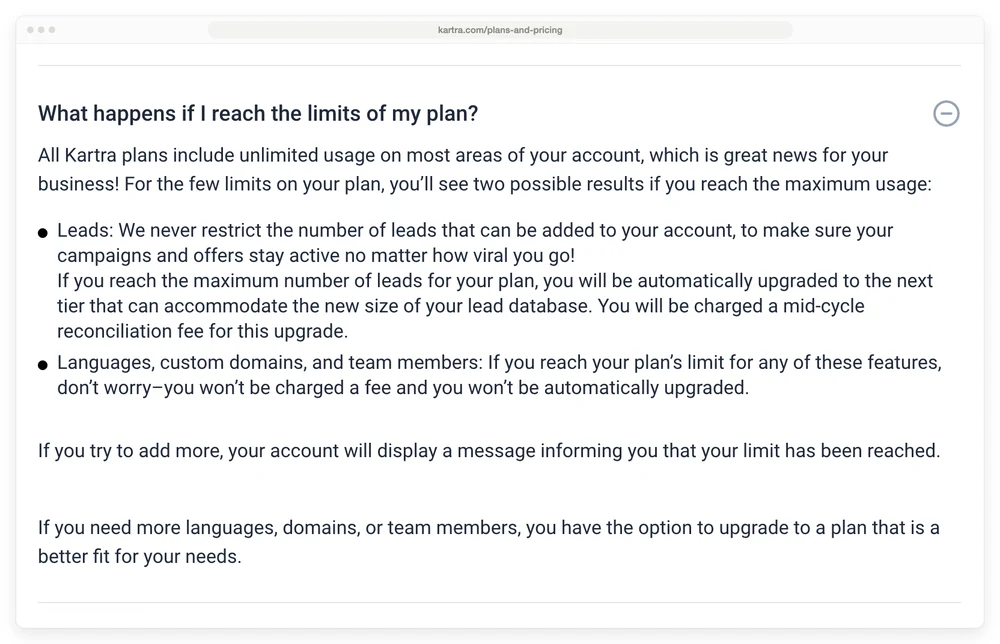
Kartra’s own FAQ. Read the Leads bullet.
The wording is: “If you reach the maximum number of leads for your plan, you will be automatically upgraded to the next tier that can accommodate the new size of your lead database. You will be charged a mid-cycle reconciliation fee for this upgrade.”
So crossing your contact cap moves you up a plan without you clicking anything, and bills you for the change part-way through your billing month. Kartra does not publish what that reconciliation fee comes to.
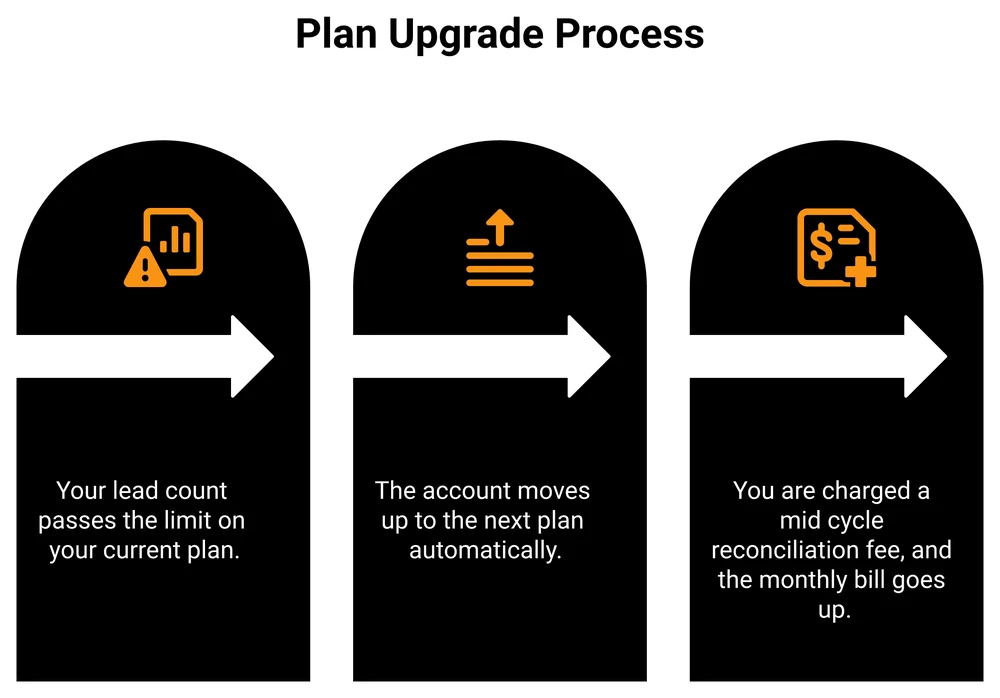
What happens when your contact list outgrows your Kartra plan.
Read together, the 2 answers say opposite things. Kartra promises a flat rate with no extra fees, then charges 2 of them: 5% of every sale on Essentials, and a reconciliation fee the moment you outgrow your plan.
It matters most on the 2 cheapest plans, because the jumps are large. Essentials holds 500 contacts and Starter holds 2,500, so a single decent lead magnet can push a new seller over the line. Starter holds 2,500 and Growth holds 12,500, a $110 a month step up.
Not one of the 5 pages ranking for this term mentions that reconciliation fee, and not one quotes the flat-rate promise sitting a few answers above it.
Course Platforms Review goes further. It answers its own FAQ question “Does Kartra have any other fee or cost I should know about?” with “None whatsoever. There are no hidden fees or transaction fees to be aware of.”
The string 5% does not appear anywhere on that page.
What each tier actually unlocks
Each Kartra plan removes a specific limit rather than adding a pile of features, so the useful question is which limit bites you first. Essentials is a single-product plan, Starter removes the product caps and the transaction fee, Growth adds the automation and affiliate tools, and Professional mostly buys headroom and live-chat support.
- Essentials, $59: 500 contacts, 10,000 emails a month, 1 custom domain, 5 pages, 1 product, 1 membership or course, 30 Kartra AI uses, 5% per sale.
- Starter, $119: 2,500 contacts, unlimited email and SMS, 0% per sale, unlimited pages, products and memberships, 100 AI uses, video hosting, 5 team members, calendars.
- Growth, $229: 12,500 contacts, 3 custom domains, funnel simulation, automations, affiliate management, surveys and quizzes, 10 team members, helpdesk.
- Professional, $549: 25,000 contacts, 5 custom domains, real-time funnel analytics, helpdesk live chat, API access, agency capacity.
The gap between Starter and Growth is the one to look at hard. Quizzes, surveys and affiliate management all sit on Growth. So if you sell courses and want a quiz, or you want affiliates selling for you, your real entry price is $229 a month and not $59.
Kartra’s own comparison table disagrees with its own plan cards
The “Compare features” table lower down Kartra’s pricing page is shifted a column against the plan cards above it, and it is worth knowing before you pick a tier from it.
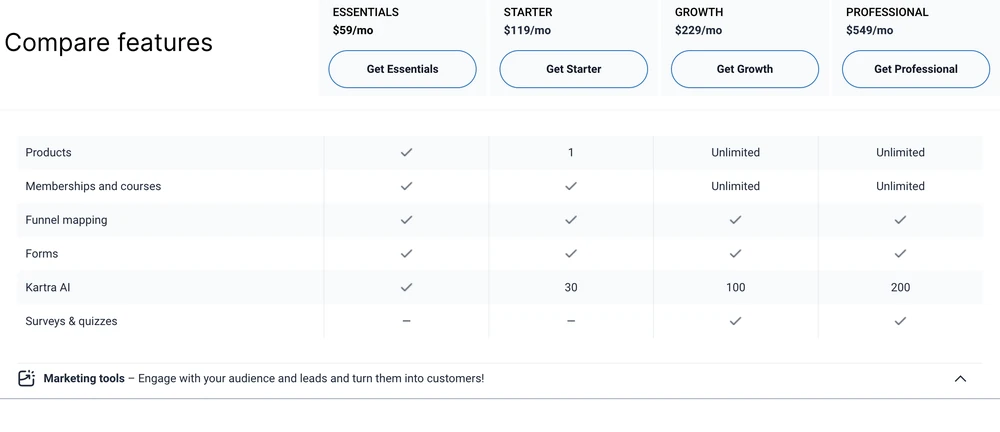
The Compare features table. The plan cards above it say Essentials gets 1 product and 30 AI uses.
Read the Products row and it tells you Starter gets 1 product and Growth gets unlimited. Read the plan card for Starter, 2 screens higher on the same page, and it says “Unlimited products”. The Kartra AI row does the same thing: the table reads 30, 100 and 200 across Starter, Growth and Professional, while the cards give Essentials 30 uses and Starter 100.
The rest of the page backs the cards, not the table. Kartra’s own per-plan breakdowns match the cards exactly. So the table is the wrong half, and a shopper comparing tiers will read it before anything else.
Worth stating plainly: this is a broken table, not a hidden charge. Nobody is being overcharged by it. It does mean the single page you would use to choose a plan cannot be trusted on its own, so check any tier against its plan card before you buy.
Monthly or annual: what you really save
Kartra’s pricing page says “Save up to 22%” and only the top plan gets near it. Essentials saves 11.9%, Starter 16.8%, Growth 17.5% and Professional 21.9%, so the smaller your plan, the less the yearly discount is worth.
| Plan | Pay monthly | Pay yearly | You save | Saving |
|---|---|---|---|---|
| Essentials | $708 | $624 | $84 | 11.9% |
| Starter | $1,428 | $1,188 | $240 | 16.8% |
| Growth | $2,748 | $2,268 | $480 | 17.5% |
| Professional | $6,588 | $5,148 | $1,440 | 21.9% |
The pages ranking for this term give 3 different figures for that discount: roughly 17%, up to 20%, and up to 22%. On Essentials, the plan a new seller is most likely to pick, it is none of the 3.
There is a second reason to think twice about paying yearly on the smaller plans. Cross your contact cap and Kartra upgrades you automatically, so a year paid up front on Essentials is a year of headroom you may not keep.
Is there a free Kartra plan?
No. Kartra has no free tier at any level, and the cheapest way to use it is the 30-day free trial, which is capped at 1,000 emails while it runs.
The trial length is the number most guides get wrong, and Kartra is part of the reason. Its trial page reads “Start your free 30-day trial”, with “30-days free” printed on each plan card and a 30-day money-back guarantee on top. A second Kartra page, still live at kartra.com/14-day-trial, reads “Start your 14-day free trial”. 3 of the 5 pages ranking for this keyword describe a $1, 14-day trial, which was the older offer.
That 1,000-email cap on the trial is not stated on any of them. It will bite if you plan to test a real broadcast to a real list before you pay.
Already comparing platforms rather than plans? Our breakdown of what Kajabi charges covers the closest all-in-one rival, including a tier Kajabi keeps off its public pricing page.
How Kartra pricing compares with Kajabi and ClickFunnels
Kartra is the cheapest of the 3 big all-in-one platforms to get into, and the only one whose entry-plan percentage you cannot avoid. Kajabi opens at $89 a month and takes 5% as well, but only if you connect your own Stripe rather than using Kajabi Payments. ClickFunnels opens at $97 and takes no cut at all. Kartra’s 5% on Essentials applies whichever processor you use.
| Platform | Cheapest plan | Cost | Cut per sale | Hosts courses |
|---|---|---|---|---|
| Kartra | Essentials | $59/mo | 5%, always | Yes, 1 course |
| Kajabi | Kickstarter | $89/mo | 0% on Kajabi Payments, 5% on your own Stripe | Yes, 1 product |
| ClickFunnels | Entry plan | $97/mo | 0% | Yes |
| Payhip | Free | $0 | 5% | Yes |
| CartMango | Silver | $10 a year, free until October 2026 | 0% | Not yet, planned for October 2026 |
I run CartMango, so treat the last row as an interested party’s number rather than a neutral one. CartMango does the checkout, the order bumps and the sales page, and it does not host a course today.
The 3 all-in-ones are closer to each other than to anything else on that table. Which one is cheapest depends on which limit you hit first: Kartra moves you on contacts, Kajabi on products and contacts, and ClickFunnels on funnels and domains. For the head-to-head on the other 2, see ClickFunnels against Kajabi, and what GoHighLevel costs if you are weighing an agency-first option too.
Is Kartra worth the price?
Kartra earns its price when you genuinely use the bundle, and it is poor value when you use 3 pieces of it. At $119 a month you are buying a page builder, an email tool, a checkout, a membership host, video hosting, forms, calendars and a helpdesk on a single bill. The cheapest honest comparison is the stack you would otherwise assemble yourself.
I am not against paying for that. Years ago I migrated a Google Workspace account by hand and lost half a day just moving files, and I still had to buy a paid tool to finish the job.
What I wrote at the time was: “I’d rather pay money because money can be gotten back. But not time.” An all-in-one is that trade in software form, and for plenty of people it is a good one.
The problem is when the trade is not real. A seller with 1 course, 1 sales page and a small list is paying $1,188 a year for a suite where a handful of the tools do the work.
That is the case Reddit tends to make loudly. In a thread on r/advancedentrepreneur asking for course platform recommendations, the poster opened with this: “I use Kartra and I absolutely hate it. It’s expensive and is a huge pain to use, with many steps for the simplest task.”
Kartra suits you if you run funnels, send real email volume, want affiliates and can use the helpdesk and calendars. It suits you badly if your business is 1 course and a checkout, because you will pay Growth prices for quiz features and Starter prices for tools you never open.
Ruzuku, which sells a course platform and ranks for this keyword, makes a version of this point well: quizzes and certificates sitting on Growth means a course seller’s real Kartra entry price is $229 a month. That is worth taking seriously, competitor or not.
If you sell courses and want to see the field first, our comparison of platforms for hosting an online course prices 7 of them properly, and our guide to selling an online course covers the part that happens before you pick software at all. If the membership side is what you are really buying, our breakdown of membership site platform costs covers that separately.
FAQ
How much does Kartra cost per month?
Kartra costs $59 a month for Essentials, $119 for Starter, $229 for Growth and $549 for Professional. Paying for a full year drops those to $52, $99, $189 and $429 a month, billed annually. There is no free plan at any tier.
Does Kartra charge transaction fees?
Yes, on the Essentials plan only. Essentials takes 5% of every sale, on top of whatever Stripe or PayPal charges you. Starter, Growth and Professional take 0%. Kartra’s marketing describes its pricing as flat-rate with “never any extra fees”, which does not square with either the 5% or the reconciliation fee above.
What happens if I go over my Kartra contact limit?
Kartra upgrades your account to the next tier automatically and charges what its FAQ calls a mid-cycle reconciliation fee. It does not publish the amount. Hitting your limit on languages, custom domains or team members works differently: nothing is charged, you simply cannot add more until you upgrade.
Is Kartra free?
No. Kartra runs a 30-day free trial, capped at 1,000 emails, plus a 30-day money-back guarantee if you stay. After that the cheapest plan is $59 a month, or $52 a month paid yearly. Older guides describing a $1, 14-day trial are out of date.
Is Kartra better than ClickFunnels?
It is cheaper to start with and charges a percentage that ClickFunnels does not. Kartra opens at $59 a month plus 5% of sales. ClickFunnels opens at $97 a month with no cut. At about $760 a month in sales the 2 cost the same, and above that Kartra’s entry plan is the dearer of the 2.
If checkout is the only piece you need
If the checkout is the only piece you need, none of these plans is the right buy, because every figure in this Kartra pricing breakdown is the price of a whole suite. Once you have worked out that you use 3 tools out of the bundle, the real question is whether you need a platform this big at all.
CartMango does the checkout half and nothing else. CartMango puts order bumps and a hosted sales page on its $10 a year Silver plan, and upsells, downsells and cart abandonment on the $20 a year Gold plan. CartMango takes 0% of your sales on every plan, and all of them are free until October 2026.
CartMango does not host courses or run an affiliate program today, though the affiliate system is due in September 2026 and the course and community features in October 2026. If you need a course platform this month, one of the platforms above is the right answer and I would rather say so. But if working through Kartra pricing has convinced you the suite is bigger than your business, the checkout on its own costs a fraction of it.
About the Author

👋 I’m Welly, founder of CartMango (the site you’re on), a checkout platform for digital product sellers. We’ve previously processed $179M+. I also run BirdSend (email marketing tool, 3.1B+ emails sent). On the side I show other non-techie digital sellers how I use AI workflows to automate 50%+ of my operations. Find me on LinkedIn.
Related Reading
- Podia pricing broken down: another all-in-one whose limits force a whole-tier upgrade
- Teachable pricing broken down: all 4 plans, including one that is not on the pricing page
- ClickFunnels alternatives: for readers weighing the funnel side rather than the course side
- Community platform costs: what the community tools Kartra leaves out actually cost