

PayPal has no single fee. For most sellers, a payment through PayPal checkout costs 3.49% plus $0.49 per transaction, money sent to you for goods and services runs 2.99%, and personal payments from a bank or balance are free. International sales, currency conversion, and instant withdrawals all cost extra.
Look up what PayPal charges and you get 5 different answers.
One site says 2.9% plus $0.30. Another says 3.49% plus $0.49. A third quotes a flat 2.99%.
They cannot all be right, and a few of them are quoting a US rate PayPal retired years ago.
On small sales, the fixed fee does more damage than the percentage. That flat charge on every transaction means a $10 product loses closer to 8% to PayPal, not the 3% the rate card implies. If you sell a lot of low-priced digital products, PayPal takes a bigger bite than the headline rate makes it look.
This post lays out every current US PayPal fee, which rate applies to your exact situation, and what each one costs on a real sale. All figures were checked against PayPal’s own fee pages in July 2026.
Key Takeaways
- PayPal has no one fee. What you pay depends on how the money reaches you: a checkout, a card, an invoice, or a friend sending cash.
- The rate quoted most often, 2.9% plus $0.30, is retired. The current online checkout rate is 3.49% plus $0.49 per sale.
- The fixed fee is what hurts small sales. A $10 sale loses about 8.4% to PayPal, while a $1,000 sale loses about 3.5%.
- Sending money to friends and family is free from a bank or balance, but costs 2.90% plus $0.30 by card and 5% on international transfers.
- Refunds do not return your fee. Chargebacks, currency conversion, and instant withdrawals are all extra costs sellers overlook.
How much PayPal charges, by transaction type
There is no one PayPal fee because PayPal is really several products in one: a checkout button, a card processor, an invoicing tool, a QR reader, and a way to send cash to a friend, each with its own rate.
Here is the full US fee schedule for sellers and personal accounts, straight from PayPal’s merchant fee page and consumer fee page.
| Transaction type | Fee (2026) | When it applies |
|---|---|---|
| PayPal Checkout, Guest Checkout, Venmo | 3.49% + $0.49 | A buyer pays through your online checkout |
| Money received for goods and services | 2.99% | Someone sends you money marked as a purchase |
| Standard card payment | 2.99% + $0.49 | You take a credit or debit card directly |
| QR code, in person | 2.29% + $0.09 | Face-to-face sale over $10 |
| Pay Later (buy now, pay later) | 4.99% + $0.49 | Buyer splits the payment |
| International commercial sale | add 1.50% | Buyer is outside the US |
| Friends and family, from bank or balance | Free | Personal payment, not a purchase |
| Friends and family, by card | 2.90% + $0.30 | Personal payment funded by a card |
One number to retire: if you have seen 2.9% plus $0.30 quoted as “the PayPal fee,” that is the old US commercial rate. It is not what you pay today.
A quick offer before the rest of the fees. If watching fees eat into your margin is new to you, it usually points to other quiet profit leaks in how you sell.
My free 5-day Online Selling Mistakes Challenge walks through the 5 most common ones and how to fix them. No cost, just email.
Good news on one front: a standard PayPal account has no monthly fee and no setup fee. You only pay when money moves. That is different from tools that charge a flat monthly subscription whether you sell anything or not.
The rate that confuses everyone: 2.99% vs 3.49%
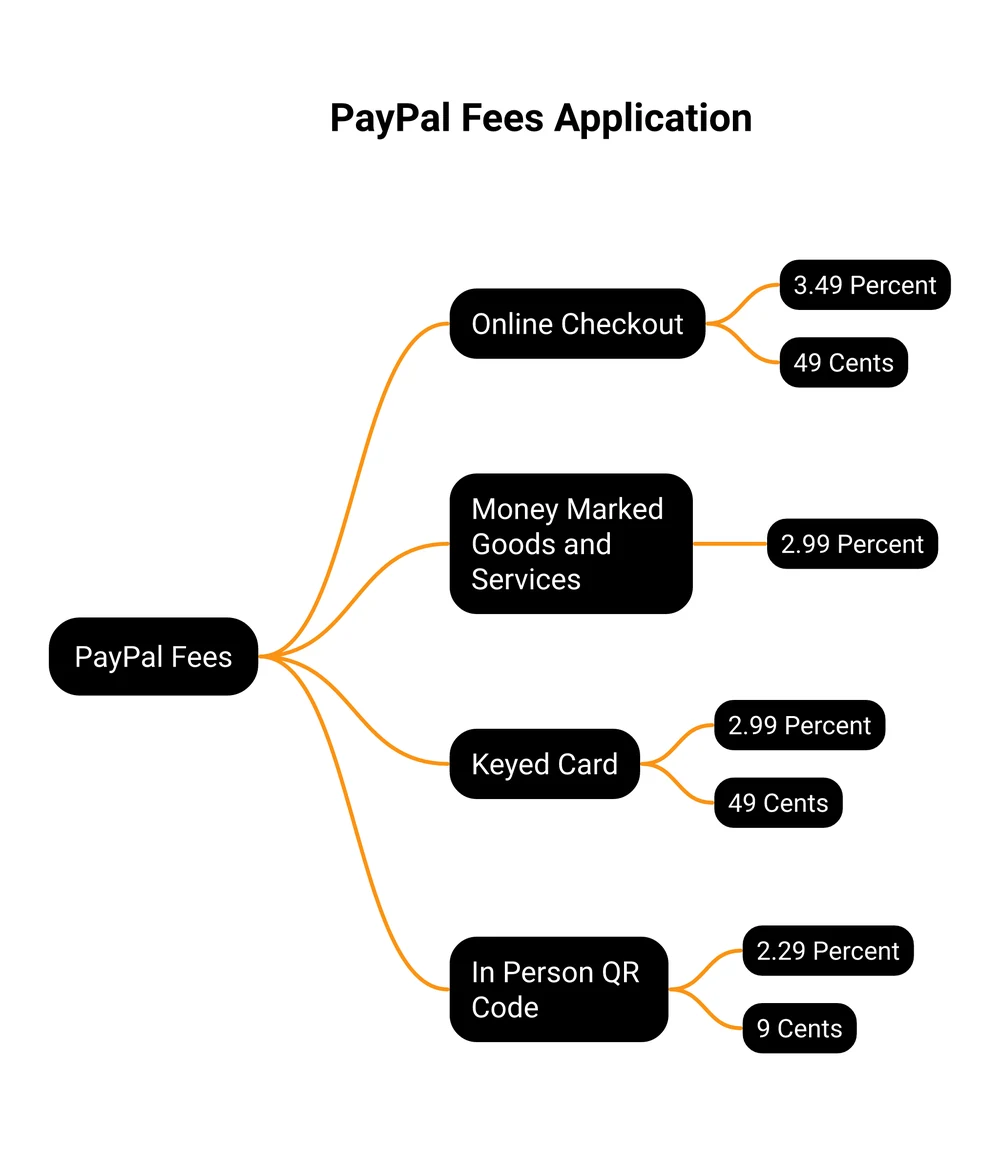
Most of the confusion around PayPal fees comes down to 2 numbers that look similar and mean different things: the 2.99% goods-and-services rate and the 3.49% plus $0.49 transaction fee for checkout. Which one you pay depends entirely on how the payment reaches you.
When a buyer pays through your checkout
This is the rate most digital sellers actually pay. If a customer clicks a PayPal button on your site, your store, or a payment link, that is a PayPal Checkout transaction. The fee is 3.49% plus $0.49. Guest checkout and Pay with Venmo run at the same rate.
When someone sends you money marked as a purchase
If a buyer opens PayPal, sends you money, and tags it as goods and services, that is a flat 2.99% with no fixed fee attached. It is cheaper than checkout for larger amounts because there is no $0.49 riding on top. The catch is you have less control over the buying experience.
When you key in a card
Take a customer’s card details directly, through an invoice or a virtual terminal, and you are looking at 2.99% plus $0.49 for a standard card payment. It is the same 2.99% as a goods-and-services payment, with the fixed 49 cents added on top because you are keying the card.
In-person and QR code
Selling face to face with a PayPal QR code is the cheapest option at 2.29% plus $0.09 for sales over $10. Most digital sellers never touch this, but market and event sellers do.
So who actually pays the fee? The seller, every time. The buyer pays nothing to complete a purchase. And you cannot legitimately tack a “PayPal surcharge” onto the buyer’s total to recover it, since that breaks PayPal’s seller rules in most cases.
What PayPal actually costs on a $10, $100, or $1,000 sale
The percentage alone hides the real cost, because that fixed $0.49 does not shrink when your product is cheap. On a small sale it can dwarf the percentage.
Here is what PayPal takes on a range of sale prices, using the standard checkout rate of 3.49% plus $0.49:
| Sale price | PayPal fee | You keep | Effective rate |
|---|---|---|---|
| $10 | $0.84 | $9.16 | 8.4% |
| $27 | $1.43 | $25.57 | 5.3% |
| $47 | $2.13 | $44.87 | 4.5% |
| $100 | $3.98 | $96.02 | 4.0% |
| $500 | $17.94 | $482.06 | 3.6% |
| $1,000 | $35.39 | $964.61 | 3.5% |
Read the effective rate column top to bottom. A $10 sale loses 8.4% to PayPal, not the 3.49% the rate card suggests. A $1,000 sale loses 3.5%. Same fee structure, very different real cost.
This is why the fixed fee matters so much to digital sellers. Sell a $10 template and you give up about 8.4% of every sale before you count refunds or anything else.
The lower your prices, the more that flat 49 cents stings, which is worth remembering when you price your digital products. Bundling 3 $9 items into one $27 order cuts the fee by about 40%.
None of this makes PayPal a rip-off. The fee is just worth checking against your own prices, especially early when your side hustle is built on small orders.
The international fees that quietly stack up
Sell to a buyer outside the US and PayPal adds a cross-border fee of 1.50% on top of the base rate. So a checkout sale to an overseas customer runs about 4.99% plus $0.49 instead of 3.49% plus $0.49.
Then there is the fee almost nobody mentions: currency conversion. If PayPal has to convert the money into your currency, it adds a spread of 3% to 4% above the base exchange rate. That is charged on top of the cross-border fee, so a cross-currency sale can lose 5% or more before you even reach the standard rate.
On the personal side, sending money internationally to friends or family costs 5% of the transfer, with a minimum of $0.99 and a maximum of $4.99.
The layering is exactly why people get confused. In a Reddit thread on PayPal fees, one user worked out that a $100 payment by debit card left the recipient with $91.80, while the same amount from a bank account left $94.70.
Another summed it up in 3 words: “Man this is confusing.” Hard to argue with that.
The PayPal fees nobody advertises
The rate card leaves plenty out. These are the charges that surprise sellers after the fact.
Refunds do not return your fee. When you refund a customer, PayPal sends them the full amount back but keeps the fee you originally paid to receive the payment. PayPal’s merchant terms put it plainly: “the fees you originally paid to receive the payment are not returned to you.”
So a refunded $100 sale still costs you the $3.98 you paid in fees. The buyer gets everything back, PayPal keeps its cut, and you eat the difference.
Chargebacks and disputes. If a buyer disputes a charge through their card issuer, PayPal charges the seller a $20 chargeback fee. A dispute filed through PayPal carries a $15 standard dispute fee, rising to $30 for sellers with high dispute rates.
Getting your money out. Moving your balance to your bank the standard way is free and takes 1 to 3 business days. Want it in minutes? Instant Transfer costs 1.75% of the amount, capped at $25.
| Hidden fee | What it costs |
|---|---|
| Refund | Original fee kept, not returned |
| Chargeback | $20 per case |
| Standard dispute | $15 per case |
| Instant transfer to bank | 1.75%, max $25 |
None of these show up on the headline rate, and together they can add up to real money over a busy month.
How to reduce PayPal fees, and the trick that gets accounts frozen
You cannot make PayPal free, but you can stop leaking money to it.
- Use standard withdrawals. Skip the 1.75% Instant Transfer when you can wait a day or two for the money. The free standard option costs nothing.
- Avoid unnecessary currency conversion. If you hold a balance in another currency, converting it costs 3% to 4%. Where you can, get paid and hold funds in the same currency.
- Raise your price points or bundle. Since the fixed fee hits small orders hardest, a $27 bundle keeps more of your money than 3 separate $9 sales.
- Apply for micropayments if you sell cheap items. PayPal has a micropayments rate of 4.99% plus $0.09. The tiny $0.09 fixed fee makes it cheaper than standard pricing on sales under about $27, and PayPal automatically applies whichever rate costs you less.
- Ask PayPal about volume rates. High-volume sellers can contact PayPal to discuss custom merchant pricing. It is not advertised, but it exists.
Now the tip you will see everywhere that you should ignore. Plenty of guides suggest asking buyers to pay through Friends and Family to dodge the seller fee. Do not do it.
Friends and Family is for personal payments, not purchases. Using it for a real sale breaks PayPal’s rules, strips both buyer and seller protection, and can get your account limited or frozen if PayPal spots the pattern. The few dollars you save are not worth losing your ability to get paid.
If PayPal fees have you rethinking how you collect payments, it helps to know how to sell without a single platform or add a checkout to your own site.
What PayPal’s fees mean if you sell digital products
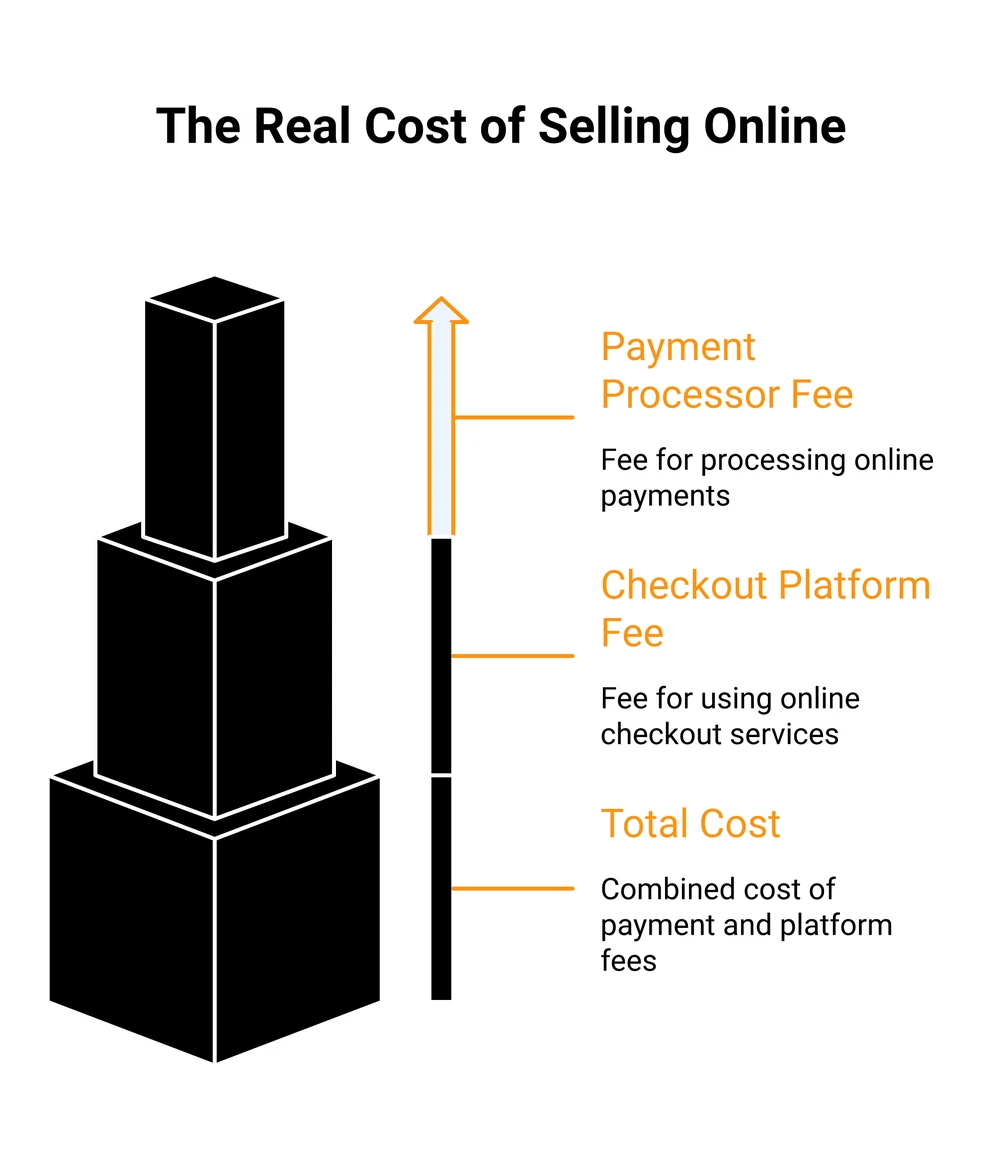
Here is the piece most fee guides skip. PayPal is a payment processor. Its job is to move the money. The real cost of selling is that processing fee plus whatever you use to run the checkout itself: the page, the cart, the upsells, the file delivery.
Some sellers run PayPal on its own. Others add a dedicated checkout platform, like Gumroad, Payhip, or CartMango (which I run).
Each of those has its own cost: a per-sale percentage, a monthly plan, or a flat yearly price. The number that matters is the total, the payment processing plus whatever your checkout platform adds.
That total is what you should compare when you look at where to sell besides a marketplace or weigh up the best Gumroad alternatives. A tool with a small yearly fee but no per-sale cut can beat a “free” tool that takes a percentage of every order, once you sell enough volume. At low volume, the free option usually wins.
Do not stop at the PayPal number. Add up the whole stack.
PayPal fees FAQ
How much does PayPal charge for a $100 transaction?
Through PayPal checkout, a $100 sale costs $3.98 (3.49% plus $0.49), leaving you $96.02. As a standard card payment it is $3.48 (2.99% plus $0.49). A personal payment from a friend’s bank or balance is free.
How much does PayPal charge for a $500 transaction?
A $500 checkout sale costs $17.94, so you keep $482.06. As a standard card payment the fee is $15.44. International sales add 1.50%, and currency conversion adds another 3% to 4% if PayPal has to switch currencies.
How much does PayPal take out of $1,000?
On a $1,000 checkout sale, PayPal takes $35.39 and you keep $964.61. As a standard card payment the fee drops to $30.39. The bigger the sale, the closer your effective rate gets to the base percentage.
Is there a fee for using PayPal?
Opening and holding a PayPal account is free, and there is no monthly fee on a standard account. You pay per transaction when you sell (2.99% to 3.49% plus a fixed fee) or when you send a personal payment by card. Receiving money from a friend’s bank or balance costs nothing.
PayPal is one of the most widely used ways to get paid online, with 426 million active accounts across 202 markets as of 2022. That reach is the reason so many sellers accept it, fees and all. The smart move is simple: know your real effective rate on the sales you actually make, and watch that fixed fee on every small order.
You cannot make PayPal’s cut disappear, but the checkout you sell through is a cost you can control. CartMango is the checkout platform I built for digital sellers who want to keep more of every sale: a flat yearly price, no per-sale cut, plus upsells and order bumps that lift what each buyer spends. Free during the beta, then $10 a year.
About the Author

👋 I’m Welly, founder of CartMango (the site you’re on), a checkout platform for digital product sellers. We’ve previously processed $179M+. I also run BirdSend (email marketing tool, 3.1B+ emails sent). On the side I show other non-techie digital sellers how I use AI workflows to automate 50%+ of my operations. Find me on LinkedIn.
Related Reading
- How to price digital products: set prices that still profit after fees
- Add a shopping cart to your website: 4 ways to take payments on your own site
- Where to sell besides Etsy: marketplaces vs your own store, with real fee math
- The best Gumroad alternatives: for readers comparing checkout platforms