
Kajabi vs Kartra comes down to what you sell and your list size. Kajabi fits course and community sellers, with public plans from $179 a month. Kartra fits funnel-heavy marketers from $59 a month plus 5% a sale, or $119 on its cheapest no-cut plan, and stays cheaper until your list passes 12,500 contacts.
The plan prices here come from each brand’s own pricing page. Billed yearly, they drop to $143, $52 and $99 a month. Kajabi adds 2% on Basic, 1% on Growth and 0.5% on Pro only when you use an outside card processor. Past 12,500 contacts Kartra moves you to its $549 Professional plan automatically, while Kajabi Growth holds 25,000 for $249.
Kajabi and Kartra both promise to replace your whole tool stack: courses, pages, email and checkout on 1 bill. Their entry prices sit $120 a month apart, $59 against $179.
The 13 comparisons that rank for this search also disagree with each other. Only 2 state both per-sale fees, 5 still quote retired Kajabi prices, and Kajabi’s own comparison says every Kartra plan takes 0%. Kartra Essentials takes 5%.
Price each job your course business needs on both platforms, at the plan you would actually buy, and 2 things decide the pick: whether your buyers need a community, and how big your list will get.
Leaving, the last job below, costs your buyers their access on both.
Key Takeaways
- Kartra costs less on a small list. At 2,500 contacts, Kartra Starter is $119 a month and Kajabi Basic is $179, before per-sale fees.
- The cheaper pick flips above 12,500 contacts. From there Kartra needs its $549 Professional plan, while Kajabi Growth holds up to 25,000 contacts for $249.
- Check the per-sale fee for your plan. Kartra Essentials takes 5% of every sale. Kajabi takes 2% on Basic, but only with an outside processor.
- Kajabi wins the course job. Every public Kajabi plan adds a community space and a student app, while Kartra offers comment forums inside its memberships.
- Leaving hurts on both. Pages go offline, buyers lose access, and both help centers warn their subscriptions can keep charging until you cancel them.
- CartMango, the checkout I run, covers the checkout jobs only. CartMango’s order bumps start at $10 a year from November, upsells need $20, affiliates $30, and it hosts no courses yet.
Kajabi vs Kartra pricing at a glance
Kartra sells 4 plans from $59 to $549 a month, and Kajabi’s pricing page shows 3 from $179 to $499. Both give you 14 days free and a 30-day money-back guarantee, and both price partly by contacts.
Whichever platform you pick, a launch can still lose sales to its pricing, its sales page or a missing follow-up. The Online Selling Mistakes Challenge covers the 5 mistakes solo sellers make most, and how to fix each, over 5 short emails.
Kartra Essentials is the only plan below that takes 5% of every sale whatever processor you use, while Kajabi adds 2%, 1% or 0.5% only when you skip Kajabi Payments and PayPal.
| Plan | Monthly | Billed yearly | Contacts | Products | Cut per sale |
|---|---|---|---|---|---|
| Kartra Essentials | $59 | $52 a month | 500 | 1 | 5% |
| Kartra Starter | $119 | $99 a month | 2,500 | Unlimited | 0% |
| Kartra Growth | $229 | $189 a month | 12,500 | Unlimited | 0% |
| Kartra Professional | $549 | $429 a month | 25,000 | Unlimited | 0% |
| Kajabi Basic | $179 | $143 a month | 2,500 | 5 | 0%, or 2% on another processor |
| Kajabi Growth | $249 | $199 a month | 25,000 | 50 | 0%, or 1% on another processor |
| Kajabi Pro | $499 | $399 a month | 100,000 | Unlimited | 0%, or 0.5% on another processor |
Kajabi prints its yearly totals on its pricing page: $1,716 for Basic, $2,388 for Growth and $4,788 for Pro. Kartra’s plans page shows only the per-month rate on yearly billing and a “save up to 22%” label, so a Kartra yearly total is 12 times that rate: $5,148 for Professional, for example.
Kajabi also sells a Kickstarter plan at $89 a month, for 1 product and 250 contacts, through a direct signup link rather than its pricing page. It caps you at 250 contacts, so it drops out of every comparison below. Everything this post says about Kajabi’s plans refers to the 3 on its pricing page.
Kartra’s 14-day trial caps every plan at 1,000 emails until it ends.
For a full breakdown of each brand on its own, see what every Kajabi plan costs and Kartra’s 4 plans in detail.
Hosting the course: Kajabi has the community and the app
Kajabi is the stronger course host of the 2, because every plan puts a private community and a customer app for iPhone and Android next to the course itself. Your buyers watch lessons and talk to each other in 1 place, on their phone, and you build none of it.
Kajabi Basic sells 5 products, and courses, coaching, memberships, downloads and podcasts all count toward that 5. Growth raises that to 50 and adds live cohort courses, where a group starts together and moves through on a schedule. Pro is the plan that puts your own branded app in the App Store.
Kartra builds courses inside its membership portal, with drip scheduling and comment forums that you can moderate. Essentials holds 1 membership or course and 5 pages. Starter opens unlimited memberships, courses, pages and products, and it is the first plan whose card lists video hosting.
What Kartra’s plans page does not list at any price is a separate community space or a student app. If your members expect their own feed and groups between lessons, that gap decides the job before price comes into it.
CartMango, which I run, does not host courses today. Its course hosting and community are still being built and will arrive on the $30 a year plan, and neither is live yet.
Taking the money: checkout, upsells and the per-sale fees
Kajabi and Kartra both build checkout pages with order bumps, upsells and downsells, and they differ on what each takes from a sale. Kajabi’s pricing page leads with “0% revenue share,” and its plan table, behind the “Compare every feature” link, carries a fee row for outside processors.
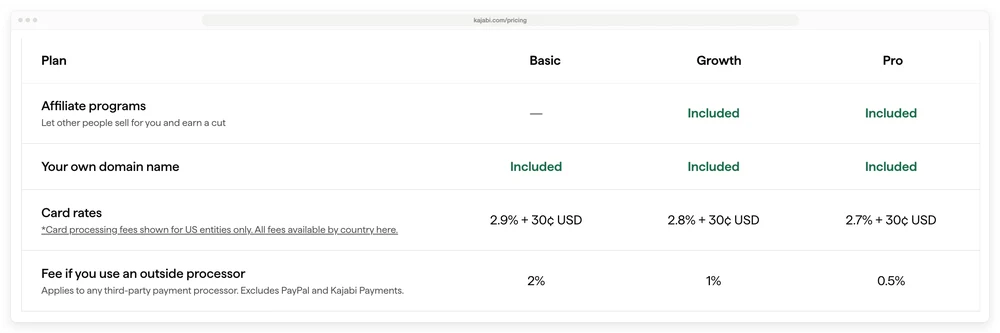
Kajabi’s own plan table. Read the last row, “Fee if you use an outside processor.”
That row reads “Fee if you use an outside processor,” and Kajabi’s note under it says: “Applies to any third-party payment processor. Excludes PayPal and Kajabi Payments.” Kajabi’s fee help page adds that Kajabi Payments runs for businesses registered in Australia, Canada, select European countries, the UAE, the UK and the US. Outside those, there is no extra fee for using Stripe.
Kartra has no card processor of its own. It connects to Stripe, PayPal, Authorize.net and Braintree, and Stripe’s standard US rate is 2.9% + 30¢ a card. On top of that, Essentials takes 5% of every sale. Starter takes nothing, so the $60 a month between the 2 plans pays for itself once you sell more than $1,200 a month.
Kajabi’s own comparison page gets Kartra’s fees wrong: it says Kartra “offers three pricing plans” and that “All plans include 0% transaction fees.” Kartra lists 4, and the cheapest one is the only plan on either platform that takes a cut whatever processor you use.
On a $100 card sale in the US, Kajabi Basic through Kajabi Payments and Kartra Starter both leave you $96.80, Kajabi Basic on your own Stripe leaves $94.80, and Kartra Essentials leaves $91.80.
| Plan and how you get paid | Card fee | Platform cut | You keep |
|---|---|---|---|
| Kajabi Basic, Kajabi Payments | $3.20 | $0 | $96.80 |
| Kajabi Basic, your own Stripe | $3.20 | $2.00 | $94.80 |
| Kajabi Growth, your own Stripe | $3.20 | $1.00 | $95.80 |
| Kartra Essentials, Stripe | $3.20 | $5.00 | $91.80 |
| Kartra Starter, Stripe | $3.20 | $0 | $96.80 |
| CartMango, Stripe | $3.20 | $0 | $96.80 |
That last row is my own product, CartMango. Each row also pays a plan price: $143 or $199 a month billed yearly on the Kajabi rows, and $52 or $99 on the Kartra rows. CartMango’s plans will cost about $0.83 to $2.50 a month billed yearly ($10 to $30 a year) once paid plans start in November, and CartMango is free right now.
Kajabi Growth also lowers its own card rate to 2.8% + 30¢ through Kajabi Payments, and Pro to 2.7% + 30¢, so a high-volume seller on Kajabi’s own processor pays slightly less per sale than on Kartra.
Affiliates sit on the Growth plan on both
Kartra and Kajabi both keep affiliate programs off their cheaper plans, so you need Kartra Growth at $189 a month billed yearly or Kajabi Growth at $199. Kartra lets you set commission percentages and pay affiliates by PayPal, bank wire or check, according to its affiliate feature page. Kajabi’s plan table describes the feature in 1 line: “Let other people sell for you and earn a cut.”
CartMango runs affiliates on its Platinum plan, $30 a year (about $2.50 a month billed yearly), for up to 250 affiliates, but it hosts no course for those affiliates to send buyers into yet.
Emailing the list: unlimited sends, with Kartra bundling more extras
Kajabi sends unlimited marketing email on every plan, while Kartra caps Essentials at 10,000 emails a month and goes unlimited, with SMS included, from Starter.
The automation split runs along plan lines again. Kajabi keeps advanced automations, the ones that branch on a condition such as “bought product A but not B,” for Growth and Pro, along with webhooks and a comment-to-DM tool for social posts. Kartra lists automations on Growth too, but its cheaper plans already carry a funnel mapper, 100 pre-built campaigns and, from Starter, calendars for booking calls. Growth adds a helpdesk, surveys and quizzes.
That bundle is what 1 Kartra user credits. In an r/EcommerceWebsite thread, a commenter who ran a coaching program on Kartra for 8 months wrote that running “funnels, checkout, and video hosting in the same spot saved me hours compared to juggling WordPress + ActiveCampaign.” The same person added: “I recouped the $99/mo after my second upsell campaign, so ROI can be fast if you actually ship funnels.”
CartMango has no email marketing tool. It passes each buyer to the email tool you already use, with native connections to Kit, ActiveCampaign, Beehiiv and BirdSend, which I also run.
Paying for your list as it grows
Both platforms charge by contacts, and Kartra’s tiers climb faster: its Growth plan holds 12,500 contacts, half of the 25,000 on Kajabi Growth. That single difference is what flips the cheaper platform as a list grows.
Kartra counts every lead in the account, buyers or not, so a lead magnet that works is what pushes you up. Its plans page answers “What happens if I reach the limits of my plan?” like this: “If you reach the maximum number of leads for your plan, you will be automatically upgraded to the next tier that can accommodate the new size of your lead database. You will be charged a mid-cycle reconciliation fee for this upgrade.”
The same FAQ, 3 questions earlier, calls the subscription “a flat-rate price, which means there are never any extra fees.”
Kajabi takes a softer line. Its plan table counts the “number of contacts you can email and market to.” Its FAQ says it will let you know when you hit a limit, and you can either move up a plan or add contacts “in blocks of 25,000 for $125 a month, at any size.” So a Basic account at 3,000 contacts costs less on Growth ($249) than on Basic plus a block ($304).
Kartra is the cheaper of the 2 up to 12,500 contacts, by $60 a month at 2,500, then Kajabi Growth undercuts Kartra Professional by $300 a month at 25,000.
| Your list, up to | Kartra plan | Kartra price | Kajabi plan | Kajabi price | Cheaper |
|---|---|---|---|---|---|
| 500 contacts | Essentials | $59 ($52), plus 5% a sale | Basic | $179 ($143) | Kartra, by $120 before its 5% |
| 2,500 contacts | Starter | $119 ($99) | Basic | $179 ($143) | Kartra, by $60 |
| 12,500 contacts | Growth | $229 ($189) | Growth | $249 ($199) | Kartra, by $20 |
| 25,000 contacts | Professional | $549 ($429) | Growth | $249 ($199) | Kajabi, by $300 |
| 100,000 contacts | None listed | No price published | Pro | $499 ($399) | Only Kajabi lists a plan |
Prices are monthly, with the per-month rate on yearly billing in brackets. On yearly billing the gaps are $44 at 2,500 contacts, $10 at 12,500 and $230 at 25,000, so the order is the same.
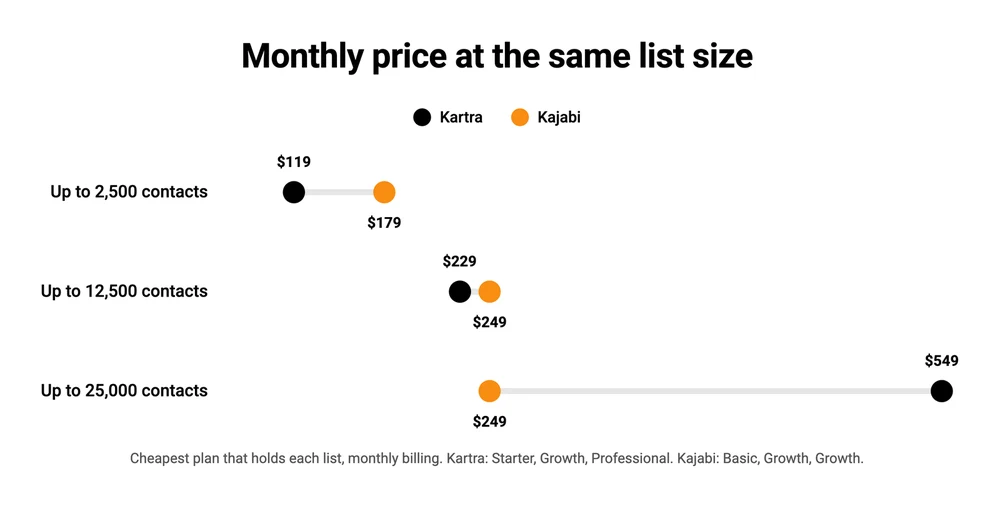
The cheapest plan that holds each list, on monthly billing. Kartra is cheaper in the first 2 rows and costs $300 more in the third.
The plans in each row are not identical, so check what you would give up. At 2,500 contacts Kajabi Basic includes the community and app but caps you at 5 products, while Kartra Starter sells unlimited products with comment forums but no separate community space. At 25,000 Kartra Professional adds live chat to the helpdesk that comes with Growth, plus real-time funnel analytics, and Kajabi Growth lists neither.
Leaving: what your buyers lose when you cancel
Canceling either platform takes your pages and course offline at the end of the billing period, and both warn that your buyers’ subscriptions can keep charging unless you cancel them yourself. None of the 13 ranking comparisons says what happens to your buyers when you leave.
Kajabi’s cancellation guide says your site goes inactive on the date the account is set to cancel, at the end of the billing period, and customers “will lose access to the Products they have purchased.” It is blunt about recurring payments: “Each subscription has to be canceled individually, by you, or the customer will keep being charged.” Customer data may be deleted 90 days after the account ends, your custom domain is disconnected, and any legacy plan price is gone if you come back.
Kartra offers 2 exits in its freeze or cancel guide. Freezing costs $9.99 a month in storage and keeps your setup, but pages, files and member content stop loading for visitors and you cannot edit them. Canceling ends the storage fee, and Kartra warns your account data “may be gradually deleted.” Its guide also tells you to cancel active customer subscriptions before you go, or customers “may continue being charged for content they can no longer access.”
Before you cancel either one:
- Export your contact and customer lists.
- Download every course video and file you uploaded.
- Cancel or move each active subscription, one by one.
- Move your custom domain to its next home.
Which platform covers which job
Kajabi alone hosts a course with a community space and a student app, Kartra matches it on checkout, email and affiliates on its Growth plan, and CartMango covers checkout and affiliates without hosting a course.
| Job | Kajabi | Kartra | CartMango |
|---|---|---|---|
| Host the course | Every plan, with a community space and app | 1 course on Essentials, unlimited from Starter, comment forums | Not yet |
| Checkout, bumps, upsells | Checkout on every plan, 2% on Basic with an outside processor | Checkout on every plan, 5% on Essentials | Bumps from $10 a year, upsells at $20, 0% a sale plus Stripe’s card fee |
| Email and automations | Unlimited email, advanced automations on Growth | 10,000 emails on Essentials, automations on Growth | No email marketing, buyers go to your email tool |
| Affiliates | Growth, $199 a month billed yearly | Growth, $189 a month billed yearly | Platinum, about $2.50 a month billed yearly |
| Growing list | 2,500, 25,000 or 100,000 contacts | 500 to 25,000, moves you up automatically | Plans not priced by contacts, buyers sync to your email tool |
| Leaving | Site offline, data may be deleted after 90 days | Freeze for $9.99 a month, or cancel | Subscribers keep paying you through your own Stripe or PayPal |
Pick Kajabi if your buyers will use a community and a student app, or once your list passes 12,500 contacts. Pick Kartra if you live in funnels, want calendars and a helpdesk in the same login, and your list stays at or under 12,500. A course seller with a small list and no need for a community saves $60 a month on Kartra Starter up to 2,500 contacts, or $44 on yearly billing.
If neither bundle fits what you sell
A seller with a few low-priced files gets the least out of either bundle, because both charge the same plan price in a slow month as in a busy one. At $179 a month, Kajabi Basic needs 7 sales of a $27 ebook to cover the plan, before card fees.
A course with a community on a tighter budget has cheaper homes, and our list of 8 Kajabi alternatives priced all-in compares them on the same basis. If funnels are the whole business, ClickFunnels against Kajabi is the closer comparison. An agency running client accounts should read GoHighLevel against Kajabi first.
FAQ
Is there anything better than Kajabi?
For a funnel-led business with a list under 12,500 contacts, Kartra costs less every month and bundles calendars and a helpdesk. For a course with an active community, Kajabi is the stronger of these 2, because every public plan includes the community and a student app. For a seller who only needs a checkout or a cheaper course host, a smaller tool usually fits better, and our Kajabi alternatives list prices 8 of them.
How much is Kartra per month?
Kartra costs $59, $119, $229 or $549 a month on monthly billing for Essentials, Starter, Growth and Professional. On yearly billing the per-month rates are $52, $99, $189 and $429. Essentials also takes 5% of every sale, and Kartra moves you up a plan automatically when your contacts pass the plan’s limit.
What are the downsides of Kajabi?
Kajabi’s main downsides are price and the limits on Basic: 5 products, 2,500 contacts, no affiliate program and a “Powered by Kajabi” footer for $179 a month. Using your own Stripe instead of Kajabi Payments adds 2% a sale on Basic, in the countries where Kajabi Payments runs. Canceling takes your site offline and your students lose access to what they bought.
Is Kartra legit?
Yes. Kartra is a real, paid product run by Kartra Inc. from Las Vegas, and its plans page says 60,000+ coaches and business owners use it. Reviews are mixed: our Kartra review found slow or hard-to-reach support was the top complaint in 14 of the 37 Trustpilot reviews giving 1 or 2 stars.
Is Kartra free to use?
No, Kartra has no free plan. You can try any plan free for 14 days, with sending capped at 1,000 emails during the trial, and Kartra adds a 30-day money-back guarantee once you pay. After that the cheapest plan is Essentials at $59 a month, or $52 a month billed yearly.
What is the Kajabi app used for?
The Kajabi app lets your customers open your courses and community on iPhone and Android, and it comes with every public plan with nothing to build. On Pro, Kajabi also publishes your own branded app in the App Store under your name. Kajabi’s own FAQ names that app, and running more than 1 brand, as the reasons to pick the $499 plan.
When the checkout is the only job you need done
Kajabi vs Kartra is a choice between 2 bundles, and both charge for the whole bundle on every bill, whether you use the course area, the email tool and the funnel builder or not. That is a fair trade for a seller who uses all of it.
If your course host and email tool are already set, the part you need may be only a sales page and a checkout with order bumps and upsells. CartMango does that job on its own: Mini Pages for the sales page, order bumps on every plan, upsells on the $20 plan and affiliates on the $30 plan, with 0% a sale plus Stripe’s card fee. CartMango is free right now, and paid plans start in November from $10 a year.
About the Author

👋 I’m Welly, founder of CartMango (the site you’re on), a checkout platform for digital product sellers. We’ve previously processed $179M+. I also run BirdSend (email marketing tool, 3.1B+ emails sent). On the side I show other non-techie digital sellers how I use AI workflows to automate 50%+ of my operations. Find me on LinkedIn.
Related Reading
- Kajabi Review: 94 recent Trustpilot reviews sorted, the own-processor fee and what cancelling does to students
- Kartra Review: all 127 Trustpilot reviews sorted by how they arrived, and which plan fits which seller
- Kajabi vs Teachable: live prices and the 2 break-even points between them
- ClickFunnels Alternatives: 8 options priced at the same 10,000 contacts