

ThriveCart vs Stripe is a choice between a checkout and the payment account under it, since ThriveCart charges cards through Stripe. Stripe alone (2.9% plus 30¢ a sale, no monthly fee) suits a seller testing an offer. ThriveCart ($444 a year, 0% of a basic sale plus Stripe’s fee) suits funnel and course sellers.
Costs below use 40 sales of $97 a month. ThriveCart sends payments to a new Stripe sub-account through Stripe Connect+, and accounts opened before April 2025 on an older connection pay 0.5% extra. CartMango, which I run, suits bumps and upsells on a small budget: free right now, from $10 a year once paid plans start in November, 0% a sale plus Stripe’s fee.
A new course seller asked this on Skool, almost word for word: would Stripe on its own do the same job as ThriveCart? It sounds like a yes-or-no question, and it has 5 different answers.
Pick wrong on the ThriveCart side and you pay $444 a year for features you never switch on. On the Stripe side, the mistake is wiring file delivery, follow-up emails and upsells together yourself.
And in 2026 ThriveCart changed how it connects to Stripe, which shifts the answer for anyone who already sells. The cost table uses 40 sales of $97 a month, and each seller situation ends with a pick, a price and what you give up.
Key Takeaways
- ThriveCart runs on Stripe. It passes on Stripe’s 2.9% plus 30¢ and takes 0% of a basic sale, so the plan price is most of the gap.
- New ThriveCart accounts get a new Stripe sub-account. Stripe Connect+ sends new sales there, while subscribers you already bill keep paying into your old account.
- Older ThriveCart connections now cost 0.5% more. Since October 8, 2026, accounts opened before April 2025 pay 0.5% extra on payments through a legacy Stripe connection.
- Stripe alone already sells add-ons. Payment Links, with no monthly fee, take promo codes and up to 10 optional items, but offer no 1-click upsell after payment and deliver no files.
- Affiliates and extra bumps need ThriveCart Pro+. Standard at $444 a year has 1 order bump and 1-click upsells. Pro+ costs $804 a year.
- CartMango sends sales straight to your Stripe or PayPal. CartMango puts order bumps on its $10 a year plan and upsells on its $20 plan, with no cut per sale.
ThriveCart vs Stripe: the checkout and the account underneath
ThriveCart charges your buyers’ cards through Stripe, so on a basic sale with a US card you pay Stripe’s 2.9% plus 30¢, the same rate Stripe’s pricing page lists for anyone.
Wondering whether your checkout is what’s costing you sales? In the free Online Selling Mistakes Challenge, 5 short emails walk through the mistakes solo sellers keep making.
ThriveCart’s own fee page says it “charges 0% fees” and that the fees you see are “processor fees passed on from Stripe, PayPal and Authorize.Net.” That 0% holds for a basic sale and stops there. The same page lists its own add-on fees: on the Standard subscription plan, 0.10% on subscription bumps, 5% of the first payment a retention offer saves, and 0.5% on each sale where it calculates and collects tax.
ThriveCart also does a job Stripe never tries to do. Every ThriveCart subscription plan comes with a ThriveCart Academy plan for courses and communities, and the Academy plan on Standard covers unlimited courses and up to 2,000 community members. It replaced the older course tool, ThriveCart Learn, which ThriveCart closed to new accounts in May 2026.
What each setup costs on 40 sales of $97 a month
On 40 sales of $97 a month, the all-in monthly total is $124.52 for Stripe alone, $161.52 for ThriveCart Standard, $180.92 for ThriveCart Standard on an older (legacy) Stripe connection, $191.52 for ThriveCart Pro+, and about $126.19 for CartMango’s $20 a year Gold plan once paid plans start.
| Setup | Plan, a month | Card fees | Total | Upsells after payment |
|---|---|---|---|---|
| Stripe alone | $0 | $124.52 | $124.52 | No |
| ThriveCart Standard | $37 | $124.52 | $161.52 | Yes |
| ThriveCart Standard, legacy Stripe link | $37 | $143.92 | $180.92 | Yes |
| ThriveCart Pro+ | $67 | $124.52 | $191.52 | Yes |
| CartMango Gold | about $1.67 | $124.52 | about $126.19 | Yes |
Every plan price is the yearly bill divided by 12, so all 5 rows sit on the same basis. ThriveCart prints $444 a year for Standard and $804 a year for Pro+. Paid month to month, they are $47 and $87, which makes those totals $171.52 and $211.52.
The card fees are 2.9% of $3,880, which is $112.52, plus 30¢ on each of the 40 sales, which is $12. The legacy row adds ThriveCart’s 0.5% on $3,880, another $19.40, and only accounts opened before April 2025 can still be on that kind of connection. CartMango, the checkout I run, is free right now, so today its row is just the $124.52. From November, CartMango’s $10 a year Silver plan carries order bumps, and its $20 Gold plan adds upsells.
None of these totals include sales tax collection or cards from abroad. Stripe adds 1.5% for international cards, and ThriveCart’s fee page lists the same 1.5%.
If you are still checking whether the offer sells
A seller with an idea and no sales yet should start with Stripe alone and a Payment Link. It covers the few people who might buy before you know the offer works.
That is the advice a member gave in a Skool thread where a newcomer asked this exact question: “I started out with just Stripe (and ThriveCart uses Stripe) so it can work just fine.” Their suggestion was blunt. “Create a payment link and see if you can get a few people you already know you buy it using Stripe.”
It costs nothing up front. A $97 sale costs about $3.11 in card fees and there is no plan to pay for. A Payment Link can carry promo codes and up to 10 optional items, which buyers tick before paying, per Stripe’s Payment Links guide. Our SamCart vs Stripe breakdown shows Stripe’s optional-items screen.
What you give up is everything around the payment. There is no sales page, so the same member “built the landing page on notion and then linked to Stripe for payment.” After the sale, Stripe’s post-payment options include a thank-you message or a redirect to a URL you choose, and neither is a protected download. Our Gumroad vs Stripe comparison covers that delivery gap. They were clear about the limit too: “It worked for validating the idea but after that you’ll need something better.”
If your Stripe account already holds customers and subscribers
A seller who already bills customers through Stripe can add ThriveCart, but only by running 2 Stripe accounts side by side. Pick ThriveCart in this situation only if that is fine with you.
ThriveCart’s help center says Stripe Connect+ is its default Stripe connection for every plan, and accounts created after April 2025 cannot connect the older versions at all. Connecting Connect+ does not reuse your current account. In ThriveCart’s own words, “Stripe will be setting up an additional Stripe sub-account” and “all transactions moving forward will be processed via that new sub-account.” You reach it from a dropdown in your Stripe dashboard.
New sales land in the new sub-account. Subscribers you already bill keep paying into the old one, and ThriveCart tells you to check the new account’s bank details, payout schedule and identity checks so payouts are not delayed. For ThriveCart subscriptions on an older connection, its team can move them across, with exceptions: subscriptions still in a trial, ones with a set number of payments, and paused ones cannot be migrated.
If you already use ThriveCart on an older connection, this one costs you. ThriveCart’s help center says that from October 8, 2026, payments through “supported legacy Stripe payment integrations will carry a 0.5%” fee, and its fee page lists the same 0.5% for non-Connect+ accounts.
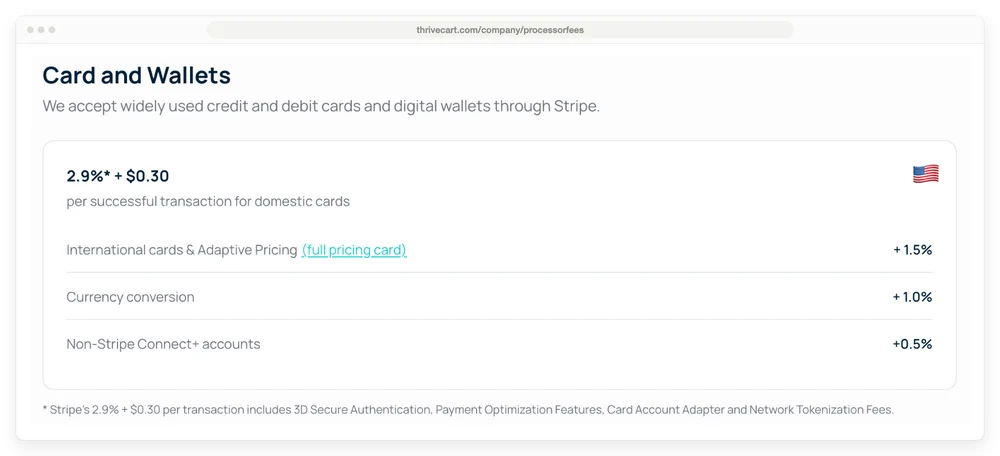
ThriveCart’s processor fees page. Read the last line: Non-Stripe Connect+ accounts pay +0.5%.
On $3,880 a month that is $19.40 a month, or $232.80 a year. The same page lists a “Bring your own Stripe account” option as “coming soon”, priced “From 2%”, without saying whether that 2% replaces Stripe’s card fee or sits on top of it. Ask ThriveCart support which applies before you plan around it.
If every buyer should see a second offer
A seller who wants a second offer on every sale needs a checkout, because Stripe alone covers only the half before payment. For example, a $97 course with a $27 workbook offered at checkout, a 1-click offer after payment, and maybe affiliates later.
Stripe’s optional items work before payment, and Payment Links can also offer a monthly subscriber the yearly plan at checkout, but there is no 1-click offer after payment. Abandoned carts are a build job too. Stripe’s abandoned-cart guide says that to send the emails you “create a webhook handler for expired sessions and send an email that embeds the session’s recovery URL.” In plain terms, someone has to write code that sends each reminder. Plenty of buyers leave, too: Baymard Institute’s tally of 50 studies puts the average cart abandonment rate at 70.22%.
The pick is ThriveCart Standard if you also want courses in the same place, and a cheaper checkout if you mainly want the bumps and upsells. ThriveCart Standard, at $444 a year or $47 a month, has 1 bump offer, 1-click upsells and downsells, A/B split testing and abandoned cart recovery. Multiple order bumps, the affiliate center with automated payouts and subscription dunning (automatic retries of failed card payments) sit on Pro+, which is $360 a year more. ThriveCart’s help center adds that Pro+ features such as multiple order bumps need Stripe Connect+ set up.
CartMango puts order bumps on its $10 a year Silver plan, upsell pages and cart abandonment on its $20 Gold plan, and an affiliate system for up to 250 affiliates on its $30 Platinum plan. The abandoned-cart emails send through the email tool you connect. CartMango does not host courses yet, so ThriveCart’s Academy is the reason to pay ThriveCart’s price if your product is a video course.
If overseas buyers mean VAT on every sale
A seller whose first overseas sales raised the VAT question should use the tax tool on the checkout they already have: Stripe Tax on a Payment Link, ThriveCart’s own on ThriveCart. A member in the same Skool thread described the problem: “I’m having a serious hold-up in my sales because I setup stripe, made my first few sales, and now need to collect and pay VAT taxes in several countries overseas.”
Stripe and ThriveCart charge almost the same for it. Stripe Tax costs 0.5% per transaction where you are registered to collect, and it works on Payment Links. ThriveCart charges 0.5% per eligible transaction on Standard and 0.35% on Pro+. On $3,880 of taxable sales, that is $19.40 a month at 0.5% or $13.58 at 0.35%.
What you give up is the paperwork shortcut. Both tools work out the tax at checkout, and registering and paying in each country is still on you, unless you pay a filing service. That member wanted a merchant of record, a service that becomes the legal seller and handles the tax, and noted that moving to one would mean dropping ThriveCart’s checkout.
If you would rather pay once than every year
A seller who plans to sell for years can still pay ThriveCart once. The Standard lifetime license costs $495, and against $444 a year it is the cheaper route from year 2 on.
The lifetime license pays higher add-on fees. ThriveCart’s fee page lists 0.25% on subscription bumps for lifetime accounts against 0.10% on the Standard subscription, and 8% of the first payment a retention offer saves against 5%.
ThriveCart’s pricing section also says each subscription license comes with an Academy plan, and the lifetime license is a one-off payment, so ask ThriveCart whether courses come with it before you count on them. Stripe alone has no plan to pay for at all, once or yearly. CartMango bills yearly only, at $10 to $30 a year depending on the plan.
Which setup fits your situation
Stripe alone fits a seller still testing an offer at 2.9% plus 30¢ a sale, ThriveCart Standard at $444 a year fits a seller who wants funnels and courses in one place, and CartMango’s $10 to $30 a year plans fit a seller who mainly wants bumps and upsells on Stripe or PayPal.
| Situation | Pick | Cost | The catch |
|---|---|---|---|
| Still testing the offer | Stripe Payment Link | 2.9% + 30¢ a sale | No sales page or file delivery |
| Customers already on a Stripe account | ThriveCart, with 2 Stripe accounts | $444 a year | Connect+ opens a new sub-account |
| A second offer plus courses | ThriveCart Standard | $444 a year | 1 bump, affiliates need Pro+ |
| Overseas buyers and VAT | Your checkout’s tax tool | 0.5% a taxed sale (0.35% on Pro+) | You still register and pay |
| Pay once, not yearly | ThriveCart lifetime | $495 once | 8% of a saved payment, not 5% |
| A second offer on a small budget | CartMango | $10 to $30 a year | No course hosting yet |
CartMango is the checkout I run, and every plan includes order bumps plus both one-time and subscription selling.
FAQ
Does ThriveCart use Stripe?
Yes. Stripe Connect+ is ThriveCart’s default Stripe connection on every plan, and ThriveCart also connects PayPal and Authorize.Net. With Connect+, Stripe sets up a separate sub-account for your ThriveCart sales, reachable from a dropdown in your Stripe dashboard. ThriveCart takes 0% of a basic sale and passes on Stripe’s 2.9% plus 30¢ for US cards.
How much is ThriveCart per month?
ThriveCart Standard costs $47 a month, or $444 billed yearly, which works out to $37 a month. Pro+ costs $87 a month, or $804 billed yearly at $67 a month. A Standard lifetime license costs $495 once. The Standard and Pro+ plans start with a 30-day free trial, and card fees come on top.
Is ThriveCart good?
Yes, for a seller who wants bumps, upsells and courses in 1 tool and is fine with a separate Stripe sub-account. Standard covers checkout pages, 1 order bump, 1-click upsells, abandoned cart recovery and an Academy plan for courses. The weak spots are the plan price, since affiliates and multiple bumps need Pro+ at $804 a year, and the new Stripe setup.
Which is better, ThriveCart or SamCart?
For bumps and upsells on each tool’s entry plan, ThriveCart has the edge. ThriveCart Standard includes 1 order bump and 1-click upsells, while SamCart’s entry Core plan has neither, as our SamCart vs Stripe breakdown shows plan by plan. Both run on Stripe, so the card fee is the same either way.
Where CartMango fits next to Stripe and ThriveCart
The ThriveCart vs Stripe choice mostly turns on what happens after the card goes through. Stripe alone takes the money and offers little after it. ThriveCart adds the second offer, the recovery email and the course area, for $444 a year and a new Stripe sub-account.
CartMango covers the selling part at $10 to $30 a year: order bumps on its $10 plan, upsells and cart abandonment on its $20 plan, and every buyer sent into Kit, ActiveCampaign, Beehiiv or BirdSend so you can sell to them again. CartMango sends each sale straight into your own Stripe or PayPal account, takes no cut per sale, and is free right now, with paid plans starting in November.
About the Author

👋 I’m Welly, founder of CartMango (the site you’re on), a checkout platform for digital product sellers. We’ve previously processed $179M+. I also run BirdSend (email marketing tool, 3.1B+ emails sent). On the side I show other non-techie digital sellers how I use AI workflows to automate 50%+ of my operations. Find me on LinkedIn.
Related Reading
- ThriveCart vs Kajabi: ThriveCart’s $444 a year against Kajabi’s all-in-one price
- ThriveCart vs Leadpages: a checkout, a page builder, or both
- Choosing a WordPress Stripe plugin: the per-sale cut some plugins add on top of Stripe
- How to sell subscriptions online: what 6 tools keep from a $10 a month subscriber