

ThriveCart vs Kajabi comes down to how much of the bundle you already own. ThriveCart at $444 a year suits sellers who already own a site and a list. Kajabi from $1,716 suits sellers who would rather buy the whole stack once. That is $1,272 apart.
ThriveCart dropped its lifetime-only model on 15 July 2026, so both sides are subscriptions now. ThriveCart charges 0% of sales on Standard and Pro+. Kajabi charges 0% through Kajabi Payments and 2% on Basic if you bring your own Stripe, and caps Basic at 5 products. Every price here was read off both pricing pages, on annual billing.
I sell a checkout platform myself, which is worth knowing before you read a word of this.
The rivalry is not what sent me down this hole. I opened page 1 of Google for this exact phrase and not 1 of the 7 written guides on it knew ThriveCart had repriced 2 months earlier.
4 of those 7 are published by a company with a product in the fight: ThriveCart, Kajabi, FreshLearn and SamCart. The 4 that do name a price all price the old lifetime licence, and they disagree with each other on the upgrade.
ThriveCart’s own page sits at number 1 and still says “None, pay once, use forever.” So here is the comparison with today’s numbers in it, split by the situation you are actually in.
Key Takeaways
- ThriveCart moved to subscriptions on 15 July 2026. Standard is $444 a year, Pro+ is $804, and the lifetime licence is now a footnote.
- Kajabi Basic is $1,716 a year against ThriveCart Standard’s $444. That $1,272 decides most of the situations below.
- Kajabi takes 2% of every sale on Basic if you use your own Stripe, 1% on Growth, 0.5% on Pro. ThriveCart takes 0%.
- ThriveCart Academy is now bundled in, so Standard includes unlimited courses and up to 10 communities.
- Not 1 of the 7 guides on page 1 quotes a current ThriveCart price. 4 still sell the $495 lifetime licence, and they disagree on the upgrade.
- ThriveCart now runs a 30-day free trial. Kajabi runs one too but publishes no length beside its plans.
What changed in ThriveCart vs Kajabi pricing, and why page 1 has not caught up
ThriveCart announced monthly plans on its own blog on 15 July 2026. Its words: the company “built its reputation over the past decade on a lifetime license model,” and kept hearing “I’d love to try ThriveCart before I fully commit.”
So there are now 3 ThriveCart plans. Standard is $37 a month billed annually, or $47 month to month. Pro+ is $67 and $87. Enterprise is quote-only.
Whichever you land on, the platform is rarely what costs you money. The 5 things that usually do are in a free email course, the Online Selling Mistakes Challenge.
Every new plan carries a 30-day trial. The lifetime option survives as a single line of text under the pricing cards, reading “Ready to commit for life? Available as a lifetime option.”
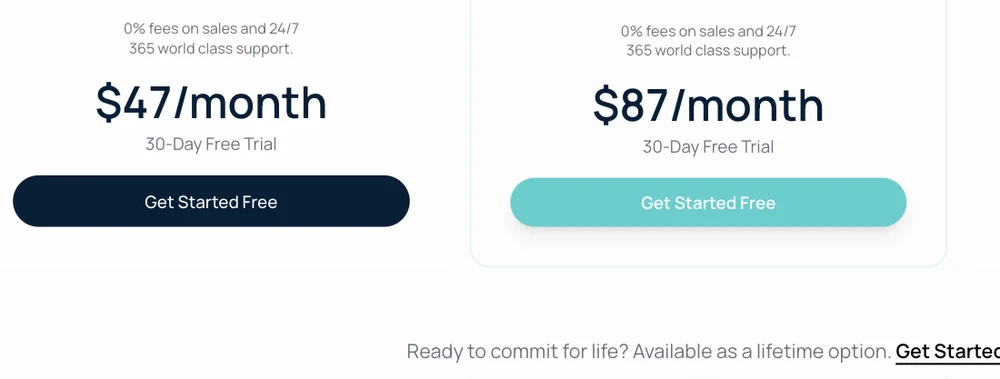
thrivecart.com/pricing sends you to a sign-in screen rather than a price list, and so do the plan URLs in the site’s own navigation. The only public price list sits on the Pro+ product page, and the numbers on it are drawn in by JavaScript after the page loads, so a plain fetch of the page source returns 3 plan names with no prices attached.
Kajabi’s page is the opposite. It leads with the numbers, on annual billing by default, and it puts the fee table on the same screen.
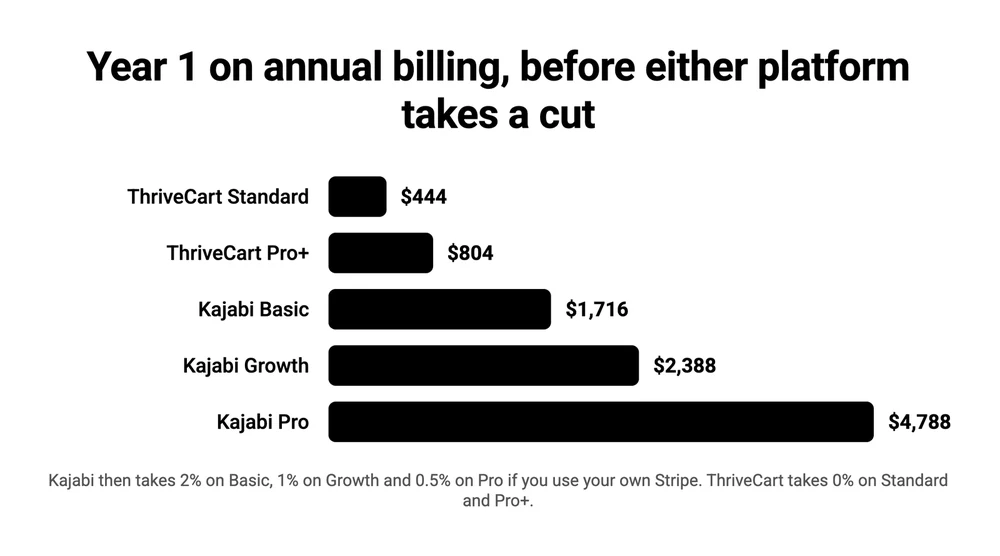
Here is the year-1 cost of every published plan on both platforms, all quoted on annual billing so the comparison sits on 1 basis. ThriveCart Standard is $444 a year and Kajabi Basic is $1,716, a gap of $1,272 before either platform takes a cent of your sales, and Kajabi Basic then takes 2% of everything you sell if the money runs through your own Stripe.
| Plan | Billed yearly | Billed monthly | Cut of your sales | Products |
|---|---|---|---|---|
| ThriveCart Standard | $444 | $47/mo | 0% | Unlimited |
| ThriveCart Pro+ | $804 | $87/mo | 0% | Unlimited |
| Kajabi Basic | $1,716 | $179/mo | 0% via Kajabi Payments, 2% via own Stripe | 5 |
| Kajabi Growth | $2,388 | $249/mo | 0% via Kajabi Payments, 1% via own Stripe | 50 |
| Kajabi Pro | $4,788 | $499/mo | 0% via Kajabi Payments, 0.5% via own Stripe | Unlimited |
Both numbers in each Kajabi cell are true at the same time. Take payments through Kajabi Payments and Kajabi’s own platform fee is 0%. Connect your own Stripe account instead and Kajabi adds the second number on top of whatever Stripe already charges you.
Now compare that against page 1.
It is not close.
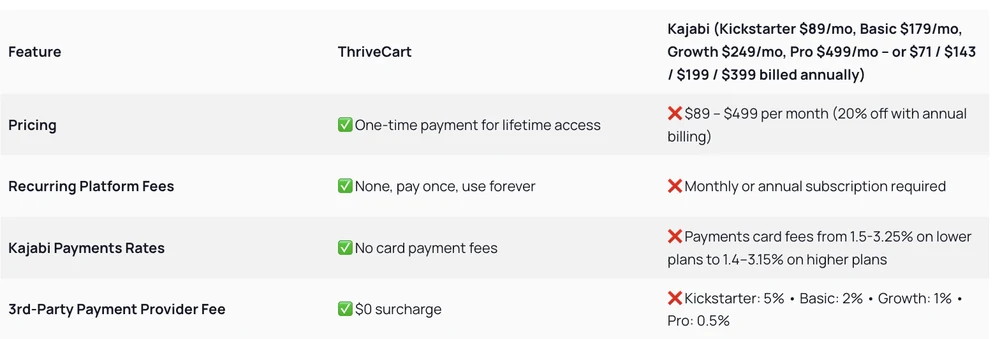
FreshLearn writes “One-time payment of $495 (+ $295 for Pro add-on)” and totals it as “$790 total”. Mihael Cacic writes “$495 one-time payment for a lifetime account. The Pro version costs an additional $195.” Mara Kucirek puts the pro upgrade at “an additional $195”. Lauren Lea builds a cost table around “~$495 (One-time)” plus “~$195”.
So 2 of them price the Pro upgrade at $195 and 1 at $295, for the same product. Our own ThriveCart lifetime deal breakdown explains why: ThriveCart retired the $195 one-time Pro upgrade in April 2025 and replaced it with Pro+ at $295 a year. The 2 guides quoting $195 are quoting a price that has not existed for over a year, and the guide quoting $295 has the right number but bills it once instead of every year. ThriveCart Academy, the course and community engine that used to be a separate purchase, is now included in both plans.
ThriveCart’s own page is the strangest. It ranks first, it is titled “ThriveCart vs Kajabi 2026: Full Comparison for Creators,” and it never states a ThriveCart price at all.
If you already pay for a website and an email tool
ThriveCart Standard, at $444 a year.
You are buying a checkout here, and Kajabi’s price is mostly made of things you already own. Its bundle is priced as though you are starting from nothing, because for a good number of its customers that is true, and the whole pitch of an all-in-one platform is that you stop assembling parts. If you have already assembled them, that pitch is aimed at somebody else and you are the one paying for it.
Kajabi Basic bundles a website builder, unlimited marketing emails, landing pages, funnels and a course platform into $1,716 a year. That bundle is the product. If your site is already on WordPress or Squarespace and your list already lives in Kit or MailerLite, you are paying $1,272 extra for a second copy of both, and then either migrating everything or running 2 systems in parallel.
What you give up is smaller than the ranking guides suggest. ThriveCart Standard includes Academy Starter, which covers unlimited courses and students, up to 10 communities and up to 2,000 community members. What it does not include is email marketing. ThriveCart sends transactional and cart-recovery mail, but there is no broadcast list and no newsletter, so whatever you pay your email tool sits on top of the $444.
There is a size limit worth knowing before you commit. Academy Starter gives you 100 GB of video storage and caps any single video file at 2 GB. Pro+ raises that to 500 GB and 4 GB per file. Kajabi publishes no video cap on its pricing page at all.
On course delivery itself the 2 platforms trade places depending on what you count. Kajabi’s plan table lists cohort courses, video transcriptions and translations, a customer app and a branded mobile app that its own page prices at a “$199/mo value”. ThriveCart Academy lists none of those.
Go the other way and the numbers flip hard. Kajabi Basic gives you 1 community and 1 website, and Pro at $4,788 still only gives you 3 of each. ThriveCart Academy Starter, inside the $444 plan, gives you up to 10 communities and 2,000 members. If you run several programmes that each need their own space, that is a 10 to 1 gap in ThriveCart’s favour and no page-1 guide mentions it.
Day to day, the trade is between 1 tool and 3. Kajabi is 1 login, 1 bill and 1 support queue, which is genuinely worth something when things break. ThriveCart plus a site plus an email tool is cheaper and more of your time.
This is also the one situation where a plain checkout is worth pricing. If your course already lives somewhere and all you want is the cart in front of it, CartMango, which I built and run, is free until October 2026 and $10 to $30 a year after that, with no cut of your sales.
If you are starting with nothing but an idea
Kajabi’s single bill starts looking reasonable here, and this is the situation where most readers of this comparison actually sit: no site, no list, no course host, 1 idea and a budget. Everything above assumed you had already bought some of the pieces. If you have not, the arithmetic changes, because Kajabi’s price stops being a duplicate of things you own and starts being the price of buying them for the first time.
The honest answer turns on what you would buy to fill ThriveCart’s 2 gaps.
ThriveCart Standard gets you a checkout, funnels and a course platform for $444. It does not get you a website or an email tool. Kajabi Basic adds both of those to the same 3 for $1,716. So the question is whether a website and an email list cost you more or less than $1,272 a year.
Turn that $1,272 into a monthly allowance and the decision stops being vague. It is $106 a month. That is the budget a website and an email tool have to fit inside before Kajabi’s single bill becomes the cheaper way to buy the same 5 things.
So here is the pick. Price the site builder and the email tool you would actually use, at the list size you actually have. Under $106 a month together, buy ThriveCart Standard and those 2 tools. Over $106 a month, buy Kajabi Basic and stop assembling.
What the cheaper route costs you is 3 logins instead of 1, 3 renewal dates, and the job of wiring them together yourself. That is the real price of the $1,272, and for some people it is worth more than the money.
Here is the same arithmetic somewhere with no software in it.
A while back I had a Coway water filtration system put into my house. 2 units: an outdoor filter for the tap water we bathe and wash dishes with, and a reverse osmosis unit for drinking water.
I did not buy it because the product impressed me. I buy drinking water every month where I live, and the Coway subscription costs about the same as the water I was already buying. So the tap filtration came along free, on top of a bill that was already in my budget. My own word for it at the time was a no-brainer.
Platform pricing works the same way, in both directions. Kajabi looks expensive against $0 and reasonable against a stack you already pay for. ThriveCart looks cheap against Kajabi and less cheap once you add the website and the email tool it lacks. Price both against what is already leaving your account each month.
One more Kajabi number belongs in this decision, because it moves with you. Basic caps you at 5 products and 2,500 contacts. Hit either ceiling and the next step is Growth at $2,388 a year, which is $672 more.
If you want the money landing in your own Stripe account
ThriveCart, and the gap is wider than the plan prices suggest.
ThriveCart takes no cut of your sales. The Standard and Pro+ pricing cards both read “0% fees on sales”, so nothing comes off the top, and Enterprise is quote-only so I cannot tell you what that charges.
Kajabi’s pricing page carries the headline “No hidden fees. No revenue sharing.” Scroll to the fee table on the same page and it lists a third-party payment provider fee of 2% on Basic, 1% on Growth and 0.5% on Pro.
That applies to any processor other than Kajabi Payments and PayPal, and it stacks on top of the card fee your processor already charges. Stripe’s published US rate is 2.9% plus 30 cents, and PayPal publishes its own schedule separately.
Use Kajabi Payments instead and the platform cut disappears. Kajabi’s own card rates are 2.9% plus 30 cents on Basic, 2.8% on Growth and 2.7% on Pro for US businesses. So the 2% is a price for bringing your own processor, not an unavoidable tax.
Here is the size of it. Run $63,600 of sales through your own Stripe on Kajabi Basic in a year and the 2% alone costs you $1,272, which is exactly the gap between the 2 entry plans. In other words, at that volume Kajabi Basic costs you the price gap twice over. ThriveCart is cheaper than Kajabi Basic at every sales volume, and this number tells you how fast the gap widens rather than when it opens.
Whether that matters comes down to how attached you are to owning the payment relationship, and only you know that. Some sellers genuinely do not care whose merchant account the money passes through. If you are one of them, Kajabi Payments removes this whole section from your decision.
If you do care, it is worth knowing the pattern is not universal. CartMango pays into your own Stripe or PayPal with no platform cut and no choice to make, and so does ThriveCart. Kajabi is the one charging for the preference.
If you want Kajabi’s course engine behind ThriveCart’s checkout
Run ThriveCart and Kajabi together. It is a real, vendor-supported setup, and not 1 of the 7 guides ranking for this phrase mentions it.
ThriveCart lists Kajabi on its integrations page, described as “Connect Kajabi to deliver digital content and assign offers seamlessly,” with its own support article behind it. The buyer pays on a ThriveCart checkout, and Kajabi grants them access to the course.
Sellers do this for a specific reason. ThriveCart’s checkout carries 2 things Kajabi’s does not: A/B split testing on the cart itself, on both plans, and multiple order bumps on Pro+. Abandoned cart recovery is not on that list, whatever the roundups say. Kajabi documents checkout abandonment emails and even reports the revenue they recover, so both platforms chase the people who leave.
The cost is the obvious problem. ThriveCart Standard plus Kajabi Basic is $2,160 a year, which is $444 more than Kajabi alone and nearly 5 times ThriveCart alone. You are paying twice for a checkout and twice for a course platform, and using half of each.
So this makes sense in 1 narrow case and is hard to justify outside it. It is worth it when your Kajabi library and your students are already there, moving them is a real project, and your checkout is measurably losing sales. It is not worth it as a starting setup.
The question underneath it is usually whether a migration is worth it. If the honest answer is that only the cart is broken, buying a second platform to fix the cart is the expensive version of the fix.
If you bought the ThriveCart lifetime licence before 15 July 2026
Nothing changes for you. ThriveCart’s announcement is explicit on this: “if you’re already a ThriveCart customer, your current plan isn’t affected. You keep everything you have today.”
That is worth saying plainly because it is the one group for whom this whole comparison does not apply. You already paid. Kajabi at $1,716 a year has to beat a platform that now costs you nothing per year, which is a very different test from the one a new buyer is running.
The question that does still apply to you is the add-on question. Our ThriveCart lifetime deal breakdown found that the headline $495 was rarely the end of it once the Pro upgrade and the tax handling were added, and lifetime holders reported features they expected to be included sitting behind a separate annual charge. That is still how the lifetime route works out.
1 thing did change, and not in your favour. Academy is now bundled into the new subscription plans, so a buyer arriving today gets the course and community engine included, while your licence gives you whatever you paid for. Worth checking what your account actually shows before you assume you have it.
Which one, for which situation
Affiliate management is the clearest example of how differently these 2 price the same capability. Kajabi puts its affiliate program on Growth, at $2,388 a year. ThriveCart puts its Affiliate Center on Pro+, at $804 a year. Same job, $1,584 apart.
ThriveCart is the pick in 3 of these 6 situations and Kajabi in 1, and the gap between the 2 plans being compared runs from $1,272 at the entry tier to $1,584 once you need affiliates.
| Your situation | Pick | Year 1 | The catch |
|---|---|---|---|
| Website and email tool already paid for | ThriveCart Standard | $444 | No broadcast email, 100 GB video cap |
| Starting with nothing, replacement stack over $106 a month | Kajabi Basic | $1,716 | 5 products, 2,500 contacts, then $2,388 |
| Starting with nothing, replacement stack under $106 a month | ThriveCart Standard plus those tools | $444 plus your stack | 3 logins, 3 renewal dates |
| Course already on Kajabi, cart is losing sales | Both | $2,160 | Paying twice for 2 things |
| You need an affiliate program | ThriveCart Pro+ | $804 | Kajabi wants $2,388 for the same job |
| Course lives elsewhere, you only need a cart | CartMango | $0, then $10 | Courses and community: not yet, planned for October 2026 |
That last row is my own product, so the row states a price and nothing else. CartMango is free until October 2026 and then $10 to $30 a year, and it takes no cut of your sales. Courses and community are not live on it: both are planned for October 2026, on the $30 plan. It is a checkout rather than an alternative to either platform above, and on this keyword that distinction is the whole point.
FAQ
How much does ThriveCart cost?
$37 a month billed annually, which is $444 a year, for ThriveCart Standard. Pro+ is $67 a month billed annually, or $804 a year. Month to month those become $47 and $87, and Enterprise is quote-only.
A lifetime licence is still sold, but ThriveCart publishes no price for it anywhere public, and thrivecart.com/pricing is a sign-in form, not a price list.
Does ThriveCart take a percentage of sales?
No. The Standard and Pro+ pricing cards both state 0% fees on sales, so the only per-sale cost on those plans is whatever Stripe or PayPal charges you directly. Kajabi works differently: 0% through Kajabi Payments, but 2% on Basic, 1% on Growth and 0.5% on Pro if you connect your own processor.
What are the downsides of Kajabi?
Price is the obvious one, at $1,716 a year against ThriveCart’s $444. Beyond that: Basic caps you at 5 products and 2,500 contacts, the affiliate program and branding removal need Growth at $2,388, and the API, custom code editor and branded mobile app are Pro-only at $4,788. Support is the part neither pricing page will tell you about. On ThriveCart’s side, a r/digital_marketing thread started in 2023 and still being answered calls it “buggy” with “terrible customer support”. I found no equivalent pile-on for Kajabi, which is worth knowing if support matters more to you than $1,272.
Is there anything better than Kajabi?
Depends which part of Kajabi you are paying for, which is why the answer is usually a stack rather than 1 swap. ThriveCart is the obvious swap if courses plus checkout is all you use it for. Teachable and Thinkific replace the course half, Circle or Skool the community half, and Systeme.io gets closest to replacing the whole bundle on a free tier. We priced the realistic replacements in our Kajabi alternatives breakdown, and the ThriveCart alternatives roundup covers the other direction. If you want the full fee picture on 1 platform, our full Kajabi fee breakdown traces the surcharges the plan table leaves out.
Does Kajabi still sell the $89 Kickstarter plan?
Not on its pricing page. That page now shows 3 plans starting at $143 a month billed annually, and the word Kickstarter appears nowhere in it, including the underlying page code. Our earlier Kajabi pricing breakdown found the tier still being sold at $89 while hidden from the public table. I could not retest that this time, because Kajabi’s signup pages sit behind a bot block, so treat $89 as possibly still available and $143 as the cheapest plan Kajabi will show you.
Do both platforms have a free trial?
Both do, and only ThriveCart publishes the length. ThriveCart’s pricing cards read “30-Day Free Trial” on Standard and Pro+, which arrived with the July 2026 change. Kajabi’s pricing page carries a “Start Free Trial” button and names no length anywhere beside the plans, and the figure differs between its promo banners and its signup flow. Check the length on the checkout screen before you hand over a card.
How much of that bundle do you already own?
Every situation above comes down to 1 question, and ThriveCart vs Kajabi is just the form it arrives in: how much of the bundle you are about to buy do you already own? That is a question about your own bank statement.
If the honest answer is “most of it, I just need the checkout to work,” then a cart is what you are shopping for. CartMango takes order bumps on every plan, pays straight into your own Stripe or PayPal, and takes nothing per sale. It is free until October 2026, then $10 a year to start. Upsells, downsells and cart abandonment sit on the $20 plan.
Underneath ThriveCart vs Kajabi you are choosing how much software to own. Owning only the part that takes the money is the cheapest answer on the table above, and for plenty of sellers it is also the right one.
About the Author

👋 I’m Welly, founder of CartMango (the site you’re on), a checkout platform for digital product sellers. We’ve previously processed $179M+. I also run BirdSend (email marketing tool, 3.1B+ emails sent). On the side I show other non-techie digital sellers how I use AI workflows to automate 50%+ of my operations. Find me on LinkedIn.