

ThriveCart is the pick when your job is selling. Its Standard plan runs checkout, order bumps, 1-click upsells and courses for $444 a year, and takes 0% of a basic sale. Leadpages is the pick when your job is pages and leads: $276 a year publishes pages and forms, and A/B testing starts at $948.
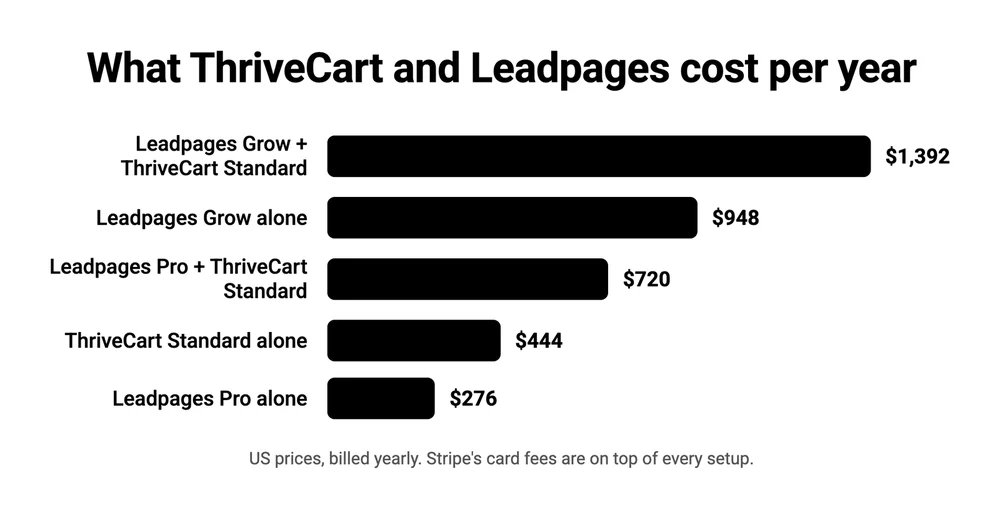
The ThriveCart vs Leadpages line blurred: ThriveCart made ThrivePages its default editor, and Leadpages sells checkouts with order bumps. Neither takes a cut of a basic sale beyond Stripe’s 2.9% + $0.30. Running both costs $720 a year, $1,392 with testing. CartMango (free right now, from $10 a year in November) covers 1 sales page plus checkout. Prices are US, billed yearly, from vendor pages.
You probably have 2 tabs open, 1 for each tool, and a budget that may only stretch to 1 of them. Picking got harder in 2026, because each tool now does part of the other’s job.
The 2 comparison pages ranking for this search have not caught up. They list Leadpages plans that no longer exist and price ThriveCart only as a one-time purchase, so their tables point you at the wrong bill.
Below are both price lists from the vendors’ own pages, the yearly cost of running the 2 together, and a pick for 4 seller situations: leads first, paid traffic, 1 login, or 1 page that takes the money.
Key Takeaways
- ThriveCart sells subscriptions now. Standard costs $47 a month or $444 a year. The $495 lifetime licence is still sold, as a link under the plans.
- Leadpages starts at $29 a month on Pro. Pro publishes 25 pages. A/B testing needs Grow at $99 a month, or $948 a year.
- Neither takes a cut of a basic sale. ThriveCart’s fee page does list small charges for tax collection and a few subscription add-ons.
- Running both costs $720 to $1,392 a year, depending on whether you need Leadpages’ page testing on top of ThriveCart’s checkout.
- For 1 sales page and a checkout, CartMango, the checkout I run, is free right now, then from $10 a year once paid plans start in November.
ThriveCart vs Leadpages pricing, side by side
Billed yearly, ThriveCart’s cheapest plan is Standard at $444 a year, Leadpages’ cheapest paid plan is Pro at $276, and Leadpages’ page testing starts at $948 a year on Grow. Both run a free trial: 30 days on ThriveCart, 7 on Leadpages.
Wondering whether the tool, the price or the page is what is costing you sales? The Online Selling Mistakes Challenge checks 5 common leaks, 1 short email a day for 5 days.
ThriveCart’s 2 subscription plans cost $444 and $804 a year, and the 4 Leadpages plans below run from $276 to $1,908, with Scale above them at $3,828.
| Plan | Month to month | Billed yearly | What it adds |
|---|---|---|---|
| ThriveCart Standard | $47 | $444 a year | Checkout, 1 order bump, 1-click upsells, cart recovery, A/B split testing, courses |
| ThriveCart Pro+ | $87 | $804 a year | More order bumps, affiliates, failed-payment retries, custom domains |
| ThriveCart lifetime | Paid once | $495 once | A Standard account. ThrivePages is not on its checkout list |
| Leadpages Pro | $29 | $276 a year | 25 pages, 1 domain, forms, sign-ups stored 30 days |
| Leadpages Business | $49 | $468 a year | 50 pages, 2 domains, lead CSV export |
| Leadpages Grow | $99 | $948 a year | Unlimited pages, A/B testing, 4 domains |
| Leadpages Optimize | $199 | $1,908 a year | Heatmaps, AI traffic routing |
ThriveCart’s pricing cards switch between monthly and yearly billing with a toggle. The lifetime licence is no longer a plan card. It sits as 1 line of text below the cards, and that link opens a checkout for $495, paid once.
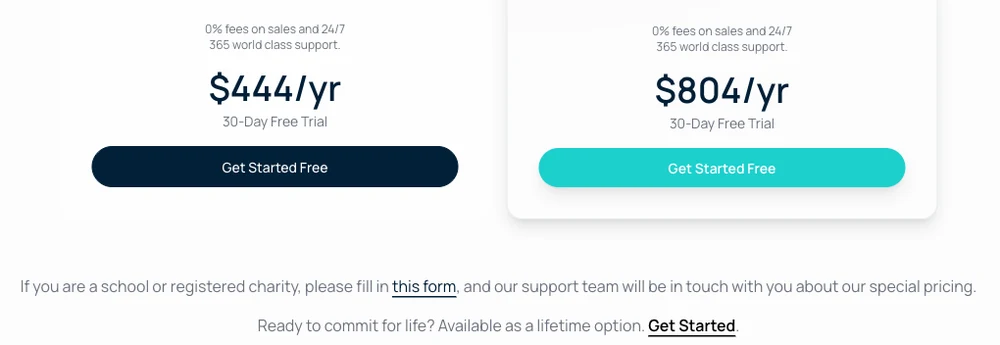
Against $444 a year, the $495 licence pays for itself early in year 2. Add Pro+ to it and ThriveCart’s own checkout charges $790 up front, then $295 every year after. That matches what our ThriveCart lifetime deal breakdown found about the add-on that keeps renewing.
Leadpages prices change with the country you load the page from. The figures above are US prices, from the price data inside the Internet Archive’s US copy of the pricing page, and they match the plan prices in Leadpages’ own pricing FAQ. Load the page from Indonesia, where I live, and Grow shows $57 a month instead of $99. That archived copy also listed a $10 Starter plan for 5 pages, which the live page has since dropped.
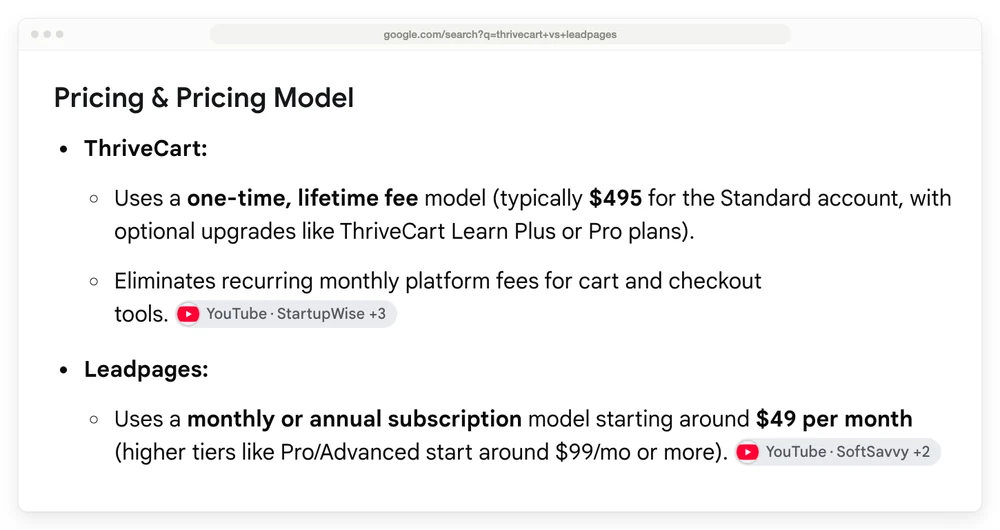
The 2 comparison pages ranking for this search are further behind. SaaSworthy’s page, which puts the current month in its title, prices Leadpages “Standard” at $5 a month and ThriveCart at $495 one-time, and says neither has a free trial. TrustRadius lists Leadpages Standard at $49 a month and ThriveCart at $495 or $690 one-time. Leadpages has no Standard plan now, and both tools run free trials. The AI summary at the top of Google repeats the same old pair. It calls ThriveCart a “one-time, lifetime fee model” at $495 and starts Leadpages at around $49 a month.
On a basic sale, both tools leave you with just the Stripe fees. ThriveCart’s fee page says “0% to ThriveCart” on transactions, and Leadpages says it charges nothing on top of standard Stripe processing, so a US card costs Stripe’s 2.9% + $0.30 on either. ThriveCart’s fee page does list some extra charges, though. Tax calculation and collection costs 0.5% per eligible transaction on Standard and 0.35% on Pro+. On the $444 Standard plan, subscription bumps and Advanced Adaptive Pricing carry a 0.10% commission, and retention offers take 5% of the first payment they save. Pro+ pays 0% on those 3, and lifetime accounts pay the most: 0.25%, 0.25% and 8%.
Which half of selling is your bottleneck
ThriveCart and Leadpages now overlap, but each was built for a different half of the sale. ThriveCart is a checkout first: the payment, the bump, the upsell, the course a buyer gets afterwards. Leadpages is a landing page builder first: the page, the form, and the test that tells you which headline works.
Both tools reach into the other half now. Leadpages’ checkout has order bumps and sends buyers to a separate upsell page after they pay. ThriveCart hosts sales pages with the checkout built in, and its release notes describe ThrivePages as covering everything “from sales page to checkout, upsell and thank-you”. Testing is where they still split. ThriveCart lists A/B split testing among its funnel tools on Standard. Leadpages’ Grow plan tests up to 6 versions of a page, and its higher plan adds heatmaps.
The 4 situations below are the ones where the right pick changes. Find yours, then check the cost and the catch.
If a free download has to come before the sale
For a seller who gives away a lead magnet first, say a checklist or a short guide, and sells to those subscribers by email later, the pick is both tools, each doing its own half. Leadpages Pro at $276 a year hosts the opt-in pages, with forms and webhooks on every plan and up to 5 connections to other tools, so sign-ups flow into your email tool. ThriveCart Standard at $444 a year takes the money when you sell. Together that is $720 a year, or about $60 a month.
Why not 1 tool? Leadpages can sell. Its own ecommerce page says to deliver a digital product with a “Stripe thank-you page redirect” to your access link, and its upsells live on a separate page. If you are still building that first opt-in, our guide to a lead capture page covers the 5 parts it needs. Going the other way works too. ThriveCart lists “lead captures” among the things its checkouts can host, and many email tools host a sign-up page on their own. If either covers your opt-in, skip Leadpages and save the $276.
What you give up with 2 tools is simplicity: 2 logins, 2 bills and a hand-off between them. A seller in an r/DigitalMarketing thread from April 2025 ran a similar stack, “Leadpages for the lead magnet and then Countdownhero with Thrivecart”. They reported that Leadpages would no longer pass each subscriber’s email through to the countdown tool, which broke the 3-day offer they had planned.
On Pro, form submissions are kept for 30 days, and the pricing table puts lead CSV export on Business. Connect every form to your email tool before you launch, so nothing sits inside Leadpages waiting to expire.
If paid ads send the traffic and the page needs testing
Paid traffic changes the math. When every click costs money, the pick is Leadpages Grow plus a checkout, because Grow is the first Leadpages plan that can test which version of a page turns more of those clicks into buyers. Grow costs $99 a month or $948 a year. It runs A/B tests of up to 6 versions of a page, plus a feature that swaps headline words to match the ad someone clicked. Leadpages’ own pricing FAQ says Pro and Business “do not include these testing features”.
With ThriveCart Standard handling the checkout, the bill comes to $1,392 a year, about $116 a month. The next Leadpages plan up, at $1,908 a year, adds click and scroll heatmaps and an AI feature that routes each visitor to the version most likely to convert. The cost is $948 a year on top of the checkout. On a $50 product, after Stripe’s 2.9% + $0.30, Grow needs about 20 extra sales a year to pay for itself.
ThriveCart Standard lists A/B split testing among its own funnel tools. Check in its 30-day trial whether that covers what you want to test before you pay for Grow.
If you want the sales page and the checkout behind 1 login
ThriveCart on its own is the pick when you want the whole sale in 1 place, with no separate page builder. ThriveCart made ThrivePages its default editor for new accounts from 20 July 2026, and older accounts can move their checkouts into it with an importer. A single design can run as a page ThriveCart hosts, an embedded checkout or a pop-up.
Standard covers the core selling tools at $444 a year. You get unlimited products, 1 order bump, 1-click upsells and downsells, cart recovery and sales tax automation, which carries the 0.5% fee above. It also bundles the Academy Starter plan, with unlimited courses and up to 2,000 community members. Pro+ at $804 a year adds more than 1 bump per checkout, the affiliate center and failed-payment retries for subscriptions. It also drops the small commissions on subscription bumps and retention offers to 0%.
If you dislike renewals, the $495 lifetime licence buys a Standard account outright. Its checkout page lists hosted carts, funnels, bumps, 1-click upsells and unlimited courses. It does not list the community or ThrivePages, so confirm what your account gets before you pick it over the $444 plan. Lifetime accounts also pay the highest add-on commissions on ThriveCart’s fee page, including 8% of the first payment a retention offer saves.
You lose Leadpages-style page testing beyond ThriveCart’s own split tests. You also still need an email tool for the list. Our roundup of ThriveCart reviews and complaints covers the support problems sellers reported before the 2026 changes.
If 1 page that takes the money is all you need
For a seller with 1 ebook or template and traffic from social posts or their own emails, 3 setups do the job at very different prices.
ThriveCart Standard at $444 a year hosts a checkout page with bumps and 1-click upsells, which may be more than a single product needs. Leadpages Pro at $276 a year can put a Stripe checkout on a page. Its checkout page says checkout is “built into every landing page”, but its ecommerce page says it comes on “plans that support online sales” without naming them, so confirm Pro includes it during the 7-day trial.
The third is CartMango, which I run. Its Mini Pages editor builds a simple sales page that CartMango hosts, and the button goes straight to its checkout. CartMango is free right now, and paid plans start in November 2026 from $10 a year, with order bumps on every plan. CartMango’s upsells and downsells need the $20 plan.
CartMango’s feature list has no opt-in forms or A/B testing, and its homepage leaves email marketing to the email tools it connects to. Its embeddable checkout is still on its list of planned features, so for now the checkout opens on its own page.
Across the 4 situations, the yearly bill runs from CartMango’s $10 a year (free right now) to $1,392 for Leadpages Grow plus ThriveCart Standard.
| Your situation | Pick | Cost, billed yearly | The catch |
|---|---|---|---|
| Free download before the sale | Leadpages Pro + ThriveCart Standard | $720 a year (about $60 a month) | 2 logins. Skip Leadpages if ThriveCart or your email tool hosts the opt-in |
| Paid ads, page needs testing | Leadpages Grow + ThriveCart Standard | $1,392 a year (about $116 a month) | Testing starts on Grow, not Pro or Business |
| Sales page and checkout in 1 place | ThriveCart Standard with ThrivePages | $444 a year (about $37 a month) | Affiliates and extra bumps need Pro+ at $804 a year |
| 1 page that takes the money | CartMango with Mini Pages | Free right now, then from $10 a year in November (about $0.83 a month) | No opt-in forms or A/B tests listed, no embeddable checkout yet |
That last row is my own product, so check the CartMango feature list against what you sell before you take my word for it.
How to add a ThriveCart checkout to a Leadpages page
You can run the page in Leadpages and the checkout in ThriveCart. I found no guide from either company that names the other, so here is the route both sets of help docs support.
- Build the product and its checkout in ThriveCart, in ThrivePages on newer accounts.
- On ThriveCart’s final save screen, choose how the checkout is delivered: a ThriveCart-hosted page, an embedded checkout, or a pop-up. Copy the URL or the embed code.
- In Leadpages, either point a button at the checkout URL, or paste the embed code into an HTML widget. Leadpages documents the HTML widget for its Classic builder. I found no matching guide for its newer editor, so test it there before you rely on it.
- Publish, then run a real test purchase on the live page, not the preview.
The link button is the safer of the 2 routes. It works in nearly any page builder, and if an embed ever breaks, buyers still reach a working checkout.
What happens when you leave either tool
When you cancel Leadpages on its newer builder, its billing help says your account drops to a free tier, and pages over its limit plus custom domains are “deactivated” rather than deleted. Our Leadpages alternatives guide covers what to export before that happens.
On ThriveCart, our guide to cancelling ThriveCart found that closing a seller account meant emailing support. It also found that your customers’ subscriptions keep running on your own Stripe or PayPal account after you leave, so recurring income survives the move. With both tools running, test the hand-off between them with a real email address, and test it again after either tool updates.
FAQ
Does ThriveCart take a percentage of sales?
Not on a basic sale. ThriveCart’s fee page says “0% to ThriveCart” on transactions, so a US card costs only Stripe’s 2.9% + $0.30. The same page lists small charges on extras: tax collection at 0.5% per eligible transaction on Standard and 0.35% on Pro+, plus, on Standard, 0.10% on subscription bumps and Advanced Adaptive Pricing and 5% of the first payment a retention offer saves.
How much does Leadpages cost per month?
On US pricing, Leadpages Pro costs $29 a month, Business $49, Grow $99, Optimize $199 and Scale $399. Paying yearly saves about 20%, so Pro comes to $276 a year and Grow to $948. Prices vary by country, and every plan starts with a 7-day trial that needs a card.
Is ThriveCart good?
For a seller with more than 1 product who wants bumps, 1-click upsells and courses on 1 bill, ThriveCart Standard covers a lot for $444 a year. For 1 product it can be more than you need. Sellers have complained about support and the old lifetime upgrade path, and our look at whether ThriveCart is legit covers those, written before the 2026 pricing change.
Is the ThriveCart lifetime deal still available?
Yes. A link under ThriveCart’s plan cards opens a checkout for a Standard account at $495, paid once. Adding Pro+ costs $790 up front and then $295 a year, and lifetime accounts pay higher commissions on a few add-ons. The lifetime checkout does not list the community or ThrivePages, so check what is included before you buy.
What are some good alternatives to Leadpages?
For collecting emails, Kit’s free plan covers up to 10,000 subscribers and Systeme.io’s covers 2,000 contacts. Unbounce and Swipe Pages both sell split testing for paid traffic, and Carrd builds cheap one-page sites. For selling 1 product, a checkout like CartMango is enough. ThriveCart fits when you also want courses and a community on the same bill. Our Leadpages alternatives breakdown prices each of them by job.
Does Leadpages charge a fee on its checkout?
No. Leadpages’ checkout page says it “charges nothing on top of standard Stripe processing”, so a US card costs Stripe’s 2.9% + $0.30 and nothing more. Its ecommerce page says checkout comes on plans that support online sales without naming them, so confirm your plan includes it.
When the sale is 1 page and 1 button
If the ThriveCart vs Leadpages choice comes down to 1 product and 1 sales page, you may not need either yet. ThriveCart’s $444 a year pays for courses, communities and upsell chains, and Leadpages’ testing tools start 2 plans above Pro.
CartMango covers that smaller job. You get a hosted Mini Page, a checkout that pays out to your own Stripe or PayPal and delivers the file, and order bumps on every plan. CartMango is free right now, then from $10 a year once paid plans start in November.
About the Author

👋 I’m Welly, founder of CartMango (the site you’re on), a checkout platform for digital product sellers. We’ve previously processed $179M+. I also run BirdSend (email marketing tool, 3.1B+ emails sent). On the side I show other non-techie digital sellers how I use AI workflows to automate 50%+ of my operations. Find me on LinkedIn.
Related Reading
- Leadpages alternatives by job: if the ThriveCart vs Leadpages choice leaves you wanting neither, what each Leadpages job costs elsewhere
- ThriveCart alternatives: 8 checkouts compared if ThriveCart is not the fit
- ThriveCart vs ClickFunnels: the cart against the full funnel builder
- What a lead capture page needs: the 5 parts, and what each tool costs
- What an order bump is: how a checkbox at checkout raises what each buyer spends