

Gumroad is the pick when you want the store, file delivery and sales tax handled, at 10% plus $0.50 per direct sale on top of 2.9% plus $0.30 processing. Stripe is the pick when you’ll build those jobs yourself, at 2.9% plus $0.30 alone. A $20 sale costs $3.38 on Gumroad and $0.88 on Stripe.
That is the Gumroad vs Stripe trade: fee against jobs done for you. Gumroad’s Discover marketplace also finds buyers, at 30% a sale. A third route connects your own Stripe account to CartMango, which I run, for file delivery with no per-sale cut, though tax stays with you. Figures use US card rates.
A buyer pays $20 through a plain Stripe payment link. They see a thank-you message. Unless you set things up first, no file arrives, no sales tax gets worked out and their email never reaches your list.
On Gumroad, the file goes out on its own and the sales tax gets handled for you, and the buyer joins a customer list you can email from inside Gumroad.
So this post splits the choice into the 5 jobs a digital sale needs done: charging the card, delivering the file, collecting tax, paying you out and selling to that buyer again. For each one you’ll see who does it and what it costs.
Key Takeaways
- Gumroad takes 10% plus $0.50 per direct sale, with 2.9% plus $0.30 card processing on top, so a $20 sale costs $3.38.
- Stripe takes 2.9% plus $0.30 on a US card, but a Stripe Payment Link ends at a thank-you message, so you build file delivery yourself.
- Gumroad is the easiest route on sales tax. As the legal seller since January 2025, it collects and pays sales tax, VAT and GST for you.
- Stripe’s Managed Payments takes on your sales tax for 3.5% more per sale, but only for automated digital products from businesses in 37 supported locations.
- Gumroad’s rate drops to 5% plus $0.50 on direct sales once your paid sales reach $20,000 in a calendar month, resetting on the 1st.
- CartMango connects to your Stripe or PayPal, delivers the file and syncs buyers to your email tool with no per-sale cut, but tax stays with you.
Gumroad fees vs Stripe fees on each sale
On a $20 product, you keep $16.62 after Gumroad fees and $19.12 after Stripe fees. Gumroad’s pricing page shows its 10% plus $0.50 and promises no hidden fees, but its help article on fees says card processing of 2.9% plus $0.30 comes on top. Stripe charges only that 2.9% plus $0.30 on a US card.
Fees are only one of the ways a small shop leaks money. If you want to find the others before they cost you, the Online Selling Mistakes Challenge is a free 5-day email course on the 5 mistakes that cost solo sellers the most.
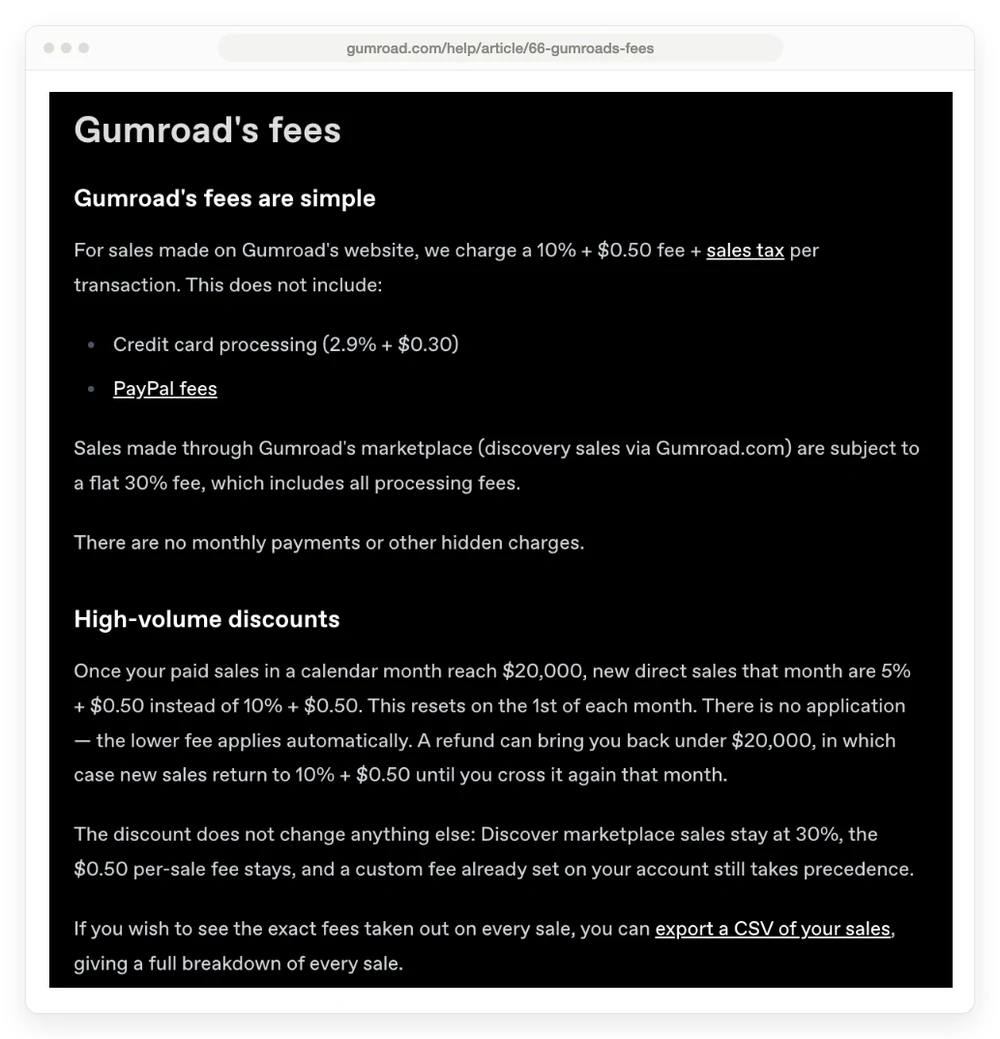
Gumroad’s High-volume discounts paragraph only affects bigger sellers. Once your paid sales in a calendar month reach $20,000, Gumroad charges 5% plus $0.50 on new direct sales for the rest of that month. It applies by itself and resets on the 1st, and a refund that drops you back under $20,000 puts you back on 10%. The $0.50 stays either way, and Discover sales stay at 30%. In real money, a month with $30,000 of direct sales pays 5% instead of 10% on the last $10,000, which saves $500. Below $20,000 a month, nothing changes.
None of the 5 comparison articles on Google’s first page mentions Gumroad’s $20,000 discount, and Gumroad’s pricing page doesn’t either. Paritydeals, which adds Gumroad’s fees up correctly, treats them as flat and says “no volume discount changes it on either side”. Separately, 3 pages ranking for this keyword state the basic rate wrong: WP Smart Pay calls it a “10% all-in rate”, LaunchAdvisor still quotes paid plans at 3.5% to 5% that Gumroad no longer sells, and StackShare’s directory lists 3.5% plus $0.30.
Discover is something Stripe doesn’t offer at all. A sale through Gumroad’s own marketplace costs a flat 30%, processing included, and it brings a buyer who had never heard of you. In a July 2025 r/SaaS thread, a seller who already had a Stripe account chose Gumroad for exactly that, because “they have a platform with users already”. A few sign-ups came in, though at the time of posting there were “No actual sales yet”.
On a $20 sale over a US card, Gumroad takes $3.38 on a direct sale and $6 on a Discover sale, Stripe with Managed Payments takes $1.58, and Stripe alone takes $0.88, the same as CartMango with your own Stripe account.
| Route | $10 sale | $20 sale | $50 sale | $1,000 sale |
|---|---|---|---|---|
| Gumroad, direct sale | $2.09 | $3.38 | $7.25 | $129.80 |
| Gumroad, Discover sale | $3.00 | $6.00 | $15.00 | $300.00 |
| Stripe alone | $0.59 | $0.88 | $1.75 | $29.30 |
| Stripe with Managed Payments | $0.94 | $1.58 | $3.50 | $64.30 |
| CartMango with your Stripe | $0.59 | $0.88 | $1.75 | $29.30 |
CartMango’s row matches Stripe alone because CartMango takes nothing per sale, and you pay Stripe’s fee straight to Stripe.
On the Stripe rows, an international card adds 1.5% and a currency conversion adds 1%, per Stripe’s pricing page.
File delivery: getting the product to your buyer
Gumroad handles file delivery the moment the buyer pays, and a Stripe Payment Link delivers nothing.
Stripe’s payment link guide gives the buyer 2 possible screens after paying: a thank-you message, or a redirect to a page you choose. Past that, Stripe points you to a partner such as Zapier, or to its API and webhooks.
You can redirect buyers to a download page, but that page works for anyone who has the address, paid or not. Managed Payments doesn’t change this either: its docs list tax, fraud, disputes and customer support, and delivery isn’t on the list.
Gumroad’s download links are protected, so a shared link doesn’t hand your product to strangers. I’ve built checkout software for creators since 2013, first Zaxaa and now CartMango, and both have had to get the file to the buyer and nobody else. CartMango delivers the file on every plan, and only paying customers can open it.
The same gap shows up if you sell from a Framer site with a Stripe buy button.
Collecting sales tax and VAT
Gumroad is the easiest route on this job.
Since January 1, 2025, Gumroad has been the merchant of record on your sales, which means it’s the legal seller, and it collects and pays the sales tax, VAT and GST it owes on your sales. On Stripe alone, you’re the seller. Stripe Tax can work out and collect the tax for 0.5% per transaction, but only in places where you’ve registered to collect it, and you still have to register in each of those places.
Stripe now sells its own answer to Gumroad here. Managed Payments makes Stripe the merchant of record for 3.5% per sale on top of the normal card fee, and handles sales tax, VAT and GST in more than 80 countries. On a $20 sale that comes to $1.58 in total, less than half of Gumroad’s $3.38.
Who can use it is the catch. Your business has to be based in 1 of 37 supported locations: the US, Canada, 31 European countries, Australia, Hong Kong, Japan or Singapore. Stripe also runs an eligibility review, and a Japan-based business still handles tax on its domestic Japanese sales itself. Per Stripe’s Managed Payments eligibility rules, e-books, online courses, software and digital media qualify, while consulting, design work and live 1-on-1 coaching do not. You also have to sell through Stripe directly, since platforms built on Stripe Connect are excluded.
CartMango leaves you as the seller too, so tax is your job there, the same as on Stripe alone. Selling to buyers in Europe or the UK brings its own rules, covered in our guide to the EU and UK tax duty that a plugin can’t take off your hands.
Getting paid out to your bank
Stripe pays into your own Stripe balance, then on to your bank on a schedule you pick. Gumroad holds your sales in a Gumroad balance first, and its payout help page adds these rules:
- Weekly, monthly or quarterly payouts need a balance of at least $100, and each sale waits at least 7 days before it can go out.
- Daily payouts are only for US sellers with an eligible bank account, 4 earlier payouts and an account at least 60 days old.
- Instant payouts skip the 7-day wait and start from $1, but only for money Stripe has already settled.
That last rule shows that Stripe sits behind Gumroad’s card sales.
You can’t add a new Stripe account of your own to Gumroad, though. Its help page says it no longer accepts new connected Stripe accounts, except from sellers in Brazil.
On Stripe, your first payout after your first live sale typically takes 7 to 14 days. After that, money moves daily, weekly or monthly, whichever you set.
CartMango holds no money: payments land in your own Stripe or PayPal account at the moment of sale.
Selling to the same buyer again
Gumroad lets you email buyers from inside Gumroad, Stripe gives you a receipt and a payment record, and neither puts a buyer on your own email list without extra tools. None of the comparison pages on Google’s first page for this keyword explains how a buyer gets onto your list after paying.
Gumroad has email broadcasts and automated workflows built in, and you can export your followers and customers whenever you like. Its built-in connections stop at Discord and Circle, so sending buyers into Kit or another email tool automatically takes Zapier. Stripe emails a receipt. For a one-time Stripe Payment Link sale it records the buyer as a guest customer rather than a saved customer, and getting that email address onto your list means Zapier or code.
Gumroad bills memberships through its own account, so those recurring payments don’t come with you. Subscriptions created in your own Stripe account live in that account. CartMango sends each buyer to Kit, ActiveCampaign, BirdSend or Beehiiv, and existing recurring payments keep reaching you if you leave it.
When Gumroad’s cut stops being worth it
Gumroad’s cut stops being worth it once the fee gap pays for the jobs you’d take on. At 100 sales of $20 a month, Gumroad takes $338 and Stripe takes $88, so the $250 difference is your monthly budget for delivery, tax and email, spent on tools or on your own evenings.
At 10 sales a month that budget is $25, which buys very little, and Gumroad is the easier deal.
Past $20,000 a month the gap narrows. Each $20 direct sale then costs $2.38 on Gumroad against $0.88 on Stripe, so the difference falls from $2.50 to $1.50 a sale. If tax is the job you’d dread most, price Managed Payments first. It keeps Stripe’s setup and costs $1.58 on a $20 sale, as long as your business is in a supported location and your product qualifies.
Gumroad vs Stripe vs CartMango, job by job
Gumroad covers all 5 jobs, the last of them only through its own email tool, for about 13% to 21% of a direct sale between $10 and $1,000. Stripe alone charges the card and pays you out, and CartMango with your own Stripe account adds delivery and email sync but leaves the tax with you.
| Route | Charge | Deliver | Tax | Payout | Sell again |
|---|---|---|---|---|---|
| Gumroad | 10% + $0.50, plus 2.9% + $0.30 | Yes, protected links | Yes, Gumroad is the seller | Gumroad balance, $100 minimum, 7-day wait | Emails inside Gumroad, Zapier for other tools |
| Stripe alone | 2.9% + $0.30 | No, you build it | Stripe Tax at 0.5% where you register | Your own Stripe account | Receipt only |
| Stripe with Managed Payments | 2.9% + $0.30, plus 3.5% | No, you build it | Yes in 80+ countries, if eligible | Your own Stripe account | Receipt only |
| CartMango with your Stripe | 2.9% + $0.30, plans free until October 2026, then $10 to $30 a year | Yes, protected links | No, you stay the seller | Your own Stripe or PayPal account | Syncs to your email tool |
FAQ
Does Gumroad use Stripe?
Gumroad’s own payout help says instant payouts depend on “how much of your balance Stripe has already settled”, so Stripe sits behind its card sales. Unless you’re in Brazil or connected one earlier, you don’t get your own Stripe account through Gumroad. Sales land in your Gumroad balance first, and Gumroad keeps its 10% plus $0.50 either way.
Can you connect your own Stripe account to Gumroad?
Only in Brazil, for new sellers. Gumroad’s help page on connecting Stripe says it no longer supports new connected Stripe accounts except for sellers from Brazil. Sellers who connected a Stripe account earlier still get paid into it at the time of sale, and Gumroad still takes its 10% plus $0.50.
How much is the Stripe fee for $1,000?
$29.30, if the $1,000 is a single sale on a US card: 2.9% is $29 and the fixed fee adds $0.30. An international card adds 1.5%, making it $44.30. Split the same $1,000 into 50 sales of $20 and the fee is $44, because the $0.30 is charged 50 times. Gumroad would take $169 on those 50 direct sales.
Why are people leaving Gumroad?
Cost and control are the 2 differences you can check on Gumroad’s own pages. A direct sale costs about 12.9% plus $0.80 once card processing is added, against 2.9% plus $0.30 on Stripe. Standard payouts need a $100 balance and a 7-day wait, and new sellers outside Brazil can no longer connect their own Stripe account. If you’re weighing a move, our Gumroad alternatives roundup covers 7 options.
Stripe’s rate with the delivery done for you
CartMango keeps you on Stripe’s $0.88 per $20 sale and does the delivery and email jobs for you. If the Gumroad vs Stripe math pulls you toward Stripe, but building those 2 jobs yourself does not appeal, CartMango connects to your own Stripe or PayPal account and does both.
It takes no per-sale cut, it’s free until October 2026 and then $10 to $30 a year, and sales tax stays with you, exactly as it would on Stripe alone.
About the Author

👋 I’m Welly, founder of CartMango (the site you’re on), a checkout platform for digital product sellers. We’ve previously processed $179M+. I also run BirdSend (email marketing tool, 3.1B+ emails sent). On the side I show other non-techie digital sellers how I use AI workflows to automate 50%+ of my operations. Find me on LinkedIn.
Related Reading
- Framer ecommerce: selling from a Framer site, and the file-delivery job most guides skip
- WordPress Stripe plugin: the per-sale cut some plugins add on top of Stripe’s fee
- Gumroad vs Payhip: 2 hosted stores compared on fees and features
- Is Gumroad safe?: what Gumroad protects for buyers and sellers
- Gumroad alternatives: 7 options if you’re ready to move