

Podcasters make money by selling their own products and services, running memberships or premium content, earning affiliate commissions, and landing sponsorships. For most shows, selling your own offers to a small loyal audience earns more than ads, which pay roughly $18 to $25 per 1,000 downloads and rarely add up until you pass a few thousand downloads per episode.
Most advice on how to make money as a podcaster skips the part you actually need: how much a show like yours really earns. The honest answer is uncomfortable. Half of all podcast episodes get fewer than 30 downloads in their first week, and ad money at that size is a few dollars a month. So the podcasters who earn real income rarely sit around waiting for a sponsor to notice them. They sell something their listeners already want. I’ve spent years around people who sell online for a living, and the pattern holds up every time. A small audience that trusts you beats a big audience that just presses play. This guide covers every way podcasters make money, what each one realistically pays at your download numbers, and where to start if you’re not famous and have no plans to be.
Key Takeaways
- Half of all podcast episodes get fewer than 30 downloads in their first week, so ad income is tiny for the vast majority of shows.
- Ads pay about $18 to $25 per 1,000 downloads, which means sponsorships barely matter until you clear a few thousand downloads per episode.
- For small and mid-size shows, selling your own products, coaching, or memberships to loyal listeners earns far more than waiting on sponsors.
- One niche podcaster reports under 1,000 downloads per episode but a top sponsor paying 6 figures a year. Audience fit beats raw size.
- Pick 2 or 3 income streams that match your show and your audience instead of chasing all 9 at once.
How much money can you actually make as a podcaster?
Start here, because the number sets your whole strategy.
The audience is real. About 80% of Americans aged 12 and older have listened to a podcast, per Edison Research. So is the money. US podcast advertising hit $2.86 billion in 2025, up almost 18% in a year, per the IAB and PwC. But most of that flows to a tiny group of big shows.
Look at the real download spread from Buzzsprout’s global stats, which track more than 100,000 active podcasts.
A new episode needs fewer than 30 downloads in its first week to beat half of all shows. To crack the top 10%, it needs around 400. The top 1% starts near 4,700.
The ceiling is real, but rare. Alex Cooper’s Call Her Daddy signed a podcast deal reported at up to $125 million, per Variety. That’s the rare exception, not a plan you can copy.
So what does an ordinary show earn? Host-read ads pay around $18 per 1,000 downloads for a 30-second spot and $25 for a 60-second spot, based on AdvertiseCast’s rate index. Run that against real download numbers and the picture gets honest fast.
Here’s a rough monthly income map from ads alone, assuming a single 60-second mid-roll at a $25 CPM and 4 episodes a month.
| Downloads per episode | Rough monthly ad income | What actually pays at this size |
|---|---|---|
| Under 100 (about half of all shows) | A few dollars | Your own products, coaching, affiliate links |
| ~500 | ~$50 | Affiliate + your own offers, maybe 1 niche sponsor |
| ~2,000 | ~$200 | Direct niche sponsors + your own products + memberships |
| ~5,000 | ~$500 | Ad networks open up, streams start to stack |
| ~20,000+ | ~$2,000+ | Premium sponsorships plus everything else |
Before you pick a method, it helps to spot where your show quietly loses sales. The free 5-day Online Selling Mistakes Challenge walks you through the 5 mistakes solo creators make most when they try to sell to an audience.
The bigger point is simpler. Stop treating ads as the goal. For most shows those ad numbers stay small, and the fastest money comes from selling to the people who already listen.
The 9 ways podcasters make money
There are more than 9, but these are the streams that actually pay. Most successful shows combine 2 or 3 of them.
| Method | How it pays | Realistic income | Best for |
|---|---|---|---|
| Sell your own products | Listeners buy your course, ebook, or templates | Highest for small shows, no download minimum | Any show with a clear offer |
| Coaching and services | Listeners hire you | High per client | Experts, consultants, coaches |
| Memberships and premium | Fans pay monthly for bonus content | Recurring, grows with superfans | Loyal niche audiences |
| Affiliate marketing | Commission on products you recommend | Small to moderate, starts day 1 | Review and recommendation shows |
| Sponsorships and ads | Brands pay per 1,000 downloads | Low until a few thousand downloads | Bigger shows, or sharp niches |
| Listener support | Fans tip or donate | Small, supplemental | Community-driven shows |
| Merchandise | Sell branded gear | Small, brand-dependent | Shows with a strong identity |
| Live shows and events | Ticketed appearances | Lumpy, can be big | Shows with local or loyal fans |
| YouTube and repurposing | Ad revenue on video versions | Needs 1,000 subscribers | Video-friendly shows |
The rest of this guide breaks down each one, starting with the method that pays small shows the most.
Sell your own products and services
This is the lever most podcasters ignore, and it’s the one that pays first.
You don’t need 5,000 downloads to sell a $40 workbook or a $500 coaching package. You need 50 people who trust you.
People listen to you for hours, in their ears, on their commute. A podcast earns that kind of trust in a way few formats can, and it converts far better than a banner ad ever will.
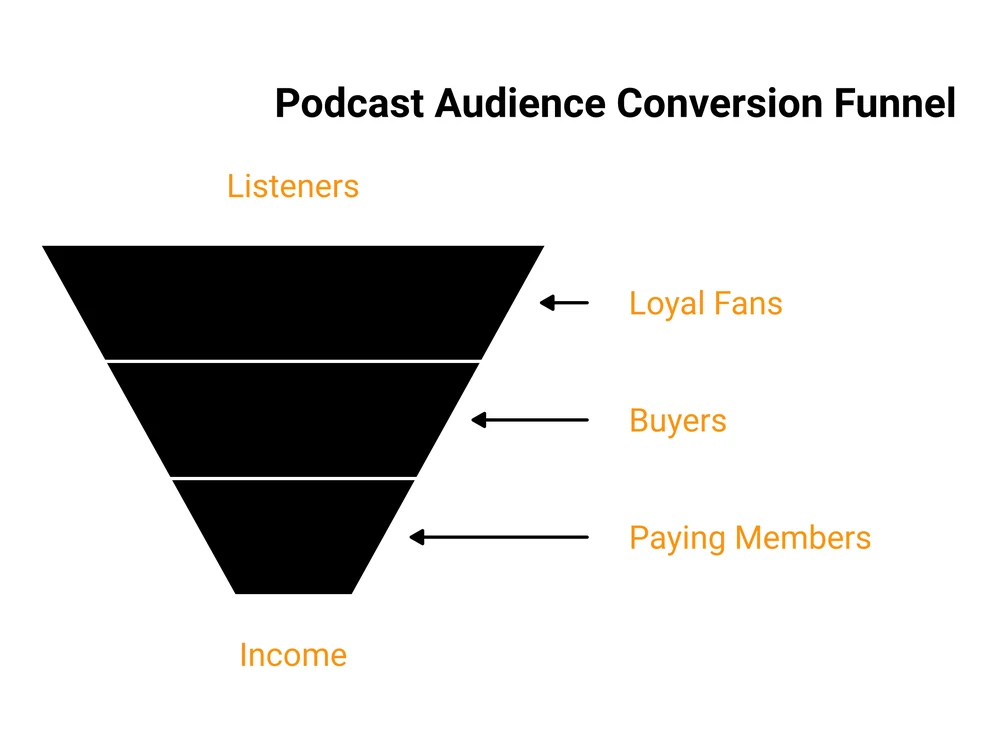
What can you sell? The list is long: online courses, ebooks, templates, presets, Notion systems, paid workshops, done-for-you services, consulting, and coaching. If you teach anything on your show, you can package a deeper version of it.
Real numbers back this up. In Apple’s own creator case study, the indie show Darknet Diaries earned over $6,000 a month from Apple podcast subscriptions alone.
That’s not a celebrity show. It’s one person who gave loyal listeners something worth paying for.
A few ideas by show type:
- A marketing podcast sells a course or a swipe file of templates.
- A fitness or mindset show sells coaching packages or a group program.
- A hobby show sells digital downloads. If you’re stuck, this list of 100 digital product ideas is a good start.
Pricing trips people up. Charge too little and you work for scraps, too much and nobody bites. This guide on how to price digital products walks through a simple method.
Where you sell matters, because every platform takes a cut. Here’s what a few common checkout options charge.
| Platform | Fee per sale | Monthly cost | Best for |
|---|---|---|---|
| Gumroad | 10% + $0.50 | Free | Beginners who want zero setup |
| Payhip | 5% (free plan) | Free | A simple storefront |
| Your own checkout (Stripe) | ~2.9% + $0.30 (processing only) | Varies by tool | Full control |
| CartMango | No per-sale platform cut on top of Stripe | Free in beta, then from $10/year | Keeping more per sale, plus upsells |
I’ll be straight with you: CartMango is the checkout platform I build, made for solo sellers who want to keep more of each sale instead of handing a percentage to a marketplace. If you’d rather compare options first, here’s an honest roundup of the best Gumroad alternative picks.
Memberships and premium content
Memberships turn your most loyal listeners into recurring income. Instead of one-off sales, fans pay every month for bonus episodes, an ad-free feed, early access, or a community.
This is where podcasting money gets serious at scale. Public estimates on Graphtreon put the top podcast on Patreon at roughly $270,000 a month, with a couple of others estimated near $200,000.
Those are outliers, but the model works at small sizes too. A show with 300 members paying $5 a month is $1,500 in recurring revenue, every month, from a few hundred people.
The main platforms each take a cut:
- Patreon takes about 10% on its current plan, plus payment processing.
- Apple Podcasts Subscriptions takes 30% in the first year a subscriber stays, then 15% after that, plus a $19.99 a year program fee.
- Spotify’s partner program pays creators 50% of the ad revenue it sells against your video episodes.
- Buy Me a Coffee takes 5%.
The trade-off is ownership. Fan platforms are easy to start, but they own the payment relationship. If you build your membership on your own checkout instead, you keep more and you keep the customer.
The right answer depends on your size and how hands-on you want to be. Building an email list alongside your membership is the most reliable way to sell to those fans again, the same way creators make money from a newsletter.
Sponsorships and ads
Sponsorships are what most people picture when they think about podcast money. They’re also the most oversold option for small shows.
Here’s why. At $18 to $25 per 1,000 downloads, a show doing 500 downloads an episode earns about $10 to $12 per ad slot. That’s not a business.
Most ad networks won’t even talk to you until you’re doing a few thousand downloads per episode, and 5,000 is a commonly cited benchmark to attract steady brand deals.
But raw size isn’t the whole story. One podcaster in r/podcasting says their show averages under 1,000 downloads an episode across more than 900 episodes, yet their top sponsor pays 6 figures a year to be the only advertiser reaching their very specific audience. As they put it, riches are in the niches.
That’s the real sponsorship lesson. A tight, well-defined audience is worth more per listener than a big general one. If your 800 listeners are all dentists, a dental supply company will pay well to reach them. You have 2 ways to land sponsors:
- Direct deals: pitch brands your audience already loves. You keep 100% and you can start small. Even a handful of listeners can work if the fit is perfect.
- Ad networks and marketplaces: they place ads for you and take a cut, but they usually want bigger download numbers first.
Pitch on audience and engagement, not just downloads. Explain exactly who listens and why they buy.
Affiliate marketing
Affiliate marketing is the fastest stream to start, because you can do it on day 1 with no audience-size requirement.
You recommend a product you genuinely use, share a custom link or promo code, and earn a commission when a listener buys. If you already mention tools, books, or gear on your show, skipping affiliate links means passing up easy income.
Say you host a show about starting a podcast. You already tell people which microphone and which hosting service you use.
Sign up for those companies’ affiliate programs, drop your link in the show notes, and every listener who buys through it earns you a cut. Amazon Associates, hosting platforms, and most software tools run affiliate programs you can join for free.
It works best when the recommendation is real. Listeners can smell a cash grab. Recommend the mic you actually record with, the software you actually use, the book that actually changed how you think. The income is usually modest, a few dollars to a few hundred a month for most shows, but it stacks well with everything else and costs you nothing to run.
Other income streams: tips, merch, live shows, and YouTube
These streams are smaller for most shows, but the right one can fit your audience perfectly.
Listener tips and donations
Some fans just want to support you. Tools like Buy Me a Coffee let listeners drop a few dollars with no strings attached. It won’t replace your salary, but for community-driven shows it adds up, and it’s a low-effort way to test whether people value the show enough to pay.
Merchandise
If your show has a strong identity, an inside joke, or a catchphrase, merch can work. Shirts, mugs, stickers. Print-on-demand means no upfront inventory. Just know that merch is a branding play as much as an income play, and margins are thin.
Live shows and events
Ticketed live recordings, meetups, or workshops can bring in a chunk of money at once, especially for shows with a loyal local following. It’s lumpy income, but a sold-out room of superfans can out-earn a year of ads.
YouTube and repurposing
Posting your episodes as videos on YouTube opens a second ad stream. You need 1,000 subscribers and 4,000 watch hours to earn ad revenue, per YouTube’s Partner Program rules.
YouTube also feeds discovery, which grows every other stream. If ad revenue there stays small, there are still ways to earn from YouTube without AdSense, like driving viewers to your own products.
How to start making money from your podcast
You don’t need every stream to make money as a podcaster. You need the 2 or 3 that fit your show and your size. Here’s a realistic path.
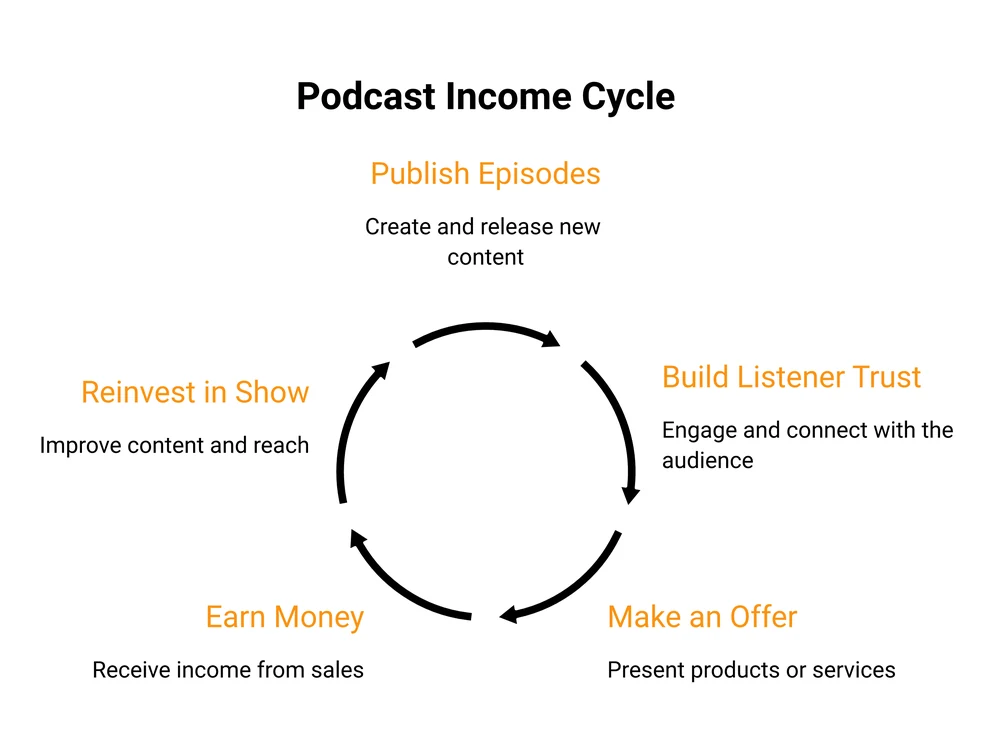
If you have a small show (under 1,000 downloads per episode): ignore sponsors for now. Set up affiliate links for anything you already recommend. Then build a single offer of your own, a paid workshop, a template, or a coaching slot, and mention it on every episode. This is where your first real money comes from.
If you have a growing show (1,000 to 5,000): keep selling your own products, add a membership for your superfans, and start pitching direct niche sponsors who fit your audience. Don’t wait for a network to find you.
If you have a bigger show (5,000+): now sponsorships and ad networks are worth the effort. Stack them on top of your products and memberships. Diversify so no single sponsor can sink your income.
Two habits matter at every size. First, publish consistently so listening becomes a routine. If you’re just getting going, this guide on starting a solo podcast covers the basics.
Second, ask. Tell listeners exactly what to do at the end of every episode, whether that’s joining your list, buying your thing, or leaving a review. Money follows a clear call to action.
FAQ
How much do beginner podcasters make?
Most beginners make very little at first, often under $100 a month, because ad income depends on download numbers that take time to build. The beginners who earn faster skip ads and sell something of their own, like a small digital product or a coaching offer, to the listeners they already have.
How much do podcasts with 10,000 listeners make?
At around 10,000 downloads per episode, ad and sponsorship income lands in the ballpark of $1,000 to $2,000 a month, depending on how many ad slots you run and your CPM. Shows that size usually earn more from their own products and memberships than from ads alone.
How many listeners do you need to make money podcasting?
There’s no hard minimum if you sell your own products, since a few dozen loyal listeners can buy a course or coaching. For sponsorships, most brands and networks want a few thousand downloads per episode, with 5,000 a commonly cited benchmark for steady deals.
Do podcasts make money on Spotify?
Yes, but indirectly for most shows. Spotify’s partner program shares ad revenue on video episodes, and you can sell subscriptions there. For the majority of podcasters, Spotify is a place to grow an audience you then monetize through your own offers, not a direct paycheck.
Do I need an LLC to start a podcast?
No, you don’t need an LLC to start or to make money from a podcast. Many podcasters operate as sole proprietors when they begin. An LLC can make sense later for liability and tax reasons once income is steady, but it’s not a requirement to earn.
If a paid membership or your own products are part of the plan, the platform you use decides how much of that recurring income you keep, and whether you keep it if you ever leave. That’s the one thing I built CartMango to fix. Every subscription you create keeps paying you even if you walk away, so your recurring revenue is never held hostage. It’s free during beta, then starts at $10 a year.
About the Author

👋 I’m Welly, founder of CartMango (the site you’re on), a checkout platform for digital product sellers. We’ve previously processed $179M+. I also run BirdSend (email marketing tool, 3.1B+ emails sent). On the side I show other non-techie digital sellers how I use AI workflows to automate 50%+ of my operations. Find me on LinkedIn.
Related Reading
- How to start a solo podcast: the low-cost setup to get your show live
- How to make money from a newsletter: the same honest-income playbook for email
- How to sell online courses: package your podcast knowledge into a paid course
- Earn money from YouTube without AdSense: monetize video without waiting on ad revenue