
Systeme.io suits a first course on a small budget: its free plan covers 1 course and $10,000 in lifetime sales, and paid plans start at about $14 a month billed yearly, with no platform cut. Kajabi suits a seller who wants a customer app and automatic video transcripts, at $143 a month billed yearly.
Kajabi vs Systeme.io splits on limits, per both pricing pages. Systeme.io’s free plan also caps you at 500 students and 1 email campaign, and Kajabi Basic caps you at 5 products and 2,500 contacts. CartMango, which I run (free right now, from about $0.83 a month billed yearly once paid plans start in November, 0% a sale plus card fees) covers checkout only.
You have a course idea and 2 tabs open. Both promise courses, email and funnels in 1 place. The first has a free plan. The second’s cheapest listed plan costs $179 a month, or $1,716 if you pay for a year.
These questions come up once students start paying. Which limit forces your first upgrade? What does each platform add to a monthly subscription charge? And what do students lose if you cancel or downgrade?
Below, Kajabi and Systeme.io go job by job, in the order you meet each one: putting the course online, taking the money, emailing buyers, recruiting affiliates and, last, leaving.
Key Takeaways
- The price gap is wide. Kajabi Basic costs $1,716 a year billed yearly, while Systeme.io’s top plan costs $970 and its free plan nothing.
- Systeme.io’s free plan has a ceiling. It holds 1 course and 500 students, and stops taking payments once lifetime sales reach $10,000.
- Kajabi adds fees in 2 places. Basic adds 2% a sale on your own Stripe account, and Kajabi Payments adds 0.7% to every subscription charge.
- Affiliates cost less to switch on in Systeme.io. Every Systeme.io plan includes an affiliate program, while Kajabi starts it on Growth at $199 a month billed yearly.
- Kajabi cuts students off when you cancel. Their subscriptions keep billing until you cancel each one. On Systeme.io, going over a plan limit after a downgrade can lock students out.
- CartMango, which I run, covers only the checkout side. Order bumps, upsells and affiliates cost $10 to $30 a year once paid plans start in November, with no course hosting yet.
Before you pay for either platform, it helps to know which selling mistakes trip up new course sellers. The Online Selling Mistakes Challenge covers 5 of them, 1 email a day for 5 days, free.
Kajabi vs Systeme.io: what each costs at your list size
Kajabi lists 3 plans on the Kajabi pricing page: Basic at $179 a month, Growth at $249 and Pro at $499, or $143, $199 and $399 a month billed yearly. Systeme.io sells Free at $0, Startup at $17 a month, Webinar at $47 and Unlimited at $97, or $170, $470 and $970 for a year, which it calls 2 months free.
Systeme.io costs less than Kajabi at every list size below, on yearly billing for both: $170 a year against $2,388 at 5,000 contacts, and $970 against $4,788 at 100,000.
| Contacts | Systeme.io plan | Systeme.io a year | Kajabi plan | Kajabi a year |
|---|---|---|---|---|
| Up to 2,000 | Free | $0 | Basic | $1,716 |
| 2,500 | Startup | $170 | Basic | $1,716 |
| 5,000 | Startup | $170 | Growth | $2,388 |
| 10,000 | Webinar | $470 | Growth | $2,388 |
| 25,000 | Unlimited | $970 | Growth | $2,388 |
| 100,000 | Unlimited | $970 | Pro | $4,788 |
Kajabi Basic stops at 2,500 contacts. Kajabi sells extra contacts in blocks of 25,000 for $125 a month, so Basic plus 1 block comes to $304 a month on monthly billing, against $249 for Growth. Kajabi also counts products: Basic sells 5, Growth 50 and Pro as many as you like. Kajabi has no free plan, only a 14-day free trial and a 30-day money-back guarantee.
The free row has 2 catches: 1 course and 500 students, and payments stop at $10,000 in lifetime sales, covered in job 2.
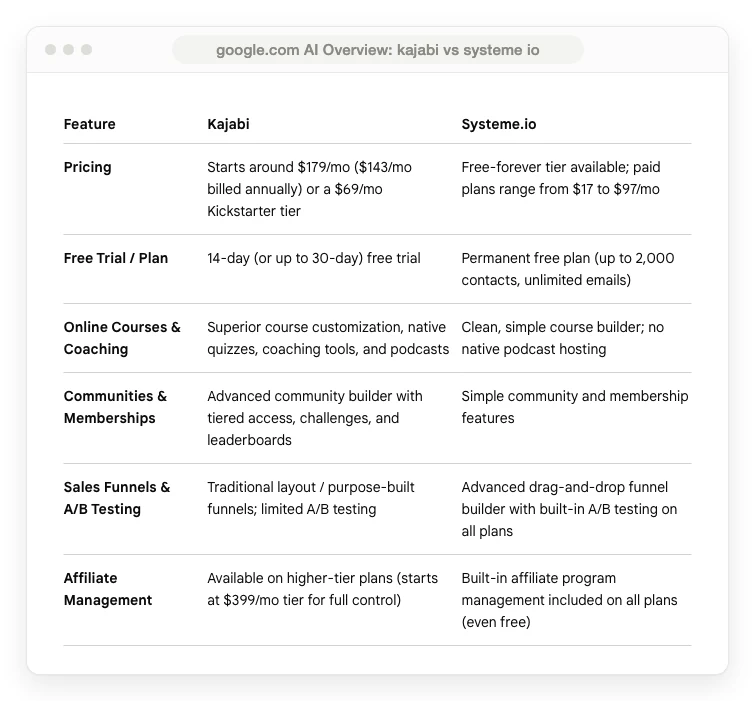
Some prices you’ll see elsewhere are out of date. 2 of the 5 written comparisons on Google’s first page still put Systeme.io’s paid plans at $27 a month, against $17 on its pricing page. Google’s AI Overview also lists a $69 Kickstarter tier for Kajabi, while Kajabi’s pricing page shows 3 plans and its code no longer mentions Kickstarter. Our Kajabi pricing breakdown found Kickstarter sold at $89 a month through a separate signup link.
Running a done-for-you email service a few years back meant a lot of sales calls. My habit became prepping the day before, or the morning of the call, instead of days ahead. The disasters I had been preparing for almost never turned up.
Platform plans work the same way. Buy for the list and products you have today, and move up when you are near a cap, such as Kajabi Basic’s 2,500 contacts or the single email campaign on Systeme.io’s free plan.
Job 1: putting the lessons and videos online
Kajabi and Systeme.io both host courses, and Kajabi adds a customer app, automatic video transcripts and, from Growth, live cohort courses.
On Kajabi, courses, coaching, memberships, downloads and podcasts count as products, and Basic allows 5. Every plan includes video transcripts and translations, plus a Kajabi app your customers use on iPhone and Android. Live cohort courses, where everyone starts on the same date, come with Growth. Your own branded app in the App Store needs Pro, at $399 a month billed yearly.
Systeme.io gives you 1 course on Free, 5 on Startup, 20 on Webinar and unlimited on Unlimited. Students are capped at 500 on Free and unlimited on every paid plan. Its help center explains how to upload and host your videos, up to 2GB a file, with unlimited storage.
Systeme.io’s own Kajabi comparison page says the opposite, that “systeme.io does not host video natively”, and tells movers to use YouTube, Vimeo or Wistia. The help center article walks through the upload step by step, so test 1 video upload before you build a whole course around it. If most of your course is long video, our guide to video hosting for courses compares 21 hosts.
Community comes with both. Kajabi Basic gives you 1 community with unlimited private groups inside it, and Systeme.io gives you 1 community on Free, 5 on Startup and 20 on Webinar, with unlimited members.
CartMango, the checkout I run, does not do this job yet. CartMango hosts no courses and no video files, and course hosting and a community are being built for its $30 a year Platinum plan, not live yet. Today CartMango can sell the downloadable parts of a course, such as PDFs, audio and worksheets, while the videos stay on a host like Vimeo or YouTube.
Job 2: the sales page, the checkout and the cut from each sale
Systeme.io adds no platform fee to any sale on any plan. Kajabi adds none to a one-time sale through Kajabi Payments, its own processor, but subscription charges there carry an extra 0.7%. Card processing costs extra on both.
Both build your pages too. Kajabi includes a website, plus unlimited landing pages and funnels, on every plan, with the checkout built in. Systeme.io gives you 1 website on Free, 5 on Startup, 20 on Webinar and unlimited on Unlimited, and its funnels run 3, 10, 50 and unlimited. Order bumps and 1-click upsells run 1, 10, 100 and unlimited.
If funnels are the main way you sell, our ClickFunnels vs Kajabi comparison goes deeper on Kajabi’s funnel builder.
Here is what Kajabi takes, according to Kajabi’s US fee page and its compare table. Kajabi Payments charges 2.9% + $0.30 a card sale on Basic, 2.8% + $0.30 on Growth and 2.7% + $0.30 on Pro. International cards add 1.5%, and every subscription or payment-plan charge adds 0.7%, the first one included.
Connect your own Stripe account instead, where Kajabi Payments is offered, and Kajabi adds 2% a sale on Basic, 1% on Growth and 0.5% on Pro, on top of Stripe’s fee. PayPal is excluded from that extra fee. Systeme.io connects to Stripe, PayPal, Apple Pay and several regional processors and adds nothing, so you pay only the processor. For a US card on Stripe’s standard pricing, that is 2.9% + $0.30.
On a $100 course sold to a US card, here is what leaves your sale:
- Kajabi Basic on Kajabi Payments: $3.20.
- Kajabi Basic on your own Stripe account: $5.20, Stripe’s $3.20 plus Kajabi’s $2.
- Systeme.io on Stripe: Stripe’s $3.20 and nothing else.
A $50 monthly membership on Kajabi Payments costs $2.10 a charge on Basic once the 0.7% is added.
1 written comparison on Google’s first page, Miha Cacic’s, says both platforms “charge zero transaction fees”. On Kajabi that holds only for one-time sales on Kajabi Payments.
Systeme.io’s pricing page also leaves out a free-plan cap. Its help article on how plans are moderated says free accounts have “a lifetime sales revenue limit of $10,000 USD”. A warning banner appears at $8,000. At $10,000, payment pages stop accepting new sales until you move to a paid plan, and affiliate commissions do not count toward the total.
None of the 5 written comparisons on Google’s first page mentions it, and our Systeme.io review covers what happens near the cap.
CartMango adds 0% to each sale on top of Stripe’s or PayPal’s fee too, with order bumps on every plan and upsells from the $20 a year Gold plan once paid plans start in November.
Job 3: emailing the people who bought
Kajabi and Systeme.io both send unlimited emails on every plan, so the difference is how many contacts you can keep and how many automations you can run. Kajabi stores 2,500 contacts on Basic, 25,000 on Growth and 100,000 on Pro. Advanced automations, the ones with conditional filters, and webhooks to your other tools start on Growth.
Systeme.io stores 2,000 contacts on Free, 5,000 on Startup, 10,000 on Webinar and unlimited on Unlimited. The free plan gives you 1 email campaign, meaning 1 automated email series, and 1 automation rule, such as tagging a buyer. Startup raises both to 10, and Webinar to 100. For a first launch, 1 welcome series plus 1 sales sequence already needs Startup.
CartMango has no email tool of its own. CartMango connects natively to Kit, ActiveCampaign, Beehiiv and BirdSend, the email tool I also run, and reaches other tools through Make.com.
Job 4: getting affiliates to sell your course
Systeme.io includes an affiliate program on every plan, the free one too, while Kajabi starts it on Growth at $249 a month, or $199 billed yearly.
For this search, Google’s AI Overview puts Kajabi’s affiliate management on a “$399/mo tier for full control”. Systeme.io’s own Kajabi comparison page says $399 in its text and “Starts at $199/month” in its table. Kajabi’s compare table lists affiliate programs on Growth and Pro, and $399 is what Pro costs a month on yearly billing. Believe the AI Overview and you would budget $4,788 a year for affiliates, when Kajabi’s real starting point is $2,388.
The free Systeme.io plan runs 1 affiliate program, and paid plans keep it on. That makes Systeme.io a low-cost way to test whether anyone will promote your course before you pay for anything.
If you sell downloads rather than a hosted course, CartMango runs affiliates on its $30 a year Platinum plan once paid plans start in November, for up to 250 affiliates. In CartMango, 1 affiliate link covers the main offer plus its order bumps, upsells and downsells.
Job 5: keeping students’ access when you downgrade or quit
Cancelling Kajabi takes your students’ access away and leaves their subscriptions billing. On Systeme.io, the risk comes from going over a free-plan limit, for example after a downgrade, which can lock students out of their courses.
Kajabi’s cancellation guide spells it out. At the end of your billing period your site goes inactive, customers cannot log in, and they lose the products they bought. Your custom domain disconnects.
Cancelling the account does not cancel your customers’ active subscriptions or payment plans. Each one has to be cancelled by hand, or the customer keeps being charged for a site they can no longer open. Kajabi may delete customer data 90 days after the account ends, and our Kajabi review lists what to export before you cancel.
Systeme.io’s documented risk sits with downgrades. Cancel a paid plan and the account drops to Free at your next billing date. If you are then over a free limit, say 3 courses or 4,000 contacts, Systeme.io’s restriction rules start: 3 warning emails, 1 a day, then a restricted account on day 4.
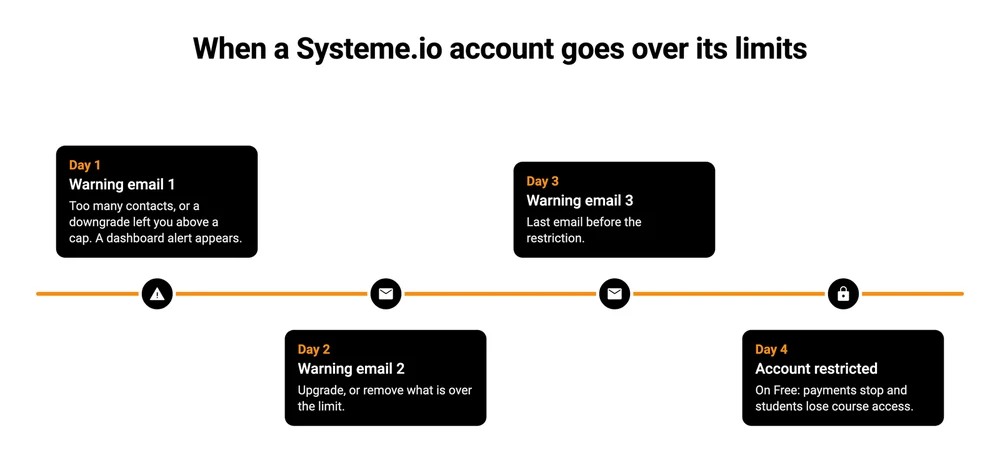
On a restricted free account, payments and opt-ins stop, and students cannot open its courses, including lessons they had already reached. Enrollments and progress are kept for when the restriction lifts. Systeme.io’s help center does not say what happens to customers’ recurring payments if you close the account entirely, so ask support before you do.
To move from Kajabi to Systeme.io, Systeme.io’s team does the migration for free on any yearly plan, or on Unlimited paid monthly. A Systeme.io user of six years, in an r/systeme_io post suggests testing before you move: “Build one complete funnel in Systeme.io first.” The same post warns against moving a working business wholesale: “don’t migrate everything because an all-in-one screenshot looks cleaner.”
The 5 jobs in 1 table
Systeme.io costs $0 to $970 a year, Kajabi $1,716 to $4,788 with a customer app and transcripts, and CartMango $10 to $30 from November for checkout and affiliates only.
| Job | Kajabi | Systeme.io | CartMango |
|---|---|---|---|
| Course and videos | 5 products on Basic, videos hosted, customer app | 1 course and 500 students free, videos up to 2GB each per its help center | Not yet, no course or video hosting |
| Checkout and fees | No platform fee on one-time sales via Kajabi Payments, 0.7% more on subscriptions, 2% more on your own Stripe on Basic | No platform fee on any plan, free plan stops at $10,000 in lifetime sales | 0% platform fee plus card fee, order bumps on every plan, upsells from $20 a year |
| Emailing buyers | 2,500 contacts on Basic, unlimited sends | 2,000 contacts and 1 campaign free, unlimited sends | No email tool, connects to Kit, ActiveCampaign, Beehiiv or BirdSend |
| Affiliates | From Growth, $199 a month billed yearly | Every plan, free included | Platinum, $30 a year, up to 250 affiliates |
| Leaving | Students lose access, subscriptions keep billing until cancelled | Over a free-plan limit, for example after a downgrade, students can be locked out of courses | No students to lose yet, and subscribers keep paying you if you leave CartMango |
| Yearly cost | $1,716 to $4,788 | $0 to $970 | Free now, $10 to $30 from November |
Pick Systeme.io if you are launching your first course and want to pay little until sales come in: Free covers 1 course and 1 email series, and Startup at $170 a year covers 5 courses and 10 email series. Pick Kajabi if you want the customer app and automatic transcripts and your sales already cover $1,716 a year. And read the CartMango column knowing I run it: for a course with video lessons, it is the wrong pick today.
FAQ
Is there anything better than Kajabi?
For a first course on a small budget, Systeme.io covers the same course, checkout, email and affiliate jobs from $0, and its biggest plan costs $970 a year billed yearly. For a product that is mostly a paid community, Skool or Circle are built around the community itself. Our Kajabi alternatives guide prices 8 options against what each one replaces.
Is Systeme.io any good?
For a first course, funnel and email list on little money, yes. The limits to plan around are the free plan’s 1 course, 500 students, 1 email campaign and 1 automation rule, plus the $10,000 lifetime sales cap. Our full Systeme.io review sorts its low-star Trustpilot reviews by complaint.
How much does Systeme.io cost per month?
$0 on Free, $17 on Startup, $47 on Webinar and $97 on Unlimited, paid monthly. A year costs $170, $470 or $970, which works out to about $14, $39 and $81 a month. Every plan takes 0% of your sales, and you pay your payment processor’s fee on top.
Is Kajabi worth the money?
It is when you use most of the bundle. Kajabi’s pricing page says 1 subscription replaces 5 tools: a website, email, a checkout, a community and courses. If you sell 1 course to a small list, $1,716 a year on Basic is a lot to earn back before profit, and Systeme.io does the same jobs for far less. Our guide on how to sell online courses covers the selling side either way.
Can you move from Kajabi to Systeme.io?
Yes. Systeme.io’s team migrates you for free on any yearly plan, or on Unlimited paid monthly, so check what it will move before you pay. Before you cancel Kajabi, export your contacts, download your videos and cancel every active student subscription, since cancelling the Kajabi account does not stop them.
If your course is files, not video lessons
If your course is files, such as a workbook, a template pack or an audio course, you can skip both Kajabi and Systeme.io. Kajabi vs Systeme.io is a choice between 2 all-in-ones, and both make sense when you want the course, the email and the community under 1 login.
CartMango, which I run, is built for the files case: a hosted Mini Page, a checkout that takes 0% a sale, order bumps on every plan, and buyers sent straight into Kit, ActiveCampaign, Beehiiv or BirdSend. CartMango is free right now, and paid plans start in November at $10 a year.
About the Author

👋 I’m Welly, founder of CartMango (the site you’re on), a checkout platform for digital product sellers. We’ve previously processed $179M+. I also run BirdSend (email marketing tool, 3.1B+ emails sent). On the side I show other non-techie digital sellers how I use AI workflows to automate 50%+ of my operations. Find me on LinkedIn.
Related Reading
- Kajabi vs Teachable: what each sale really costs on both, and the third-party payment fee most ranking pages miss
- Payhip vs Kajabi: a cheaper route for downloads and simple courses, and who files the sales tax
- Best course platform: 6 course platforms priced live, with the cut each one takes per sale
- LMS for online courses: real fees for 7 platforms and the crossover point on every entry plan