

Heartbeat pricing puts Build at $49 a month, Grow at $149 and Scale at $849, or $40, $124 and $766 each if you pay for a year up front. Every plan also takes a cut of each member payment, 5%, 2.5% and 1.25% in that order, and Stripe’s 2.9% plus 30 cents sits on top of that cut.
Community platform pricing pages are easy to read and hard to budget from. Heartbeat’s is a good example. The 3 numbers on the page are real, and a percentage of every member payment leaves on top of them.
The second problem is stranger. The member limit that decides which plan you need is published 2 different ways on Heartbeat’s own website, and Google is repeating the wrong one at the top of the search results.
Below: the plan prices on both billing cycles, Heartbeat’s cut added to Stripe’s so you see the real percentage, the revenue point where moving up a plan starts saving you money, and what the plan price leaves out.
Key Takeaways
- 3 plans, 3 different cuts. Build is $49 a month, Grow $149 and Scale $849, or $40, $124 and $766 on annual billing.
- The percentage stacks. Heartbeat takes 5%, 2.5% or 1.25%, and Stripe charges its own 2.9% plus 30 cents on top of that.
- Google has the Grow member cap wrong. Its AI Overview says 1,000 members. Heartbeat’s own pricing page says 5,000.
- Build costs more than Grow past around $40,000 a year in member payments, which is roughly 115 members paying $29 a month.
- Video hosting costs extra on Build. It is a $19 a month add-on with 50 hours, included free on Grow and Scale.
Heartbeat pricing, plan by plan
Heartbeat pricing covers 3 plans and prices each of them 2 ways, so the number you see depends on which billing cycle the page is showing. It loads on the yearly toggle by default, which is why “$40” turns up in so many reviews when the monthly price is $49.
Annual billing saves 17% on Build and Grow and 10% on Scale, in Heartbeat’s own words. That is $98 a year off Build, $298 off Grow and $988 off Scale.
Curious where else your money quietly leaks out when you sell online? The free 5-day Online Selling Mistakes Challenge walks through the 5 that cost solo sellers the most.
Build is the cheapest plan at $49 a month and it carries the biggest cut at 5%. Scale is the most expensive at $849 a month and carries the smallest cut at 1.25%.
| Plan | Billed monthly | Billed yearly | Members | Heartbeat’s cut | Video hosting |
|---|---|---|---|---|---|
| Build | $49 a month | $40 a month, $490 a year | 350 | 5% | Paid add-on |
| Grow | $149 a month | $124 a month, $1,490 a year | 5,000 | 2.5% | 50 hours |
| Scale | $849 a month | $766 a month, $9,200 a year | Unlimited | 1.25% | 200 hours |
The member number is a ceiling on the size of your community. Heartbeat’s own FAQ answers the per-seat question directly: you are not charged per community member of any kind. Admins and moderators are unlimited on every plan, so adding a second moderator costs nothing.
The cut falls as the plan price rises. That is how the whole ladder works: you buy a lower percentage with a bigger subscription. Whether the swap is worth making depends on how much money moves through your community, and there is a number for that further down.
The transaction fee, and what it costs once Stripe stacks on top
Heartbeat’s transaction fee sits on top of card processing. Its pricing page says so in a footnote and again in its FAQ: Heartbeat charges a transaction fee based on your plan, added on top of Stripe’s standard credit card processing fee, which it puts at 2.9% plus 30 cents.
So the headline 5% on Build is never really 5%. Take a $29 monthly membership, a common price for a paid community.
Heartbeat takes $1.45 of it. Stripe takes another $1.14. You are down $2.59 before you have paid yourself anything.
On a $29 monthly membership, Build takes $2.59 of every payment once Stripe is included, Grow takes $1.87 and Scale takes $1.50.
| Plan | Heartbeat’s cut | Stripe’s cut | Total taken | You keep |
|---|---|---|---|---|
| Build | $1.45 | $1.14 | $2.59 | $26.41 |
| Grow | $0.73 | $1.14 | $1.87 | $27.13 |
| Scale | $0.36 | $1.14 | $1.50 | $27.50 |
Read those as percentages and the picture gets clearer. Build costs you 8.9% of a $29 payment, Grow costs 6.4% and Scale costs 5.2%. The 30 cent piece is why the small numbers hurt most: on a $9 membership that flat charge alone is 3.3% before anybody’s percentage is applied.
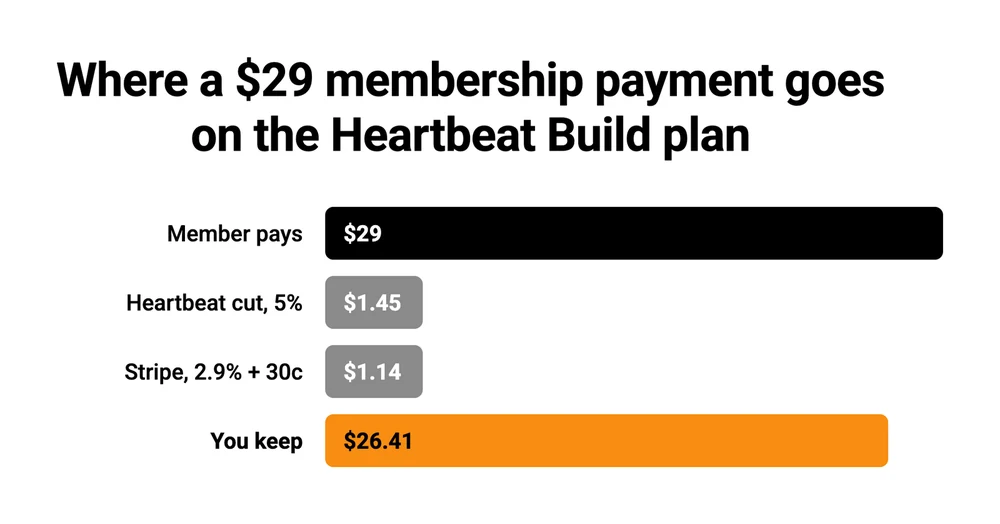
A reviewer on the first page of Google does run this math, and only for Build. Himanshu Bisht’s Heartbeat review states that at $97 a month on the Build plan you are giving away close to 8% of that revenue before you pay yourself anything. No page I read carries the same math across to Grow or Scale, which is where the decision actually gets made.
Why Google says the Grow plan stops at 1,000 members
Google’s AI Overview for “heartbeat pricing” says the Grow plan covers up to 1,000 members. Heartbeat’s own pricing page says 5,000, in the plan card and again in the full feature comparison table underneath it.
That gap is worth $700 a month. If you run a community of 1,200 people and you trust the summary at the top of the search results, you would conclude you need Scale at $849 a month. Grow at $149 a month covers you, with 3,800 members of headroom left over.
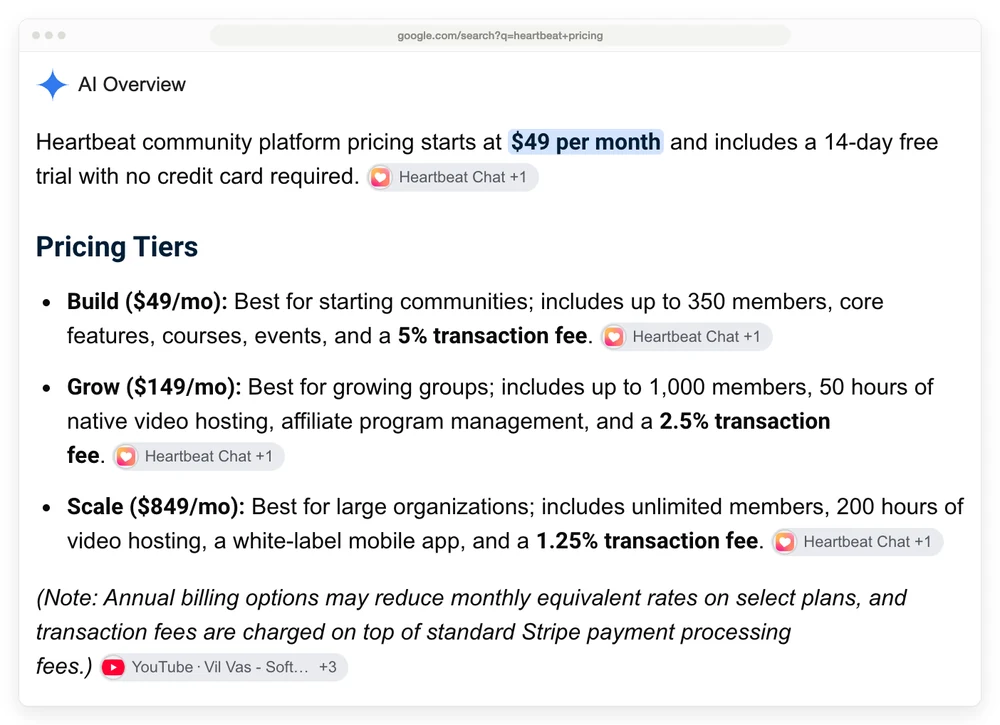
Google did not invent the number. It is quoting Heartbeat.
3 of Heartbeat’s own comparison articles state the smaller figure. Its Heartbeat vs Discord page says the Grow plan is $149 a month for up to 1,000 members. Its Heartbeat vs Thinkific page repeats that wording.
Its Heartbeat vs Facebook Groups page says it twice on the same page, once in a feature table reading “Build: 350, Grow: 1,000” and once in the prose underneath. So the company’s marketing pages and the company’s pricing page disagree, and the search engine picked the marketing pages.
The 1,000 figure looks like a leftover from an older plan structure. A page-1 review by Marie O’Sullivan, which states on the page that its pricing is correct as of August 2024, describes a starter plan at $40 a month that lets you add up to 1,000 members.
Today $40 a month buys the Build plan and Build stops at 350. Somewhere between then and now the entry tier’s ceiling came down, and the old number kept circulating.
Google says so itself, in the help page it attaches to its AI Overviews: AI responses may include mistakes. The awkward version here is that the mistake was on the vendor’s website first.
Whichever plan you land on, read the member cap off the pricing page, not off a summary, a review or a comparison article. That includes Heartbeat’s own comparison articles.
The point where Grow gets cheaper than Build
Grow gets cheaper than Build once your members are paying you around $40,000 a year, on annual billing. Below that the extra $1,000 a year that Grow costs is more than the 2.5% it saves you. Above it, the saving wins.
The arithmetic is short. Build costs $490 a year plus 5% of your member payments, and Grow costs $1,490 a year plus 2.5%.
Set those 2 equal and the difference cancels out at $40,000 of payments. If you are paying monthly rather than yearly, the same point moves to $48,000.
At $29 a month per member, Grow gets cheaper than Build at about 115 paying members, which is a third of the 350 that Build allows. At $9 a month it never happens before Build’s cap.
| Your monthly price per member | Grow gets cheaper at | Share of Build’s 350-member cap |
|---|---|---|
| $9 | 370 members | Over the cap, so never |
| $19 | 175 members | 50% |
| $29 | 115 members | 33% |
| $49 | 68 members | 19% |
| $97 | 34 members | 10% |
For most paid communities, Build is the cheaper plan for only the first slice of its own capacity. The plan is labelled “Popular” on the pricing page and it holds 350 members, and if you charge $29 a month you should be looking at Grow somewhere around member 115. The plan works fine at that size. The gap sits between what the cap lets you hold and what the money says you should be paying.
Scale works differently. Moving from Grow to Scale saves 1.25% and costs $7,710 more a year, so on fee savings alone it only pays for itself past roughly $616,800 a year in member payments. Scale earns its price on unlimited members, the white-label mobile app and same-day support, rather than on the fee saving.
What the plan price leaves out
4 real costs sit outside the plan price, and none of them appears in the 3 numbers at the top of the pricing page.
Video hosting on Build. Heartbeat’s FAQ describes native video hosting as a $19 a month add-on that includes 50 hours of storage, included on Grow and Scale instead. If your community runs on recorded calls or a video course, Build is really $49 plus $19. On annual billing that is $718 a year, still $772 less than Grow, so the add-on is usually the cheaper move.
Heartbeat’s branding. The Build plan carries a “Powered by Heartbeat” line. Removing it is a Grow feature, so a white-labelled community starts at $149 a month.
Stripe, and only Stripe. Heartbeat’s payment methods answer lists cards, Cash App Pay, Link, and local bank methods including Bancontact, EPS, iDEAL, Przelewy24, SEPA Direct Debit and bank transfers. Every one of those is a Stripe method and PayPal is not on the list.
If a decent share of your buyers pay by PayPal, that is a real cost, and it never shows up as a fee.
The limits inside Build. Build gives you 5 automation workflows and 1 custom landing page. API access, conversion tracking for ad platforms, the affiliate program and white-labelled emails all start on Grow. Those matter if you run ads to your community or pay affiliates to fill it.
Does Heartbeat have a free plan
Heartbeat has no free plan. It runs a 14-day free trial with no credit card required, and that is the only way to use it without paying.
Heartbeat’s FAQ says that if you have not upgraded by the end of the trial your community is deactivated, and communities that stay inactive for 30 days are deleted automatically. So a trial you start and abandon does not sit quietly waiting for you.
Refunds are handled case by case, in Heartbeat’s wording, with no stated money-back window. Between that and the deletion clock, use the 14 days properly.
My kids started swimming lessons in November 2022. 2 months later they had gone from too afraid to be in the pool without me to swimming a third of the way across it without a kickboard. They got there because they got their feet wet, and I was the one who made them.
I did the same thing that year with a kind of client work I had never sold before, after months of asking myself what if I make a mistake. A 14-day trial is the cheap version of that. Just do not start the clock on a week when you have no time to use it.
How the cut compares to Skool and the rest
Skool’s cheapest plan costs less than Heartbeat’s and takes more out of each payment. Skool Hobby is $9 a month against Heartbeat Build’s $49, and its cut is 10% plus 30 cents with card processing already inside that number. Heartbeat’s 5% has Stripe’s 2.9% plus 30 cents added on top of it.
Run both against the same $29 membership and Heartbeat Build takes $2.59 while Skool Hobby takes $3.20. Skool’s $99 Pro plan drops its cut to 2.9% plus 30 cents on payments up to $899, rising to 3.9% above $900. On a $29 membership that is $1.14, the cheapest per-payment number of the 3.
That flips the answer depending on your size. At 100 members paying $29 a month, Skool Pro is the cheapest of those options over a year. At 20 members it would be the most expensive, because $99 a month buys a lot of transaction fees at that scale.
The full picture across Skool, Circle, Mighty Networks, Patreon and Discord, priced against the same membership, is in our community platform for creators comparison. If you want the numbers on their own, the Skool pricing breakdown goes through both Skool plans and the fee its pricing page does not show, and Mighty Networks pricing covers all 4 of its plans including the 2 with no price card.
What people using Heartbeat run into
Heartbeat runs on Stripe alone, and that carries an operational consequence no pricing page mentions. A creator described it in an r/stripe thread about reporting: “My Stripe is integrated with something else (Heartbeat Chat)… Stripe is the only payment processing option they integrate with, so I’m stuck with it.”
Stripe’s own reporting covers the payment layer, so anything about what was sold and to whom has to come from Heartbeat. If you are used to reconciling revenue inside Stripe, that is a change of habit rather than a fee, and nobody warns you about it on a pricing page.
Reviews of the product itself are warm. Marie O’Sullivan, who bought a lifetime deal in late 2022, writes that she is delighted she did and now runs live workshops on it as a course platform. What her review does not carry is a transaction fee, a tier name or any price except $40.
Which Heartbeat plan fits which community
Build at $49 a month fits a community under about 100 paying members, or any size at all if you charge under $10 a month. Add $19 if you need video hosting. Accept the Heartbeat branding and the 5%.
Grow at $149 a month fits anything past roughly $40,000 a year in member payments, which arrives far earlier than Build’s 350-member cap suggests. It is also the first plan with white-labelling, an affiliate program, API access and conversion tracking, so it is where a community with paid traffic starts.
Scale at $849 a month fits communities past 5,000 members or ones that want their own branded mobile app. Buy it for the headroom and the app, because the numbers above show the fee saving alone will not cover it.
If your community is free and you only need somewhere for people to talk, none of these plans is aimed at you. If it is paid, the wider question of what to charge for a membership matters more than which tier you land on.
FAQ
How much does Heartbeat cost?
Heartbeat costs $49, $149 or $849 a month for Build, Grow and Scale, or $40, $124 and $766 a month if you pay yearly, which works out to $490, $1,490 and $9,200 a year. On top of the plan, Heartbeat takes 5%, 2.5% or 1.25% of every payment your members make, and Stripe charges its own 2.9% plus 30 cents.
What is the Heartbeat platform?
Heartbeat is a community platform for creators, coaches and course sellers. It combines chat channels, voice and video rooms, courses, events, member directories and paid memberships in 1 place, so members can move between a discussion and a course lesson without leaving. Several unrelated products share the name, so check you are looking at heartbeat.chat.
Is Heartbeat a dating app?
Not the Heartbeat this guide is about. Heartbeat at heartbeat.chat is a community platform for creators, coaches and course sellers. The name is shared by several unrelated products, and Google’s own People Also Ask box for “heartbeat pricing” mixes them together, which is why a project management tool’s pricing also turns up on the first page of results.
Does Heartbeat charge per admin or per member?
No. Heartbeat’s FAQ says you are not charged per community member of any kind, and admins and moderators are unlimited on all 3 plans. The member number on each plan is a ceiling on how many people your community can hold. Heartbeat charges nothing per seat.
Is annual billing worth it on Heartbeat?
Annual billing saves 17% on Build and Grow and 10% on Scale, which is $98, $298 and $988 a year. You can switch between monthly and annual at any time and Heartbeat says it applies any prorations or refunds when you do. The saving is real, so the only reason to stay monthly is if you are still deciding.
What happens when the Heartbeat free trial ends?
The trial runs 14 days with no credit card. If you have not upgraded by the end of it, your community is deactivated, and Heartbeat’s FAQ says communities that remain inactive for 30 days are deleted automatically. Export anything you care about before that window closes.
Can I sell courses and memberships through Heartbeat?
Yes. Courses come in evergreen and cohort-based formats on every plan, and you can sell access with membership tiers, checkout pages, paid waitlists and upsells. The transaction fee applies to those payments the same way it applies to memberships. If courses are the main thing you sell rather than the conversation around them, a dedicated course platform is usually the better fit.
Charging for a community you host somewhere else
Every number in Heartbeat pricing is built the same way: a subscription you can see, plus a percentage you have to go looking for, on top of a processor fee that never goes away. On a community platform that trade is often a fair one, because the room full of people is the thing your members are paying for.
It is a worse trade when the room is not what you are selling. If you run your community somewhere free like Discord or a group chat, and you only need a way to charge people for it, a percentage of every payment buys you nothing.
A checkout does that job without taking a cut. CartMango takes no percentage of your sales on any plan, handles one-off products and subscriptions on all 3 tiers, and pays out straight to your Stripe or PayPal account. CartMango is free until October 2026 and then $10 to $30 a year. CartMango does not host courses or a community yet, and both of those arrive on the $30 a year plan in October 2026.
About the Author

👋 I’m Welly, founder of CartMango (the site you’re on), a checkout platform for digital product sellers. We’ve previously processed $179M+. I also run BirdSend (email marketing tool, 3.1B+ emails sent). On the side I show other non-techie digital sellers how I use AI workflows to automate 50%+ of my operations. Find me on LinkedIn.
Related Reading
- Skool vs Circle: the 2 platforms Heartbeat gets compared against most, priced head to head
- Circle competitors: 8 alternatives sorted by which kind of buyer each one serves
- Best recurring revenue businesses: 20 models that bill members every month
- How to sell online courses: for readers whose community is really a course with a chat attached