

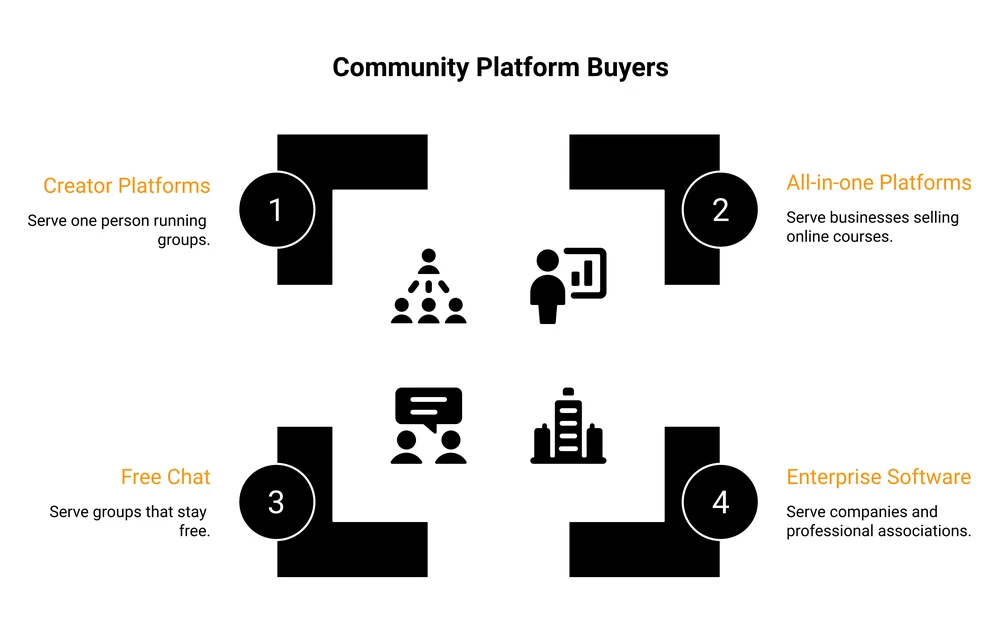
Circle competitors split into 4 groups: creator platforms like Skool, Mighty Networks and Heartbeat, all-in-ones like Kajabi and Podia, free chat tools like Discord, and enterprise software like Hivebrite and Bettermode. They differ on 2 numbers, the monthly plan and the cut taken from every member payment. Every price below was read from the vendor’s own pricing page.
Type those 2 words into Google and you get a strange page of results. A tool charging $9 a month sits a few rows above one starting at $895 a month. 2 of the results are about a different company that happens to be called Circle, and it sells crypto infrastructure.
The lists that look most helpful are mostly written by companies that appear in them. None of that is anybody’s fault, and it still leaves you comparing 8 tools built for 4 different kinds of buyer.
This post sorts them by who each one is actually for, prices them from their own pricing pages, and says plainly which group you are probably in.
Key Takeaways
- Circle’s own comparison page ranks first for its own competitors keyword. It compares 17 rivals on features, and its main grid carries no price or fee column.
- 3 of the ranking guides put their own product at number 1. Podia, Ruzuku and Odd Circles each named themselves the best Circle alternative.
- The price spread is roughly 100x. Skool starts at $9 a month, Hivebrite at $895, both returned for the same search.
- Circle’s transaction fee is not on its plan cards. It is 2% on Professional and 1% on Business, behind a Compare plan features panel.
- Discord looks free and takes the biggest cut here. A 10% platform fee plus 6% payment processing is 16% of every membership payment.
Before any of the numbers, it is worth knowing something about the guides you are reading, because it explains why no 2 of them agree.
If you want the wider version of this problem, the free 5-day Online Selling Mistakes Challenge walks through the profit leaks most solo sellers miss, and platform fees are only the first one.
Who wrote the first page of Google for this
The first page of Google for circle competitors is written almost entirely by companies with something in the race. I opened all 9 organic results and counted.
The result ranking first is circle.so/compare, which is Circle’s own page. It compares Circle against 17 named rivals and calls itself an honest comparison of every Circle alternative.
Its main grid compares on community, courses, AI features and white label. There is no price column and no fee column in that grid.
Then come the guides. Podia’s article is titled 6 Best Circle Alternatives for Creators and its number 1 pick is Podia. Ruzuku’s is titled 7 Best Circle Alternatives for Course Creators and its number 1 pick is Ruzuku. Odd Circles runs 11 Top Alternatives to Circle.so and its number 1 pick is Odd Circles. 3 of them rank their own product first.
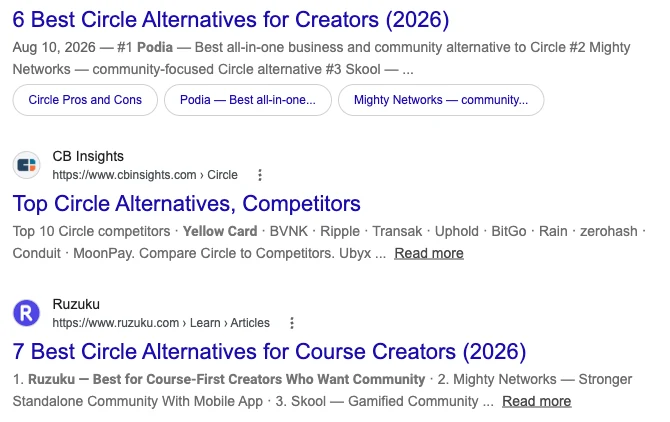
2 more results are about a different company. CB Insights and TrustRadius both cover Circle Internet Financial, which issues the USDC stablecoin.
CB Insights lists Yellow Card, BVNK, Ripple, Transak, Uphold, BitGo and MoonPay as Circle’s top competitors. TrustRadius lists Coinbase, MetaMask and NOWPayments. Useful pages, wrong Circle.
That leaves 3 results with nothing to sell you: a G2 listing, a YouTube comparison and a Reddit thread. Which is why the recommendations swing so hard depending on which tab you have open.
Podia genuinely is an alternative to Circle, and Ruzuku genuinely is a course platform somebody might move to. A list ordered by its own author still puts that author near the top. So the ranking tells you who wrote the page, and you are left to work out the fit yourself.
Circle competitors sort into 4 groups, not 1 ranking
Circle’s rivals were built for 4 different buyers, which is why a tool at $9 a month and a tool at $895 a month both come back for the same search.
Circle sits in an awkward middle. It is expensive enough that cheap creator tools undercut it, and cheap enough that enterprise community software looks like a different category. So it collects rivals from both directions plus the free chat apps underneath it.
Skool, Mighty Networks and Heartbeat start between $9 and $95 a month on their entry plans and take 2% to 10% of member payments. Kajabi and Podia start between $49 and $179 a month and put courses and email marketing on the same plan as the community. Discord is free to run and takes 16% of a paid subscription. Bettermode and Hivebrite start between $499 and $895 a month and are sold to organisations rather than creators.
| Group | Tools | Entry plan | Cut on the entry plan | Built for |
|---|---|---|---|---|
| Creator platforms | Skool, Mighty Networks, Heartbeat | $9 to $95 a month | 2% to 10% | 1 person running a paid group |
| All-in-ones | Kajabi, Podia | $49 to $179 a month | 0% to 5% | A business selling courses too |
| Free chat | Discord | $0 | 16%, more through an app store | Groups that stay free |
| Enterprise | Bettermode, Hivebrite | $499 to $895 a month | Not published | Companies and associations |
Those are month-to-month rates where the vendor sells one. Hivebrite publishes an annual-billing rate only, and every platform above except Discord and Hivebrite knocks 15% to 20% off if you pay for the year.
Pick your group first. Comparing Skool against Hivebrite is comparing a bicycle against a delivery van, and both showed up because you typed the same 2 words.
The creator platforms: Skool, Mighty Networks and Heartbeat
Skool, Mighty Networks and Heartbeat are the 3 tools most people mean by a Circle alternative, and all 3 start cheaper than Circle once you compare them on the same billing basis. Circle publishes an annual-billing rate only, $89 a month for Professional. On that same basis Skool Hobby is $7.50 a month, Heartbeat Build is $40 and Mighty Networks Launch is $79.
Skool prints its transaction fee on the plan card, which almost nobody else does. Hobby is $9 a month and takes 10%. Pro is $99 a month and takes 2.9%, with card processing inside that number rather than added underneath.
2 details are missing from Skool’s plan cards and sit in its payments help doc instead. There is 30 cents on every transaction. And the 2.9% becomes 3.9% on any transaction of $900 or more, so a $997 cohort seat is charged at the higher rate. Our Skool pricing breakdown works through both.
Circle publishes $89 a month for Professional and $199 for Business, both billed annually, and its fee is 2% and 1% on those plans plus 0.5% on Circle Plus. Those percentages are real and they are on Circle’s pricing page. They are just not on the plan cards. You scroll past the plans and open a panel called Compare plan features to find them.
Mighty Networks is the closest structural match to Circle. Launch is $95 a month month to month, or $79 a month if you pay for the year, which Mighty publishes as $950 a year. Scale is $215 or $179. Its fee ladder is 2%, 1% and 0.5%, the same 3 rungs as Circle’s, and our Mighty Networks pricing breakdown covers the plans with no pricing card.
Heartbeat is the one that tells you the truth in a footnote. Build is $49 a month or $490 a year, Grow is $149 or $1,490, Scale is $849 or $9,200. Its fees are 5%, 2.5% and 1.25%, and its own pricing page states that Stripe’s card fee of roughly 2.9% plus 30 cents is charged on top of that.
Skool Pro takes $3.20 out of a $100 member payment and Circle Professional takes $5.20, so the platform advertising 2.9% costs you less per payment than the platform advertising 2%:
| Platform | Entry plan | Larger plan | Its cut | Stripe on top? |
|---|---|---|---|---|
| Skool | $9 a month | $99 a month | 10%, then 2.9%, plus 30c | No, included |
| Circle | $89 a month | $199 a month | 2%, then 1% | Yes |
| Mighty Networks | $95 a month | $215 a month | 2%, then 1% | Yes |
| Heartbeat | $49 a month | $149 a month | 5%, then 2.5% | Yes |
We priced that head to head across 4 crossover points in Skool vs Circle, and ran the same maths across 7 platforms in what community platforms really cost. The short version is that a lower percentage on a higher base can still cost you more, and which way it falls depends on your monthly member revenue.
A community manager on Reddit put the frustration better than any comparison table. Asked what platform people use and why, one member of r/CommunityManager replied simply that the prices for community platforms are seriously outrageous and asked somebody to explain why. Nobody in the thread answered.
The same thread is more useful on fit than on price. Several members independently landed on Skool for pure engagement and flagged the same limitation each time, that Skool runs 1 shared discussion feed rather than separate spaces, and that its course tools are basic. The top reply summed the split up as Skool for creator businesses and Circle for anyone who needs white labelling.
Worth knowing on that last point: Circle’s white labelling is not on the $89 plan. Removing Circle branding needs Business at $199 a month.
The all-in-ones: Kajabi and Podia
Kajabi and Podia sell a course and marketing platform that happens to include a community, so they cost more than the community tools and replace more of your stack.
Kajabi Basic is $179 a month month to month, or $143 a month billed annually, which its own page describes as saving $432 a year. That works out at $1,716 for the year. Basic includes 5 products, 2,500 contacts and 1 community.
Kajabi’s headline says no hidden fees and no revenue sharing, and on its own payment rails that holds: Kajabi Payments charges 2.9% plus 30 cents and no platform cut. Route payments through a third-party processor instead and Kajabi charges 2% on Basic, 1% on Growth and 0.5% on Pro. Same ladder as Circle and Mighty Networks, applied to a different choice. The full tier picture is in our Kajabi pricing breakdown.
Podia is the cheaper one. Mover is $49 a month or $504 a year, Shaker is $99 or $1,008, Earthquaker is $179 or $1,800. Only Mover charges a Podia transaction fee, at 5%. Shaker and Earthquaker take nothing beyond your payment processor.
That makes Podia Shaker an awkward comparison for Circle. On annual billing Shaker is $84 a month against Circle Professional’s $89, so it is $5 a month cheaper, it takes 0% where Circle takes 2%, and it adds a course platform and an email tool on top. What Circle gives you for the extra money is better discussion spaces, which is a real thing to want and a narrower one than the price gap suggests.
When courses are the real product and the community is the extra, compare against the course platforms rather than against Circle. We priced 7 of them in LMS for online courses.
Discord looks free and takes the biggest cut here
Discord costs nothing to run and takes 16% of a paid subscription on desktop, which is more than any paid platform on this page charges.
Discord’s own Monetization Terms set out the schedule for Server Subscriptions. On desktop and in a browser it is a 10% platform fee plus 6% payment processing.
Through an app store the processing fee jumps. The terms list 30% for the iOS App Store, dropping to 15% once a subscription has been auto-renewing for a year, with Google Play on the same 15% for auto-renewing subscriptions and 30% for everything else. Discord’s 10% sits on top of whichever one applies.
There is a clause worth reading before you assume that lands on you. For purchases made through the Discord mobile app, the terms say you direct Discord to raise the price of your offering to cover the app store’s processing fee. So your member pays more rather than you taking less, and Discord’s 10% still comes off the top either way.
Apple’s Small Business Program is a separate route to a 15% rate, for developers under $1 million in yearly proceeds. It applies to Discord as the developer, not to you.
This is why plenty of paid Discord servers never switch on Server Subscriptions. The creator sells access through their own checkout, then a bot hands the member their role. The room stays free to run and the money never touches Discord’s fee schedule.
The enterprise tier: Hivebrite and Bettermode
Hivebrite and Bettermode are the results that make this search confusing, because both are sold to organisations with a budget rather than to a creator with a laptop.
Bettermode Starter is $499 a month month to month, or $399 a month billed annually, which its page publishes as $4,788 a year. That plan holds up to 10,000 members. Growth is $1,750 or $1,500 a month, published as $18,000 a year.
Bettermode publishes no transaction fee anywhere, and the reason is worth saying plainly: its plans carry no member-payment feature to charge a fee on. It is customer community software for companies, so charging your members sits outside what it does.
Hivebrite starts at $895 a month for Core and $1,995 for Flex, both billed annually, with 2 higher tiers priced only after a sales call. It publishes no transaction fee either. Every plan says talk to us rather than start a trial.
Neither belongs on a shortlist with Skool unless you are running an alumni network, a professional association or a customer community with a real budget behind it. Google surfaces them alongside Skool anyway, Hivebrite inside the G2 listing on page 1 and Bettermode in the related searches underneath it. That is 2 words matching, not 2 tools answering the same question.
What happens to your members if you leave
Whether your members’ payments follow you to a new platform depends on who holds the card, and it splits these tools cleanly in 2.
Circle, Mighty Networks and Heartbeat all connect to your own Stripe account. Your members’ cards live with Stripe under your name, which is why all 3 charge their percentage on top of Stripe’s rather than instead of it. Moving is a real job, and the billing relationship is already yours.
Skool works the other way. Skool is the merchant of record, so it holds the payment relationship, files EU VAT for you and absorbs the chargeback admin. The trade is that subscriptions billed on Skool’s merchant account cannot move with you. Your members have to subscribe again somewhere else.
Both arrangements buy you something. Skool’s flat 2.9% beats running your own Stripe when your buyers are spread across countries, because Stripe adds 1.5% for an international card on top of its published rate of 2.9% plus 30 cents.
We worked through this across 8 platforms in who keeps your members if you leave. It is the question worth asking before you sign up rather than after, because it gets more expensive the longer you wait.
How to pick, without buying for a business you do not have yet
Pick by which of the 4 groups above describes your situation today, then take the cheapest tool in that group that does the job, because every one of them lets you move up later.
If a paid group is the whole product, you are in the creator tier. Skool if discussion is the value and you want the fee printed on the card. Circle if your brand cannot look like everyone else’s and you can budget $199 for the plan that removes its branding.
Mighty Networks if you want Circle’s layout with a stronger mobile app. Heartbeat if events and calls are the thing people show up for. Our guide to Skool alternatives runs the same comparison from the other direction.
If courses are the product and the group is the extra, look at Kajabi and Podia before any community tool. If your group is free and social, Discord is fine, and just do not turn on Server Subscriptions. If you are buying for an organisation with a procurement process, Hivebrite and Bettermode exist for you.
There is a version of this decision that costs people real money, and it is buying capacity for a community that does not exist yet. I used to be the opposite of a just-in-time operator. When I ran a done-for-you email service I would prepare talking points and slides days ahead of a sales call, working through a long list of things that might go wrong. Now I prepare the morning of the call, and the disasters I used to rehearse mostly never turned up.
Platform choice is where that habit turns into a bill. The plan you might need in 18 months is a poor reason to pay for it in month 1. Every tool here lets you upgrade the day you actually need to, and none of them refunds the 17 months you spent on the wrong tier.
If nobody in your group has posted in a month, no platform on this page fixes that.
FAQ
Who is Circle’s biggest competitor?
Skool and Mighty Networks, depending on what you are measuring. Mighty Networks is the closest structural match, with the same spaces-and-courses structure and the same 2%, 1% and 0.5% fee ladder. Skool is the bigger threat commercially, because it starts at $9 a month against Circle’s $89 and prints its fee where you can see it.
What are some good alternatives to Circle?
Skool for a discussion-first paid group, Mighty Networks for Circle’s structure with a better mobile app, Heartbeat for event-driven communities, and Kajabi or Podia if courses matter more than the community. Discord works when the group stays free. Hivebrite and Bettermode only make sense for organisations.
Is Circle better than Skool?
Circle is better if you need separate spaces, real course hosting or white labelling, and you can afford $199 a month for the plan that removes Circle branding. Skool is better if discussion is the product and you want simple pricing. Skool Pro also takes $3.20 out of a $100 member payment against Circle Professional’s $5.20.
How does Circle make money?
Circle charges a monthly plan of $89 for Professional or $199 for Business, both billed annually, plus a transaction fee of 2% or 1% on member payments that sits on top of your Stripe fees. Email marketing is a separate add-on, free under 100 contacts and rising with your list, so a growing community pays more than the plan price suggests.
Does Circle have a free plan?
No. Circle runs a 14-day free trial with no card required, and its lowest paid plan is $89 a month billed annually. Skool at $9 a month and Discord at $0 are the cheap entry points on this list. Podia Mover at $42 a month on annual billing is the cheapest of the all-in-ones.
Which Circle competitor charges no transaction fee?
Podia on Shaker and above, and Kajabi when you use Kajabi Payments rather than a third-party processor. Every other paid platform here takes a percentage of member payments. Bettermode and Hivebrite publish no fee because neither one collects money from your members in the first place.
When you only need the second half
Every tool on this page is doing 2 jobs at once, hosting the room and collecting the money, and you pay a percentage for the bundle whether or not you need both halves.
Plenty of people already have the room. A free Discord server, a Facebook group, a Slack workspace that works fine. What they need is a way to charge for access without handing over 16% of it, which is the pattern the Discord section above describes.
I should be upfront that I have a stake in this. I run CartMango, a checkout platform for solo digital sellers, and I built cart software before that, so I am not a neutral voice on where your checkout should live.
CartMango hosts no community and no courses today. Both are being built, and they arrive on the $30 a year plan in October 2026.
Until then, if you need somewhere to host the group, 1 of the platforms above is your answer and I would rather you picked the right one.
CartMango does the money half. CartMango takes one-time payments and subscriptions, hosts the sales page through Mini Pages so you need no website of your own, takes no cut of your sales, and keeps your subscriptions running if you ever leave. CartMango is free until October 2026, then starts at $10 a year.
Circle Professional costs $89 a month and takes 2% plus Stripe, Skool Pro costs $99 and takes 2.9%, Discord costs nothing and takes 16%, and a free group paired with a CartMango checkout costs nothing until October 2026 and takes no platform cut at all:
| Route | What it costs | Cut of member payments | Hosts the community? |
|---|---|---|---|
| Circle Professional | $89 a month | 2% plus Stripe | Yes |
| Skool Pro | $99 a month | 2.9% all in | Yes |
| Discord Server Subscriptions | $0 | 16% on desktop | Yes |
| Free group plus CartMango checkout | Free until October 2026, then from $10 a year | 0%, plus your own processor | Not yet, planned for October 2026 |
To be plain about the last row, CartMango is mine, and it is on that list because it charges no percentage of your sales, not because it can host your community.
That last row is only the right answer if you already have somewhere for people to gather. If you do not, pick 1 of the Circle competitors above, pay for it and get on with it.
About the Author

👋 I’m Welly, founder of CartMango (the site you’re on), a checkout platform for digital product sellers. We’ve previously processed $179M+. I also run BirdSend (email marketing tool, 3.1B+ emails sent). On the side I show other non-techie digital sellers how I use AI workflows to automate 50%+ of my operations. Find me on LinkedIn.
Related Reading
- Skool vs Circle: the 2 closest rivals priced head to head, with 4 crossover points
- What community platforms really cost: 7 platforms priced at 100 members paying $25 a month
- Skool alternatives: the same comparison run from the other side
- Who keeps your members if you leave: 8 membership platforms on who holds the card