

For a creator whose fans already want to pay, Patreon is a fair deal at 10% of income plus payment processing. As your only income it is risky, because Patreon’s terms let it close any account “at our sole discretion” and withhold funds over a policy breach.
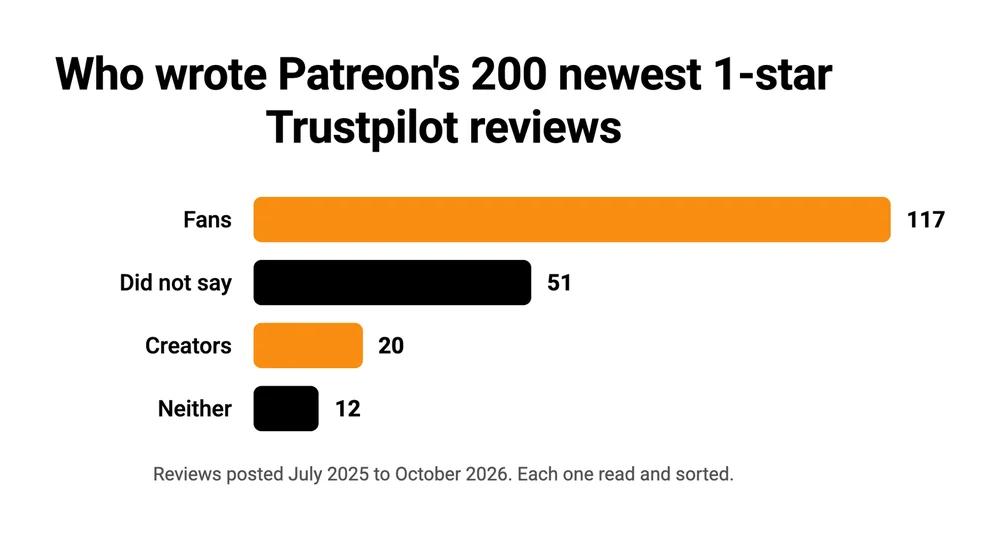
Fans and creators judge it on different things. This Patreon review sorted the 200 newest 1-star Trustpilot reviews by who wrote them. 117 of the 200 came from fans, mostly about charges and refunds. 20 came from creators, and 15 of those say they lost a page, an account or access to their money. Only 2 of the 200 are mainly about fees.
Search for a Patreon review and the numbers do not agree. Trustpilot says 1.2 out of 5. Apple’s App Store says 4.9.
Neither number tells a creator where to build an income. In reviews, a fan’s worst day on Patreon is a surprise charge, and a creator’s is a closed page.
This review draws on Patreon’s own terms and help pages, Reddit threads from working creators, TechCrunch’s reporting and those Trustpilot reviews, sorted one by one.
You’ll see what Patreon costs, what changed in 2026, and the verdict for 5 situations, including what to do if you only pay a creator.
A platform’s cut is only 1 place money leaks. The Online Selling Mistakes Challenge covers the top 5 selling mistakes over 5 days, so you can check your own.
Key Takeaways
- Fair if your fans already exist. Patreon takes 10% plus processing, so a $5 pledge leaves about $4.05 before payout fees.
- Recent 1-star reviews come mostly from fans. Fans wrote 117 of Trustpilot’s newest 200 1-star reviews, and creators wrote just 20.
- Creators report closed accounts. 15 of those 20 creators say they lost a page, an account or access to their money.
- iPhone signups can cost 43% more. Outside the US, Apple’s 30% fee pushes the in-app price up by default unless the creator absorbs it.
- Legacy billing ends November 1, 2026. Creators who miss the switch get moved automatically, with billing paused until they log in and set prices.
- Keep a way out. Patreon’s terms allow closure at its sole discretion, so export your member emails and keep a second way to reach fans.
What Patreon is, and what it costs in 2026
Patreon is a membership platform where fans pay creators monthly or yearly for posts, videos, podcasts, chats and digital products. Jack Conte and Sam Yam launched it in May 2013, and it is based in San Francisco.
Joining costs nothing. Patreon’s pricing page says “You only pay when you start earning.”
The fee is 10% of your income if your page went live after August 4, 2025. Pages published before that date can keep a legacy rate of 5%, 8% or 11%, and they drop to 10% if the page is ever unpublished, by the creator or by Patreon. On top of the 10%, Patreon charges card processing of 2.9% plus $0.30 per payment in US dollars, a 2.5% currency conversion fee when a fan pays in a different currency, and a payout fee such as $0.25 for a US bank transfer.
A $5 pledge leaves about $4.05 in your balance. A $3 pledge leaves $2.31, because the $0.30 bites harder on small pledges. Our Patreon fees breakdown works through every fee and pledge size, so this review will not repeat it.
The 10% buys a hosted page, memberships, digital product sales, up to 100 hours a month of video hosting once you have paying fans, plus chats, polls and comments. Creators who only need the billing part can use a plain checkout instead. CartMango, the checkout I run, is 1 example. It bills members and takes no cut of each sale, but it has no fan feed, no community and no discovery.
Patreon reviews: why the scores run from 1.2 to 4.9
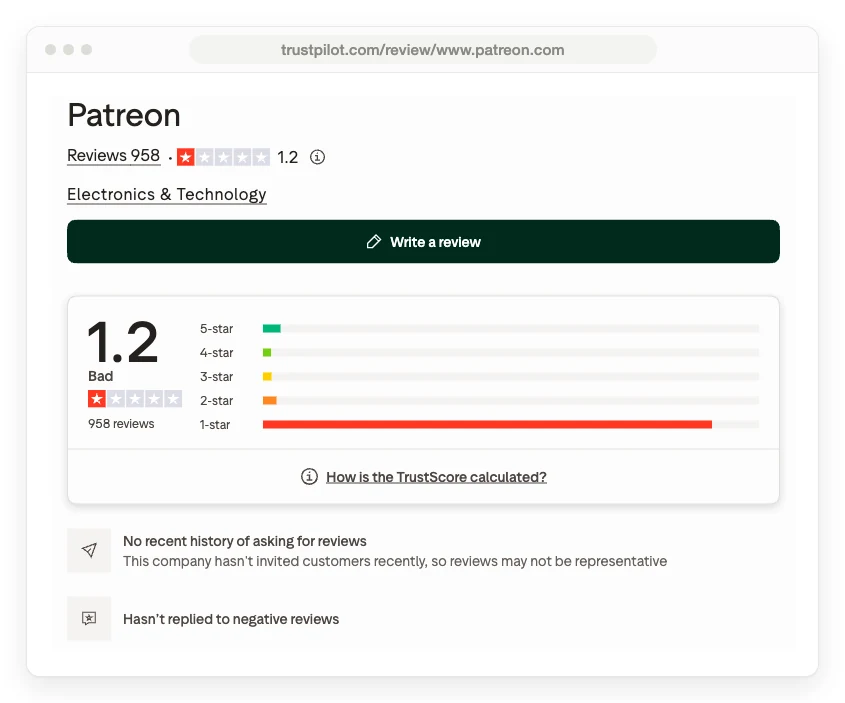
Patreon scores 1.2 out of 5 on Trustpilot from 958 reviews and 4.9 on Apple’s App Store from 581K ratings, with G2, Software Advice and Google Play in between.
| Source | Score | Count | Who is rating |
|---|---|---|---|
| Trustpilot | 1.2 | 958 | Anyone, and recent 1-star reviews are mostly fans |
| G2 | 4.2 | 63 | Business software buyers |
| Software Advice | 4.4 | 28 | Business software buyers |
| Google Play | 4.8 | 309K | Android app users |
| Apple App Store | 4.9 | 581K | iPhone and iPad app users |
The low score and the high scores can both be true, because they sample different people. App store ratings come from people with the app installed. Trustpilot reviews come from whoever chooses to write one.
Trustpilot’s Patreon page shows 867 of the 958 reviews at 1 star, and it adds 2 notes beside the score. Patreon has not invited reviewers lately, “so reviews may not be representative”, and it has not replied to negative reviews.
Trustpilot also says it does not fact-check reviews. So read the 1.2 as a count of complaints, and as a weak guide to how most members feel.
Who wrote the 200 newest 1-star reviews
Fans wrote 117 of the 200 newest 1-star reviews on Patreon’s Trustpilot page. Creators wrote 20, 12 came from people who were neither, and 51 do not say. Fans here means people who pay a creator or are being charged by Patreon.
Trustpilot’s filter stops at the newest 200 of the 867, which reach back to July 2025. Each review was read and sorted by who wrote it and what went wrong.
What the fans complain about
Money tops the fan complaints: 81 of the 117 fans write about a refund, a charge after cancelling, a charge they did not recognise, trouble cancelling or a creator who did not deliver.
| Main complaint | Fans | What Patreon’s help pages say |
|---|---|---|
| Refund refused | 32 | The creator decides first, within 60 days of payment |
| Charged after cancelling | 15 | Cancelling on or after the billing date still triggers that charge |
| Charge they did not recognise | 15 | “You may have another account” |
| Could not cancel | 10 | Cancel under Settings, then Memberships |
| Creator did not deliver | 9 | It “does not violate our terms if a creator doesn’t deliver expected benefits” |
Refunds top the list because of how Patreon routes them. A fan asks through Billing History within 60 days, and then, in Patreon’s words, “the creator will review it and decide whether to approve or decline it”. Patreon may step in at its own discretion.
Patreon’s refund policy lists “Item not received” as a case that may qualify, while its help page says a missing benefit breaks no rule. 1 Trustpilot reviewer summed up the result: “So its 100% up to creator to decide refund.”
Refund requests reach the creator first, and a refund Patreon grants comes out of the creator’s balance.
What the creators complain about
Closed accounts and held money dominate the creator reviews. 15 of the 20 creators say they lost a page or an account, or could not reach their money, and none of the 20 is mainly about fees.
A new creator whose account closed after a first sale warned that “you can do everything correctly and still lose your account and your earnings overnight”. A creator with almost 2 years on the platform put it this way: “Your entire business can disappear overnight without transparency or communication.”
A review is 1 side of a story. Some of these creators may have broken a rule, and at least 2 of the 15 mention adult or AI-made work, where Patreon’s terms add extra requirements.
Fees barely show up in any of this. Only 2 of the 200 are mainly about fees, 7 mention fees at all, and 1 mentions Apple.
What changed at Patreon in 2026
4 changes in 2026 matter to a creator choosing Patreon: a new discovery feed, merged profiles, a 20% staff cut and the end of legacy billing.
| When | What changed | What it means |
|---|---|---|
| April 28 | A Home feed, short public Quips posts and shared posts with other creators opened up | Patreon now pitches itself as a place to find new fans |
| July 6 to August 17 | Creator and fan profiles merged | A “one-time, irreversible change” that puts your creator name on your fan activity |
| July 23 | 20% of staff laid off, 93 people | CEO Jack Conte told staff the cuts were not about AI replacing people |
| November 1 | Legacy billing ends | Creators still on older billing must move to subscription billing |
Patreon says the new network delivers “over 1 million new members per month to creators”. That is Patreon’s own number, and on Patreon a member can be free, so it says little about paying fans.
The merged profile drew a strong reaction. An r/patreon thread with 83 comments asked who planned to cancel over it, and 1 creator replied: “I’ve had a crazy amount of cancellations compared to usual since the news dropped.”
TechCrunch reported the layoffs as Patreon’s way to adjust its costs. I found no public number showing whether a smaller team changes support times, so treat that as an open question. Support was the main complaint in 24 of the 200 reviews.
If your fans already ask how to pay you
Patreon is a good buy for a creator with a podcast, a channel or a newsletter whose fans keep asking how to support the work. You pay nothing up front, and fans get a checkout and an app many of them already know. Google Play alone shows over 10M downloads.
The strongest case comes from creators who stay. 1 podcaster told an r/podcasting thread: “Patreon had been my full time income since January 2023”. A magazine said in a 2023 Trustpilot review that it has been funded through Patreon since 2014 and has “never had a single problem”.
Small pages count too. Another show in that Reddit thread reports “about $40 a month after Patreon’s fees ($52 before) from 12 subscribers”.
A creator who ran a custom paywall site for almost 10 years told r/patreon that moving to Patreon ended the billing issues, password resets and site upkeep: “I’ll happily give up 8% to alleviate those headaches.” That was in 2024 at an 8% rate. A new page pays 10%.
What it costs: about 19% of a $5 pledge once the 10% and card processing are both counted, and about 16% of a $10 pledge. Price your lowest paid tier at $5 or more, since a $3 tier loses 23%.
The percentage stays flat, so the dollars climb. On $1,000 a month from 200 fans at $5 each you keep about $811. At $5,000 a month from 1,000 fans, the same fees come to about $945 a month. That is a small price early on and a real bill at scale. Our Patreon alternatives post shows where flat-fee tools break even.
What you give up: the billing. Patreon’s terms call it “the billing entity” on each charge, so you can export member emails but never their card details. If you move, every member has to sign up again. As 1 creator put it in that same thread: “If I leave I risk losing most of my patrons and them never finding me again.” Billing through your own Stripe or PayPal account with a checkout like CartMango avoids that, but you lose Patreon’s app and the habit fans already have, and sales tax becomes your job.
If you are starting with no audience
Patreon is a poor first step for a creator with no audience, because a membership page needs fans before it earns anything. Opening a page is free, so the cost is your time while no fans exist yet.
The new Home feed aims at this exact gap. It uses fan overlap to show your work to new people, and Patreon says it is only available in English for now. In a 43-comment thread about the feed, 1 creator wrote that “having to advertise off of Patreon to build a base is a big weakness of the platform”.
A creator on Trustpilot was blunter: “I get only free followers and only 1 donator”.
Verdict: build the audience first on a channel people already use, such as YouTube, a podcast or a newsletter. These content creator business models show the options. Add a Patreon page when fans start asking.
What it costs: nothing up front, then 10% plus processing on whatever comes in.
What you give up: time that could go into a channel with reach of its own.
If most of your fans join on an iPhone
Outside the US, Apple takes 30% of new purchases made in the Patreon iPhone app, and by default Patreon raises the in-app price by about 43% so you still earn the same. A $10 tier on the web shows as $14.29 in the app. You can switch that off in your billing settings, and then you absorb Apple’s fee yourself.
Several things soften this. Fans in the US see your web price by default, because Patreon’s own web checkout skips Apple’s fee. Fans on the web or on Android never see the higher price, and members who joined before November 4, 2024 are not affected.
Patreon’s iPhone help page also says Apple’s fee falls to 15% after a member completes 1 year of continuous billing.
The harder part is the wait. Money from iPhone in-app purchases stays pending for up to 75 days while Apple settles it, against up to 7 days for one-time sales on the web and Android. “That 75 day iOS hold will absolutely crush new creators”, wrote 1 creator in a 31-comment thread.
Others route around it. As another r/patreon commenter said: “we encourage our patrons to sign up via the web to save that 43%”.
Apple’s rules also end legacy billing on November 1, 2026. Legacy billing means the older models that charge fans on the 1st of the month or per post. Subscription billing charges each fan on the day they joined, and it is the only model Apple’s in-app system supports. TechCrunch reported that 4% of creators were still on older models, and they must switch.
Anyone who misses the date gets moved by Patreon, and their billing stays paused until they log in and set new prices. If your page was on either older model, check your billing settings. Patreon says existing first-of-the-month members keep that date.
Verdict: still workable. Send fans to your web page, and name the price difference in your posts.
What it costs: 43% more for fans outside the US who join in the app, or 30% of your income from them.
What you give up: up to 75 days of waiting on that money, and the old billing models.
If this page would be your only income
Patreon can carry your main income only with a backup, because its terms let it close any account at its sole discretion. Patreon’s Terms of Use say: “We can terminate or suspend your account at any time at our sole discretion.” They add that Patreon “may also block or withhold access to these funds for violations of our Terms or policies or for compliance reasons”.
A real email matches that wording. A creator posted one on r/patreon, and it reads: “we will not be able to consider any appeals.” On Trustpilot, a creator with 8 years on Patreon says years of posts and statistics “became inaccessible almost instantly”.
I found no public count of how often this happens. The damage can be total when it does, which makes a backup worth the small effort:
- Export your member list every month. Patreon’s pricing page lists “exportable email lists”.
- Keep your own copy of everything you post. Assume the page could vanish tomorrow.
- Pay out often. Turn on auto-payout, which runs on the 5th, or withdraw by hand, because money sitting in your balance is what a hold can trap.
- Build an email list you own. It reaches fans even when Patreon cannot. BirdSend, the email tool I run, is 1 option.
I had this debate on Twitter with 2 friends in 2022, about social media accounts. I told my email list afterwards that accounts can be shut down even when they follow the rules: “Nobody is safe, even when you do social media correctly.” A friend’s reply in that thread applies to a Patreon page too: “nothing is 100% safe and it’s best to diversify”.
Billing can have a backup too. CartMango lets you bill a second group of members through your own Stripe or PayPal account, and those subscriptions keep paying you if you leave CartMango. It only covers members who join there, so Patreon members would have to sign up again. It will not give them a feed, a community or a way to find you. CartMango’s community and course features are not live yet, and both are planned for October 2026 on the $30 a year plan.
If your fans want a place to gather or read, look at Substack for paid writing, Ko-fi for tips and shops, or Circle or Skool for communities.
What it costs: the same 10% plus processing, a small monthly chore, and a plan fee if you add a second billing route.
What you give up: the simplicity of keeping fans and billing in 1 place.
If you are a fan paying a creator
Patreon is a legitimate company that has run since 2013, and most of the fan complaints above come down to billing. A few habits help avoid that trouble:
- Know your billing date. Patreon charges on the day you joined or on the 1st, depending on the creator. Cancelling on or after that date still triggers that charge.
- Cancel under Settings, then Memberships. Then check Billing History to confirm no renewal is pending.
- Charged with nothing showing? Reset your password with every email address you use. 1 Trustpilot reviewer traced $9 charged twice a month to 2 accounts, 1 on Gmail and 1 on Yahoo.
- Ask for a refund inside 60 days. Use Billing History. If you joined in the iPhone app, the refund runs through Apple.
Check a creator’s recent posts before you pay for a top tier, since Patreon does not treat a missing benefit as a rule break.
What it costs: whatever the creator charges, and about 43% more if you join in the iPhone app outside the US.
What you give up: a quick refund, because the creator decides first.
Patreon review verdict, situation by situation
Patreon earns a clear yes in 1 of these 5 situations, when fans already want to pay, and comes with a condition or a wait in the other 4.
| Situation | Verdict | What it costs | The catch |
|---|---|---|---|
| Fans already ask how to pay | Yes | About 19% of a $5 pledge | Members stay with Patreon if you leave |
| No audience yet | Not yet | Time, then 10% plus processing | A page brings few fans by itself |
| Fans join on iPhones | Yes, with web links | 43% more in the app outside the US, or 30% of that income | Up to 75 days to reach that money |
| Your only income | Yes, with a backup | 10% plus processing, and a monthly backup | Closure at Patreon’s sole discretion |
| You pay a creator | Yes, with care | Whatever the creator charges | Refunds go to the creator first |
Patreon’s pros: free to start, an app many fans already have, and help with fraud and chargebacks (a fan disputing a charge with their bank).
Patreon’s cons: 10% plus processing on every payment, the iPhone price rise and hold, refunds that reach you first, and closure at Patreon’s sole discretion.
FAQ
Is Patreon a trustworthy site?
Patreon is a legitimate company, launched in 2013 and based in San Francisco. Its newest 1-star reviews on Trustpilot come mostly from fans, about 4 in 10 are about money, and Patreon has not replied to negative reviews. Patreon’s help pages describe 24/7 fraud monitoring on payments. Individual creators vary, so read a page’s recent posts before paying for a high tier.
Is Patreon really worth it?
Patreon is worth it for creators whose fans already want to pay. Setup is free, and 10% plus processing covers the page, the billing and help when a fan disputes a charge with their bank. It is harder to justify with no audience, because the page will not find fans for you yet, or as your only income with no backup in place.
How much does Patreon cost per month?
Patreon has no monthly fee, and it is free to start. It takes 10% of income on pages published after August 4, 2025, plus 2.9% and $0.30 per card payment in US dollars. Fans pay the price the creator sets, which can run about 43% higher inside the iPhone app outside the US.
Why is everyone leaving Patreon?
I found no public data showing a mass exit, and Patreon says its network adds over 1 million new members a month. On Reddit, creators complain about Apple’s fee, the 75-day hold and the forced profile merge. On Trustpilot, they mostly report closed accounts and held money. Fees are the main complaint in only 2 of the 200 newest 1-star reviews.
Is Patreon safe with a credit card?
Patreon is a normal place to pay by card, and it also takes PayPal and Apple Pay. The common problem is charges that keep running, from a forgotten membership, a gift that renewed or a second account. Check Billing History every few months and cancel anything you no longer use.
What you would still own if the page closed
Before you build on any platform, ask yourself: what would you still have if your page closed tomorrow? An email list covers half of that answer. The other half is a way to bill members that does not depend on 1 page.
CartMango does that job for the members who join through it, at 0% of each sale. It is free right now, paid plans start in November from $10 a year, and Stripe or PayPal fees still apply.
About the Author

👋 I’m Welly, founder of CartMango (the site you’re on), a checkout platform for digital product sellers. We’ve previously processed $179M+. I also run BirdSend (email marketing tool, 3.1B+ emails sent). On the side I show other non-techie digital sellers how I use AI workflows to automate 50%+ of my operations. Find me on LinkedIn.
Related Reading
- Patreon fees: every fee behind the 10% in this Patreon review, and what a $5 pledge pays out
- Patreon alternatives: what you keep from $1,000 a month, and where flat-fee tools break even
- Patreon vs Substack: fees, taxes and who keeps your subscribers
- Patreon vs Ko-fi: flat 10% against Ko-fi’s 0 to 5%, and what happens when you leave
- Membership site platform: 8 platforms priced at 100 members, and who keeps your members if you leave