

The main Thinkific alternatives, priced per month on their yearly plans, are LearnWorlds at $24, Teachable at $29, Podia at $42, Circle at $89 and Kajabi at $143. Thinkific itself is $40 a month on that basis, after a 10% rise. Per-sale cuts run from 0% to 7.5% and reorder that list the moment you sell anything.
I went looking for what Thinkific charges and got 5 different answers off the first page of Google.
1 guide says the cheap plan was discontinued. Another puts the entry price at $74 a month. A third calls the free plan Thinkific’s biggest selling point.
There is a reason they disagree, and it is more interesting than sloppiness. Thinkific just put its prices up 10%, its first increase since 2022. Nearly every wrong number on page 1 is a real Thinkific price. It is just last year’s.
That still leaves you comparing a platform you would pay one number for against rivals priced at another. So I opened every pricing page myself.
Below is what each platform charges today, on both billing bases, plus the 2 costs that sit nowhere near the pricing pages.
Key Takeaways
- Thinkific starts at $40 a month if you pay for a year up front, which is $475 for the year, or $54 a month if you pay monthly. There is no free plan, only a 30-day trial.
- Thinkific raised all 3 plans 10% in 2026, its first rise since 2022. New signups pay the new price now, and existing accounts switch over from 13 August 2026.
- 1 of the 7 guides ranking for this keyword states the current numbers. 5 quote a price Thinkific has stopped charging and 1 never mentions the price at all.
- Thinkific, Podia and Kajabi all open on the annual number by default, so the same plan can read $40 a month or $54 a month depending on which view you land on. Circle publishes only 1 number and never shows a monthly price.
- Running your own Stripe on Thinkific costs 5% of every sale on the entry plan. That fee lives in a support article, not on the pricing page.
- Kajabi’s pricing page hides a 4th, cheaper plan than the 3 it displays. Starter is listed at $71 a month on the yearly plan inside the page’s own code.
What Thinkific costs today, before you compare anything to it
Thinkific charges $40 a month for Basic, $82 a month for Start and $164 a month for Grow, if you pay for a year up front. Those work out at $475, $978 and $1,968 for the year. Paid month to month instead, the same 3 plans cost $54, $109 and $219 a month. The top tier, Plus, has no public price and routes you to a sales call.
Those are new numbers. Thinkific put all 3 plans up 10% in 2026, in what its own support article calls “our first subscription price increase since 2022”. Basic went from $49 a month to $54, Start from $99 to $109 and Grow from $199 to $219. On annual billing, Basic went from $432 a year to $475.
New signups pay the new price already. Existing customers move across at their first billing cycle or renewal on or after 13 August 2026, and accounts on a non-profit or discounted rate are exempt.
There is no free plan. Thinkific’s own pricing FAQ answers the question in 1 word: “No, instead, you can explore the whole platform with a 30-day free trial.”
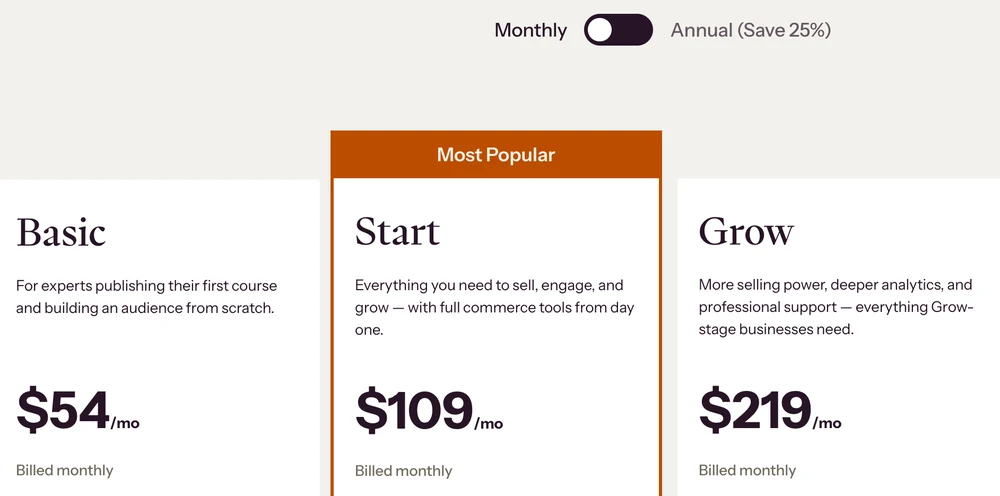
Thinkific’s pricing page with the billing toggle set to monthly. The page loads on the annual view, where the same 3 plans read $40, $82 and $164 a month.
Podia and Kajabi open on the annual price the same way, and Podia’s monthly figures sit in the page code without a visible button to reveal them. That toggle is the reason so many guides disagree. The page opens on “Annual (Save 25%)”, so a quick look gives you $40 a month and a careful look gives you $54 a month. Both are real prices for the same plan. Neither is wrong on its own, and a comparison that mixes the 2 is.
The caps are worth knowing before you shop. Every paid plan holds 10,000 active students, so you will almost certainly hit a feature limit before you hit a student limit.
Basic allows 5 digital downloads, 5 coaching sessions, 1 community and 100 GB of video streaming a month. Certificates, assignments, memberships and payment plans all start on Start at $82 a month, and removing Thinkific’s branding needs Grow at $164 a month.
New to selling a course at all? The free 5-day Online Selling Mistakes Challenge walks through the 5 mistakes that cost solo sellers the most money, and picking a platform before you have a buyer is one of them.
The Thinkific alternatives at a glance
Every price in this table is a monthly rate. LearnWorlds is the cheapest way in at $24 a month on its yearly plan, then Teachable at $29, Thinkific itself at $40, Podia at $42, Circle at $89 and Kajabi at $143. On those same plans Teachable keeps 7.5% of each sale, LearnWorlds charges $5 per enrollment, Podia keeps 5%, Circle keeps 2%, and Thinkific keeps nothing so long as you use its own processor.
| Platform | Entry plan | Per month, paid yearly | Per month, paid monthly | Cut per sale on that plan | Hosts the course |
|---|---|---|---|---|---|
| Thinkific | Basic | $40 | $54 | 0% on Thinkific Payments, 5% on your own Stripe | Yes |
| LearnWorlds | Starter | $24 | $29 | $5 per enrollment | Yes |
| Teachable | Starter | $29 | $39 | 7.5% | Yes |
| Podia | Mover | $42 | $49 | 5% | Yes |
| Kajabi | Basic | $143 | $179 | 0% on Kajabi Payments | Yes |
| Circle | Professional | $89 | not published | 2% plus Stripe’s cut | Yes |
Kajabi’s row uses the cheapest plan it advertises. There is a cheaper one buried in its pricing page, covered further down.
Circle is the odd row. Its pricing page shows 1 number per plan and discloses in a footnote that prices are “based on annual billing”. There is no toggle, so the month to month figure is not published anywhere on that page.
All 6 host your course. If your lessons already live somewhere and the only missing piece is taking payment, skip down to the split-stack section.
5 of the 7 guides on page 1 get Thinkific’s own price wrong
Page 1 for this search holds 7 guides and 1 Reddit thread. I checked every price claim each guide makes about Thinkific against Thinkific’s live pricing page. 1 guide is right.
The rest are not making numbers up. 4 of them quote a figure straight off Thinkific’s old price card, which was correct until the 10% rise. That is worth knowing before you judge them, and it does not help you, because you cannot pay last year’s price.
FreshLearn publishes all 3 current tiers on both billing bases and ranks last. Podia reports the $49 a month Basic plan as retired when it was repriced to $54 a month, Ruzuku puts the entry at $74 a month, Circle prices API access at $149 a month, and Zenler calls a free plan Thinkific’s biggest merit.
| Guide, in page-1 order | What it tells you Thinkific costs | Where that number came from |
|---|---|---|
| Esmerise, 1st | Removing Thinkific branding needs “the $195/month plan” | No Thinkific plan has cost $195 a month. Branding removal sits on Grow, now $164 a month on the yearly plan |
| Ruzuku, 2nd | “Paid plans start at $74/mo (annual) for Start” | $74 a month was Start’s old yearly-plan rate, now $82 a month. And Basic, at $40 a month, is the actual entry plan |
| Podia, 4th | Thinkific “retired its free plan and $49 Basic plan” | $49 a month was Basic’s old month-to-month price. Basic was repriced to $54 a month, not retired, and it is the first card on the page |
| Circle, 5th | “API access locked to the most expensive paid tier ($149/mo)” | $149 a month was Grow’s old yearly-plan rate, now $164 a month. Grow is also not the top tier |
| People Managing People, 6th | Names Thinkific 36 times and never prices it | No figure to check |
| Zenler, 7th | “The free plan is the biggest merit of Thinkific” | Thinkific has no free plan. Its “£888 a year” is Start’s old annual total, in the wrong currency |
| FreshLearn, last | “$54/month, or $40/month if billed annually” | Correct, on all 3 tiers and both billing bases |
The Reddit thread sits at 3rd, and Ruzuku is listed twice, which is why the numbers skip.
4 of those 5 wrong figures are Thinkific’s own old prices, to the dollar. Circle’s $149 and Ruzuku’s $74 are the monthly rates Grow and Start carried on the yearly plan before the rise. Zenler’s 888 is what a year of Start used to cost.
Podia’s is the one worth showing you, because it is the only error on the list that a reader cannot recover from. A stale price still points you at the right plan. Being told the plan was withdrawn takes it off your shortlist entirely. Basic did cost $49 a month, it was repriced to $54, and Podia’s guide reports it as retired.
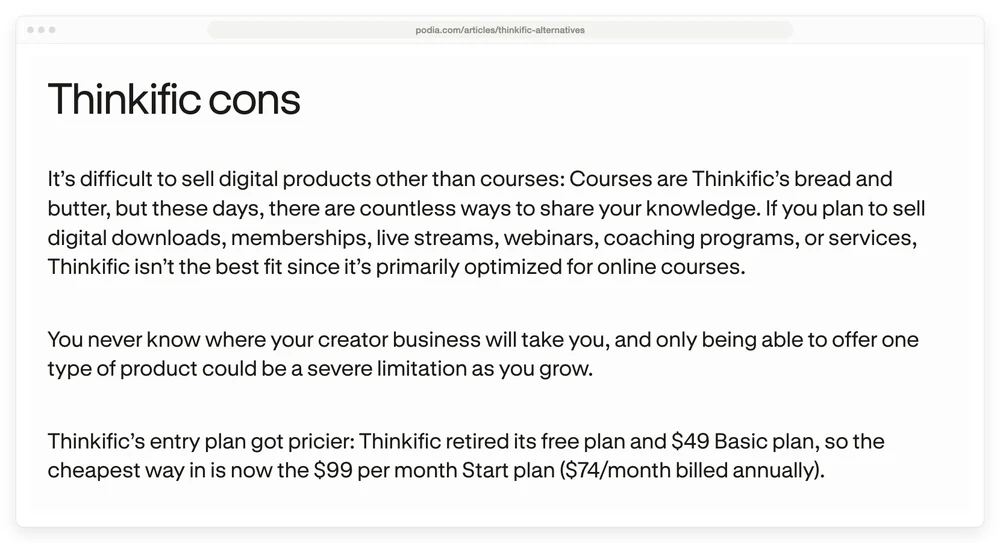
From Podia’s Thinkific alternatives guide. Basic is live and is the first card on Thinkific’s pricing page, at $40 a month on the yearly plan against Podia’s own $42 a month.
Every one of these numbers was right on the day it was typed. Platforms rename tiers, move features between plans and reprice, and a roundup keeps ranking long after its prices stop being true. Zenler’s guide is dated 2024 and still sits 7th.
The catch is that a stale price is invisible. It reads exactly like a current one, and the only way to tell them apart is to open the vendor’s page yourself.
The pattern holds beyond Thinkific. Ruzuku prices Circle with a “Basic $49/mo” plan that Circle does not sell.
Podia and People Managing People both put LearnDash at $199 a year, where its current 3 tiers run $259, $399 and $599 a year. Circle and People Managing People both put Podia’s entry at $33 a month, where Podia’s own page says $42 a month, or $504 for the year.
The single most reliable page is FreshLearn’s, which prints all 3 Thinkific tiers on both billing bases and runs to nearly 7,000 words. It ranks last of the 7.
Worth saying plainly: 6 of those 7 guides are published by a platform that appears in its own list of alternatives. Esmerise ranks Esmerise best overall. Ruzuku, Podia, Circle, Zenler and FreshLearn each recommend themselves. Only People Managing People sells nothing here, and it is also the page that prices Kajabi correctly.
Kajabi’s cheapest plan is not on Kajabi’s pricing page
Kajabi’s pricing page shows 3 plans, all priced per month on a yearly plan: Basic at $143 a month, Growth at $199 and Pro at $399. Its own headline reads “No hidden fees. No revenue sharing.”
A 4th plan, cheaper than all 3, sits in the page’s own code. Kajabi’s pricing page carries a plan named Starter at $71 a month on the yearly plan, or $89 a month paid monthly, with 1 product, 250 contacts and 2 admin users.
The feature comparison chart lower down has a matching Starter column, and that column carries a styling instruction that hides it from view. Its signup link still uses the plan’s older name, kickstarter, which is what guides called it when it was visible.
Be careful how much weight you put on that. What I can show you is that the plan and its price are still in the page Kajabi serves today. What I cannot show you is whether a new customer can still buy it, and at least one competitor’s guide describes Kajabi as having scrapped the tier outright.
So treat $71 as a question to ask Kajabi rather than a price to plan around. If $143 a month is the number stopping you, it costs nothing to ask whether Starter is still available before you walk away. We went through the full Kajabi ladder in our roundup of Kajabi alternatives.
What is a cheaper alternative to Thinkific?
LearnWorlds at $24 a month on its yearly plan is the cheapest entry price of the platforms here, and Teachable at $29 a month is next. Whether either is actually cheaper than Thinkific’s $40 a month depends entirely on how much you sell.
Here is the arithmetic on a $100 course.
LearnWorlds Starter charges $5 per paid enrollment. Sell 4 courses in a month and the platform costs $24 plus $20, so $44 that month. Thinkific Basic on Thinkific Payments costs $40 and keeps nothing. LearnWorlds stops being the cheap option at 4 sales a month.
Teachable Starter charges 7.5%. On $100 courses that is $7.50 a sale. Teachable costs $29 plus $7.50 a sale, so it passes Thinkific’s flat $40 somewhere between the 1st and 2nd sale of the month. At 10 sales a month Teachable Starter costs $104 and Thinkific Basic costs $40.
Podia Mover charges 5%, so $5 a sale on top of $42. At 10 sales that is $92.
The ranking depends on a number the guides never ask you for: how much you plan to sell. Under a handful of sales a month, the cheap entry plans genuinely are cheaper. Past that, a flat fee with no cut wins, and it keeps winning by more every month.
The 1 platform that stays flat at volume on its own entry plan is Thinkific, provided you take payment through Thinkific Payments. That flat cost has 1 condition attached, and it is not on the pricing page.
What are the disadvantages of Thinkific?
Thinkific’s 3 real disadvantages are a 5% fee for using your own payment processor, a feature set that starts thin on the entry plan, and a pace of change that long-term customers complain about.
The third-party payment gateway fee. Thinkific publishes a support article called the Third-Party Payment Gateway Fee FAQ. Its table charges 5.0% on Basic, 2.0% on Start, 1.0% on Grow and 0.5% on Expand for every sale you process through Stripe or PayPal instead of Thinkific Payments. The article states plainly that “the fee does not apply to transactions made through Thinkific Payments”.
Read that fairly, because it cuts both ways. Thinkific Payments costs 2.9%, which is in line with the card rates you would pay anyway. Stripe publishes 2.9% plus 30 cents per successful transaction on domestic cards, and PayPal puts its own checkout at 3.49% plus a fixed fee. So most sellers can take Thinkific’s default and never meet the 5%.
It bites when you have a reason to keep your own gateway. Plenty of sellers do, usually because their customers, subscriptions and refund history already live there. On Basic that preference costs 5% of everything you sell.
Of the 7 guides on page 1, 1 mentions this fee. We covered the same ground from the other direction in our Teachable vs Thinkific comparison.
What Basic does not include. Course completion certificates, assignments, graded quizzes, live cohorts, memberships and payment plans all sit on Start at $82 a month, which is $978 for the year. Basic caps digital downloads at 5 and coaching sessions at 5. If you sell anything other than a straight video course, the entry plan runs out fast.
Branding and SCORM. Removing Thinkific’s own branding from your site needs Grow at $164 a month, or $1,968 for the year. SCORM support sits on Plus, the tier with no public price.
What course sellers say on Reddit
The most useful page in these search results was written by a customer. It sits 3rd, above 4 of the guides, and it is a thread in r/elearning from a seller trying to leave after 8 years.
The poster sells training bundles to 9-1-1 agencies and runs about 10,000 active users a year. Their complaint is not price:
I have been with Thinkfic since 2017. I am frustrated as in almost 8 years; they have not made any of the enhancements that users have suggested over and over.
Their specific blocker never appears on any guide on page 1. They need SCORM modules that students cannot skip, and they report that on Thinkific students “can just skip the whole module without ever doing the material the way it’s set up”. For compliance training, a module you can click past is the same as no module.
The thread is also a fair warning about advice in general. 1 commenter predicted what would happen to it:
There’s lots of other upstart solutions (you’ll probably get founders in the comments), but I’ve been burned with platforms going out of business / not being supported anymore which is why I stick to the more widely adopted ones.
He was right. The replies include people introducing themselves as working at Academy of Mine, Granulearn, WorkPlan Learning, TalentLMS, Synap and Konstantly. The top comment discloses a LearnWorlds affiliate link in its opening sentence, which is more honesty than most of page 1 manages.
And 1 exchange in that thread is the whole problem in miniature. A commenter quoted LearnWorlds’ active-user limits from memory, another corrected him, and he replied: “Thanks for the correction! They have been changing the numbers around so I must have been using older numbers.”
That is a person who genuinely uses the product, getting the caps wrong because the vendor changed them. A guide written 18 months ago has no chance.
The option none of the 7 guides lists
Thinkific does 2 separate jobs, and every alternative on page 1 replaces both of them whether you need that or not.
Job 1 is hosting the course: lessons, videos, progress tracking, a student login. Job 2 is taking the money: a checkout, order bumps, receipts, refunds, getting the buyer into your email tool.
If job 1 is already handled, you are paying a course platform for something you are not using. Plenty of sellers deliver lessons through an unlisted YouTube playlist, a shared Drive folder, a Notion page or a plain PDF, and the only thing they genuinely need is a way to charge for access.
A year on Thinkific Basic costs $475 before you sell anything. A year on Teachable Builder, the cheapest Teachable plan with no per-sale cut, costs $828. A year on Podia Shaker costs $1,008. A checkout with no course hosting attached costs a fraction of any of them.
| Setup | Total cost for 1 year | Cut per sale | Hosts the course |
|---|---|---|---|
| Thinkific Basic, on Thinkific Payments | $475 | 0% | Yes |
| Teachable Builder | $828 | 0% with teachable:pay | Yes |
| Podia Shaker | $1,008 | 0% | Yes |
| CartMango | $0 until October 2026, then $10 to $30 a year | 0% | Not yet, planned for October 2026 |
I built CartMango, so treat that bottom row exactly the way you should treat Circle ranking Circle first in its own guide.
The honest limits of that row: CartMango does not host courses today. A learning management system and a community feature are planned for October 2026, and affiliate management for September 2026. Until those ship, this is a checkout that sits in front of content you host somewhere else, and if you want lessons, progress tracking and a student login in 1 place, buy a course platform from the table further up.
The choice is real in both directions. Sellers with a real curriculum, quizzes and completion tracking should pay for a course platform. Sellers with 6 videos and a workbook are often buying a learning management system to avoid building a payment page.
Why I check this myself now
I trusted the first page of Google on a question about my own business for years, and the first page was wrong.
The question was Gmail’s Promo Tab. I could not get my emails into the Primary Tab and I wanted to know why. Every result told me the same thing, which I described at the time like this: “If you Google this topic, you’ll find blog posts telling you there’s nothing you can do about it.” One post even argued the Promo Tab was a good place to land, because shoppers go there on purpose.
So I accepted it. In my own words: “For years, I’ve foolishly thought that’s the case.”
What broke it was a subscriber asking why my emails sat in the Promo Tab when they were not promotional. So I went and tested it myself instead of reading about it, which took whole days for weeks. There was a way out, and the blog posts had been repeating each other.
When a page of results all agree, that often means they share a source rather than that they are right.
Checking what Thinkific charges took me 3 minutes.
How to check any platform’s real price in 3 minutes
Every wrong number in this article would have been caught by the same 3 checks. They work on any platform, including the ones here after this post ages.
- Find the billing toggle before you read the price. If the page says “Save 20%” or “Save 25%” anywhere near the plans, you are looking at the annual price. Switch it to monthly and write down both numbers. On the entry plans that is $14 a month on Thinkific and $5 on LearnWorlds, and $36 on Kajabi Basic.
- Search the page for the word “fee”. Platform fees, per-enrollment fees and payment processing fees are usually a footnote or a separate support article rather than a line on the plan card. Thinkific’s 5% is in a support article. Circle’s 2% is in a comparison table below the plans.
- Check the cap that matches how you sell. Active students, products, video streaming and admin seats all differ by tier, and the 1 that runs out first decides your real price. Teachable Starter allows 100 active students. Thinkific Basic allows 10,000 and caps digital downloads at 5 instead.
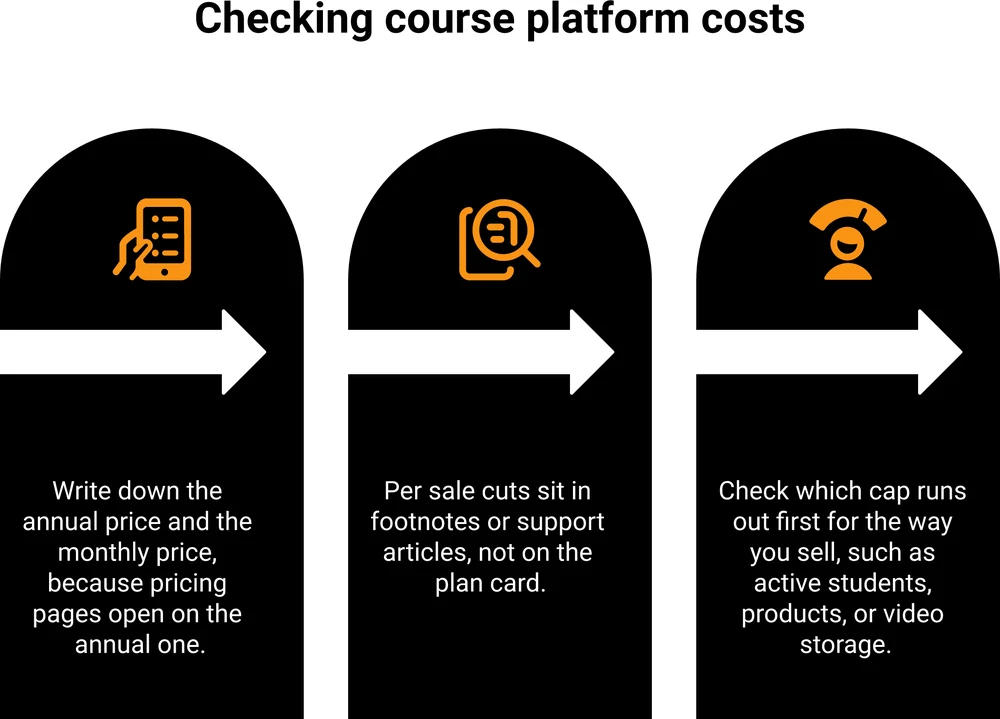
The 3 checks, in the order that saves the most time.
If a guide gives you 1 number per platform with no billing basis and no fee, it has not done any of this, and neither has whoever copied it next.
Which of these fits you
Pick LearnWorlds if you sell to companies, need SCORM or want assessment tools built for real teaching. $24 a month on the yearly plan, and remember the $5 per enrollment on that plan.
Pick Teachable if you want the lowest bill while you find out whether anyone wants the course. $29 a month on the yearly plan. Watch the 7.5% and move to Builder at $69 a month before it costs more than the upgrade.
Pick Podia if you want courses, digital downloads, a community and email in 1 subscription and you would rather not assemble anything. $42 a month on the yearly plan for Mover, with 5% per sale until you reach Shaker at $84 a month.
Pick Kajabi if you want the marketing side, funnels and email in the same place as the course, and your revenue can carry it. The visible entry is $143 a month on the yearly plan. Ask about Starter at $71 before you pay that.
Pick Circle if the community is the product and courses are the bonus. $89 a month on the yearly plan, plus 2% of each sale.
Stay on Thinkific if you are already there, you use Thinkific Payments and your complaint is price rather than a missing feature. On the entry plan with its own processor it is one of the cheapest flat costs here at volume.
Still deciding what to build before you decide where to put it? Our guide to selling online courses covers the offer, and our breakdown of what course platforms really charge prices 7 of them at the same sales volume.
FAQ
Which is better, Skool or Thinkific?
Skool and Thinkific do different jobs. Skool is a community with courses attached, and Thinkific is a course platform with a community attached. Skool’s Hobby plan is $9 a month and keeps 10% of every sale, where Pro is $99 a month and still keeps 2.9%.
Thinkific charges more up front and nothing per sale on its own processor, so Skool is cheaper to open and dearer to sell on. Pick Skool if the discussion is the product and the course is the reason people stay.
Does Thinkific have a free plan?
No. Thinkific’s pricing FAQ answers this directly: “No, instead, you can explore the whole platform with a 30-day free trial.” The free plan that several guides still describe has been retired. If a page tells you Thinkific’s biggest merit is its free plan, that page has not been checked in years.
What are the top 5 LMS platforms?
By the volume of coverage on this search, they are Thinkific, Teachable, Kajabi, LearnWorlds and Podia, with Circle and Mighty Networks close behind on the community side and LearnDash leading for WordPress. Google’s own AI Overview for this search names Kajabi, Teachable, LearnWorlds, Mighty Networks, Circle, LearnDash and Podia, and gives no prices for any of them.
Can I move my course and students off Thinkific?
Yes, and the slow part is video rather than data. Export your student list first while the account is live, then download your videos, which takes far longer than people expect. Before you commit, ask the new platform who owns your recurring payments, because several run subscriptions on their own systems rather than directly on your Stripe account, so the billing relationship does not travel with you.
Is Thinkific worth it in 2026?
For a straight video course sold through Thinkific Payments, the entry plan is competitive at $40 a month on the yearly plan with no cut per sale. It gets expensive when you need certificates, memberships or payment plans, which start at $82 a month, or your own branding removed, which starts at $164 a month. The Reddit complaints are about pace of development rather than value.
The part you can stop paying for
Most Thinkific alternatives charge you monthly for 2 things bundled together, the course hosting and the checkout. If you only need 1 of them, that is worth knowing before the annual invoice lands.
CartMango is the checkout half on its own, and it takes 0% of your sales, so what the buyer pays is what you keep. CartMango is free until October 2026, then $10 a year.
About the Author

👋 I’m Welly, founder of CartMango (the site you’re on), a checkout platform for digital product sellers. We’ve previously processed $179M+. I also run BirdSend (email marketing tool, 3.1B+ emails sent). On the side I show other non-techie digital sellers how I use AI workflows to automate 50%+ of my operations. Find me on LinkedIn.
Related Reading
More live-price breakdowns of the platforms in this Thinkific alternatives comparison:
- Teachable vs Thinkific: the head-to-head, with the crossover points where each one gets cheaper
- Teachable alternatives: the same live-price treatment for the other big name on this list
- Community platforms for creators: for readers whose real product is the group, not the course
- What course platforms really charge: 7 platforms priced at the same sales volume
- How to sell online courses: the offer and the launch, before the platform