

A $10 download costs a US seller $1.40 in fees on Etsy and $2.09 on Gumroad, so for most sellers Etsy wins on price, unless its own ads found the buyer. Etsy also brings marketplace traffic from shoppers searching for files. Gumroad suits sellers who already have followers to send to a page.
Etsy charges $0.20 per listing, a 6.5% transaction fee and 3% + $0.25 processing. Gumroad fees are 10% + $0.50 a sale plus 2.9% + $0.30 for cards, or 30% on its marketplace. My own checkout, CartMango (free right now, from $10 a year once paid plans start in November, 0% per sale), costs $0.59 in Stripe fees on $10 but brings no shoppers.
You have a file ready to sell. A planner, a pack of templates, a PDF guide. Etsy is open in 1 tab, Gumroad in another, and the guides you read crown different winners.
Some of the guides for this search quote Gumroad’s fee wrong. A Medium post drops the $0.50 Gumroad adds to every sale, Sellfy’s guide quotes a rate that is not on Gumroad’s fee page, and with the right numbers the cheaper platform flips.
Below you’ll see what each platform takes from the same sale at 4 prices. Then come 5 seller situations where the right pick changes, from having no audience at all to wanting the same buyers back for a second product.
Key Takeaways
- Etsy costs less per sale. A $10 download costs $1.40 in Etsy fees against $2.09 on Gumroad, for a US seller and card.
- Etsy’s ads reverse that. An Offsite Ads sale of $10 costs $2.90, and the ads turn mandatory once a shop passes $10,000 a year.
- Gumroad’s marketplace starts locked. Gumroad Discover lists you only after $100 in real sales and a risk review, then takes 30%.
- Etsy keeps the buyer’s inbox off-limits. Etsy bars adding its buyers to your list without consent. Gumroad lets you email customers after $100 earned.
- A direct checkout costs least but brings no shoppers. CartMango (free now, from $10 a year once paid plans start) takes 0%, so $10 costs $0.59 in Stripe fees.
Gumroad vs Etsy: what each takes from the same sale
Etsy takes less than Gumroad from a sale whenever Etsy’s ads did not bring the buyer, for any seller doing under $20,000 a month on Gumroad. Both stack 3 charges: Etsy’s add up to 9.5% plus $0.45 a sale, Gumroad’s to 12.9% plus $0.80.
Picking the wrong platform is only 1 of the selling mistakes that cost new sellers money. If you’d like to catch the rest before your first launch, the Online Selling Mistakes Challenge covers 5 of them over 5 days, by email.
Here is what each charges, read from their own pages:
- Etsy: $0.20 per listing, a 6.5% transaction fee, and 3% + $0.25 for payment processing on US orders (Etsy’s fee policy and payments policy). Each time a listing sells and renews itself, Etsy charges another $0.20, so on digital downloads the listing fee lands on every sale.
- Gumroad: 10% + $0.50 on every sale made from your own Gumroad page, plus card processing at 2.9% + $0.30, per Gumroad’s fee help page. A sale that comes through Gumroad’s marketplace, Discover, costs a flat 30% with processing included.
- Offsite Ads: Etsy charges 15% of any order that comes from an ad it ran for you on search engines and social networks, capped at $100 an order. Shops past $10,000 in sales over a year pay 12% and can no longer switch the ads off.
On a $10 download, Etsy takes $1.40, a Gumroad direct sale takes $2.09, and CartMango takes nothing beyond Stripe’s $0.59, while an Offsite Ads sale costs $2.90 and a Gumroad Discover sale $3.00.
| Where the sale happens | $5 sale | $10 sale | $20 sale | $100 sale |
|---|---|---|---|---|
| Etsy | $0.93 | $1.40 | $2.35 | $9.95 |
| Etsy, when Offsite Ads brought the buyer | $1.68 | $2.90 | $5.35 | $24.95 |
| Gumroad, from your own page | $1.45 | $2.09 | $3.38 | $13.70 |
| Gumroad Discover marketplace | $1.50 | $3.00 | $6.00 | $30.00 |
| CartMango, card paid through Stripe | $0.45 | $0.59 | $0.88 | $3.20 |
All figures are total fees for a US seller and a US card, before sales tax. CartMango connects to your own Stripe or PayPal account, and its row assumes a card paid through Stripe.
The CartMango row is the checkout I run, so read it knowing that. CartMango takes no cut, but once paid plans start in November its entry plan costs $10 a year, which pays for itself on $10 files after 13 sales compared with Etsy, or 7 compared with a Gumroad direct sale. CartMango also sends you no shoppers at all, and that is what the extra money on Etsy’s row buys.
Why page 1 cannot agree on which one is cheaper
The summary Google puts above the results for this search lists Gumroad as a flat 10% plus card processing. The $0.50 per sale is missing from both the text and its comparison table.
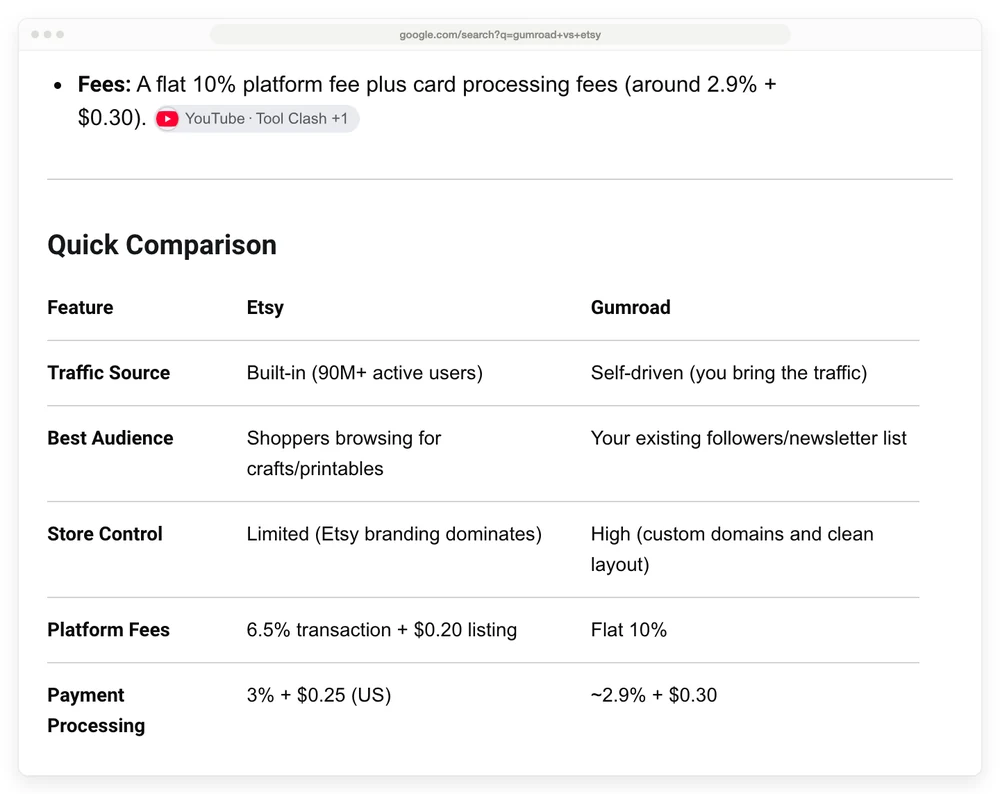
Google’s AI summary for “gumroad vs etsy”. Read the Platform Fees row: Gumroad shows as “Flat 10%”, with no $0.50.
The pages it draws on show the same gap. One of them, a Medium post by Simon Parsons that the summary cites, says Gumroad charges “a flat 10% fee” and concludes that a $25 sale leaves you $22.50 on Gumroad against $22.20 on Etsy, so Gumroad wins.
Put the $0.50 and the card fee back and that same $25 sale leaves $20.97 on Gumroad and $22.17 on Etsy. The winner swaps.
Sellfy’s guide, which ranks second for this search and comes from a rival checkout, quotes Gumroad at 9% + 30¢, a rate that does not match Gumroad’s current fee page. Other results run the full math. An InsightRaider explainer prices a $20 sale at $2.35 on Etsy and $3.38 on Gumroad, the same as the table above, and a beehiiv newsletter finds Etsy leaves more per order at every price it checked.
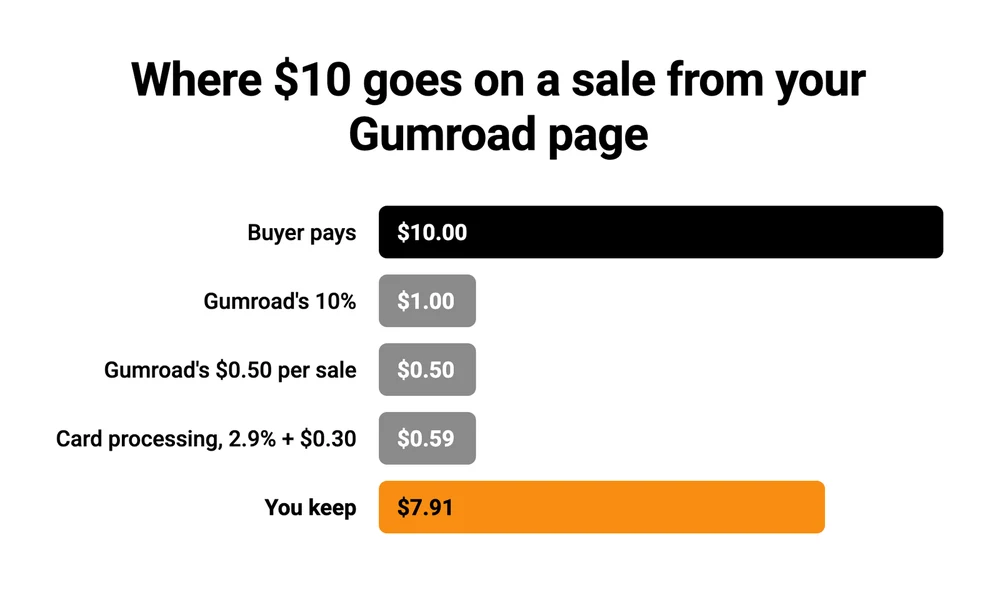
Gumroad’s own fee page lists all 3 charges. Google’s summary for this search shows only the 10% and the card fee.
If shoppers will need to find you through search
Etsy is the pick for a seller with no email list and no following, selling something people type into a search box: printables, planners, wedding templates, worksheets.
Of these 2, Etsy is the platform that hands a brand-new seller strangers who are already shopping. The top answer in an r/DigitalProductEmpir thread puts it plainly: you “get at least some built-in search traffic”, and more of it once a shop has 10 to 20 or more products with decent photos and SEO.
Gumroad does have a marketplace too, called Discover, though Google’s summary for this search says it has “no built-in marketplace traffic to speak of”. On day 1 that is close to true. Gumroad’s help page sets 3 conditions before Discover lists you:
- A $100 balance from genuine sales, with no self-purchases.
- A risk review, which takes about 3 weeks on average after you pass $100.
- Per product: at least 1 sale, a category and ratings switched on.
So the first $100 has to come from traffic you found yourself. A seller who has made $16,500 on Gumroad said as much in another thread: Gumroad “doesn’t provide cold launch traffic.”
What it costs: $1.40 on a $10 file, rising to $2.90 on the orders Offsite Ads bring in. You can opt out of those ads while your shop is under $10,000 a year.
What you give up:
- Etsy’s search rewards Etsy-style products. A seller in that same thread, who has sold over 30,000 items on Etsy, warns that “what you’re selling on Gumroad won’t necessarily sell on Etsy.”
- A set-up fee. Etsy’s fee policy says new shops may pay a one-time set-up fee when they open, charged to your card at onboarding.
- The buyers. Etsy’s seller policy bars adding them to your email list without their consent.
If Etsy is where you start, this walkthrough of Etsy for digital products covers the listing setup and what each price point really keeps.
If people already follow you on social media or by email
Sell direct, through Gumroad or a checkout of your own, if people already follow you and would click your link. That might be a newsletter, an Instagram account, a YouTube channel or a community. Every buyer here comes from you, so when you send a follower to an Etsy listing, Etsy’s search did none of the work, yet the same fees and rules apply to that sale.
Gumroad is the easy direct option. It hosts your product page and delivers the file. It also acts as the merchant of record, so it collects and pays sales tax and VAT on every sale for you. Etsy does some of this too: its fee policy says it collects US sales tax in certain states and VAT on digital items in certain countries.
What it costs on Gumroad: $2.09 on a $10 sale, so you pay $0.69 more per sale than on Etsy for Gumroad’s hosted page and tax handling. Full breakdown in this Gumroad pricing guide.
What you give up on Gumroad:
- Your money waits. On Gumroad’s standard schedules, payouts start once your balance reaches $100, and each sale is held for at least 7 days first. Instant payouts skip the wait for some US sellers, for a 3% fee.
- Emailing buyers waits too. Gumroad’s help page says you cannot send emails until you’ve earned $100 after fees and received a payout.
The other route is a checkout that takes no cut. CartMango charges 0% per sale, so the same $10 sale costs only Stripe’s standard card fee of 2.9% + 30¢, which is $0.59, and its Mini Pages editor hosts the sales page, so you need no website of your own (Gumroad and Payhip host pages too).
The trade: CartMango leaves sales tax and VAT with you, because you stay the seller of record, and it brings no shoppers. If you’re weighing other direct options, this list of Gumroad alternatives compares them on fees.
If most of what you sell costs under $5
Etsy is the pick for a seller of $2 sticker packs, $3 printables and $4 worksheet bundles.
At low prices the fixed part of each fee matters most. Gumroad adds $0.80 to every sale before any percentage ($0.50 to Gumroad, $0.30 to the card processor). On a $5 file that alone is 16% of the price.
On a $5 file, Etsy leaves you $4.07, a sale from your Gumroad page $3.55 and a Gumroad Discover sale $3.50.
| Price | Etsy keeps you | Gumroad direct keeps you | Gumroad Discover keeps you |
|---|---|---|---|
| $3 | $2.26 | $1.81 | $2.10 |
| $5 | $4.07 | $3.55 | $3.50 |
| $10 | $8.60 | $7.91 | $7.00 |
Below $4.68, a sale through Gumroad’s own Discover marketplace, at 30%, leaves you more than a sale from your own Gumroad page. The percentage is bigger, but the flat $0.80 disappears.
What you give up on Etsy: the $0.20 relisting charge hits every single sale, which on a $2 item is 10% of the price on its own. If you sell cheap PDFs, this guide on how to sell PDFs has an Etsy price sample.
If you want the same buyers to come back
A direct checkout, Gumroad or your own, is the pick for a seller planning a second product, a bundle or an upgrade. For that seller the first sale matters less than whether they can reach the buyer again.
What it costs: $2.09 on a $10 sale through Gumroad, or $0.59 on CartMango, against $1.40 on Etsy. So Gumroad costs $0.69 more per sale than Etsy, and CartMango $0.81 less.
Etsy is clear about this in its seller policy: “Without the buyer’s consent, and subject to other applicable Etsy policies and laws, you may not add any Etsy member to your email or physical mailing list, use that buyer’s identity for marketing, or obtain or retain any payment information.” (Etsy Seller Policy)
So say 200 people buy your $10 template. On Etsy you have 200 orders and no list you may email without asking each person first. On a direct checkout those 200 buyers are already in your customer records when the next product is ready. Gumroad gives you that list: once you’ve earned $100 after fees and had a payout, you can email customers by product, price paid or date from its dashboard, and every payout report includes customer data.
CartMango sends each buyer to your email tool, through native connections to Kit, ActiveCampaign, beehiiv and BirdSend, or through Make.com, which links to 3,000+ apps. Order bumps work on every plan, so a buyer can add a second item before paying.
What you give up: Etsy’s search traffic, plus Gumroad’s $100 wait before you can send that first email.
If you want an Etsy shop and your own store at the same time
Running Etsy and a direct store together works for a seller who wants Etsy’s strangers and their own fans, as long as the 2 stay separate paths. What it costs: each sale pays the fees of wherever it happened, so $1.40 on a $10 Etsy sale and $2.09 or $0.59 on the direct side.
Etsy’s line is drawn at the sale itself. Its fee policy says “any action to move a transaction off the Etsy platform is strictly prohibited by Etsy.” Add the buyer-email rule above and the split is simple:
- Etsy is where strangers find you, and those orders stay Etsy orders.
- Your direct page is where your own followers buy, and those buyers can join your list.
Price both the same, so no Etsy buyer has a reason to go hunting for a cheaper link.
You do not need a website for the direct half. This guide on selling without a website shows the hosted-page options. And if you’re comparing more than these 2 platforms, this guide to the best digital product platform narrows 14 of them down in 4 cuts.
Gumroad vs Etsy, matched to your situation
Etsy fits sellers with no audience at $1.40 on a $10 sale. Sellers who bring their own buyers pay $2.09 on Gumroad, or $0.59 plus a yearly plan on CartMango.
| Your situation | Pick | Cost on a $10 sale | The catch |
|---|---|---|---|
| Nobody knows you yet | Etsy | $1.40, or $2.90 via Offsite Ads | Buyers can’t join your list without consent |
| Products under $5 | Etsy | $0.93 on a $5 sale | $0.20 relisting on every sale |
| You want both | Etsy plus a direct page | $1.40 on Etsy, plus the direct row | Etsy sales cannot move off Etsy |
| You want repeat buyers | Gumroad | $2.09 | You can email buyers only after $100 earned |
| You have followers, want tax handled | Gumroad | $2.09 | $100 minimum, 7-day hold on standard payouts |
| You have followers, want the lowest fee | CartMango | $0.59, plus $10 a year once paid plans start | No shoppers, tax stays with you |
FAQ
How much does Etsy take from a $100 sale?
Etsy takes $9.95 from a $100 sale for a US seller: $0.20 listing, $6.50 transaction fee and $3.25 processing, leaving $90.05. If Offsite Ads brought the buyer, add $15 at the 15% rate, or $12 at the 12% rate for shops past $10,000 a year. The processing fee also applies to any sales tax on the order.
Is Gumroad cheaper than Etsy?
For almost every seller, no. A Gumroad direct sale costs more than an Etsy sale, as long as no Etsy ad brought the buyer. The exception is a big month. Once your Gumroad sales pass $20,000 in a calendar month, new direct sales drop to 5% + $0.50, and then a Gumroad sale on anything priced over about $22 costs slightly less than on Etsy.
Do people actually make money on Gumroad?
Yes. A seller posting in r/DigitalProductEmpir reports $16,500 in total, over $2,000 a month, from PDFs made in Canva. The same post is blunt about how: Gumroad sends no launch traffic, so sales came from blogs and social media the seller ran. Gumroad works when you can bring buyers to it.
Can I make $10,000 a month on Etsy?
Some shops do, and the guides ranking for this search give no sourced figure for how many shops get there. A shop at $10,000 a month is far past the line where Etsy’s ad rules change: once a shop passes $10,000 in sales over 365 days, Offsite Ads become mandatory at 12% of every order they bring, for the life of the shop.
Who is Etsy’s biggest competitor?
For handmade goods it’s Amazon Handmade, which our competitors of Etsy roundup names Etsy’s largest direct competitor because of Amazon’s own traffic. For digital files, the alternatives are checkouts that host your page but bring fewer or no shoppers: Gumroad (10% + $0.50 per sale), Payhip (5% per sale on its free plan) or CartMango (0% per sale, free right now, from $10 a year once paid plans start).
Can you sell the same product on Etsy and Gumroad?
Yes, sellers do list the same file in both places. What Etsy’s fee policy strictly prohibits is narrower: moving a transaction that started on Etsy off the platform. Keep the prices matched and send your own followers to your direct page.
The checkout for buyers you bring yourself
In Gumroad vs Etsy, Etsy is the better place to meet strangers. For everyone who already follows you, the questions are how much of the sale you keep and whether that buyer lands on your email list.
A follower who buys through your Etsy listing still costs you Etsy’s $1.40 on a $10 file, though Etsy did not find that buyer. CartMango charges no cut per sale, hosts the sales page, and sends each buyer to your email tool, so the next launch has someone to go to. CartMango is free right now, and paid plans start in November from $10 a year.
About the Author

👋 I’m Welly, founder of CartMango (the site you’re on), a checkout platform for digital product sellers. We’ve previously processed $179M+. I also run BirdSend (email marketing tool, 3.1B+ emails sent). On the side I show other non-techie digital sellers how I use AI workflows to automate 50%+ of my operations. Find me on LinkedIn.
Related Reading
- Etsy for digital products: what you really keep after Etsy’s fees, by price
- Gumroad pricing: every Gumroad fee, including the ones stacked on the 10%
- Competitors of Etsy: 15 places to sell besides Etsy, sorted by category
- Gumroad vs Payhip: the other direct-sale matchup sellers weigh
- Gumroad review: what 118 recent Trustpilot reviews say about payouts and support