

What you sell decides which WordPress ecommerce plugin you need. WooCommerce covers physical goods, Easy Digital Downloads and SureCart cover digital files, MemberPress gates content, and WP Simple Pay takes one-off Stripe payments. WooCommerce core costs nothing, while the paid plugins run $49.50 to $199.50 for the first year and 3 of them double after that.
The cost is the messy part, because the number in a roundup keeps disagreeing with the number on the vendor’s own page.
I read the 5 guides on page 1 for this search, then opened every vendor’s pricing page and checked the same figures at the source. 4 of those 5 quote a price that no longer exists. The fifth runs to nearly 5,000 words and never states a price at all.
So this post does 3 things. It matches the plugin to what you sell, it works out the real 2-year bill, and it shows you the percentage cut that 4 of these 5 plugins take on the cheapest way in.
Key Takeaways
- Match the plugin to the product. WooCommerce for physical goods, Easy Digital Downloads or SureCart for digital files, MemberPress for gated content, WP Simple Pay for simple payments.
- The advertised price is a first-year price. Easy Digital Downloads, MemberPress and WP Simple Pay all carry the same footnote saying renewals are charged at full price, which is double.
- 4 of the 5 plugins take a percentage on the cheapest way in. Easy Digital Downloads and WP Simple Pay charge 3%, MemberPress Launch charges 4.9%, SureCart’s free plan charges 2.9%. WooCommerce is the exception.
- WooCommerce core really is free and takes no cut, but recurring payments cost $279 a year and memberships cost $199 a year on top, plus hosting.
- You do not need an ecommerce plugin at all to sell digital products from a WordPress site. A hosted checkout links out from any page you already have.
Before the plugin comparison: if you are still working out where the money leaks on a small digital business, the free 5-day Online Selling Mistakes Challenge walks through the 5 that cost solo sellers the most. About 4 minutes a day.
Which WordPress ecommerce plugin fits what you sell
WooCommerce fits physical goods, Easy Digital Downloads and SureCart fit digital files, MemberPress fits gated content, and WP Simple Pay fits a single payment form. Every plugin below sells something well and something else badly, and the split is clean enough that the choice usually makes itself once you name what is going in the cart.
WooCommerce is the default for physical goods and it is the only one of these with real scale behind it: 7 million-plus active installations on the WordPress.org plugin directory, against 80,000-plus for SureCart and 40,000-plus for Easy Digital Downloads. That gap has a practical consequence. Themes, page builders and hosts test against WooCommerce first, so a WooCommerce store is the one least likely to hit an odd conflict nobody has written a support doc about.
The 2 plugins built for digital files are Easy Digital Downloads and SureCart. Easy Digital Downloads is the older name and has the bigger extension library.
SureCart is newer and runs the cart in the cloud rather than in your database. It arrived years after Easy Digital Downloads and already has twice the installs.
MemberPress is a different job again. It gates content behind a login and bills members on a schedule. Reach for it when the thing you are selling is access.
WP Simple Pay is the smallest of them, at 8,000-plus installs. It puts a Stripe payment form on a page and stops there. You get no cart and no product catalogue, which is exactly what somebody selling 1 thing wants.
Ecwid is worth naming because Google’s own AI summary lists it alongside these, and it works differently: a hosted store that you embed into WordPress, so your products and orders live on Ecwid’s servers rather than in your database. It charges no transaction fee on any plan.
Its catch is the entry price. The $5 Starter plan cannot sell digital goods at all, and the cheapest plan that can is $29 a month on annual billing, which is $348 a year and more than any licence in the table below.
Of the 5 plugins in that table, WooCommerce is the only one whose cheapest way in takes no percentage of your sales, and the other 4 take between 2.9% and 4.9%.
| Plugin | Best for | Cheapest way in | Cut on that plan | Cheapest 0% plan |
|---|---|---|---|---|
| WooCommerce | Physical goods, mixed catalogues | Free core plugin | 0% | Free |
| Easy Digital Downloads | Digital files, software licensing | Free Lite version | 3% on Stripe | $199.50 |
| SureCart | Digital files, subscriptions | Free Launch plan | 2.9% per sale | $199 |
| MemberPress | Gated content, memberships | Launch, $199.50 | 4.9% per payment | $349.50 |
| WP Simple Pay | One-off Stripe payments | Free Lite version | 3% per transaction | $49.50 |
Prices read live off each vendor’s own pricing page, and the fee figures come from each vendor’s own documentation. Stripe and PayPal charge their standard rates on every row, and none of these plugins replaces that.
What the paid plugins cost in year 2
Easy Digital Downloads, MemberPress and WP Simple Pay all print the same footnote at the bottom of their pricing pages: special introductory pricing, all renewals are at full price. Each one shows the full price struck through above the discounted one, so the information is on the page. It is just sitting where nobody reads.
The effect is that the entry price you compare across 5 browser tabs is a first-year number, and the second year is exactly double.
Easy Digital Downloads Personal is $99.50 then $199. Extended is $199.50 then $399. MemberPress Launch is $199.50 then $399, and WP Simple Pay Personal is $49.50 then $99.
SureCart is the exception in this group. Its pricing page carries no introductory-price footnote and no struck-through figure, so its $199 a year for 1 store is what you pay every year.
Over 2 years, the cheapest digital-file route through Easy Digital Downloads costs $298.50, not the $199 you would get by doubling the advertised $99.50.
| Route | Year 1 | Year 2 | 2-year total |
|---|---|---|---|
| WooCommerce core only | $0 | $0 | $0 |
| WP Simple Pay Personal | $49.50 | $99 | $148.50 |
| Easy Digital Downloads Personal | $99.50 | $199 | $298.50 |
| SureCart Pro, 1 store | $199 | $199 | $398 |
| Easy Digital Downloads Extended | $199.50 | $399 | $598.50 |
| MemberPress Launch | $199.50 | $399 | $598.50 |
| WooCommerce plus Subscriptions | $279 | $279 | $558 |
Hosting is separate on every row, and so is the payment processor.
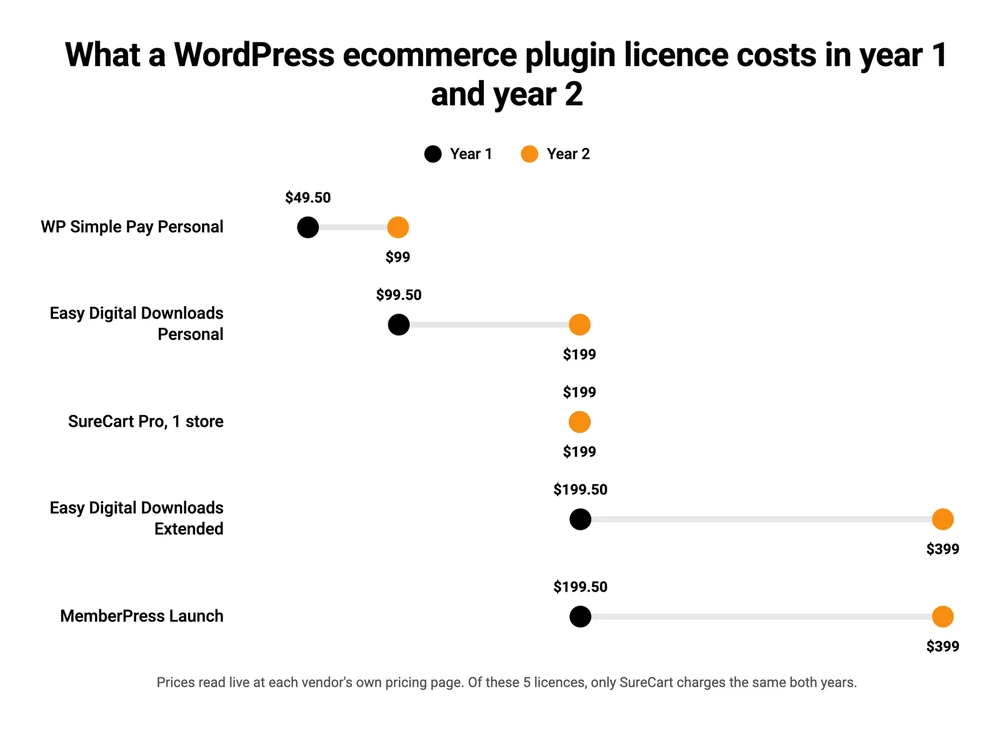
The length of each bar is the renewal jump. SureCart is the only licence here where the 2 ends sit on top of each other.
The same pattern runs through WordPress hosting, which is worth knowing because you are buying both. Our WooCommerce digital downloads guide found Bluehost, 1 of WooCommerce’s own recommended hosts, listing its ecommerce plan at $15.99 a month on a 12-month term and renewing at $23.99 a month. Sitting above those numbers on the same page: no hidden fees.
The cut 4 of the 5 take on top of the licence
Easy Digital Downloads, WP Simple Pay, SureCart and MemberPress all take a percentage of your sales on their cheapest plan, between 2.9% and 4.9%. A licence fee is a flat number you can see coming. A percentage grows every time you make a sale.
Free versions taking a cut is fair enough, and 3 of them do exactly that. Easy Digital Downloads Lite and WP Simple Pay Lite each add 3% to Stripe’s own charge, and SureCart’s free Launch plan adds 2.9%.
WP Simple Pay and SureCart then drop that fee the moment you buy any paid licence. Easy Digital Downloads does not. Its 3% carries on right through the $99.50 Personal plan and stops only at the $199.50 Extended pass.
MemberPress never had a free version to drop a fee from. Its cheapest plan, Launch at $199.50, charges 4.9% of every successful payment. So 2 paid plans here still take a slice of every sale, and both of them are the entry tier a beginner would pick.
Easy Digital Downloads is the one most likely to catch a new seller out, because the pricing page gives no hint of it. Personal is the only tier whose feature list omits the words no platform fees, and the fee itself is documented over in the Stripe setup docs.
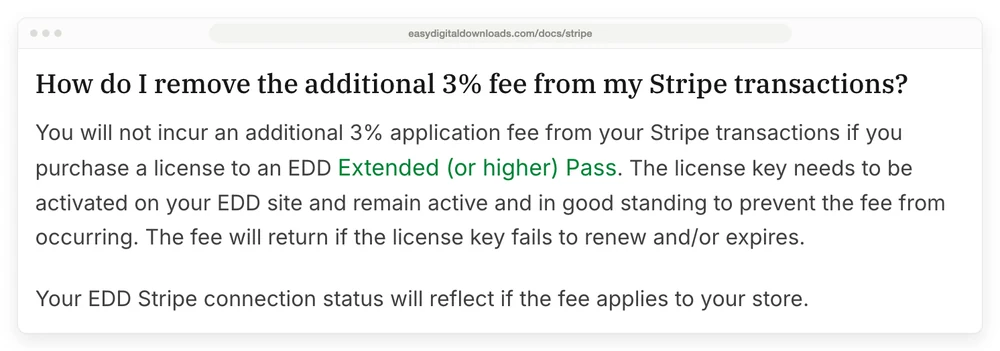
Easy Digital Downloads documentation on removing the 3% Stripe fee. Read the second line: the licence has to be Extended or higher, and the fee comes back if the licence lapses.
MemberPress splits the disclosure in 2. Its Launch plan card says “+Transaction Fees”, so you know a fee exists, and the number itself sits in a closed accordion at the foot of the page under Common Questions. Our MemberPress pricing breakdown covers what that 4.9% does to a monthly membership.
SureCart is the straightest of the group and prints 2.9% directly under the $0 on its plan card.
None of these replaces your payment processor. Stripe’s published US rate is 2.9% plus 30 cents on a domestic card, and the plugin’s cut sits on top of it.
On a $29 sale, MemberPress Launch costs you $2.56 all in and Easy Digital Downloads Personal costs $2.01, against $1.14 on a plugin that takes nothing.
| Plugin route | Plugin cut | Stripe cut | You keep |
|---|---|---|---|
| MemberPress Launch | $1.42 | $1.14 | $26.44 |
| Easy Digital Downloads Personal | $0.87 | $1.14 | $26.99 |
| WP Simple Pay Lite | $0.87 | $1.14 | $26.99 |
| SureCart Launch, free | $0.84 | $1.14 | $27.02 |
| WooCommerce core | $0 | $1.14 | $27.86 |
Moving from Easy Digital Downloads Personal to Extended costs $100 more in year 1, and the 3% eats $100 once you pass about $3,333 in Stripe sales.
So Personal only saves you money below roughly $278 a month in sales. Above that, the cheaper licence is the more expensive one. At renewal the gap between the 2 plans widens to $200, which pushes the crossover out to roughly $6,667 a year.
That is a real decision and no roundup I read makes it, because none of them carries both numbers.
Halfway point, and if the fee maths is what you came for, the full PayPal fee breakdown does the same exercise for the other processor most sellers end up using.
Is WooCommerce really free
Yes, and more genuinely than the question usually assumes. WooCommerce core sells a product, takes the payment and delivers a digital file with a protected link, a download cap and an expiry date, without a paid add-on and without a percentage cut. Everything in that sentence is in the free download.
Selling a file costs nothing. Selling it on a payment plan costs $279 a year through WooCommerce Subscriptions, putting it behind a membership costs $199 through WooCommerce Memberships, and chasing abandoned carts costs $159 through AutomateWoo.
| What you want | Extension needed | Yearly price |
|---|---|---|
| Sell a file and deliver it | none | $0 |
| Cap downloads and expire the link | none | $0 |
| Sell on a payment plan or subscription | WooCommerce Subscriptions | $279 |
| Put files behind a membership | WooCommerce Memberships | $199 |
| Recover abandoned carts | AutomateWoo | $159 |
Recurring payments are the line most digital sellers cross, and it is the most expensive one on the list. WooCommerce Subscriptions is $279 a year, which is more than the entire first-year cost of any of the dedicated digital-file plugins.
Then there is hosting, which WooCommerce needs and a hosted checkout does not. And there is the plugin count, which is where WooCommerce quietly gets expensive in a way no pricing page shows.
Why the roundups and the vendors disagree on price
The roundups and the vendors disagree because 4 of the 5 guides on page 1 are quoting prices their vendor has since retired. I checked every price in this post at the vendor’s own pricing page, then checked what each guide says.
cmsMinds ranks second for this search with a piece running close to 5,000 words on which plugin to buy. It contains no dollar figure at all. Its own FAQ asks how much you should expect to spend on plugins overall, and the page source holds no price to answer it with.
The other 4 all quote prices their vendors have retired.
Worth saying that the best guide on this topic is not on page 1. WPBeginner’s runs to 10,000 words across 12 plugins, and every current entry price in it is right, Easy Digital Downloads at $99.50 a year and MemberPress at $199.50 a year included. What it never does, across all 12 entries, is say what any of them costs to renew.
Zapier lists SureCart’s paid plugin at $39 a month, and SureCart has no monthly plan of any kind. It also prices MemberPress at $359 a year with $179.50 for the first year, which was the old Basic tier. MemberPress now sells Launch at $199.50 renewing at $399.
Zapier does get Easy Digital Downloads right, and phrases it the way the others should: $199 a year, $99.50 for the first year.
EcommerceGold and StoreEngine both put SureCart’s yearly plan at $179. SureCart’s pricing page now says $199. EcommerceGold adds that the $179 renews at $199, so the figure it prints as next year’s price is this year’s price.
Its SureCart lifetime licence is $599 against a real $699. SearchWP carries the same retired MemberPress number as Zapier, $179.50 a year.
None of that is dishonest. Plugin prices move, roundups get refreshed by editing the intro, and a number in a table looks equally current whether it was checked yesterday or 2 years ago. It does mean the sensible move is to open the vendor’s own pricing page before you buy, and to look for the asterisk under it.
Selling from a WordPress site without an ecommerce plugin
A hosted checkout replaces the ecommerce plugin entirely, and a roundup of plugins has no reason to mention it. You keep WordPress for your site and your content, and the checkout lives somewhere else.
The mechanics are unremarkable. You create the product in a hosted checkout tool, you get a link, and you put a button on any page you already have. There is no cart plugin to install and no licence to renew, and the payment never touches your database.
The honest limits are worth stating first. A hosted checkout gives you no shop pages inside WordPress, no product catalogue in your admin, and no place to manage physical inventory or shipping.
If you sell physical goods, this route is wrong and WooCommerce is right. If you sell files, courses or coaching, you probably never needed the shop pages.
Payhip, Gumroad and CartMango all do this job, and their pricing models differ enough that the right pick depends on your volume. Payhip and Gumroad take a percentage of every sale with no yearly fee, which is cheap at low volume and expensive later.
CartMango charges a yearly fee and takes no cut, which runs the other way. I should say plainly that CartMango is mine.
On the same $29 sale used above, Gumroad’s cut leaves you $24.46, Payhip’s free plan leaves you $26.41, and CartMango leaves you $27.86 because it takes nothing beyond what Stripe charges.
| Route | Platform cut | Yearly fee | You keep on $29 |
|---|---|---|---|
| Gumroad, direct sale | 10% plus 50 cents | $0 | $24.46 |
| Payhip, free plan | 5% | $0 | $26.41 |
| Payhip Plus | 2% | $348 | $27.28 |
| CartMango | 0% | $0 until October 2026, then from $10 | $27.86 |
Stripe’s 2.9% plus 30 cents is deducted on every row, because none of these 3 replaces the processor. Gumroad’s own fee page adds one thing worth knowing if you get big: its 10% drops to 5% on direct sales for the rest of any calendar month in which you pass $20,000 in paid sales.
CartMango also hosts the sales page itself through Mini Pages, so the button does not have to live on your WordPress site at all. What it will not do is host a course or run a community, and both of those are in development rather than available, targeted for October 2026. If you need either today, MemberPress does that job now and this is not a substitute for it.
If you want the longer version of this route, we have a guide on selling digital products without a website and one on adding a shopping cart to a website you already own.
The plugins a store needs that are not the cart
The cart is a single line on a longer list, and the rest of the list is where the plugin count runs away from you. A store needs backups, security, caching and SEO before it needs anything clever, and each of those is another plugin, another update and another thing that can conflict on a Tuesday morning.
The Reddit thread ranking on page 1 for this search is a good illustration, mostly because it is somebody working it out in real time. The poster was building a store for a publishing business, listed the jobs they needed covered, and added that they hoped the plugins would not break the bank because the business had not started yet.
A commenter told them a digital-only catalogue would be better served by a more targeted tool than WooCommerce. They chose WooCommerce, then came back saying they could not tell which plugins overlapped.
A developer in that r/Wordpress thread put the problem better than any vendor page does:
For instance, you might find a plugin that does X, Y & Z but you only need it for Y. Then you find another plugin that does A, but it also does B, C & D. So now you’ve installed 2 plugins to use 2 out of 7 features that these two plugins provide.
The thread is 3 years old and archived, and that specific complaint has aged perfectly. It is also the strongest argument for picking the plugin that matches your product on the first try rather than assembling one out of parts.
Is WordPress still worth building a store on
WordPress is nowhere near outdated. It runs 40.7% of all websites and 58.9% of every site whose content system is known, measured by W3Techs. That is a very large installed base and it is why every host, theme and page builder still treats WordPress as the default case.
What has changed is the alternative. Hosted checkouts and store builders now cover the parts a small digital seller uses most. WordPress still wins on everything around the shop: the blog, the pages, the SEO, and owning the lot outright.
So treat them as 2 separate decisions. Keep WordPress for the site. Pick the selling layer on its own merits, which may or may not be a plugin.
FAQ
What is the best plugin for ecommerce in WordPress?
There is no single best one, and the honest answer is the shortest one: WooCommerce if you ship physical products, Easy Digital Downloads or SureCart if you sell files, MemberPress if you gate content behind a login, WP Simple Pay if you just need a payment form. Volume and product type decide it.
Is WooCommerce 100% free?
The plugin is. WooCommerce core sells products, takes payments and delivers digital files with no licence fee and no percentage cut. Hosting is not free, and the extensions most stores end up wanting are not either: Subscriptions is $279 a year and Memberships is $199 a year.
Can you do ecommerce with WordPress?
Yes, in 2 ways. You install an ecommerce plugin and run the shop inside WordPress, or you keep WordPress for the site and link out to a hosted checkout. The first gives you product pages in your admin. The second gives you no plugin to maintain and no licence to renew.
Is WooCommerce better than Shopify?
Shopify and WooCommerce answer different questions. Shopify is a hosted store where the monthly fee covers hosting, security and updates, and you accept the platform’s limits. WooCommerce is free software on hosting you rent and maintain, with far more control and a longer list of things that are now your job. For a small digital catalogue, both are heavier than the work needs.
Do WordPress plugin licences cost more when they renew?
Often, and by a lot. Easy Digital Downloads, MemberPress and WP Simple Pay each show a discounted first-year price with the full price struck through above it, and each carries a footnote saying renewals are charged at full price. The second year is double the first on all 3. SureCart does not do this.
Which WordPress ecommerce plugin is cheapest for selling digital products?
Over 2 years, WooCommerce core at $0 is cheapest if a plain file sale is all you need, and WP Simple Pay Personal at $148.50 is cheapest among the paid options. Easy Digital Downloads Personal comes to $298.50 and still takes 3% on Stripe, which is the number that flips the answer once you are selling regularly.
Keep WordPress, move the checkout
Every price above follows the same pattern. The WordPress ecommerce plugin market sells you a licence, then sells you the renewal at double, then in 2 cases takes a percentage of the sales that licence was supposed to cover. WooCommerce is the honourable exception on the cut, and charges you in extensions and hosting instead.
If what you actually sell is files, courses or your own time, the shop pages were never the valuable part. CartMango is a checkout for exactly that seller: 0% platform cut on every plan, your Stripe and PayPal payouts landing directly, and your recurring payments staying yours if you ever leave. CartMango is free until October 2026, then $10 a year.
About the Author

👋 I’m Welly, founder of CartMango (the site you’re on), a checkout platform for digital product sellers. We’ve previously processed $179M+. I also run BirdSend (email marketing tool, 3.1B+ emails sent). On the side I show other non-techie digital sellers how I use AI workflows to automate 50%+ of my operations. Find me on LinkedIn.
Related Reading
- WooCommerce digital downloads: the WordPress ecommerce plugin most stores start with, its native setup and the real hosting bill
- MemberPress pricing: where the 4.9% sits and what it does to a monthly membership
- Easy Digital Downloads alternatives: for readers who have decided against the extension route
- LearnDash alternatives: 8 course plugins priced on the year 2 renewal, same trap, different corner of WordPress
- MemberPress alternatives: 8 options priced on the year 2 renewal rather than the first-year discount