

Worth it on Shaker, limited on Mover: that is the verdict on Podia for a creator selling courses, coaching and a community from a single site. Shaker costs $99 a month ($84 billed yearly) with PayPal, upsells and no Podia fee, while the $49 Mover plan takes 5% of every sale and leaves those out.
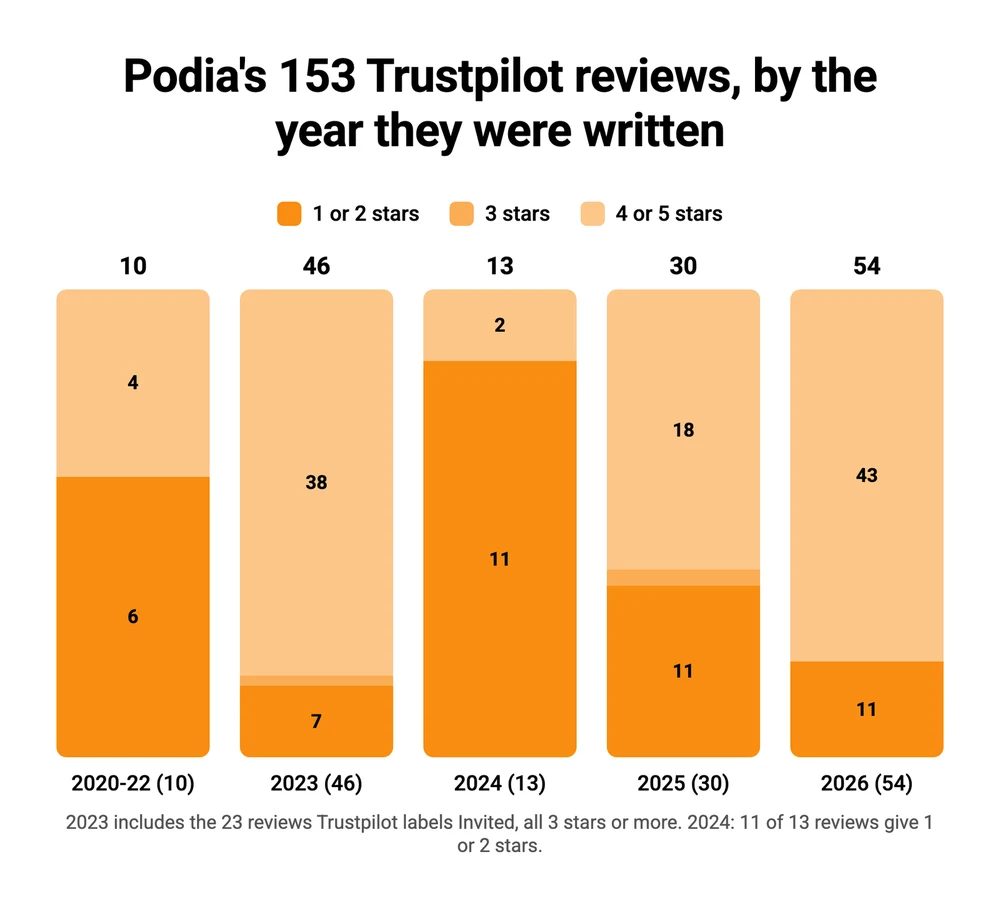
This Podia review sorted all 153 of its Trustpilot reviews: 96 give 5 stars and 40 give 1 star, a 4.1 score made of fans of the easy setup and sellers hit by slow support, locked accounts or price changes. There is no free plan, only a 14-day trial, and cancelling Podia cancels every member subscription for good.
Podia’s pitch is everything on 1 bill: courses, downloads, coaching, a community, email and a website. Many of its recent 5-star reviews praise exactly that, and most mention the support team, several by name.
The money questions come at specific moments: when sales pass $840 a month on yearly billing, when a buyer asks to pay by PayPal, when you want an upsell, and when you move down a plan or stop paying.
So this review follows a Podia store through 5 jobs, in the order a seller meets them, from the trial to the day you stop paying. Each one is checked against Podia’s help center and all 153 of its Trustpilot reviews.
Key Takeaways
- There is no free plan. Podia offers a 14-day trial with no card, though the second-ranked review for this search still describes a free plan.
- Mover takes 5% of every sale. It costs more than Shaker once sales pass $840 a month on yearly billing, or $1,000 on monthly billing.
- PayPal, upsells and affiliates start on Shaker. Moving down to Mover disconnects PayPal, removes your upsells and closes your affiliate program.
- Trustpilot splits into 2 camps. 96 of 153 reviews give 5 stars and 40 give 1 star, mostly over missing features, support or price changes.
- Stopping is final for members. Cancelling, or a plan payment that keeps failing, cancels every recurring member subscription, and Podia says they cannot be reinstated.
What 153 Podia reviews on Trustpilot praise and complain about
Podia’s Trustpilot reviews praise the all-in-one setup and the support team, while the 46 1- and 2-star reviews complain about missing features, slow support, changed prices and locked accounts. 105 of the 153 give 4 or 5 stars and 2 sit in the middle, so a 4.1 TrustScore and 40 one-star reviews share the same Podia Trustpilot page.
4 of the low reviews describe a launch going wrong: an account locked mid-launch, emails held back, a sales page that would not come together in time. If your own launch is close, the Online Selling Mistakes Challenge is 5 short, free emails on the mistakes that quietly cost solo sellers their sales.
Trustpilot labels 23 of the 153 as Invited, all written between 27 October and 9 November 2023, and every one gives 3 stars or more.
The other 130 carry Trustpilot’s Unprompted review label, and the page notes that Podia has no recent history of asking for reviews.
The 4 complaints, counted
Read one by one, the 46 low reviews fall into 4 main complaints. Of the 46, 17 are about a missing feature, a limit or a bug, 11 about slow or AI-first support, 8 about Podia changing prices or rules on sellers already using it, and 6 about a locked account or lost data.
| Complaint | Reviews | Since 2025 | In a seller’s words |
|---|---|---|---|
| Missing feature, limit or bug | 17 | 9 | “PODIA DOES NOT INTEGRATE WITH GOOGLE ADS AT ALL” (Michael, October 2025) |
| Slow or AI-first support | 11 | 6 | “The chatbot was unhelpful and i had to wait 6 hours” (Nadia, July 2026) |
| Prices or rules changed | 8 | 4 | “Podia is no longer the platform I signed up for” (Severine, October 2026) |
| Account locked or data lost | 6 | 2 | “They Just Blocked my website and my business over a weekend” (Olga, December 2025) |
| Other, incl. 2 buyers | 4 | 1 | “They blame the sellers that pay them” (Ken, a buyer, November 2021) |
What the fans praise
Support is also what most of the fans praise: most of the 49 4- and 5-star reviews from the past 12 months mention the support team, several by name. Podia’s own replies add context: it told an Australian reviewer that its team is “primarily staffed during U.S. East Coast business hours”, and told another that its AI assistant, Penny, “successfully resolves about 70% of support conversations on her own.”
The changed-prices row is mostly long-time sellers. A French reviewer who had used Podia for nearly 6 years wrote that her plan went from about $39 a month to $89 or more. Podia replied that it kept existing rates for current creators “as long as their plans remained unchanged”, and that her own “original plan and pricing were maintained.”
Trying Podia before you pay for a plan
Podia has no free plan. You get a 14-day trial with no card, and if you do not pick a paid plan by the end, your site is unpublished and your account is deleted after 180 days, according to Podia’s trial help page.
The free plan ended in October 2024, when a Trustpilot reviewer wrote that “everything has become paid and it’s replaced by a free trial.” In a r/edtech thread on the change, a community owner who missed the emails wrote: “My site basically disappeared.” A Podia employee replied in the same thread in 2026 that “There’s still a 30-day free trial though”, but Podia’s pricing page and help center both say 14 days.
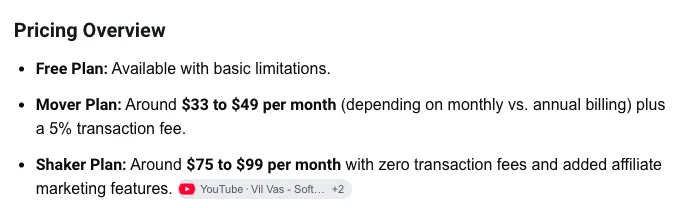
Other reviews have not caught up either. Miha Cacic’s review, ranked second for this search, still quotes a free plan with an 8% fee, Mover at $39 a month and Shaker at $89, all retired. Google’s AI answer for this search has listed the same free plan, with Mover at “around $33 to $49” and Shaker at “around $75 to $99”.
Podia’s trial FAQ says the trial includes “upsells, PayPal, affiliates, and more”, which are exactly the tools the $49 Mover plan leaves out, so the trial shows you the Shaker experience. If you plan to settle on Mover, leave those 3 out while you build, or you will set up a store around tools you then lose.
2 smaller trial limits: custom tracking codes are not available until you pay, and email is capped at 100 subscribers.
Running courses, downloads, coaching and a community from a single Podia site
Podia puts online courses, digital downloads, coaching, live and in-person events, a community, email, a website and a checkout on every plan. That bundle is what many of its 5-star reviewers came for. A reviewer wrote: “Before Podia, I had a hodgepodge of platforms, apps, and software duct-taped together.”
The course side has moved fast this year. Podia’s changelog lists lessons that open only after earlier ones are done, quiz passing scores, open-ended quiz questions, and a course dashboard showing how many students completed each lesson. That partly answers 2 older complaints: Ruzuku’s review of Podia still says its quizzes are multiple-choice only, and a 1-star review from January 2026 said there was no way to know when a student finished a course.
Each plan caps what you can hold, and you cannot buy extra of a single item:
- Mover: 50 products, 500 videos, 25 community spaces, no assistants.
- Shaker: 150 products, 1,000 videos, 100 spaces, 1 assistant.
- Earthquaker: no limits on any of those.
Products here include events and plans. Say you run 30 courses, 15 webinars and 6 membership plans: that adds up to 51, already past Mover’s 50. Podia’s help center says plainly that it does not offer “à la carte upgrades for individual limits or features.”
The October 2026 login change
The newest change is the one 2 departing sellers wrote about in October: Podia has merged customer logins, so anyone who uses the same email on several Podia sites now has “one unified Podia account” and switches between them from a sidebar. Every creator is also enrolled in the Podia Creator Community by default, and Podia’s help page says each Podia “remains completely separate.”
Severine, leaving after several years, objected to “one-click access between different creators’ communities”, competitors included.
A second seller, leaving after more than 5 years, wrote in French that Podia now feels close to a social network for creators.
If you sell downloads or coaching rather than courses
If your products are downloads or coaching packages, a checkout and a sales page may be all you need, and CartMango, the checkout I run, covers that with Mini Pages for the sales page. CartMango can bill memberships too, but it does not host a members’ area, courses or a community yet, and course hosting and community are planned for October 2026 on its $30-a-year plan.
If courses or a paid community are the business, our Teachable vs Podia and Thinkific vs Podia breakdowns are the fairer comparison.
Keeping your cut once Podia sales pick up
Podia’s Mover plan takes 5% of every sale on top of card fees, so it becomes the more expensive plan once your sales pass $840 a month on yearly billing, or $1,000 a month on monthly billing. Below those lines Mover is cheaper. Above them, the 5% costs more than the jump to Shaker.
Mover is $42 a month billed yearly plus 5% of sales, Shaker $84 and Earthquaker $150 with no Podia fee, and only Shaker and Earthquaker include PayPal, upsells, affiliates and Zapier.
| Plan | Monthly | Yearly, per month | Podia fee | Email contacts | PayPal and upsells |
|---|---|---|---|---|---|
| Mover | $49 | $42 | 5% | 100 | No |
| Shaker | $99 | $84 | 0% | 500 | Yes |
| Earthquaker | $179 | $150 | 0% | 1,000 | Yes |
Here is the arithmetic behind the $840, counting plan fees only: on yearly billing Shaker costs $504 a year more than Mover, and 5% of $10,080 a year in sales, or $840 a month, is also $504. At $2,000 a month in sales, Mover costs $42 plus $100 in Podia fees, $142 a month against Shaker’s $84, before Shaker’s larger email allowance even counts.
Stripe or PayPal still take their own cut on every plan, which Podia’s pricing page puts at 2.9% + 30¢. And on Mover, PayPal is not an option at all, so every buyer has to pay through Stripe.
Email is the other number that grows:
- Included: 100, 500 or 1,000 email contacts, depending on the plan.
- Past that: a paid add-on. 1,000 contacts on Mover adds $14 a month billed yearly, and the ladder in Podia’s own pricing data runs to $1,000 a month for 500,000.
- No surprise upgrades: Podia says it never upgrades you automatically and emails you as you near the limit.
The full ladder is in our Podia pricing breakdown.
For a seller whose business is mostly downloads, CartMango takes no cut of each sale on any of its 3 plans and connects both Stripe and PayPal on every one.
Selling more from each checkout
Podia’s upsells, affiliate program and Zapier connection start on the Shaker plan. Podia’s help center documents the upsells only: after a buyer checks out, Podia shows the extra offers you picked on an upsell page, and the buyer adds them or skips.
Podia’s help page says you can add as many upsells as you like, each with its own discount. Its features page also lists a “Sales funnel” with “upsells, downsells, and order bumps”, but the help center has no article on setting up a downsell or an order bump, so test both during the trial before you plan around them. An order bump is the tick-box add-on a buyer takes on the checkout page itself, like “add the workbook for $9”.
Podia’s newer selling tools:
- Abandoned cart emails. Added on 27 October 2026. You pick a delay of 1 to 99 hours and an optional discount, and Podia emails anyone who entered their email at checkout and left.
- Buy now, pay later. Since September 2026, Affirm, Klarna and Afterpay through Stripe, for one-time purchases only, not subscriptions or payment plans. You get the full price upfront, minus fees.
- Shop and cart. Logged-in members get a Shop tab and a shopping cart for buying several of your products at once.
CartMango, for comparison, has order bumps on all 3 of its plans and upsells, downsells and cart abandonment from its $20-a-year Gold plan. CartMango sends its cart emails through the email tool you connect.
Moving down a plan, or stopping, without losing your paying members
Podia has no pause option. Cancelling, or failing to pay for your plan after several attempts, takes your site offline, cuts your customers off from what they bought, and cancels every recurring subscription and payment plan, which Podia says “cannot be reinstated.”
That rule sits on Podia’s help page about pausing, which suggests cancelling as the workaround. For a membership business that means every member has to sign up again, somewhere else, by hand.
Moving down to Mover keeps your site and your customers’ access but strips PayPal, upsells and affiliates, while cancelling or a failed plan payment cancels every member subscription for good.
| What you do | Your site | Members’ subscriptions | PayPal, upsells, affiliates | Your content |
|---|---|---|---|---|
| Move down to Mover | Stays live | Customers keep access, per Podia | Disconnected, removed, closed | Must fit Mover’s limits first |
| Cancel, or plan payment fails | Offline once the cancellation takes effect | Cancelled, cannot be reinstated | Gone with the account | Kept 180 days if you return |
| Trial ends with no plan | Unpublished | Cancelled | Not applicable | Deleted after 180 days |
Moving down instead of cancelling
Moving down is the softer route, and Podia’s own cancellation page recommends it, but you cannot move down while you are over the lower plan’s limits. Podia’s downgrade page uses the example of 55 products against Mover’s 50: you delete 5 first. Its plan-limits page adds 1 exception, email, where the downgrade goes through but sending stops until your list fits.
Podia’s help pages do not say what happens to members paying through PayPal when Mover disconnects it, so ask support first.
Refunds and exports follow 2 more rules:
- Refunds: only within 72 hours of the last charge, with no partial refunds on yearly plans.
- Exports: Podia lets you cancel at once or at the end of your billing cycle, and once the cancellation takes effect you cannot log in to export anything, so download your lists and files first. A French seller wrote in October 2026 that he cancelled, came back months later, and found he would have to pay again just to reach the courses he had written.
Like Podia, Payhip stops recurring payments when you leave it, while CartMango’s subscriptions keep billing your customers and paying you if you move on.
On Kajabi it runs the other way round: students lose access while their subscriptions keep charging until you cancel each one, as our Kajabi review explains.
Which tool covers which of the 5 jobs
At $2,000 a month in sales, on yearly billing where a tool offers it, Podia Mover costs $142 a month in plan and Podia fees, Shaker $84, Payhip Plus $69, and CartMango about $0.83 to $2.50 once paid plans start, all before card fees.
| Tool | At $2,000/mo in sales | Cut per sale | Courses and community | Selling more | If you leave the tool |
|---|---|---|---|---|---|
| Podia Mover ($42/mo yearly) | $142/mo | 5%, Stripe only | Courses and community, 50 products | Abandoned cart emails. No upsells or affiliates | Site offline, subscriptions cancelled for good |
| Podia Shaker ($84/mo yearly) | $84/mo | 0%, Stripe and PayPal | Courses and community, 150 products | Upsells after checkout, affiliates, abandoned cart emails. Downsells and order bumps listed, not documented | Site offline, subscriptions cancelled for good |
| Payhip Plus ($29/mo) | $69/mo | 2% (5% on Free, 0% on Pro) | Courses, no community | Discounted add-on before checkout, cart abandonment emails. No one-click upsell | Recurring payments stop if you leave Payhip |
| CartMango (free now, $10 to $30/yr) | About $0.83 to $2.50/mo, billed yearly | 0%, Stripe and PayPal | Not yet, planned for October 2026 | Order bumps on every plan. Upsells, downsells and cart abandonment from $20 a year | Subscriptions keep billing if you leave |
CartMango is mine, so weigh its row with that in mind. CartMango matches Shaker’s 0% cut at $10 to $30 a year against Shaker’s $1,008 a year and keeps subscriptions running when you leave, but it has no courses or community until they ship.
Payhip publishes monthly prices only: its free plan takes 5%, which comes to $100 at $2,000 a month in sales, Plus is $29 a month with a 2% fee, and Pro is $99 with none. Payhip also collects and pays EU and UK VAT and US and Canadian sales tax for you, while Podia collects tax only where you have registered and does not file for you. Our Payhip review sorts that platform’s own Trustpilot complaints.
Is Podia worth it?
Podia is worth it for a creator who sells courses, coaching and a community together, plans to stay put, and can justify Shaker’s $84 a month billed yearly. On that plan you get the whole bundle with no Podia fee, PayPal, upsells, and a support team many recent reviewers rate highly.
What Podia does well, and where it falls short:
- Good: courses, downloads, coaching, a community, email and a website on 1 bill, course tools that improved through 2026, and 0% on Shaker.
- Weak: 5% and no PayPal on Mover, hard plan caps, a support team staffed mainly in US East Coast hours, and an exit that cancels every member subscription.
It is a weaker buy in 3 situations:
- You sell downloads or coaching and little else. You would pay for a course builder, a community and an email tool you do not use.
- You need PayPal on a small budget. PayPal starts at $84 a month on yearly billing.
- You might move platforms within a year or 2. Every recurring member subscription is cancelled when you leave, so your exit cost grows with every member you sign up.
Our Kajabi vs Podia comparison prices the bigger course platform, and Podia alternatives covers 9 options.
FAQ
Is Podia free to use?
No. Podia ended its free plan in October 2024, and what replaced it is a 14-day trial with no card, with PayPal, upsells and affiliates switched on so you can test them. After that you need a paid plan, starting at $42 a month billed yearly or $49 billed monthly, or your site goes offline and your content is deleted after 180 days.
How much is Podia per month?
Podia costs $49, $99 or $179 a month on monthly billing for Mover, Shaker and Earthquaker. Billed yearly, the same plans are $42, $84 and $150 a month, or $504, $1,008 and $1,800 a year. Mover adds a 5% fee on every sale, so $2,000 a month in sales costs $142 a month on Mover against $84 on Shaker, both billed yearly. Card fees come on top, which Podia’s pricing page puts at about 2.9% + 30¢.
What is Podia used for?
Podia is used to sell online courses, digital downloads, coaching sessions, live and in-person events, and paid community memberships from a single website. It also sends email to your list and hosts your sales pages.
What is better than Podia?
For courses, Teachable or Thinkific are the closest swaps. For downloads and coaching packages, a checkout costs less at low volume: Payhip’s free plan takes 5% with no monthly fee, and CartMango takes 0% and keeps your subscriptions running if you leave. Our Podia alternatives guide prices 9 options.
Is Podia legit?
Yes. Podia is a real company, Podia Labs, and its pricing page says more than 15,000 creators run their business on it. Its Trustpilot score is 4.1 from 153 reviews, sales pay straight into your own Stripe or PayPal account, and the complaints are mostly about missing features, support speed, plan changes and locked accounts.
Can you pause a Podia subscription?
No. Podia’s help center says it does not offer a pause. Its suggested workaround is cancelling, which takes your site offline and cancels all recurring member subscriptions, or moving down to a cheaper plan, which keeps your site running but removes PayPal, upsells and affiliates if you land on Mover.
A checkout that keeps billing your members when you move on
Podia’s bundle is the reason to join, and its exit rules are the reason to plan ahead. If your members pay you every month, it helps to pick a tool where leaving does not mean asking each of them to sign up again.
CartMango handles that case: it takes 0% of each sale, pays straight into your own Stripe or PayPal, and the subscriptions you create keep paying you after you move on. CartMango is free right now, and paid plans start in November from $10 a year.
About the Author

👋 I’m Welly, founder of CartMango (the site you’re on), a checkout platform for digital product sellers. We’ve previously processed $179M+. I also run BirdSend (email marketing tool, 3.1B+ emails sent). On the side I show other non-techie digital sellers how I use AI workflows to automate 50%+ of my operations. Find me on LinkedIn.
Related Reading
- Podia Pricing: the full price list behind this Podia review, with the email add-on ladder
- Podia Alternatives: 9 options priced against Podia’s current plans
- Teachable vs Podia: both priced on yearly billing, and the sales level where the cheaper plan flips
- Kajabi Review: 94 recent Trustpilot reviews sorted, and what leaving Kajabi does to students